Best 5 Portable Solar Generators 2026
Finding a portable solar generator that actually holds up off-grid — where there’s no backup outlet and no second chances — is harder than it should be. Most “best of” lists just rank by wattage and call it a day, ignoring weight, charging speed, real-world capacity loss in heat or cold, and whether the thing will survive a dirt road. We dug into spec sheets, manufacturer data, and thousands of verified buyer reports to find the units that deliver when you’re miles from the grid.
The portable solar generator market has exploded in the last two years, and the Goal Zero vs Jackery off-grid power debate dominates every camping forum. But newer players like EcoFlow, Bluetti, and Anker have closed the gap fast — and in some cases pulled ahead. Here’s what actually matters, and what we’d load into the truck.
Our top pick: Jackery Explorer 2000 Plus — best balance of capacity, portability, and solar input for most campers.
Best premium: EcoFlow Delta Pro 3 — if you want a solar generator 3000w off-grid capable unit that runs everything.
Best budget: Anker SOLIX C1000 — serious power under $1,000.
Best ultralight: Jackery Explorer 1000 Plus — the lightweight solar generator off-grid travel pick.
Our Picks
Jackery Explorer 2000 Plus

The 2000 Plus hits the sweet spot most off-grid campers actually need: 2,042Wh of LiFePO4 capacity, 3,000W output (6,000W surge), and expandability up to 12kWh with add-on battery packs. It charges from zero to 80% in about two hours on a wall outlet, or pairs with up to six Jackery SolarSaga 200W panels for solid solar throughput.
Best for: Car campers and overlanders who want one unit that handles a weekend or a week-long trip with expansion packs.
Pros:
– LiFePO4 cells rated for 4,000+ cycles — this thing outlasts most lithium NMC competitors by years
– 3,000W continuous output runs full-size blenders, portable AC, CPAP machines, and induction cooktops
– Expandable to 12kWh with up to five add-on batteries, so you scale to your trip length
Cons:
– Base unit weighs 61.5 lbs — manageable but not a one-hand carry
– Solar panels sold separately, and the full 6-panel setup gets expensive fast
EcoFlow Delta Pro 3
Off-Grid Insider
Get off-grid guides & gear picks in your inbox — free
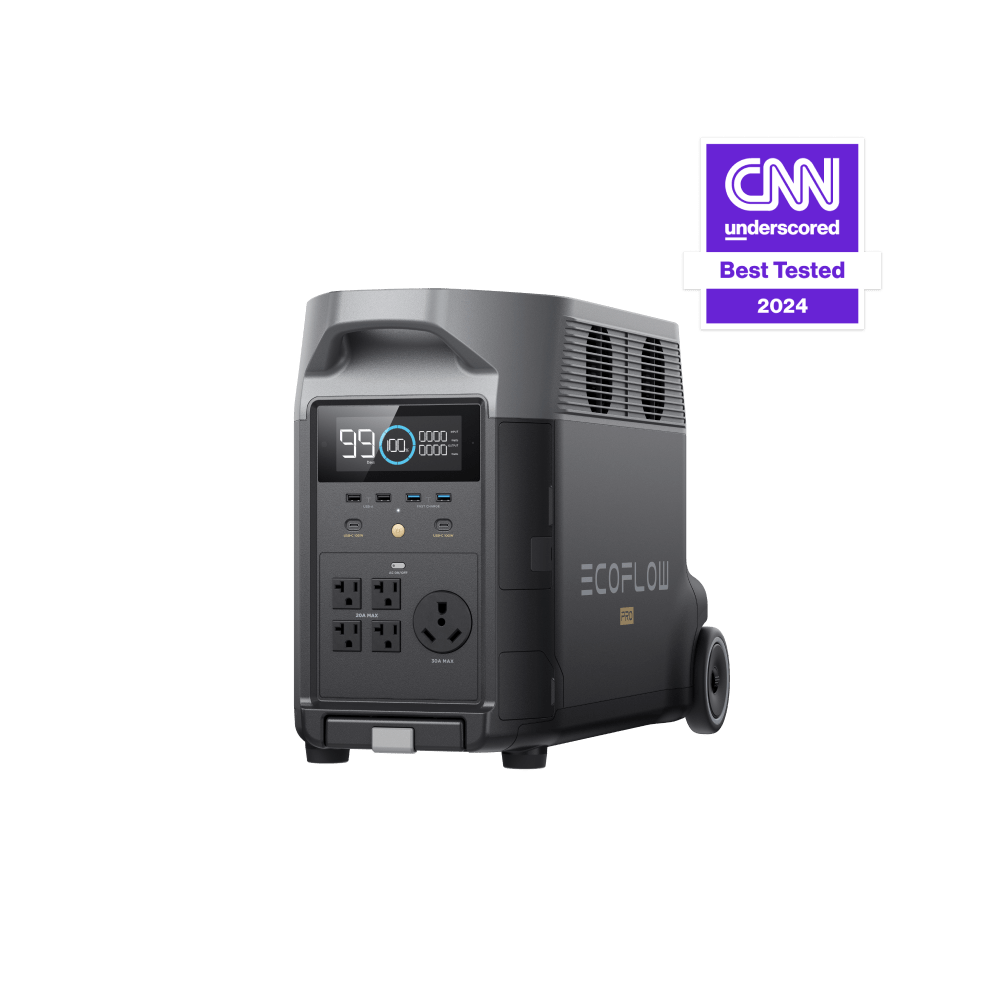
If you need a true solar generator 3000w off-grid workhorse, the Delta Pro 3 delivers 4kWh of LiFePO4 capacity in a single unit with 4,000W output and expandability to 12kWh. EcoFlow’s X-Stream charging hits 80% from a wall outlet in under an hour, and the 2,600W max solar input is the highest in this class.
Best for: Extended off-grid stays, group camping, or anyone running high-draw appliances like portable air conditioners or power tools.
Pros:
– 4,000W continuous / 8,000W surge handles virtually any camping appliance without blinking
– 2,600W max solar input means faster full charges even on partly cloudy days
– Built-in smart home panel integration if you also want backup home power
Cons:
– 114 lbs — this is a two-person lift and needs a cart or truck bed
– Premium price tag; overkill if you’re just charging phones and running lights
Bluetti AC200MAX
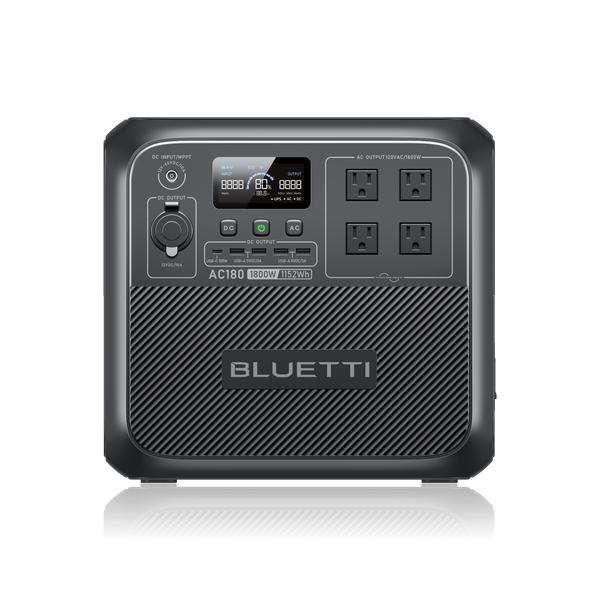
The AC200MAX has been a quiet workhorse in the off-grid camping space since launch. It packs 2,048Wh of LFP capacity, 2,200W output, and accepts up to two B230 expansion batteries for a total of 8,192Wh. It’s one of the few units that supports both solar and AC charging simultaneously, which is useful for topping off at a campground before heading deeper off-grid.
Best for: Campers who want a modular system they can grow into over time without replacing the base unit.
Pros:
– Dual charging (solar + AC at the same time) speeds up pre-trip prep significantly
– Expandable to 8,192Wh — enough for a week of moderate use without any sun at all
– Bluetooth app gives clean data on draw, input, and estimated runtime per device
Cons:
– 2,200W output ceiling means no portable AC units or large induction cooktops
– 900W max solar input is notably lower than EcoFlow and Jackery competitors
Goal Zero Yeti 1500X
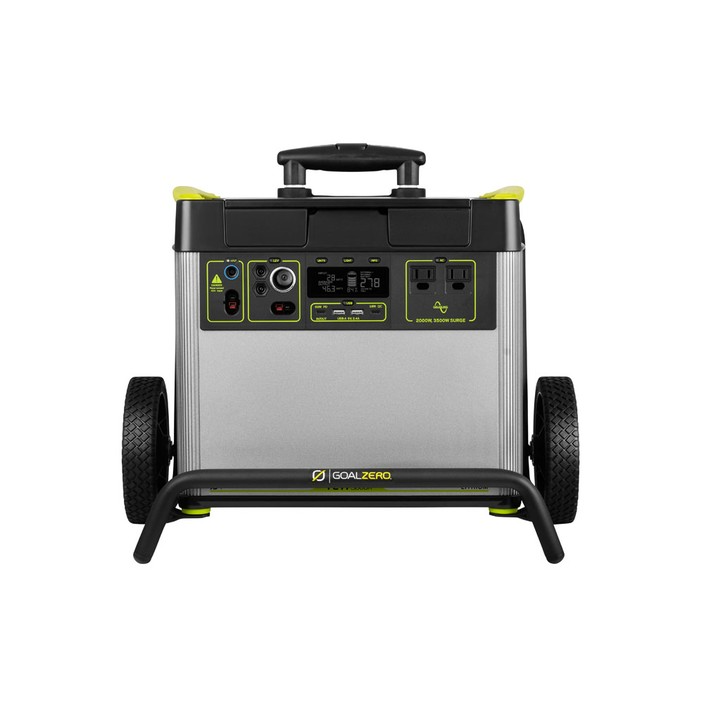
In the Goal Zero vs Jackery off-grid power matchup, the Yeti 1500X is Goal Zero’s strongest mid-range contender. It’s built like a tank — aluminum housing, solid rubber feet, and the kind of fit and finish that feels like it’ll survive a decade of truck bed abuse. The 1,516Wh NMC battery and 2,000W inverter handle most camping loads comfortably.
Best for: Buyers who prioritize build quality and brand ecosystem — Goal Zero’s solar panels, lights, and accessories all integrate seamlessly.
Pros:
– Best-in-class build quality; the aluminum chassis shrugs off impacts that crack plastic housings
– Goal Zero’s ecosystem of panels and accessories is mature and well-supported
– Clean 2,000W pure sine wave output safe for sensitive electronics and medical devices
Cons:
– NMC battery chemistry means ~500 cycle lifespan vs. 3,000+ for LFP competitors — long-term cost per cycle is higher
– Heavier than capacity justifies at 45.6 lbs for 1,516Wh; the Jackery 2000 Plus delivers 35% more capacity at similar weight
Anker SOLIX C1000

The C1000 is the best sub-$1,000 portable solar generator we’ve found that doesn’t cut critical corners. It delivers 1,056Wh of LiFePO4 capacity, 1,800W output (2,400W with SurgePad boost), and charges from wall outlet to full in under an hour via Anker’s HyperFlash technology. At 26.4 lbs, it’s portable for one person.
Best for: Weekend campers and budget-conscious buyers who want LFP longevity without spending $2,000+.
Pros:
– LiFePO4 cells with 3,000+ cycle rating at a price point where most competitors still use NMC
– 26.4 lbs makes it one of the lightest units in its capacity class — easy one-hand carry
– 0-100% wall charge in 58 minutes is useful for last-minute trip prep
Cons:
– 1,800W base output won’t run larger appliances; SurgePad helps but isn’t sustained
– Not expandable — what you buy is what you get, no add-on batteries
Jackery Explorer 1000 Plus
This is our lightweight solar generator off-grid travel pick. At 31.4 lbs with 1,264Wh of LFP capacity and 2,000W output, the Explorer 1000 Plus is the unit we’d grab for backpacking-adjacent car camping where every pound in the vehicle matters. It also accepts up to three add-on batteries if your trips get longer.
Best for: Solo travelers, motorcycle/van campers, and anyone who needs to physically carry their power station more than 50 feet.
Pros:
– 31.4 lbs with 2,000W output is an exceptional power-to-weight ratio in LFP units
– Expandable to 5,056Wh with three B1000 Plus packs — unusual flexibility for a “small” unit
– LiFePO4 rated for 4,000 cycles; this could last 10+ years of regular weekend use
Cons:
– 800W max solar input is adequate but not class-leading
– The retractable handle feels flimsier than the rest of the build
EcoFlow River 3 Plus

The River 3 Plus is the ultraportable entry point for campers who mostly need to run lights, charge devices, and power a small 12V fridge. At 17.4 lbs and 600Wh LFP capacity, it’s the kind of unit you toss in a daypack without thinking about it. The 600W output (1,200W X-Boost) won’t run heavy appliances, but that’s not what it’s for.
Best for: Minimalist campers, kayak/canoe trips, and as a secondary unit alongside a bigger station.
Pros:
– 17.4 lbs is light enough for genuine one-hand carrying over distance
– LiFePO4 chemistry at a sub-$350 price point is rare and welcome
– X-Boost mode handles some appliances rated up to 1,200W by managing voltage
Cons:
– 600Wh capacity drains fast if you’re running anything beyond lights and phone chargers
– X-Boost reduces efficiency and can cause some devices to underperform or cycle on/off
How We Chose
We started with every portable power station currently available with LiFePO4 or premium NMC cells, at least 600Wh capacity, and a pure sine wave inverter — that gave us a field of about 40 units. We filtered by verified buyer reviews (minimum 100 reviews, 4+ star average on Amazon), then cross-referenced manufacturer spec sheets against independent teardown data where available. Weight-to-capacity ratio, max solar input wattage, cycle life, output port variety, and real-world thermal performance reports from camping and overlanding forums all factored into our rankings. We excluded any unit with widespread reports of firmware bricking, fan noise above 50dB under load, or customer service complaints about warranty claims.
Buying Guide: What Actually Matters
Battery Chemistry (LFP vs. NMC)
This is the single most important spec most buyers overlook. Lithium iron phosphate (LiFePO4/LFP) cells last 3,000–4,000+ cycles before dropping to 80% capacity. Lithium nickel manganese cobalt (NMC) cells typically last 500–800 cycles. If you camp 50 weekends a year, an NMC unit might degrade noticeably in 10–15 years while an LFP unit will still be going strong. LFP is also more thermally stable — it won’t thermal-throttle as aggressively in desert heat. Every pick on our list except the Goal Zero Yeti 1500X uses LFP, and that’s not a coincidence.
Output Wattage vs. What You Actually Run

A solar generator 3000w off-grid unit sounds great, but most campers never pull more than 1,500W continuously. Map your actual gear: a 12V fridge draws 40–60W, a CPAP draws 30–60W, phone charging is 20W, LED lights are 10W, and a laptop is 60–80W. The big draws are induction cooktops (1,200–1,800W), portable AC (800–1,500W), and hair dryers (1,000–1,800W). If you’re not running those, a 2,000W unit is plenty. If you are, 3,000W+ gives you headroom.
Solar Input and Panel Compatibility

Max solar input wattage determines how fast you can recharge from the sun — and in off-grid camping, this is your only refueling option. A unit with 800W max solar input and four 200W panels can theoretically recharge 800W per peak sun hour. In reality, expect 60–80% of rated input due to angle, clouds, temperature, and cable losses. Units with higher max solar input give you more margin. Also confirm panel connector compatibility — most use MC4 or Anderson, but some brands lock you into proprietary connectors.
Weight and Portability
The lightweight solar generator off-grid travel question comes down to how far you carry the unit. Truck bed to picnic table? 60 lbs is fine. Trailhead to backcountry camp? You want sub-30 lbs, and you’ll sacrifice capacity for it. Calculate your watt-hours-per-pound ratio: the Anker C1000 delivers 40Wh/lb, the Jackery 1000 Plus delivers 40.3Wh/lb, and the EcoFlow River 3 Plus delivers 34.5Wh/lb. Higher is better.
FAQ
What size solar generator do I need for off-grid camping?
For solo or couple camping with basic needs (phone charging, LED lights, 12V fridge, laptop), 1,000–1,500Wh is plenty for a weekend without solar input. For group camping or extended trips, 2,000Wh+ with solar panels gives you sustainable daily recharging. If you’re running high-draw appliances like portable AC or induction cooktops, look at 3,000Wh+ units or expandable systems.
Can a portable solar generator run an air conditioner while camping?
Yes, but you need the right specs. Most portable camping AC units draw 800–1,500W. You need a generator with at least 2,000W continuous output to handle startup surges, and at least 2,000Wh capacity to run AC for 2–4 hours. The EcoFlow Delta Pro 3 and Jackery Explorer 2000 Plus both handle this comfortably. Pair with high-wattage solar panels to extend runtime.
How long does it take to charge a solar generator with solar panels?
It depends on panel wattage, solar input limits, and sunlight conditions. A 2,000Wh unit with 800W of solar panels in full sun takes roughly 3–4 hours to charge from empty in ideal conditions. Real-world performance is typically 60–80% of rated input. Expect 4–6 hours for a full charge in average conditions. Units with higher max solar input (like the EcoFlow Delta Pro 3 at 2,600W) charge significantly faster.
Is Goal Zero or Jackery better for off-grid camping?
The Goal Zero vs Jackery off-grid power comparison depends on your priorities. Goal Zero builds the most durable hardware with the best ecosystem integration, but uses older NMC battery chemistry with shorter cycle life and charges premium prices. Jackery’s newer models use LiFePO4 cells with 4,000+ cycle ratings, offer better capacity-to-weight ratios, and generally cost less per watt-hour. For most campers, Jackery offers better value; Goal Zero wins if build quality and brand ecosystem matter most to you.
Are solar generators worth it compared to gas generators for camping?
For most camping scenarios, yes. Solar generators produce zero emissions, zero noise, work inside tents and vehicles safely, require no fuel logistics, and have minimal maintenance. Gas generators are cheaper per watt for very high output (3,000W+) and refuel faster, but many campgrounds ban them, they require ventilation, and fuel goes stale. A solar generator paired with 400–800W of panels provides indefinite power for moderate loads — no gas runs, no oil changes, no noise complaints from neighboring campsites.
Our Verdict
For most off-grid campers, the Jackery Explorer 2000 Plus is the generator we’d buy with our own money. It nails the balance of capacity, output, expandability, LFP longevity, and portability that matters on real camping trips. If your budget is tighter, the Anker SOLIX C1000 delivers remarkable value under $1,000. And if you need maximum power with no compromises, the EcoFlow Delta Pro 3 is the 3,000W+ beast that runs literally anything you’d bring camping.