Jackery Explorer 1000 v2: Worth It in 2026?
Jackery Explorer 1000 v2 Review — 2025: The 1-kWh LFP Benchmark
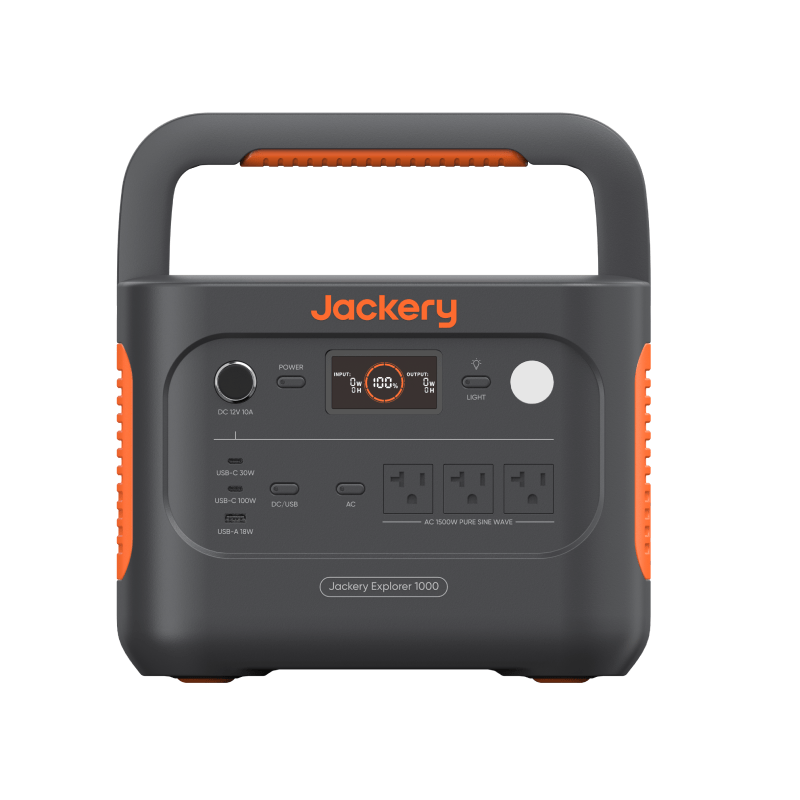
The Jackery Explorer 1000 v2 is not an incremental refresh. Where the original Explorer 1000 used NMC chemistry rated for ~500 cycles and topped out at 1,000W continuous output, the v2 arrives with LiFePO4 cells good for 4,000 cycles, a 1-hour emergency fast-charge, and 1,500W of AC output — all at $300 less than the v1’s launch price. For buyers in the 1-kWh power station market who prioritize battery longevity and day-to-day simplicity, this is the unit that moved the goalposts.
Check Current Price on Amazon →
As an Amazon Associate, OffGridFoundry earns from qualifying purchases.
At street pricing of $499–$699, the Explorer 1000 v2 is one of the strongest value propositions in the 1-kWh class. The LFP chemistry alone changes the long-term calculus: 4,000 cycles to 70% capacity projects to 10+ years of regular use, versus 2–3 years of meaningful life from the NMC competition and Jackery’s own older lineup. The 1-hour emergency fast-charge is not marketing language — lab testers confirmed 0–100% in 1 hour 2 minutes. This unit has real, testable substance behind it. The main ceiling: it stops at 1,500W continuous and offers no battery expansion path.
What We Like
- LFP chemistry with 4,000-cycle rated lifespan — the single most important upgrade over the v1. At daily use, this projects to a decade of reliable service. Most competing NMC units in this class burn through their useful cycle life in 2–4 years.
- 1-hour emergency fast-charge — lab-confirmed at 1 hr 2 min. For power outages, this changes the usability model entirely: top up from a generator in one hour and you’re back to a full 1,070Wh reserve.
- 50% more AC output than v1 — 1,500W continuous (3,000W surge) vs. the original’s 1,000W. Runs most home appliances short of central HVAC, electric dryers, or well pumps.
- 87.5% discharge efficiency under near-max load — lab-tested at 1,479W, delivering 37.5 minutes of runtime against an expected 43 minutes. That’s impressive efficiency at the top of its output range.
- 20ms UPS switchover — faster than the EcoFlow RIVER 2 Pro’s 30ms; useful for keeping sensitive electronics alive during brief outages.
- Foldable flat-top handle — the boombox-style fixed handle from the v1 is gone. The flat top enables stacking, and the folding handle reduces bulk significantly.
- Quieter than most competitors — measured around 55 dB under heavy load. Noticeably quieter than the EcoFlow Delta 2 (~60 dB) and far quieter than any gas generator in its output class.
- Dual USB-C output (100W + 30W) — charges two laptops simultaneously without needing a wall outlet.
- $300 cheaper than v1 launch price — more capacity, more output, better chemistry, lower price. The v2 is unambiguously the better product at a lower cost.
What We Don’t Like
- Solar connector ecosystem lock-in — the v2 uses DC8020 (8mm) ports instead of the older DC7909 (7.9mm) standard used on older Jackery panels and most third-party panels. The connectors appear similar and can physically seat, but old panels will not charge reliably without an adapter. Budget for the right cables if you’re pairing with non-Jackery solar.
- 400W solar input ceiling — respectable in absolute terms, but the EcoFlow Delta 2 accepts 500W, and in a class where solar recharge matters, this gap is noticeable. Two SolarSaga 200W panels in optimal conditions deliver ~3.8–4.5 hours to full charge; real-world with clouds and angle inefficiency adds significantly more.
- No battery expandability — fixed at 1,070Wh. The EcoFlow Delta 2 expands to 2–3kWh with add-on packs. If your needs will grow, the Jackery ecosystem offers no upgrade path short of buying a second unit.
- Idle battery drain — multiple owners report measurable self-discharge when the unit is left powered on but idle. Not a flaw for regular use, but it’s not a good unit to leave switched on in standby for weeks at a time.
- Single USB-A port — competitors typically ship with 2–3 USB-A ports at this price point; the v2 offers just one (18W QC).
- No IP weatherproofing — no dust or moisture resistance rating. This is a sheltered-environment device; take it outside only in dry conditions.
- Customer support concerns — multiple in-depth reviewers, including The Solar Lab, note a decline in Jackery’s support responsiveness. Buying through Amazon or a retailer with a clear return policy is advisable for warranty claims.
- The “1-hour charge” is an emergency mode — standard wall charging runs ~1 hr 35 min. The 1-hour Emergency Charge mode is real and functional, but Jackery recommends using it sparingly to protect long-term battery health.
Specs That Matter
Off-Grid Insider
Get off-grid guides & gear picks in your inbox — free
| Spec | Value |
|---|---|
| Capacity | 1,070 Wh |
| Battery Chemistry | LiFePO4 (LFP) |
| Cycle Life | 4,000 cycles to 70% |
| AC Output (continuous) | 1,500W |
| AC Output (surge) | 3,000W |
| AC Outlets | 3× 120V US |
| USB-C Output | 100W PD + 30W PD |
| USB-A Output | 1× 18W (QC) |
| 12V Car Port | 120W |
| Solar Input (max) | 400W |
| Solar Connector | DC8020 (8mm, dual ports) |
| AC Charge Time (standard) | ~1 hr 35 min |
| AC Charge Time (emergency) | ~1 hr (lab-confirmed 1 hr 2 min) |
| UPS Switchover | 20ms |
| Weight | 23.8 lbs (10.8 kg) |
| Dimensions (L×W×H) | 12.9″ × 8.8″ × 9.7″ |
| Operating Temp (discharge) | -4°F to 113°F (-20°C to 45°C) |
| Connectivity | Bluetooth + Wi-Fi (Jackery app) |
| IP Rating | None |
| Warranty | 5 years |
Real-World Performance
Independent lab testing at The Solar Lab pushed the Explorer 1000 v2 to near-maximum load (1,479W) and measured 87.5% discharge efficiency — runtime landed at 37.5 minutes against an expected 43 minutes. That’s a legitimately strong result at the top of the unit’s output range. Surge handling was also confirmed: the unit sustained 1,560W for 10 minutes and briefly registered 2,200W before its protection system stepped in. Under normal loads, real-world runtimes track closely to Jackery’s estimates: a 45W mini-fridge runs 14–20+ hours, a CPAP machine (40W) gets ~22 hours, and a laptop (60W) gets roughly 15 hours. At 800W, a space heater runs about 4 hours — which is consistent with what you’d expect from a 1,070Wh unit operating at middling efficiency.
One of the more useful real-world data points comes from an Android Police reviewer who used the Explorer 1000 v2 as an actual emergency backup during a 7-day power outage — not a controlled test, not a benchmark, but a genuine extended-use scenario. The unit handled the rotation of loads expected of a home backup station and earned a 9/10 rating. An OutdoorTechLab field test in Michigan at 12–18°F ambient temperatures pushed further: refrigerator ran 36+ hours, space heater ran 4 hours, and emergency recharge completed within the claimed 1-hour window. LFP’s thermal stability gives it real cold-weather resilience versus NMC chemistry, which degrades noticeably at low temperatures.
Fan noise registers around 55 dB under heavy load — notably quieter than the EcoFlow Delta 2 and meaningfully quieter than small gas generators in the same output class. This matters for overnight van camping, cabin sleeping quarters, or any context where generator noise is an issue. The Bluetti AC180 is quieter still (~40 dB), but it’s heavier, pricier, and carries a shorter 2,500-cycle rated lifespan.
Who Should Buy This
The Explorer 1000 v2 is purpose-built for buyers who want a reliable, long-lived 1-kWh power station that handles real loads without complexity. The core buyer profile: a homesteader, van-lifer, or weekend overlander who needs to run a mini fridge, charge devices, power a CPAP, and occasionally run a small appliance. If you’re in that band of use — 100W to 1,200W average loads, occasional bursts to 1,500W — this unit covers it cleanly and will do so for a decade of regular use at its 4,000-cycle LFP rating.
It also makes sense for existing Jackery ecosystem users who already own SolarSaga panels (particularly the newer 200W bifacial panels with DC8020 connectors) and want to step up to LFP chemistry. The v2’s tight integration with Jackery’s current solar lineup means the solar side of the equation works without any adapter hunting. Brand-loyal buyers who previously ran an Explorer 500 or the NMC Explorer 1000 v1 will find the upgrade to LFP substantial enough to justify the transition. At $499–$699 on sale, it’s competitive against everything else at the 1-kWh mark.
Who Should Look Elsewhere
If expandability is on your roadmap, the EcoFlow Delta 2 ($899 MSRP) is the better foundation. It accepts 500W of solar input, delivers 1,800W of continuous AC output, and can expand to 3kWh with additional battery modules. The Delta 2’s cycle life (3,000 cycles LFP) is lower than the Jackery’s 4,000, but its ecosystem flexibility is unmatched at this price tier.
If you primarily need portability and budget is tight, the EcoFlow RIVER 2 Pro is a smaller-class unit (768Wh, 800W output) that charges fast and comes in under $350 on sale — but it’s not a true alternative for users who need the 1,070Wh capacity or 1,500W output the Jackery provides. The comparison matters mainly if your actual load profile is modest and portability outweighs raw capacity.
For buyers who plan to run their power station in truly demanding solar configurations with mixed-brand panels and need more than 1,500W output, neither the Jackery v2 nor the EcoFlow Delta 2 is the ceiling — but that’s a different budget and use class entirely.
Bottom Line
The Jackery Explorer 1000 v2 is the best mainstream 1-kWh power station on the market at its street price. The LFP upgrade is not a checkbox feature — it fundamentally changes the longevity math, and the 1-hour emergency fast-charge is a legitimately useful capability that competitors at this price point haven’t matched. Its limitations are real (no expansion, 1,500W output ceiling, proprietary solar connectors) but they’re well-defined, and they won’t affect the majority of buyers in this class. At $499–$699 with frequent discounts, this is the power station to beat at the 1-kWh mark in 2025.
Buy the Jackery Explorer 1000 v2 on Amazon
→ Buy the Jackery Explorer 1000 v2 on Amazon