7 Best Ground Mount Solar Kits 2026
Picking a ground mount solar panel kit should be straightforward — bolt some panels to a frame, wire them up, start generating power. But the market is a mess of incomplete kits, flimsy racking, and bundles that leave you hunting for critical components on day one. We dug through spec sheets, installer forums, and hundreds of verified buyer reports to find the ground mount kits that actually deliver everything you need for a clean, permanent installation.
Our top pick: Renogy 4.8kW Ground Mount Solar Kit — the most complete, scalable system for serious off-grid builds.
Best budget pick: ECO-WORTHY 400W Ground Mount Kit — a solid entry point under $600 with real ground mount hardware included.
Best mid-range: Rich Solar 2000W Ground Mount Kit — the sweet spot between cost and capacity for a small homestead.
Our Picks
Renogy 4.8kW Ground Mount Solar Kit
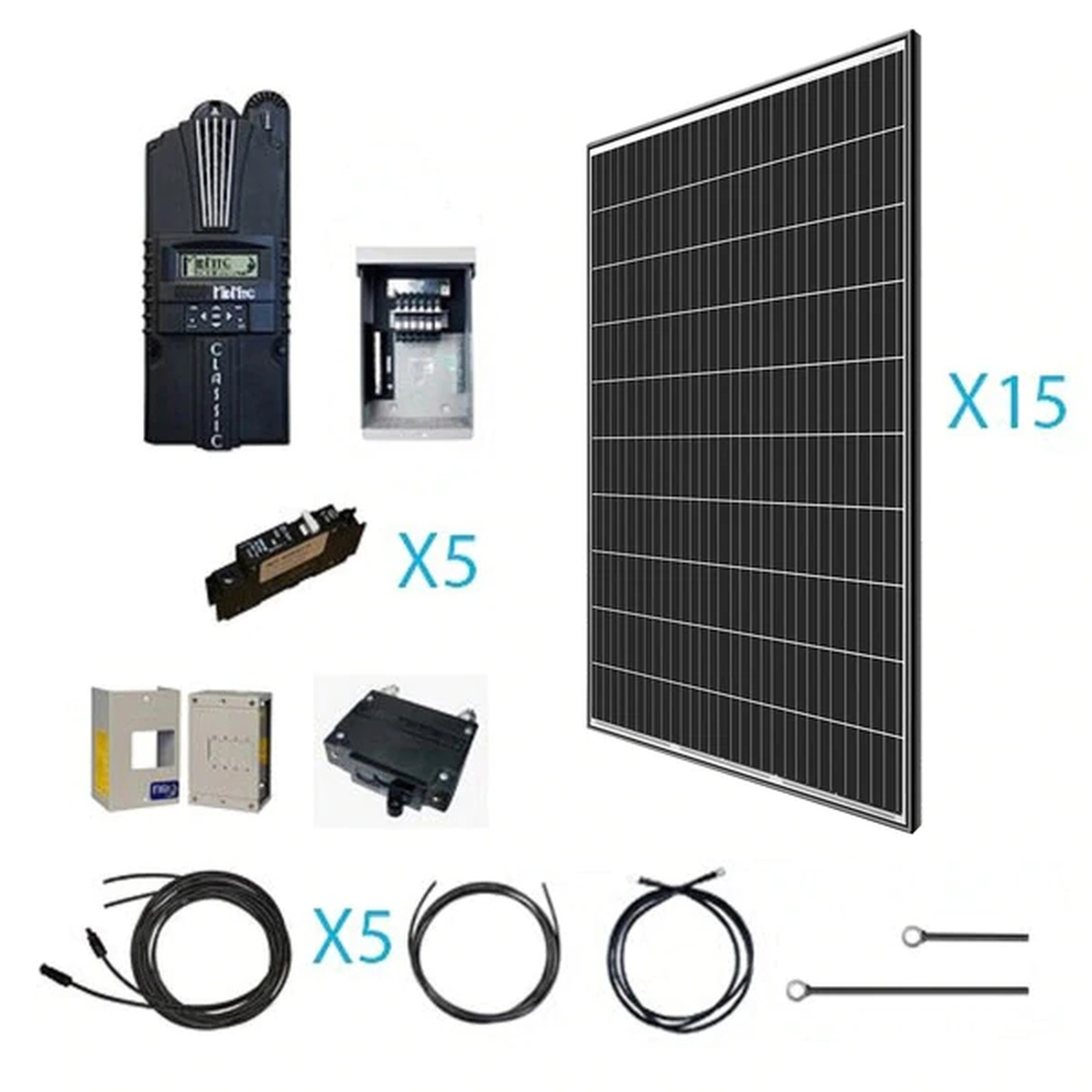
This is the kit we keep coming back to for anyone building a serious off-grid power system. Renogy bundles twelve 400W monocrystalline panels with their heavy-gauge aluminum ground mount racking, a 60A MPPT charge controller, and all the wiring and combiners you need — no scavenger hunt for missing parts.
Best for: Homesteaders and off-grid builders who want 15–25 kWh/day of production and a system that can scale.
Pros:
– Complete system from panels to charge controller — ready to install out of the box
– Heavy-duty aluminum ground mount frame rated for 90 mph wind loads with adjustable tilt from 15° to 45°
– Renogy’s 25-year panel warranty and responsive US-based support, well-documented across buyer reviews
Cons:
– The upfront cost is significant — expect to pay $4,500–$5,500 depending on current pricing
– At twelve panels, the footprint requires roughly 400 sq ft of unshaded ground — not feasible for tight properties
Rich Solar 2000W Ground Mount Kit
Off-Grid Insider
Get off-grid guides & gear picks in your inbox — free

Rich Solar has quietly built a reputation in the off-grid community for panels that perform well in partial shade and kits that actually include what they claim. This 2000W bundle pairs five 400W panels with a tilt-adjustable ground mount frame and a 40A MPPT controller. It hits the sweet spot for a cabin or small homestead pulling 8–12 kWh/day.
Best for: Small to mid-size off-grid cabins running a fridge, lights, well pump, and basic electronics.
Pros:
– Strong real-world performance in partial shade conditions — multiple community reports confirm better output than competing panels under tree canopy edges
– Ground mount racking uses stainless steel hardware throughout, resisting corrosion in humid or coastal environments
– Includes pre-terminated MC4 connectors and a wiring diagram that DIY installers consistently call clear
Cons:
– The charge controller tops out at 40A, so expanding beyond 2400W requires a controller upgrade
– Ground mount frame ships on a separate pallet and sometimes arrives days after the panels — plan accordingly
ECO-WORTHY 400W Ground Mount Kit

If you need a starter ground mount solar panel kit under $600, ECO-WORTHY’s 400W bundle is the one to grab. It pairs two 200W poly panels with an adjustable-tilt ground mount frame, a 30A PWM controller, and basic wiring. It won’t power a whole homestead, but it keeps a battery bank topped off for lights, phone charging, and a small 12V fridge.
Best for: Budget-conscious beginners, tiny cabins, or anyone who wants to start small and add panels later.
Pros:
– affordable entry point that includes real ground mount racking — most budget kits only ship roof mounts
– Simple PWM controller is dead-reliable and easy to understand for first-time installers
– Adjustable tilt frame lets you optimize angle seasonally without any modifications
Cons:
– PWM controller wastes 15–25% of potential power compared to MPPT — you’re leaving watts on the table
– Two-panel system maxes out around 1.5–2 kWh/day in good sun, which limits what you can run
BougeRV 1200W Ground Mount Solar Kit
BougeRV’s 1200W kit bundles three 400W monocrystalline panels with ground mount brackets, a 30A MPPT controller, and all cabling. It’s a clean mid-tier option that covers the gap between starter kits and full homestead systems. Buyer feedback highlights the panel efficiency — these are newer-generation mono cells pulling solid output even in overcast conditions.
Best for: RV-adjacent off-grid setups, workshops, or supplemental power alongside an existing system.
Pros:
– Compact three-panel layout fits in roughly 100 sq ft of ground space — works on tighter lots
– MPPT controller included at this price point is uncommon and adds real efficiency gains
– Panels use half-cut cell technology for better shade tolerance and lower hot-spot risk
Cons:
– Ground mount brackets feel less robust than Renogy or Rich Solar’s offerings — several buyers recommend adding concrete footings
– Customer service response times are inconsistent based on community reports
WindyNation 400W Ground Mount Solar Kit
WindyNation has been a staple in the DIY off-grid space for over a decade, and their 400W ground mount kit reflects that experience. It includes four 100W polycrystalline panels, a ground mount frame, a 30A PWM charge controller, and 40 feet of cable. The modular four-panel layout gives you more placement flexibility than a two-panel kit at a similar price point.
Best for: DIYers who want a proven, well-documented system with strong community support and plenty of install guides.
Pros:
– Massive community knowledge base — WindyNation forums and YouTube have hundreds of install walkthroughs for this exact kit
– Four smaller panels offer more flexible ground placement than two larger ones on uneven terrain
– Ships as a complete, ready-to-install package with labeled connectors
Cons:
– Polycrystalline panels are less efficient per square foot than monocrystalline — you need more ground space for the same output
– 400W total is limiting; this is really a starter or supplemental system, not a primary power source
HQST 1000W Ground Mount Solar Kit
HQST (formerly Renogy’s budget line) delivers surprisingly solid hardware at aggressive prices. This 1000W kit pairs five 200W monocrystalline panels with a ground mount racking system and a 40A MPPT controller. For the money, the spec sheet competes with kits costing 30–40% more.
Best for: Value-focused off-gridders who want monocrystalline efficiency and MPPT control without the premium price tag.
Pros:
– Among the best watts-per-dollar ratios we found in a complete ground mount solar panel kit with MPPT
– Monocrystalline panels deliver strong output in limited space — five panels cover roughly 170 sq ft
– 40A MPPT controller handles expansion to around 1200W without needing a swap
Cons:
– Ground mount racking hardware is functional but basic — upgrading to heavier L-brackets is a common community recommendation
– HQST’s warranty support gets mixed reviews compared to Renogy’s main line
How We Chose
We started with every ground mount solar panel kit available through major US retailers and filtered for systems that actually include ground mount racking — not roof mounts with a “ground mount adapter sold separately” asterisk. From there, we cross-referenced manufacturer specs against verified buyer reports, installer forums (particularly on r/SolarDIY and the DIY Solar Forum), and warranty claim patterns. We prioritized kits where the included charge controller matched the panel array’s voltage and amperage without requiring immediate upgrades. Systems with consistent reports of missing components, misleading wattage claims, or racking that failed under moderate wind loads were cut.
Buying Guide: What to Look for in a Ground Mount Solar Panel Kit

Racking Quality and Wind Rating
The ground mount frame is where cheap kits cut corners first. Look for aluminum or galvanized steel racking with a published wind load rating — 90 mph minimum if you’re in any region that sees storms. Stainless steel hardware matters more than you’d think; standard zinc bolts corrode within two seasons in humid climates. If the kit doesn’t list a wind rating, that’s a red flag.
Charge Controller Type: PWM vs. MPPT
This is the single biggest efficiency variable in any kit. PWM controllers are simpler and cheaper but waste 15–25% of your panels’ potential output by not optimizing voltage. MPPT controllers track the panels’ maximum power point and convert excess voltage into usable amperage — a real difference when you’re running a battery-based off-grid system. For any kit over 600W, we strongly recommend MPPT. The upfront cost difference pays for itself within the first year of production.
Kit Completeness — What’s Actually in the Box

“Complete kit” means wildly different things across manufacturers. At minimum, a ground mount solar panel kit should include: panels, ground mount racking and hardware, a charge controller, MC4 connectors or pre-terminated cables, and a wiring diagram. Many kits skip the battery cables, fuses, or breakers you need to connect to a battery bank. Check the component list carefully before ordering, and budget an extra $50–$100 for any missing connectors or safety components.
Panel Technology: Mono vs. Poly vs. Half-Cut
Monocrystalline panels deliver more watts per square foot and perform better in low-light conditions. Polycrystalline panels cost less but need more ground space for the same output. Half-cut cell panels (a monocrystalline variant) add better shade tolerance — if one cell is shaded, only half the panel’s output drops instead of the full string. For ground mounts where partial shading from trees or structures is possible, half-cut cells are worth the modest premium.
FAQ
What size ground mount solar panel kit do I need for an off-grid cabin?
A typical off-grid cabin running a refrigerator, LED lights, a well pump, and basic electronics needs 10–15 kWh per day. That translates to roughly 2,000–3,000 watts of panels in most US climates, accounting for seasonal variation and cloudy days. Start by listing every device you plan to run and its daily watt-hour consumption, then size your system with a 25% buffer.
How much space does a ground mount solar panel system require?
Plan for roughly 18–20 square feet per 400W panel, plus spacing for airflow and maintenance access. A 2,000W system with five panels needs approximately 150–200 square feet of unshaded ground. The ground should be relatively level, and ideally south-facing with no obstructions above 15° on the horizon.
Are ground mount solar panels better than roof mount for off-grid homes?
Ground mounts offer several advantages for off-grid properties: you can orient and tilt panels for optimal production regardless of your roof angle, maintenance and snow clearing are far easier at ground level, and you avoid drilling into your roof structure. The tradeoff is cost — ground mount racking and concrete footings typically add $500–$1,500 compared to a roof-mounted system of the same size.
Can I install a ground mount solar panel kit myself without an electrician?
The mechanical installation — assembling the racking, mounting panels, and running DC wiring to a charge controller and battery bank — is well within DIY capability for anyone comfortable with basic tools. However, if your system connects to an inverter feeding an AC breaker panel, most jurisdictions require a licensed electrician for that final connection. Check your local codes before starting.
How do I anchor a ground mount solar panel frame to the ground?
The three most common methods are concrete pier footings (most permanent, best for high winds), ground screws or helical piles (faster to install, no concrete curing time), and ballasted frames weighted with concrete blocks (no ground penetration, but requires more weight and space). For permanent off-grid installations, concrete piers at 4-foot depth are the standard recommendation in most soil types.
Our Verdict
For most off-grid builders, the Renogy 4.8kW Ground Mount Solar Kit is the best ground mount solar panel kit you can buy — it’s complete, backed by strong warranty support, and built with hardware that holds up in real-world conditions. If that’s more system than you need or more than your budget allows, the Rich Solar 2000W Ground Mount Kit delivers excellent mid-range value, and the ECO-WORTHY 400W Ground Mount Kit is the smartest way to start small without compromising on ground mount hardware.