5 Best Off-Grid Smart Home Systems 2026
Most smart home systems assume you’ve got a fat internet pipe and unlimited grid power. That’s a problem when your cabin runs on solar panels and a battery bank, and the nearest cell tower is a suggestion on the horizon. Finding a reliable solar powered smart home off-grid setup means filtering out cloud-dependent gadgets that brick the moment your Starlink drops — and that’s most of what’s on the market.
We spent weeks digging through spec sheets, community forums (r/offgrid, r/homeassistant, DIY Solar Forum), and verified buyer reports to find the systems that actually work when you’re disconnected. Below are the platforms and devices that earn their keep on limited watts and zero cloud dependency.
Our top pick: Home Assistant Green — the most flexible, lowest-power hub that runs 100% local.
Best plug-and-play: Hubitat Elevation C-8 Pro — zero cloud requirement, Zigbee/Z-Wave built in, minimal setup.
Best for energy monitoring: Victron Energy Cerbo GX — purpose-built to manage solar and battery systems with smart automation hooks.
Best battery-operated devices: SwitchBot Hub Mini + sensors — ultra-low power sensors that run on coin cells for a year-plus.
Our Picks
Home Assistant Green
The gold standard for a DIY smart home off-grid setup. Home Assistant Green draws under 3 watts, runs entirely on your local network, and supports over 2,000 device integrations — all without phoning home to any cloud server. If your off-grid system can power a USB charger, it can power this hub.
Who it’s for: Tinkerers and homesteaders who want total control and don’t mind a learning curve.
Pros:
– Draws only 2-3W — negligible load on even a small solar setup
– Fully local processing; works with zero internet connection once configured
– Massive integration library: Zigbee, Z-Wave, Wi-Fi, Bluetooth, and Matter devices all supported via add-ons or dongles
Cons:
– Requires a Zigbee/Z-Wave USB dongle (like the Sonoff ZBDongle-E or HUSBZB-1) for non-Wi-Fi devices — not included
– Initial setup and automation scripting has a real learning curve; expect a weekend of configuration

Hubitat Elevation C-8 Pro
Off-Grid Insider
Get off-grid guides & gear picks in your inbox — free

Hubitat is the closest thing to “plug in and go” for off-grid smart home control. It has Zigbee and Z-Wave radios built in, processes everything locally, and draws roughly 3-4 watts. Community members on the Hubitat forums regularly report running it on small solar setups with no issues.
Who it’s for: People who want local-only automation without the DIY overhead of Home Assistant.
Pros:
– Built-in Zigbee and Z-Wave radios — no extra dongles needed
– Dashboard and rule engine work entirely on-LAN with no cloud dependency
– Regular firmware updates that don’t require internet to apply (can be sideloaded)
Cons:
– Smaller integration ecosystem than Home Assistant — niche devices may lack support
– The web UI feels dated, and the rule-builder logic can be confusing for complex automations
Victron Energy Cerbo GX
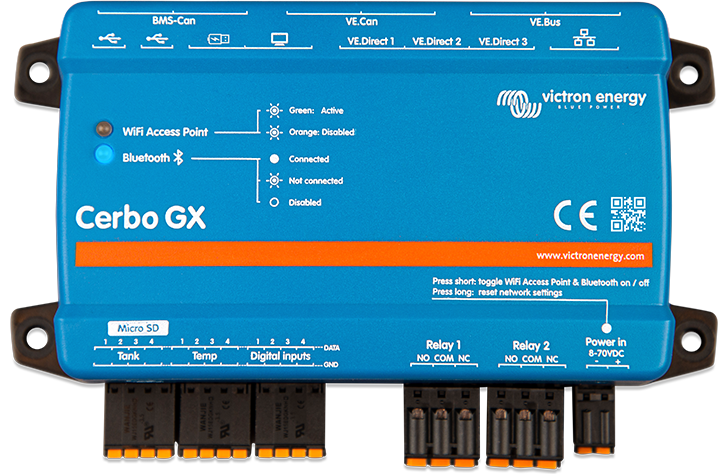
If your primary automation goal is managing your solar array, battery bank, and inverter — the Cerbo GX is purpose-built for the job. It monitors Victron charge controllers, inverters, and batteries in real time, and its relay outputs can trigger load-shedding, generator starts, or alerts based on state-of-charge thresholds. This is the brain of a solar powered smart home off-grid energy system.
Who it’s for: Anyone with a Victron-based solar setup (or planning one) who wants intelligent energy management as the backbone of their automation.
Pros:
– Native integration with Victron MPPT controllers, MultiPlus inverters, and battery monitors — zero configuration for those devices
– Built-in relay outputs for automated generator start, load disconnect, and alarm triggers
– Pairs with Home Assistant via MQTT for full smart-home integration beyond energy management
Cons:
– Only useful if you’re already in the Victron ecosystem — won’t talk to Renogy, EG4, or other brands natively
– Not a general-purpose smart home hub; you’ll still need a separate platform for lights, locks, and sensors

SwitchBot Hub Mini (Matter Enabled) + SwitchBot Sensors
SwitchBot makes the strongest case for battery operated home automation on limited power budgets. Their contact sensors, motion sensors, and temperature/humidity sensors run on CR2 or AAA batteries for 12-18 months. The Hub Mini draws under 2W and bridges everything to your local network. With the Matter-enabled version, it talks directly to Home Assistant or Hubitat without cloud relay.
Who it’s for: Off-gridders who need lots of cheap sensors (doors, windows, temperature, motion) without running wires or draining batteries fast.
Pros:
– Sensors last 12-18 months on coin cell or AAA batteries — verified across hundreds of buyer reviews
– Hub Mini draws under 2W and supports Matter for local-only communication
– Affordable sensor ecosystem: contact sensors under $15, motion sensors under $25
Cons:
– Bluetooth range from sensor to hub is limited to roughly 30 feet indoors — large properties may need multiple hubs
– Some advanced automations still route through SwitchBot cloud unless you bridge to Home Assistant via Matter
Shelly Plus 1 / Shelly Plus 1PM

Shelly devices are the workhorses of off-grid switching and monitoring. These tiny Wi-Fi relays fit behind a standard light switch or inside a junction box, draw under 1W, and — critically — run a local web server with no cloud requirement. The Plus 1PM variant adds power monitoring so you can track exactly how many watts each circuit pulls from your battery bank.
Who it’s for: Anyone who wants to automate pumps, lights, fans, or heaters with real-time power tracking and local-only control.
Pros:
– Built-in local web server and API — works perfectly with Home Assistant, Hubitat, or standalone via browser
– Plus 1PM variant measures real-time power consumption per circuit — essential for managing limited solar budgets
– Tiny form factor fits behind existing switches; rated for 16A loads (resistive)
Cons:
– Wi-Fi only — in large properties with weak Wi-Fi coverage, you may need mesh access points or repeaters
– No battery backup on the device itself; loses state during power interruptions unless paired with a UPS or automated restart rules

Reolink Argus 4 Pro + Solar Panel

Security matters off-grid, and the Argus 4 Pro is the best solar-powered camera we’ve found for properties without grid power. It runs on a rechargeable battery topped up by Reolink’s clip-on solar panel, records to a local microSD card or NVR, and supports RTSP streaming to Home Assistant. No subscription fees, no cloud dependency for core functionality.
Who it’s for: Off-grid property owners who need perimeter security without running power cables or paying monthly cloud storage fees.
Pros:
– Solar panel keeps the battery topped off in most climates — verified buyer reports from Alaska to Arizona confirm year-round operation
– Local storage on microSD card plus optional NVR; RTSP support for Home Assistant integration
– 4K resolution with color night vision and dual-band Wi-Fi
Cons:
– Wi-Fi range can be an issue on large rural properties; the camera needs line-of-sight to your router or a repeater
– Motion detection sensitivity requires tuning to avoid constant alerts from wildlife
How We Chose
We evaluated every platform and device against three non-negotiable criteria for off-grid use: power consumption under 5W per device (because every watt matters when you’re on solar), local-only operation (because internet is unreliable or nonexistent off-grid), and real-world community validation (we cross-referenced recommendations from r/offgrid, r/homeassistant, the DIY Solar Power Forum, and the Victron Community portal). We excluded any system that requires a cloud connection for basic functionality — that rules out most Alexa-dependent, Google Home-dependent, and SmartThings-dependent setups. Products with fewer than 100 verified reviews or no meaningful community discussion were also excluded.
Buying Guide: What Actually Matters for Off-Grid Smart Home Systems
Power Budget Comes First
Before you buy a single smart device, calculate what you can spare. A Home Assistant Green hub at 3W running 24/7 costs you 72Wh per day — that’s trivial on a 5kWh battery bank, but it adds up when you stack on cameras, sensors, and relays. Map your total smart-home power draw against your daily solar harvest, especially for winter months when production drops. A good rule of thumb: keep your always-on automation load under 1% of your battery bank capacity.
Local-Only Is Non-Negotiable
Cloud-dependent systems fail in three common off-grid scenarios: no internet at all, satellite internet with high latency (Starlink bufferbloat), and power-cycling your router during load-shedding events. Every hub and device in your DIY smart home off-grid setup should function fully on your LAN. Test this before you commit: unplug your modem and make sure every automation still fires.
Protocol Choice: Zigbee and Z-Wave Beat Wi-Fi for Sensors
Wi-Fi devices are fine for high-bandwidth needs (cameras, media), but for sensors, switches, and locks, Zigbee and Z-Wave are superior off-grid. They form mesh networks that extend range without extra access points, and they draw a fraction of the power — most Zigbee sensors run on coin cells for 1-2 years. This is the backbone of practical battery operated home automation: dozens of low-power sensors meshing together through a single coordinator dongle.
Plan for Failure Gracefully

Off-grid systems lose power. Your hub will restart. Build your automations with this in mind: use devices that restore their last state after power loss, set up watchdog timers to restart services, and keep critical systems (water pump shutoff, freeze protection) on simple relay logic that doesn’t depend on the hub being up. The smart layer should enhance your systems, not be a single point of failure.
FAQ
What is the best smart home hub for off-grid living?
Home Assistant Green is our top recommendation. It draws under 3W, runs entirely on your local network, and supports the widest range of devices through Zigbee, Z-Wave, Wi-Fi, and Matter integrations. For a less technical option, Hubitat Elevation C-8 Pro offers similar local-only control with less configuration required.
Can you run a smart home completely off-grid without internet?
Yes. Both Home Assistant and Hubitat process all automations locally. Pair them with Zigbee or Z-Wave devices and you have a complete solar powered smart home off-grid system that never needs to contact the internet. You only need internet for initial setup of some integrations and firmware updates.
How much solar power do you need for a smart home system?
A basic off-grid smart home setup — hub, 10-15 sensors, a few smart relays, and one camera — draws roughly 15-25W continuously. That’s 360-600Wh per day. A single 200W solar panel and a modest battery bank can handle this alongside your other loads. The key is calculating your always-on draw and ensuring it fits within your winter solar budget.
What smart home devices work without Wi-Fi?
Zigbee and Z-Wave devices work without Wi-Fi — they communicate directly with a hub via their own radio mesh. This includes sensors from Aqara, SONOFF, and Third Reality (Zigbee), and locks, switches, and thermostats from Zooz, Inovelli, and GE/Jasco (Z-Wave). You still need a LAN for the hub’s web interface, but no internet.
Is battery operated home automation reliable enough for daily use?
Absolutely. Modern Zigbee sensors from brands like Aqara and SwitchBot reliably run 12-24 months on a single coin cell battery. The mesh network protocol means they relay signals through each other, so even with one dead sensor the network self-heals. For critical applications, pair battery sensors with hardwired relays (like Shelly devices) on the actuator side.
Our Verdict
For most off-grid homesteads, Home Assistant Green is the hub to build around. It sips power, runs local, and integrates with virtually everything — from Victron solar gear to cheap Zigbee door sensors. Pair it with Shelly relays for hardwired switching, SwitchBot sensors for battery-operated monitoring, and a Reolink Argus 4 Pro for solar-powered security, and you have a complete system that runs on less power than a single incandescent bulb.