Improve Off-Grid Cabin Air Quality (Complete Guide)
Poor air quality is one of the most overlooked problems in off-grid cabins — and one of the most dangerous. When you’re burning wood for heat, cooking on propane, and sealing every gap to stay warm, you’re trapping moisture, carbon monoxide, volatile organic compounds, and particulates inside a tight envelope. The EPA estimates indoor air can be two to five times more polluted than outdoor air, and in a sealed off-grid cabin running a woodstove through a Montana winter, that number climbs fast. Natural ventilation off grid cabin setups solve this without electricity, ductwork, or monthly filter costs — but only if you design them correctly.
We dug into building science research, passive-house ventilation principles, and feedback from dozens of off-grid builders to put together a guide that actually works in real-world conditions.
What You’ll Learn
- How to design a passive ventilation system that moves air without any power
- The specific vent sizes, placements, and configurations that prevent moisture buildup and CO accumulation
- Which low-cost products improve airflow in existing cabins without a retrofit
- How to balance ventilation with heat retention so you’re not freezing yourself out
How Natural Ventilation Actually Works in a Cabin
Natural ventilation relies on two forces: stack effect (warm air rises and exits high, pulling cool fresh air in low) and cross-ventilation (wind pressure differences between two sides of a structure). Every effective natural ventilation off grid cabin design uses one or both.
Stack effect is your workhorse in cold months. Warm air inside your cabin is lighter than cold air outside. If you provide a high exhaust opening and a low intake opening, physics does the rest — warm stale air exits at the top, fresh air enters at the bottom. The greater the vertical distance between the two openings and the bigger the temperature difference, the stronger the airflow.
Cross-ventilation dominates in warmer months. Openings on opposite or adjacent walls let prevailing winds push air through the space. This requires knowing your site’s dominant wind direction — check NOAA wind rose data for your county before you finalize window placement.
The Numbers That Matter
Off-Grid Insider
Get off-grid guides & gear picks in your inbox — free
For a cabin under 800 square feet, building science guidelines recommend a minimum ventilation rate of about 0.35 air changes per hour (ACH). That means the entire volume of air in your cabin should be replaced roughly every three hours. For a 20×20-foot cabin with 8-foot ceilings (3,200 cubic feet), that’s about 1,120 cubic feet per hour of airflow.
To hit that rate passively, you need at least 1 square foot of free vent area per 300 square feet of floor space — split between intake and exhaust. For our 400-square-foot example, that’s roughly 1.3 square feet total, or about two 10×10-inch vents.
Designing Your Ventilation System

Step 1: Establish Low-to-High Airflow

Place intake vents 6–12 inches above floor level on the wall that faces your prevailing wind. Place exhaust vents within 12 inches of the ceiling on the opposite wall, or install a ridge vent or cupola on the roof. The greater the vertical separation, the better. A cabin with a loft or cathedral ceiling has a natural advantage here — you can get 12–16 feet of stack height versus 8 feet in a flat-ceiling build.
Practical options for intake vents:
- Adjustable foundation vents like the Witten 500BL (about 65 square inches of free area each) — check pricing on Amazon. Install two on your windward wall for a small cabin.
- Through-wall transfer grilles with insect screen and a manual damper so you can throttle airflow in extreme cold.
Practical options for exhaust vents:
- Gable vents near the roof peak — a 12×18-inch aluminum gable vent provides roughly 1 square foot of net free area after accounting for the screen and louvers.
- Ridge vents if you’re building new or re-roofing. A continuous ridge vent paired with soffit vents creates the most uniform airflow across the entire attic and living space.
- Cupola or turbine vent — a wind-driven turbine like the Lomanco BIB-12 moves up to 95 CFM in a 5 mph breeze with zero electricity. Check pricing on Amazon.
Step 2: Add Cross-Ventilation Paths
Windows on opposite walls are the simplest cross-ventilation strategy. Casement windows outperform double-hung windows for ventilation because the open sash acts as a scoop, directing wind into the cabin. A fully open casement captures nearly 100% of its area as free vent space, while a double-hung window only gives you 50% at best.
If your cabin only has windows on one or two walls, install a through-wall vent on the windowless side. A 6-inch round vent with a backdraft damper costs under $20 and takes about 30 minutes to install with a hole saw.
Step 3: Address Your Woodstove and Cooking Area
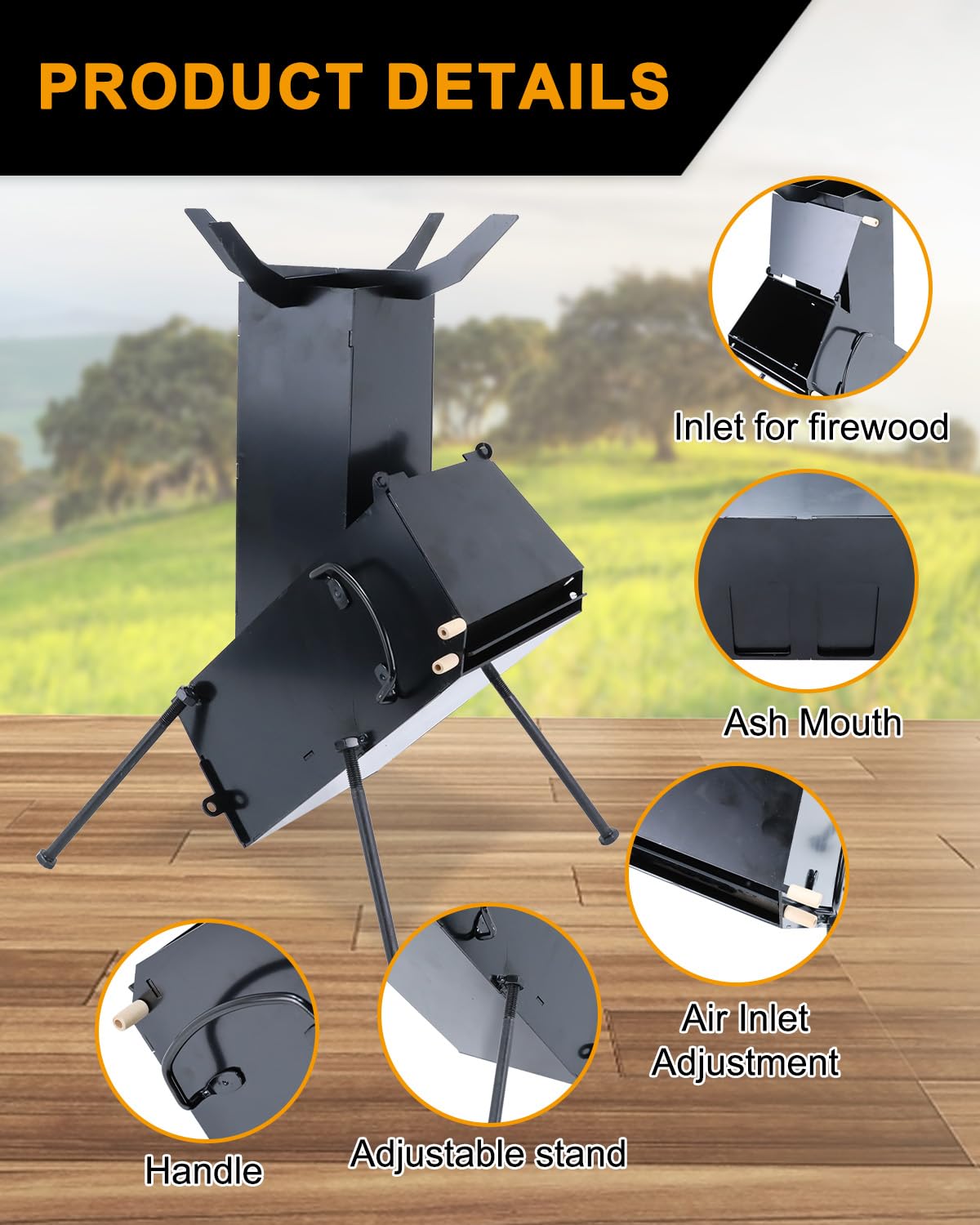
This is where most off-grid builders make critical mistakes. A woodstove consumes 20–50 CFM of air for combustion. If your cabin is well-sealed, the stove starves for air, backdrafts, and pushes smoke and CO inside.
The fix: Install a dedicated outside air kit for your woodstove. Most modern stoves from brands like Jøtul, Vermont Castings, and Drolet have provisions for a direct-connect outside air intake — typically a 3- or 4-inch insulated flex duct running from an exterior wall to the stove’s air intake. This gives the stove its own air supply without depressurizing the cabin.
For cooking, a range hood vented to the exterior is ideal, but off-grid that usually means no fan. A passive range hood vent works if your stovepipe is already creating draft — the negative pressure in the cabin pulls cooking fumes toward any available exhaust. Position a 6-inch gravity vent directly above your cook area, routed through the wall or ceiling, with a manual damper you can close when not cooking.
Step 4: Control Moisture at the Source

In a tight cabin, a family of four generates 2–3 gallons of moisture per day just from breathing, cooking, and bathing. That moisture condenses on cold surfaces and breeds mold if you don’t ventilate it out.
Key moisture-control strategies:
- Vent your bathroom separately. Even a small passive vent stack — a 4-inch PVC pipe running from the bathroom ceiling up through the roof — creates enough stack effect to pull moisture out after showers.
- Use a hygrometer to monitor indoor humidity. Target 30–50% relative humidity. The ThermoPro TP50 is a reliable, inexpensive digital hygrometer — check pricing on Amazon.
- Crack a window during and after cooking. Even a 1-inch opening on a casement window near the stove makes a measurable difference.
Upgrading an Existing Cabin
If you’re retrofitting a cabin that wasn’t built with ventilation in mind, here’s the priority order:
- Install a CO detector first. Non-negotiable if you burn anything indoors. The Kidde Nighthawk runs on AA batteries — no grid power needed. Check pricing on Amazon.
- Add a high exhaust vent on the wall opposite your main heat source. Cut a 6–8 inch hole near the ceiling, install a vent with a damper and insect screen.
- Add a low intake vent on the windward wall. A simple adjustable vent with a closeable damper lets you control airflow in winter.
- Install an outside air kit for your woodstove if one isn’t already present.
Budget for a full retrofit on a small cabin: $150–$300 in materials, one weekend of work.
Common Mistakes
Sealing the cabin too tight without compensating ventilation. Energy efficiency is great, but a cabin with spray foam on every surface and no planned air exchange becomes a toxic box. Every air-sealing upgrade should be paired with a ventilation upgrade.
Relying on a single vent opening. One vent doesn’t create airflow — it creates a dead zone. You need both intake and exhaust, separated vertically and/or horizontally, to move air through the space.
Ignoring seasonal differences. Stack effect is strong in winter (big indoor-outdoor temperature gap) but weak in summer when temperatures equalize. Your summer ventilation plan needs to lean on cross-ventilation and operable windows, not just stack vents.
Placing intake vents near pollution sources. Don’t put your fresh air intake downwind of your outhouse, compost pile, or generator exhaust. Walk your site and think about wind patterns before you drill.
Our Recommendations
Best wind-driven ventilator for off-grid cabins: The Lomanco BIB-14 Turbine Vent provides up to 167 CFM in moderate wind with zero power consumption. It’s the most effective zero-energy exhaust option we’ve found for cabins with roof access. Check pricing on Amazon.
Best indoor air quality monitor: The Airthings View Plus tracks CO2, humidity, radon, particulates, and VOCs — all the pollutants that matter in an off-grid cabin. It runs on batteries and connects via Bluetooth for data logging. Knowing your actual air quality numbers tells you whether your ventilation is working. Check pricing on Amazon.
Best budget hygrometer for moisture monitoring: The ThermoPro TP50 costs under $10 and gives you real-time humidity and temperature readings. Put one in each room to identify problem areas before mold gets a foothold. Check pricing on Amazon.
FAQ
How much ventilation does an off-grid cabin actually need?
The standard recommendation is 0.35 air changes per hour. For a typical 400-square-foot cabin, that translates to about 1,120 cubic feet per hour. You can achieve this passively with properly sized and placed intake and exhaust vents totaling at least 1.3 square feet of net free area.
Can I ventilate naturally in winter without losing all my heat?
Yes, but it requires balancing. Use adjustable dampers on all vents so you can throttle flow when it’s bitterly cold. A heat-recovery approach — like routing incoming air through a passive earth tube or running the intake duct near (but not touching) your stovepipe — can pre-warm fresh air. Even without pre-warming, the health cost of stale air far outweighs the small BTU penalty of controlled ventilation.
Do I need a CO detector if I have good ventilation?
Absolutely. Ventilation reduces risk but doesn’t eliminate it. A backdrafting woodstove or a gust of wind that reverses your stack effect can spike CO levels in seconds. Battery-operated CO detectors are cheap insurance — replace the batteries every six months and the unit itself every 5–7 years per manufacturer guidelines.
What’s the best way to test if my ventilation is working?
Hold a lit incense stick or smoke pencil near your intake and exhaust vents. At the intake, smoke should be pulled inward. At the exhaust, it should be drawn outward. If the smoke hangs motionless or drifts the wrong direction, your airflow path has a problem — usually an obstruction, insufficient vent size, or not enough vertical separation between openings.
Is a solar-powered vent fan worth adding to a passive system?
For most cabins, a well-designed passive system handles 90% of the job. But if you’re in a hot climate with minimal wind and small temperature differentials in summer, a small 10–20W solar gable fan can bridge the gap. It’s a good supplement, not a replacement for proper passive design.