5 Best Off-Grid HVAC Systems for 2026
Heating and cooling an off-grid home without grid electricity is one of the hardest problems in self-sufficient living. Most conventional HVAC systems demand thousands of watts, and even “efficient” mini-splits assume you have a fat solar array and battery bank. If you’re building on a budget — or you simply want systems that work when everything else fails — you need solutions that run on wood, thermal mass, gravity, airflow, or the sun itself.
Our top pick: Drolet HT3000 Wood Stove — best all-around off-grid heating.
Best for cooling: Hessaire MC18M Evaporative Cooler — runs on minimal 12V power, perfect for dry climates.
Best radiant heat: PEX Radiant Floor Tubing Kit — pair with a wood boiler for radiant floor heating off-grid.
Best passive: AC Infinity AIRTITAN T7 Crawl Space Fan — solar-powered ventilation for passive cooling strategies.
Our Picks
Drolet HT3000 Wood Stove
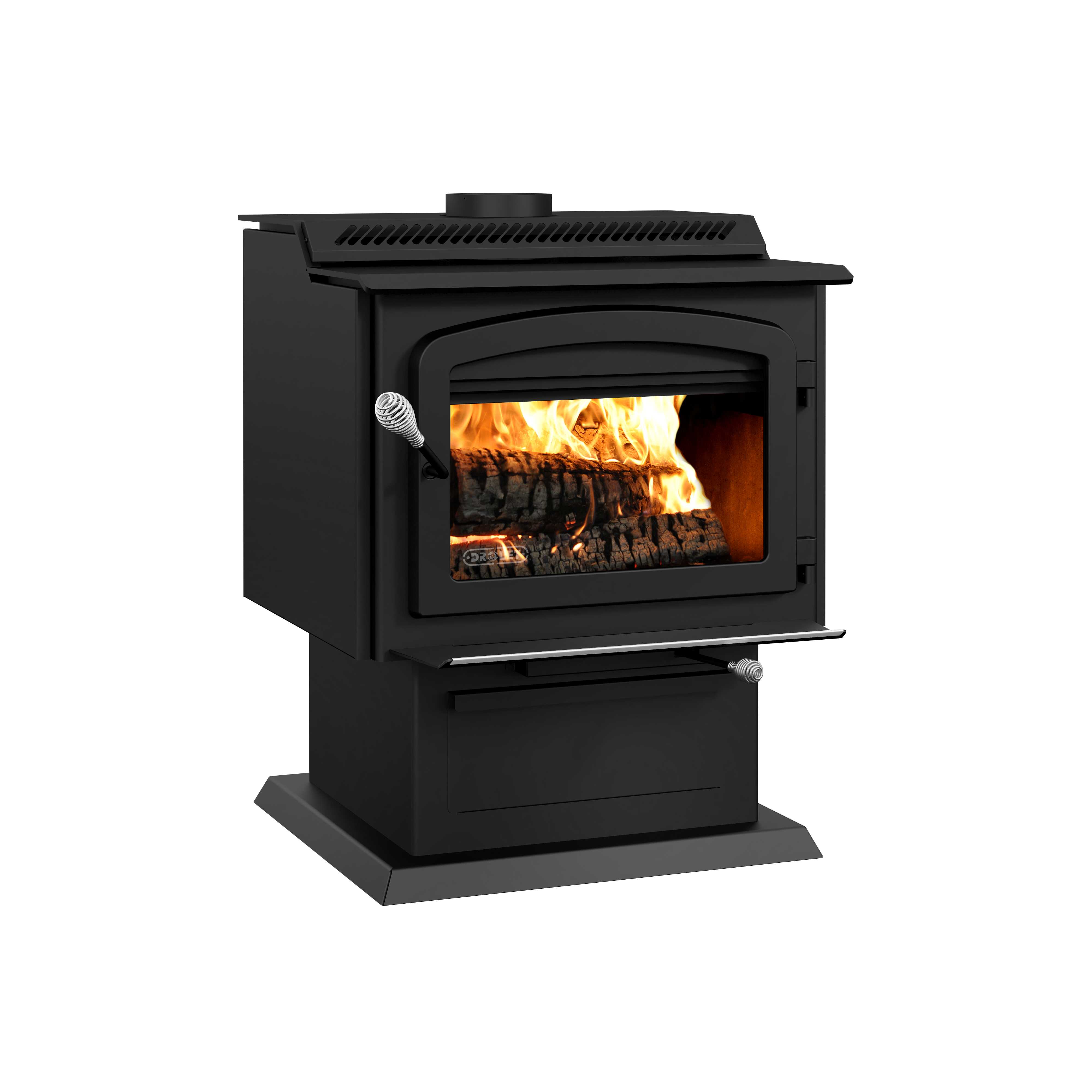
The Drolet HT3000 is a workhorse that heats up to 2,400 square feet on a single load lasting 8+ hours. It’s EPA-certified at 1.32 g/hr emissions, which means you’re getting nearly complete combustion and squeezing real BTUs out of every log — the manufacturer rates it at up to 110,000 BTU/hr.
Who it’s for: Primary heating in a medium to large off-grid cabin or home in cold climates.
Pros:
– 3.5 cubic foot firebox accepts 22-inch logs, reducing splitting and reloading frequency
– Pedestal base with built-in ash drawer makes cleanup straightforward
– Secondary combustion system burns off gases that cheaper stoves waste as creosote
Cons:
– At 475 lbs, installation requires planning — you’re not moving this thing twice
– No cooktop surface, so you can’t double it as a cooking platform without an aftermarket trivit
Hessaire MC18M Evaporative Cooler
Off-Grid Insider
Get off-grid guides & gear picks in your inbox — free

If you’re in the arid West — anywhere humidity regularly drops below 40% — an evaporative cooler off-grid setup is the most energy-efficient cooling you can get. The Hessaire MC18M covers up to 900 square feet and draws only 150 watts, meaning a single 200W solar panel and a small battery can run it all day. It uses water evaporation to drop air temperature by 15–25°F.
Who it’s for: Off-gridders in dry climates (desert Southwest, high plains, interior mountain West) who need real cooling without a massive solar array.
Pros:
– 150W draw is a fraction of what even the smallest mini-split demands — realistic for minimal solar setups
– 4.8-gallon tank runs 3-4 hours before refilling; can be gravity-fed from a rain catchment line
– Three fan speeds with oscillation cover a large room effectively
Cons:
– Useless above ~50% relative humidity — this is a dry-climate-only solution
– Adds moisture to indoor air, which in a tight cabin can create condensation issues if you don’t ventilate

Dickinson Marine Newport P12000 Propane Heater

Originally designed for sailboats, the Newport P12000 is a direct-vent propane heater that needs zero electricity. It pulls combustion air from outside and exhausts through a small flue — no fan, no blower, no wiring. Rated at 5,500–12,000 BTU, it’s ideal for small cabins under 800 square feet.
Who it’s for: Small cabins, tiny homes, or as a supplemental zone heater in a larger off-grid house.
Pros:
– Completely electricity-free — no ignition battery, no thermostat wiring, nothing
– Direct-vent design means no indoor air quality concerns and no need for a full chimney
– Compact wall-mount form factor (roughly 20″ × 14″) takes almost no floor space
Cons:
– Requires propane supply, which means ongoing fuel costs and tank logistics
– 12,000 BTU max output won’t heat a large or poorly insulated space
PEX Radiant Floor Tubing Kit with Mixing Valve
Radiant floor heating off-grid is one of the most comfortable and efficient ways to heat a home — warm floors, no blowing dust, and the thermal mass of a concrete slab stores heat for hours after the fire goes out. A PEX tubing loop embedded in your slab or stapled under subfloor connects to a wood-fired boiler or even a coil in your wood stove. The system can run on thermosiphon (gravity circulation) with no pump at all, or with a tiny 12V circulator pump.
Who it’s for: Anyone building new or doing a major renovation who wants whole-house radiant heat powered by a wood boiler.
Pros:
– Even heat distribution eliminates cold spots and the stratification problems wood stoves create
– Thermal mass in a concrete slab keeps radiating warmth 4-6 hours after the boiler stops
– Can operate on thermosiphon with zero electrical input if the boiler is positioned correctly
Cons:
– Must be installed during construction or major remodel — retrofitting under existing floors is labor-intensive
– Requires a wood-fired boiler or heat source with a water jacket, adding system complexity

AC Infinity AIRTITAN T7 Solar Ventilation Fan

Passive cooling off-grid home design starts with moving hot air out and pulling cool air in. The AIRTITAN T7 is a weatherproof exhaust fan with an integrated solar panel — it runs whenever the sun hits it, which is exactly when you need ventilation most. Mount it in a gable end, crawl space, or attic to exhaust hot air that would otherwise radiate down into your living space.
Who it’s for: Any off-grid home that overheats in summer due to attic or crawl space heat buildup.
Pros:
– Integrated 12.5W solar panel means zero wiring and zero battery drain — truly standalone
– IP44 weatherproof rating and corrosion-resistant housing designed for permanent outdoor mounting
– Moves 240 CFM, enough to meaningfully reduce attic temperatures by 20-30°F in field reports
Cons:
– Only runs during direct sunlight — no battery backup for cloudy days or evening cooling
– 240 CFM is modest; very large attic spaces may need two units
US Stove Company Wiseway Pellet Stove
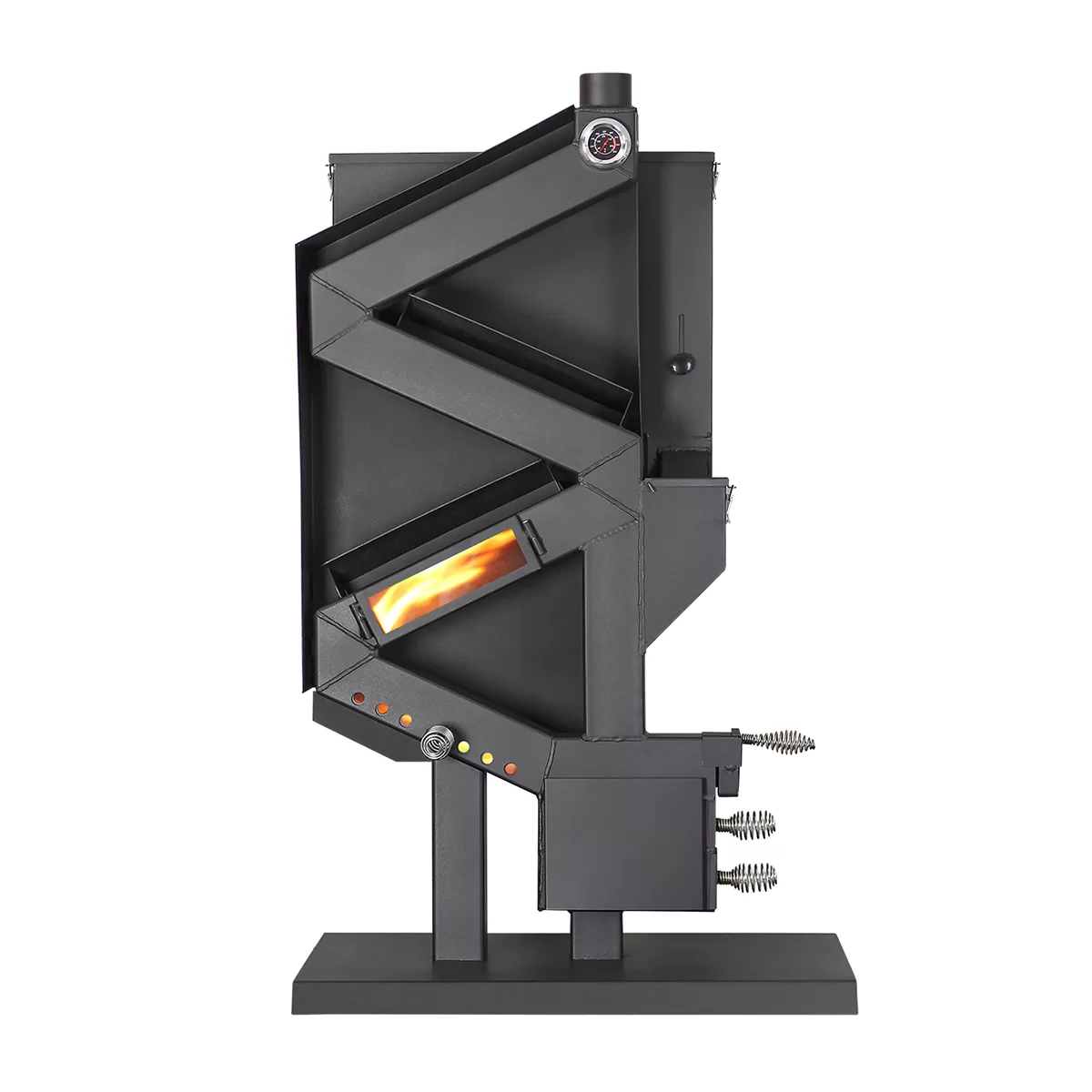
Most pellet stoves need 300-400 watts to run augers, fans, and control boards — effectively making them grid-dependent appliances. The Wiseway is the exception: it uses gravity-feed and natural draft, requiring zero electricity. It’s rated at 40,000 BTU and heats up to 2,000 square feet. You load pellets into the top hopper, light it with a gel starter, and gravity does the rest.
Who it’s for: Off-gridders who want the convenience of pellet fuel (consistent BTU output, easy storage, no splitting) without any electrical dependency.
Pros:
– Truly non-electric — gravity feed, natural draft, no auger motor, no blower, no circuit board to fail
– 40,000 BTU output is substantial and heats a real-sized home
– Burns standard wood pellets available at any hardware store, roughly $5/40-lb bag
Cons:
– 60-lb hopper lasts 8–12 hours at medium burn; you’ll reload at least twice a day in deep cold
– Natural draft means you need a proper chimney with good draw — won’t work with a short or poorly sized flue
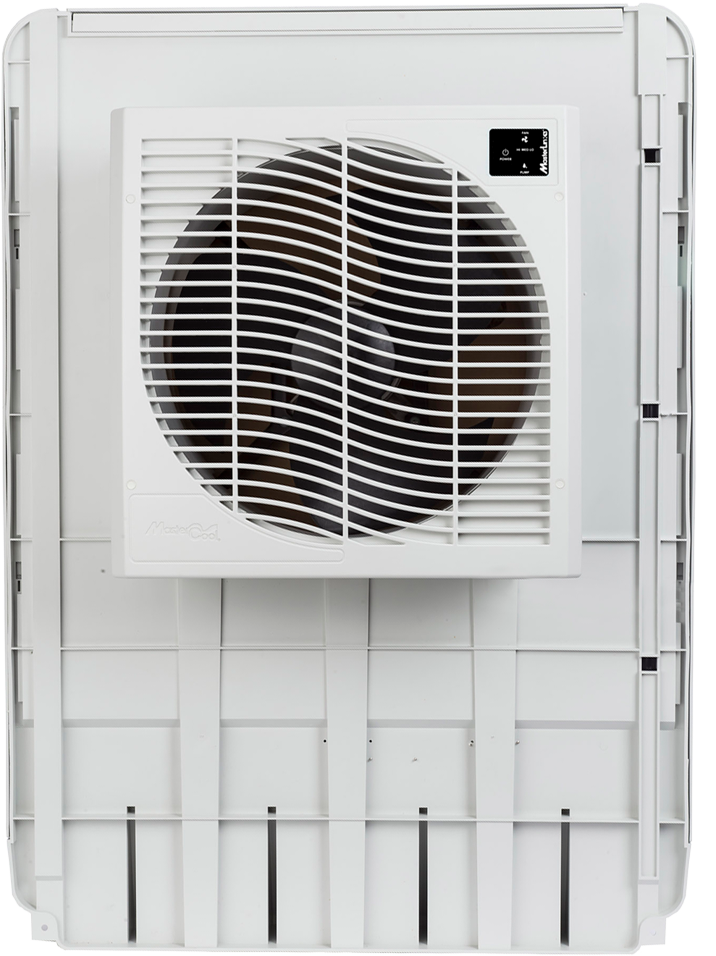
Mastercool MCP44 Window Evaporative Cooler

For larger off-grid homes in arid climates, the Mastercool MCP44 is a step up from portable evaporative units. It mounts in a window and covers up to 1,600 square feet. The draw is higher — around 430 watts — but that’s still a fifth of what a comparable AC unit would pull, making it feasible on a moderate solar setup. This is the evaporative cooler off-grid households in Arizona and New Mexico have been using for decades.
Who it’s for: Larger off-grid homes in low-humidity climates that need serious cooling capacity beyond what a portable unit delivers.
Pros:
– 1,600 sq ft coverage with 3,000 CFM airflow — this is whole-house cooling, not a desk fan
– Permanent window mount with exterior media pads delivers better cooling efficiency than portables
– Uses about 80% less electricity than a window AC unit of comparable coverage
Cons:
– 430W draw requires a decent solar array — this isn’t running off a single panel
– Window-mount installation is semi-permanent and blocks the window
How We Chose
We evaluated off-grid HVAC solutions on four criteria: total independence from grid electricity, BTU output or cooling capacity relative to energy input, proven reliability in off-grid community forums and verified buyer reviews, and realistic installation requirements for owner-builders. We cross-referenced manufacturer specs with long-term reports from off-grid homesteading communities on Reddit, Hearth.com, and permaculture forums. We specifically excluded any product that requires grid power or an inverter larger than most off-grid systems can support, because the whole point is resilience — if your heating system dies when your inverter trips, it’s not truly off-grid.
Buying Guide: What Actually Matters
Heating: BTU Output vs. Your Insulation Reality
The most common mistake in off-grid heating is buying a stove sized for your square footage without accounting for insulation. A well-insulated 1,200 sq ft cabin might need 30,000 BTU; a drafty one the same size could demand 80,000+. Before choosing a heating source, know your insulation R-values, window quality, and air sealing status. The stove is only as good as the envelope it’s heating.
Cooling: Humidity Dictates Your Options
This is the hard truth about off-grid cooling — your climate determines your strategy, not your preferences. Below 30% relative humidity, evaporative cooling is phenomenal. Between 30-50%, it works but with diminishing returns. Above 50%, forget it. In humid climates, passive cooling off-grid home design — thermal mass, earth sheltering, strategic window placement, cross-ventilation, and shade — isn’t a nice-to-have, it’s your only realistic non-electric strategy. If you’re building new in a humid climate, orient the home for prevailing breezes, install operable clerestory windows for stack-effect ventilation, and use light-colored roofing to reduce solar heat gain.
Fuel Availability and Storage
Wood is free if you have timber and a chainsaw, but you need 4-6 cords per winter in cold climates — that’s a significant time investment in cutting, splitting, and seasoning. Propane is convenient but costs money and requires delivery logistics. Pellets are a middle ground: consistent BTU output, easy to store, but you’re dependent on a supply chain. Pick the fuel that matches your land, your labor capacity, and your tolerance for supply risk.
System Redundancy
No off-grid home should rely on a single heating or cooling method. The smartest setups layer: a wood stove as primary heating, propane as backup for when you’re away or sick, and a radiant floor system connected to the wood boiler for even heat distribution. For cooling: passive design as the foundation, supplemented by evaporative cooling or solar-powered ventilation. If one system fails or fuel runs out, you’re uncomfortable — not in danger.
FAQ
What is the most efficient way to heat an off-grid home without electricity?
A high-efficiency EPA-certified wood stove paired with a well-insulated building envelope is the gold standard. Modern secondary-combustion stoves like the Drolet HT3000 extract far more heat per log than older designs, and they require zero electricity to operate. For even heat distribution, connect a wood-fired boiler to radiant floor heating off-grid through PEX tubing — the thermal mass stores heat for hours.
How can I cool my off-grid home without AC or electricity?
In dry climates, an evaporative cooler off-grid setup drops indoor temperatures 15-25°F using only water and minimal power. In humid climates, passive cooling off-grid home design is your primary tool: earth-sheltered construction, cross-ventilation, thermal mass floors and walls that absorb daytime heat, light-colored roofing, and strategic shade from trees or overhangs. Solar-powered attic fans like the AC Infinity AIRTITAN also help by exhausting trapped hot air.
Can you run radiant floor heating without electricity?
Yes. A radiant floor heating off-grid system can operate on thermosiphon — the principle that hot water rises and cold water sinks — eliminating the need for a circulation pump entirely. The wood boiler or stove with a water jacket must be positioned below the floor level for thermosiphon to work. Alternatively, a small 12V DC circulator pump draws so little power that a single solar panel can run it.
What is the cheapest off-grid heating system to install?
A quality wood stove with a Class A chimney kit is typically the lowest total installed cost — roughly $1,500–$3,000 for the stove, chimney, and hearth pad. Fuel cost is near zero if you have your own timber. The Wiseway non-electric pellet stove is another affordable option at around $2,000 installed, though pellets have an ongoing cost of roughly $250–$400 per winter depending on climate.
Does passive solar design really work for heating and cooling?
Absolutely — but only if it’s designed in from the start. South-facing windows with properly sized overhangs can provide 30-50% of a home’s heating needs in cold climates through direct solar gain. Thermal mass floors (concrete, stone, or tile) absorb that heat during the day and radiate it at night. For cooling, the same mass absorbs heat from indoor air during the day. Passive solar isn’t a product you buy — it’s a design strategy that reduces how much work your heating and cooling systems have to do.
The Verdict
For most off-grid homes, the Drolet HT3000 Wood Stove is our top heating pick — it’s efficient, proven, and runs on the most universally available fuel in rural areas. For cooling in dry climates, the Hessaire MC18M Evaporative Cooler delivers genuine temperature drops on minimal solar power. The real key to off-grid HVAC, though, is layering: start with a tight building envelope and smart passive design, then add mechanical systems to fill the gaps. The best off-grid heating and cooling setup is the one that keeps working when nothing else does.