5 Best Budget Off-Grid Solar Kits 2026
Finding a reliable entry level solar power system off-grid shouldn’t require an engineering degree or a five-figure budget. But scroll through Amazon and you’ll hit a wall of vague specs, bundled junk components, and kits that leave out critical parts — like a charge controller or properly sized wiring. We dug through spec sheets, verified buyer feedback, and real-world performance data to find the kits that actually deliver usable power out of the box.
Our Top Pick: Renogy 400W Complete Solar Kit — best overall balance of quality, capacity, and price.
Best Budget: HQST 200W Polycrystalline Solar Kit — solid entry point under $350.
Best All-in-One: Bluetti AC200L + PV200 Bundle — plug-and-play with zero wiring.
Best for Expansion: Rich Solar 400W Kit — easiest path to a bigger system later.
Our Picks

Renogy 400W Complete Solar Kit

This is the kit we point most beginners toward, and for good reason. You get four 100W monocrystalline panels, a 30A Rover MPPT charge controller, mounting hardware, cables, and connectors — everything except the battery, which lets you choose your own chemistry and capacity.
Best for: Beginners who want a real system (not a toy) and plan to power a cabin, RV, or shed with lights, fans, phone charging, and small appliances.
Pros:
– MPPT controller included at this price point is rare — expect 15-20% more harvest than PWM equivalents
– Monocrystalline panels perform noticeably better in partial shade and cloudy conditions versus polycrystalline competitors
– Renogy’s documentation and community forum make troubleshooting straightforward even for first-timers
Cons:
– Does not include a battery — budget an additional $200-$800 depending on whether you go AGM or lithium
– The included mounting Z-brackets work fine for flat roofs but aren’t ideal for ground mounting without additional hardware
HQST 200W Polycrystalline Solar Kit
Off-Grid Insider
Get off-grid guides & gear picks in your inbox — free
If you want the cheapest functional affordable solar panel kit setup that isn’t garbage, this is it. Two 100W polycrystalline panels, a 20A PWM charge controller, and all the cables you need. It won’t run a mini-fridge, but it’ll keep lights on and devices charged in a small cabin or campsite.
Best for: Tight budgets under $350, weekend cabins, or anyone who wants to learn the fundamentals before committing to a bigger system.
Pros:
– Lowest price per watt among kits that include a decent charge controller
– Simple PWM controller is actually easier for beginners to understand and configure
– Panels are surprisingly durable — multiple verified buyers report 2+ years of outdoor exposure without meaningful degradation
Cons:
– Polycrystalline cells lose efficiency faster in high heat compared to monocrystalline
– 200W total is limiting — you’ll max out quickly if you add loads beyond lighting and USB charging
Bluetti AC200L + PV200 Solar Panel Bundle
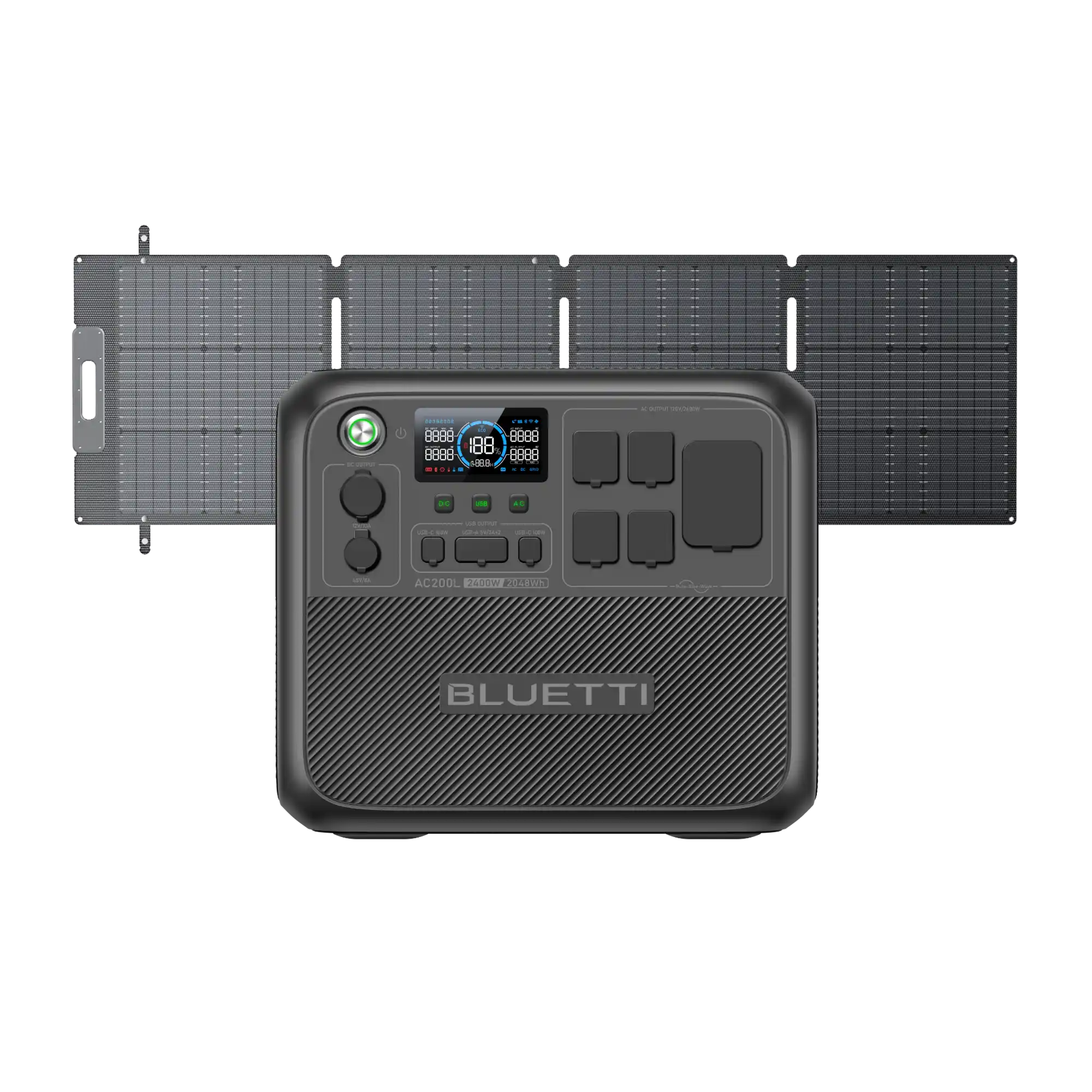
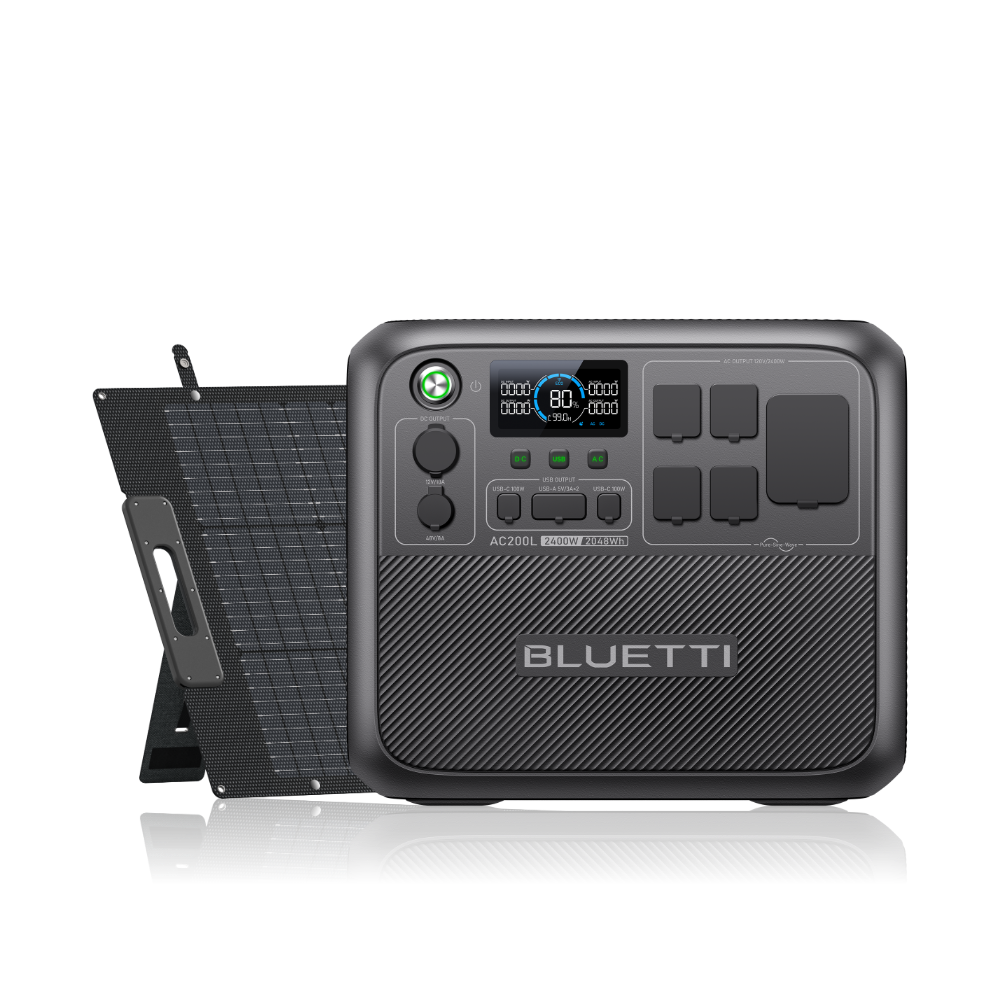
This is the zero-wiring option. The AC200L is a 2,048Wh portable power station with a built-in inverter, and the PV200 is a foldable 200W panel that connects with a single MC4-to-barrel cable. No charge controllers to configure, no battery banks to wire, no fuse boxes to install.
Best for: People who want solar power today — literally today — without learning electrical theory. Also excellent as emergency backup power.
Pros:
– Truly plug-and-play: unfold panel, plug in one cable, done
– 2,048Wh LiFePO4 battery rated for 3,000+ cycles means this thing should last a decade of daily use
– 2,400W AC output can run a microwave, power tools, or a small window AC unit
Cons:
– At roughly $1,500-$1,800 for the bundle, it’s the priciest option on this list — though still an off-grid solar system under 2000 dollars
– A single 200W panel takes 10-12 hours of direct sun to fully recharge the battery — adding a second PV200 ($350) is almost mandatory for daily use
Rich Solar 400W Premium Kit
Rich Solar doesn’t get the name recognition of Renogy, but their 400W kit is a serious contender — especially if you’re planning to expand. The kit includes four 100W monocrystalline panels, a 40A MPPT charge controller (bigger than most kits at this tier), and all wiring and connectors.
Best for: Builders who know they’ll scale up. The oversized 40A controller means you can add panels later without replacing your charge controller.
Pros:
– 40A MPPT controller supports up to ~600W of panel input, giving you significant room to grow
– Panels use half-cut cell technology for better shade tolerance
– MC4 connectors and included branch adapters make parallel wiring clean and simple
Cons:
– Customer support is slower than Renogy’s — plan to troubleshoot via forums and YouTube if issues arise
– Mounting hardware is basic; ground-mount or tilt-mount setups will need aftermarket brackets
ECO-WORTHY 200W Complete Solar Kit with Battery
This is the only kit on our list that includes a battery — a 50Ah lithium iron phosphate (LiFePO4) unit. For a beginner who wants a true all-in-one entry level solar power system off-grid without sourcing separate components, it eliminates the biggest pain point: figuring out battery compatibility.
Best for: First-time off-gridders who want everything in one box and a system producing power the same day it arrives.
Pros:
– Included 50Ah LiFePO4 battery means no compatibility guesswork — everything is pre-matched
– 20A charge controller with LCD display makes monitoring dead simple
– Total system cost is typically under $600, making it one of the most complete budget options available
Cons:
– 50Ah at 12V is only 600Wh of storage — enough for lights and small electronics, not much else
– 200W of panel input means slow recharging; cloudy days can leave you short
WindyNation 400W Solar Kit
WindyNation has been in the off-grid space for over a decade, and their 400W kit reflects that experience. It ships with four 100W polycrystalline panels, a 30A PWM charge controller, 40 feet of cable, and MC4 connectors. It’s no-frills but well-documented.
Best for: DIYers comfortable with basic wiring who want a proven, straightforward affordable solar panel kit setup without paying extra for MPPT.
Pros:
– Generous cable lengths (40 ft) mean flexible panel placement without buying extra wire
– Excellent installation documentation — their printed manual is better than most competitors
– Consistent build quality across verified buyer reviews spanning multiple years
Cons:
– PWM controller at this panel wattage means you’re leaving 15-20% of potential energy on the table versus MPPT
– Polycrystalline panels are physically larger and heavier than monocrystalline equivalents for the same output
Grape Solar 400W Off-Grid Kit
Grape Solar has wide retail distribution (Home Depot, Costco seasonally) which means easier returns if something arrives damaged — a real consideration when shipping fragile glass panels. The kit includes four 100W monocrystalline panels and a 35A PWM charge controller.
Best for: Buyers who prefer the safety net of big-box retail support and easy returns over the lowest possible price.
Pros:
– Available through major retailers with in-store return options — a significant advantage over Amazon-only brands
– Monocrystalline panels with solid efficiency ratings (around 19.8%)
– 35A controller gives decent headroom for minor system expansion
Cons:
– Priced slightly higher than comparable Renogy and Rich Solar kits, partly due to retail distribution margins
– Does not include battery or inverter — you’ll need to source both separately
How We Chose
We started with every solar starter kit available on Amazon, Home Depot, and direct-from-manufacturer sites priced under $2,000 as a complete system. We filtered for kits that include at minimum: solar panels, a charge controller, and wiring/connectors. We then cross-referenced manufacturer specs against verified buyer reviews — specifically looking for discrepancies between advertised output and real-world performance reports. Kits with recurring complaints about dead-on-arrival components, missing parts, or misleading wattage claims were cut. Finally, we weighted for expandability and component quality, because a “starter” kit that locks you into proprietary connectors or an undersized controller is a false economy.
Buying Guide: What Actually Matters in a Starter Solar Kit
Panel Wattage vs. Usable Output
A “400W” kit produces 400 watts only under perfect laboratory conditions (STC: 25°C cell temperature, 1000W/m² irradiance, air mass 1.5). In the real world, expect 70-85% of rated output. A 400W kit realistically produces 280-340W during peak sun hours. Size your system based on this adjusted number, not the sticker.
Charge Controller Type: PWM vs. MPPT
This is the single biggest performance differentiator between budget kits. PWM (Pulse Width Modulation) controllers are simpler and cheaper but waste energy when panel voltage exceeds battery voltage. MPPT (Maximum Power Point Tracking) controllers convert that excess voltage into additional charging current — delivering 15-25% more energy from the same panels. If your budget allows, always choose MPPT. Over a year, that efficiency gap pays for itself.
Battery Included or Not

Most kits under $500 do not include a battery. This isn’t necessarily a negative — it lets you choose between affordable AGM lead-acid ($150-$250 for 100Ah) or longer-lasting LiFePO4 lithium ($300-$600 for 100Ah). Lithium costs more upfront but lasts 5-10x longer and delivers usable capacity down to 80-90% depth of discharge versus 50% for lead-acid. For a permanent installation, lithium wins on lifetime cost.
Expandability
Your first kit probably won’t be your last. Check the charge controller’s maximum input wattage and voltage — a 20A PWM controller paired with a 12V battery bank maxes out around 240W of panels. If you’ll want more power within a year, either buy a kit with an oversized controller now, or plan to replace the controller when you expand. The Rich Solar kit’s 40A MPPT controller is the standout here, handling up to 600W without a swap.
Frequently Asked Questions
How much does a complete off-grid solar system cost for a beginner?
A functional off-grid solar system under 2000 dollars is absolutely achievable. Basic 200W kits start around $250-$350 without a battery. Add a 100Ah LiFePO4 battery ($300-$500) and a small inverter ($50-$100) and you’re fully operational for under $800. A more capable 400W system with lithium battery and pure sine wave inverter typically runs $1,200-$1,800 total.
What can a 400W solar kit actually power?
With a 400W kit and a 100Ah lithium battery, you can comfortably run LED lighting (8-12 hours), charge phones and laptops daily, power a 12V refrigerator (the Dometic CFX line draws 30-45W), run a fan, and operate a Wi-Fi router. You cannot run air conditioning, electric heating, a standard full-size refrigerator, or a microwave (unless you have a large power station like the Bluetti AC200L).
Do I need an electrician to install a solar starter kit?
For a basic 12V system — panels, charge controller, battery, and 12V loads — no. These kits operate at voltages low enough to be safe for DIY installation. However, if you’re connecting an inverter to your home’s wiring or installing a system above 48V, we strongly recommend hiring a licensed electrician. Local building codes may also require permits for permanently mounted systems.
How long do budget solar panels last?
Most panels from reputable manufacturers (Renogy, Rich Solar, HQST, Grape Solar) carry 25-year performance warranties guaranteeing at least 80% of rated output at year 25. The panels themselves have no moving parts and typically outlast everything else in the system. The charge controller and battery are the components you’ll replace first.
Is it better to buy a kit or build a system from individual parts?
For beginners, kits win. The components are pre-matched for voltage and amperage compatibility, the wiring is included and correctly gauged, and you avoid the most common beginner mistake: buying panels and a charge controller that don’t work together. Once you understand the fundamentals — after living with your first kit for a season — building custom systems from individual components often gives you better value and flexibility.
Our Verdict
For most beginners, the Renogy 400W Complete Solar Kit is the one to get. The included MPPT controller, quality monocrystalline panels, and strong documentation ecosystem make it the best foundation for an entry level solar power system off-grid. Pair it with a 100Ah LiFePO4 battery and a 1000W pure sine wave inverter and you’ll have a useful system for well under $1,500. If you want zero complexity and have the budget, the Bluetti AC200L bundle gets you producing power in minutes — but the Renogy kit teaches you how solar actually works, which pays dividends every time you expand.