5 Best Budget Off-Grid Wind Turbines 2026
Finding a small wind turbine that actually delivers meaningful power without blowing your budget is harder than it should be. The market is flooded with cheap units that overpromise on wattage ratings and underdeliver in real-world wind conditions, while the serious turbines jump to $3,000+ before you even add a charge controller. We dug into specs, manufacturer data, and hundreds of verified buyer reports to find the budget options that actually make sense for a small-scale off-grid setup.
Our Top Picks at a Glance
Best overall: Automaxx Windmill 1500W — best balance of output, build quality, and price for a serious off-grid system.
Best budget pick: Pikasola 400W — hard to beat under $150 for a supplemental micro wind generator for homestead use.
Best vertical axis: Happybuy 400W Vertical — low-noise, omnidirectional option for turbulent wind sites.
Best hybrid kit: Eco-Worthy 400W Wind + Solar Kit — turnkey wind-solar combo for beginners who want one box.
Best for high wind: Primus Wind Power Air 40 — proven reliability in harsh, sustained-wind environments.
Our Picks
Automaxx Windmill 1500W

The Automaxx 1500W is the closest thing to a “set it and forget it” budget turbine we’ve found. It ships with an integrated MPPT charge controller and automatic braking system — features you’d normally pay extra for — and its rated output makes a real dent in a residential wind turbine cost off-grid budget compared to piecemeal setups.
Best for: Homesteaders running a 24V or 48V battery bank who want a primary wind power source, not just a supplement.
Pros:
– Integrated MPPT controller included — no separate purchase needed
– Automatic electromagnetic braking kicks in at high RPM to protect the unit
– Available in 12V, 24V, and 48V configurations to match existing battery systems
Cons:
– Rated 1500W is peak; expect 300–600W in typical 20–25 mph winds based on buyer reports
– Heavier unit at ~35 lbs requires a sturdier mounting pole than most sub-$500 turbines
Pikasola 400W Small Wind Turbine
Off-Grid Insider
Get off-grid guides & gear picks in your inbox — free
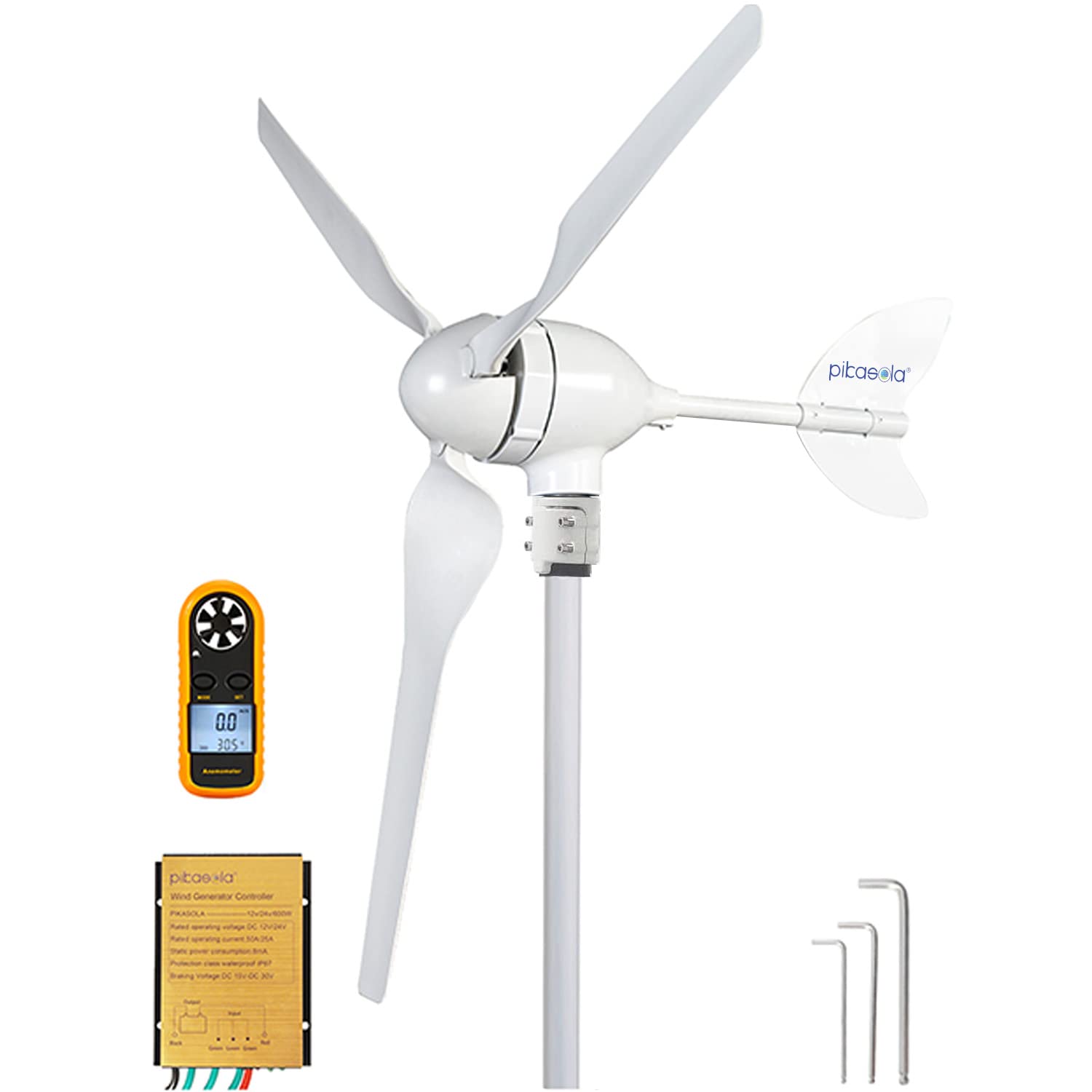
At well under $150, the Pikasola 400W is the entry-level turbine we’d point any budget-conscious off-gridder toward. It won’t power your whole cabin, but as a supplemental micro wind generator for homestead battery charging — especially paired with solar — it pulls its weight. Verified buyers consistently report it spinning up in winds as low as 6–7 mph.
Best for: Beginners wanting an affordable first turbine to supplement a solar-battery system.
Pros:
– Low startup wind speed (rated 5.6 mph) means it produces in light breezes where others sit idle
– Extremely lightweight (~6 lbs) — easy solo install on a standard pipe mount
– Five-blade design runs quieter than three-blade competitors at this price
Cons:
– Realistic output is 50–150W in moderate winds — the 400W rating is peak, not sustained
– Included charge controller is basic; serious setups will want an aftermarket MPPT unit
Happybuy 400W Vertical Axis Wind Turbine

If you’re looking at a vertical wind turbine off-grid setup — especially in areas with swirling, gusty, or ground-level turbulence — the Happybuy 400W VAWT is the budget pick that makes the most sense. Vertical axis turbines accept wind from any direction without a yaw mechanism, which means no dead spots when wind shifts. The tradeoff is lower peak efficiency compared to horizontal axis designs, but in turbulent sites that’s often a net gain.
Best for: Properties surrounded by trees, buildings, or terrain that creates unpredictable wind directions.
Pros:
– Omnidirectional — no need to orient toward prevailing wind; captures shifting gusts automatically
– Near-silent operation; multiple buyers report it’s unnoticeable from 30+ feet away
– Compact footprint works on rooftops and shorter mounts where horizontal turbines can’t safely spin
Cons:
– Lower energy conversion efficiency than horizontal axis turbines of the same rated wattage
– Heavier than comparable HAWTs, and the cylindrical profile adds wind load to the mount structure
Eco-Worthy 400W Wind Turbine + Solar Panel Kit

For someone who wants wind and solar in one purchase without sourcing components separately, the Eco-Worthy hybrid kit bundles a 400W turbine with a 100W solar panel and a hybrid charge controller. It’s not the most powerful option in any single category, but the all-in-one approach dramatically simplifies the residential wind turbine cost off-grid calculation — one box, one price, one compatible system.
Best for: Off-grid beginners who want a complete wind-solar hybrid without researching component compatibility.
Pros:
– True hybrid charge controller manages both wind and solar input to a single battery bank
– Everything ships together and is designed to work as a system — no guessing on voltage matching
– Solar panel compensates during calm days, giving more consistent 24-hour charging
Cons:
– Individual components are mid-tier; dedicated buyers can build a better system piece by piece for similar money
– The 100W solar panel is a starter size — most users will want to expand solar capacity quickly
Primus Wind Power Air 40
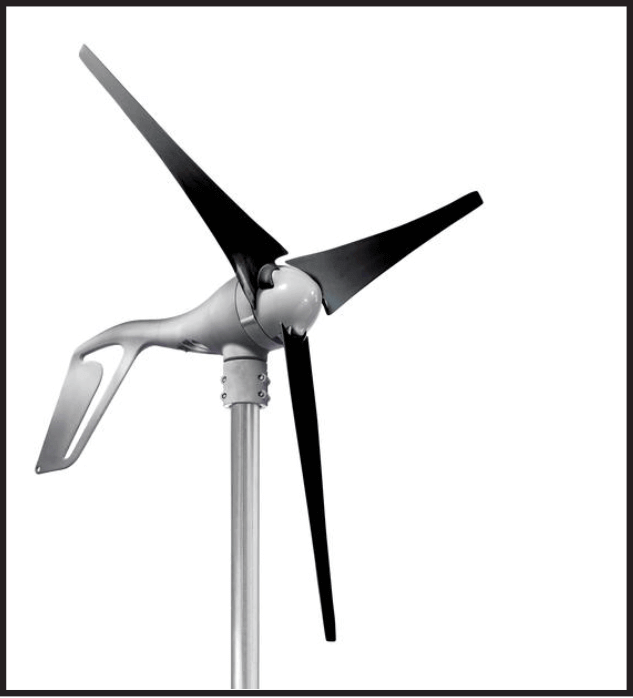
The Air 40 (successor to the Southwest Windpower Air-X) is the elder statesman of small-scale off-grid wind. It costs more than the other picks here — typically $600–$800 — but it’s the turbine with the longest real-world track record in off-grid installations. Marine and remote-cabin users have run these units for years in punishing conditions, and the failure rate data reflects that durability.
Best for: High-wind sites (coastal, plains, mountain ridges) where reliability in sustained 30+ mph winds matters more than upfront cost.
Pros:
– Proven track record spanning decades of off-grid and marine installations worldwide
– Microprocessor-controlled internal regulator manages output and braking without external controllers
– Rated for continuous operation in winds up to 110 mph with its built-in stall protection
Cons:
– Priced at 3–5x the cheapest options on this list — it’s “budget” only relative to $3K+ turbines
– Rated at 160W continuous (40 kWh/month at 12 mph average) — modest output for the price
Auecoor 800W Wind Turbine Generator
The Auecoor 800W sits in the middle ground between the ultra-cheap 400W units and the premium Automaxx/Primus tier. Its six-blade design prioritizes low-speed startup over peak output, which makes it a solid pick for areas with moderate but consistent wind. Buyers report real-world output in the 200–400W range at 18–25 mph — reasonable for the price point.
Best for: Mid-budget buyers in moderate wind areas who want more output than a 400W unit without jumping to $600+.
Pros:
– Six-blade rotor catches lighter winds better than three-blade designs at this wattage class
– Ships with a basic charge controller and mounting hardware — less to source separately
– 12V and 24V options available to match common off-grid battery configurations
Cons:
– Build quality on the charge controller is a common complaint; plan to upgrade it for serious use
– Blade diameter is wide enough to require a dedicated pole mount with adequate clearance
How We Chose
We started with every small wind turbine under $800 available through major US retailers, then filtered hard. First cut: any unit without at least 100 verified buyer reviews and a track record of 12+ months on market. We don’t trust first-generation products with no field data. Second, we cross-referenced manufacturer-rated output against real-world reports from verified buyers and off-grid community forums — because a “1500W” turbine that actually delivers 300W in typical conditions needs to be evaluated on that 300W number, not the marketing spec. Finally, we weighted for total system cost: a $100 turbine that needs a $150 aftermarket charge controller isn’t really a $100 turbine. Every pick above reflects what you’ll actually spend and actually generate.
Buying Guide: What Actually Matters in a Budget Wind Turbine

Rated Watts vs. Real Watts
This is the single biggest source of buyer frustration. Manufacturers rate turbines at peak output — the absolute maximum in ideal, sustained high wind. Real-world output is typically 20–40% of rated wattage in average conditions. A 400W turbine realistically gives you 80–160W most of the time. When calculating residential wind turbine cost off-grid, use the realistic number, not the box number, to size your system correctly. If your energy audit says you need 500W of wind generation, buy a turbine rated at 1200–1500W.
Startup Wind Speed vs. Average Wind Speed

A turbine’s startup speed (typically 5–8 mph for small units) tells you when the blades begin to spin. But spinning doesn’t mean generating useful power. Most small turbines don’t produce meaningful charge current until 10–12 mph. Check your local average wind speed data — the US Department of Energy’s Wind Resource Assessment maps are free — and match it against the turbine’s power curve, not just its startup spec.
Horizontal Axis vs. Vertical Axis
Horizontal axis wind turbines (HAWT) are more efficient in steady, laminar wind. If you have a clear site with consistent prevailing wind direction and can mount at 30+ feet, HAWT is the better choice. A vertical wind turbine off-grid setup makes more sense in turbulent, variable-direction wind — near tree lines, in valleys, or on rooftops. VAWTs are also quieter and have lower visual profile, which matters if neighbors or zoning are a concern.
Total System Cost (Not Just the Turbine)
The turbine itself is only part of the equation. Budget for:
– Mounting pole and guy wires — $50–$300 depending on height
– Charge controller upgrade — $50–$150 if the included one is inadequate
– Wiring and disconnects — $30–$80 for proper gauge cable runs
– Battery bank — if you don’t already have one, this often costs more than the turbine itself
A realistic budget for a complete small-scale wind system starts around $400–$500 for a basic 400W setup and $1,000–$1,500 for a capable 1500W installation. Factor all of this when evaluating what a micro wind generator for homestead use will actually cost you end-to-end.
FAQ
How much does a small off-grid wind turbine actually cost?
Budget small-scale turbines range from $100–$800 for the unit itself. A complete installed system including mounting, wiring, charge controller, and batteries typically runs $400–$2,000 depending on capacity. The residential wind turbine cost off-grid drops significantly if you already have a battery bank and charge infrastructure from an existing solar setup.
Can a small wind turbine power an entire off-grid cabin?
A single budget turbine under $800 will not power a full cabin alone. A 400W-rated unit produces roughly 1–3 kWh per day in decent wind, while a modest off-grid cabin uses 3–8 kWh daily. Wind works best as part of a hybrid system with solar — wind picks up at night and in winter storms when solar output drops.
Are vertical wind turbines better than horizontal for off-grid use?
Not universally. Vertical axis turbines handle turbulent, multi-directional wind better and run quieter, making them ideal for sheltered or residential sites. But horizontal axis turbines convert more energy in steady wind conditions. Your site characteristics — not a general rule — should determine which type you choose.
How much wind do I need for a small turbine to be worth it?
You need an average annual wind speed of at least 9–10 mph at your mounting height for a small turbine to produce meaningful energy. Below that, solar panels offer far better return on investment. You can check your area’s wind resource at the US DOE’s WINDExchange website using their wind maps — measure or estimate at your actual planned turbine height, not ground level.
How long do budget off-grid wind turbines last?
Most budget turbines in the $100–$400 range have a realistic lifespan of 3–5 years before bearings, blades, or controllers need replacement. Higher-quality units like the Primus Air 40 can last 10–15 years with periodic maintenance. Plan on inspecting blade condition, bearing smoothness, and electrical connections at least twice per year.
Our Final Verdict
For most off-gridders looking for the best budget small-scale wind turbine, the Automaxx Windmill 1500W is our top recommendation — its included MPPT controller and automatic braking system deliver genuine value that cheaper turbines force you to add piecemeal. If you’re just getting started and want to test wind viability on your property without a big commitment, the Pikasola 400W at under $150 is the lowest-risk way to find out if wind generation works at your site before scaling up.