5 Best Solar Charge Controllers 400W 2026
Sizing a charge controller for a 400W solar array shouldn’t be complicated, but the market makes it that way. Between inflated amp ratings, misleading efficiency claims, and controllers that overheat the moment you push them past 80% capacity, picking the wrong unit can quietly rob you of 20–30% of your solar harvest. We dug into spec sheets, teardown reports, and thousands of verified buyer reviews to find the controllers that actually deliver for a 400-watt system.
Our top pick: Victron SmartSolar MPPT 100/30 — best overall for reliability and Bluetooth monitoring.
Best value: Renogy Rover 40A MPPT — solid performance at half the price.
Best for expansion: Victron SmartSolar MPPT 100/50 — handles a 400W system now and grows to 600W+ later.
Best budget: EPever Tracer 3210AN — proven workhorse under $100.
Our Picks
Victron SmartSolar MPPT 100/30
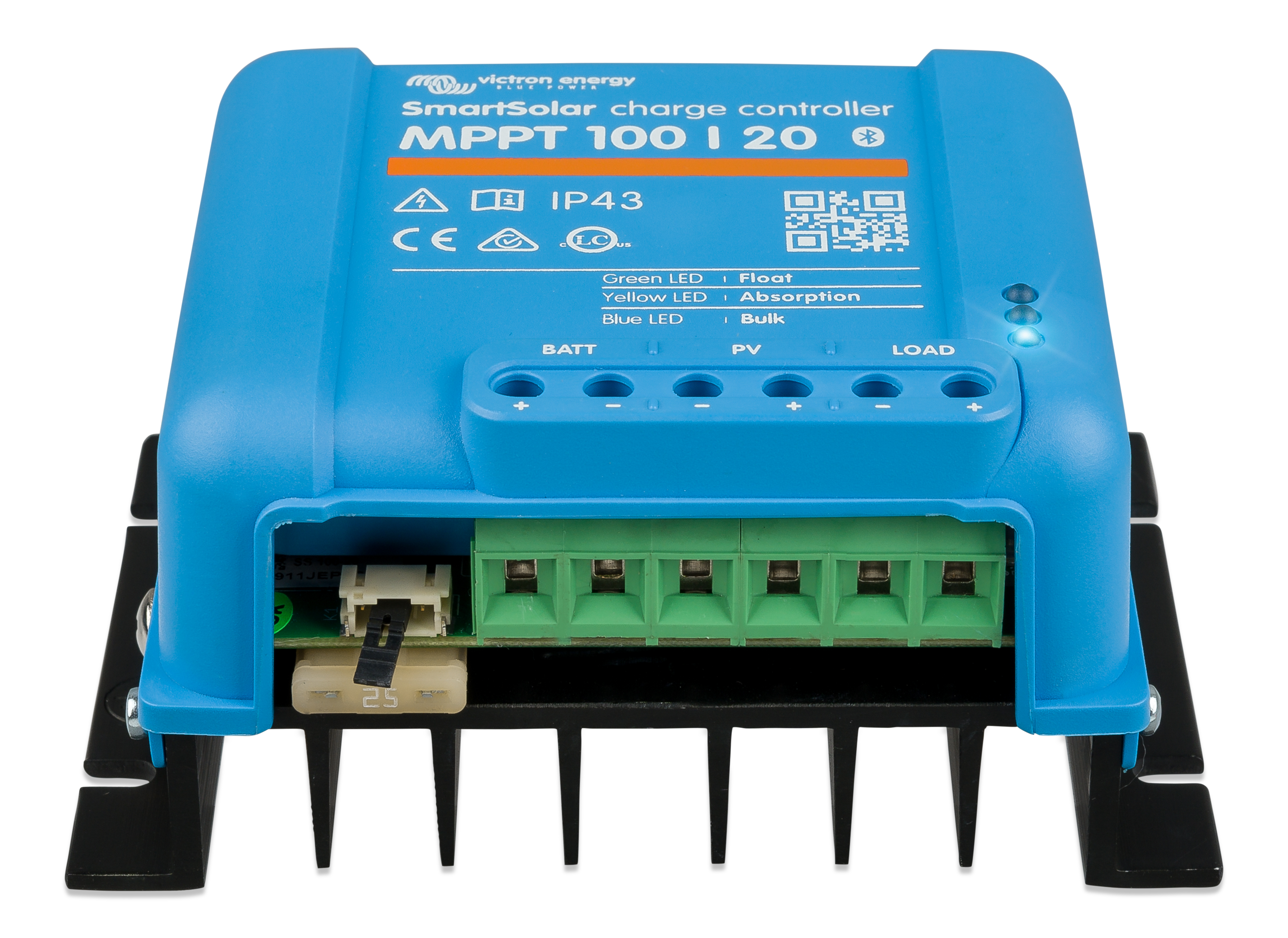
The Victron SmartSolar MPPT 100/30 is the controller we recommend to most people building a 400W off-grid solar setup. It consistently tracks maximum power point faster than competitors in partial-shade conditions, and the built-in Bluetooth with the VictronConnect app gives you real-time data without buying extra accessories.
Who it’s for: Anyone who wants a set-and-forget controller with professional-grade reliability on a 12V or 24V battery bank.
Pros:
– Ultra-fast MPPT tracking algorithm handles passing clouds and partial shade better than most units in this price range
– Built-in Bluetooth and free VictronConnect app — no extra dongle or gateway needed for monitoring
– Compatible with lithium (LiFePO4), AGM, gel, and flooded batteries with fully programmable charge profiles
Cons:
– At $130–$160, it costs nearly double the budget options on this list
– The 30A rating means you’re at roughly 85–90% capacity on a 12V system with 400W — leaves minimal headroom for future panel additions
Renogy Rover 40A MPPT Charge Controller
Off-Grid Insider
Get off-grid guides & gear picks in your inbox — free

The Renogy Rover 40A MPPT hits the sweet spot between price and capability for a 400W system. It delivers genuine MPPT conversion efficiency (rated at 99% peak, realistically 92–96% in field conditions according to community testing), and the 40A rating gives you comfortable headroom on a 12V bank.
Who it’s for: Budget-conscious builders who want real MPPT performance and room to add another panel or two down the road.
Pros:
– 40A capacity means a 400W array on 12V only uses about 75% of the controller’s rating — plenty of thermal margin
– RS-232 and optional Bluetooth module (BT-1 or BT-2) for monitoring via the Renogy DC Home app
– Solid build quality with an aluminum housing that doubles as a passive heatsink
Cons:
– Bluetooth module sold separately — adds $20–$30 to the total cost
– The LCD screen is functional but basic; the app provides a much better interface
Victron SmartSolar MPPT 100/50
If you’re planning to expand beyond 400 watts — and most off-gridders eventually do — the 100/50 is the best solar charge controller for future-proofing. It handles up to 700W on a 12V system, so your 400W array is only using about 60% of its capacity. Same excellent Victron firmware and Bluetooth monitoring as the 100/30.
Who it’s for: Builders who know they’ll add panels within the next year or two and don’t want to buy a second controller.
Pros:
– 50A rating provides massive headroom — comfortably handles expansion up to 700W at 12V or 1400W at 24V
– Same fast-tracking MPPT algorithm and Bluetooth connectivity as the 100/30
– Works seamlessly in Victron ecosystems with Cerbo GX, BMV battery monitors, and VRM remote monitoring
Cons:
– Price tag of $200–$250 is hard to justify if you’re certain you’ll stay at 400W
– Physically larger unit — requires more mounting space in tight electrical enclosures
EPever Tracer 3210AN
The EPever Tracer 3210AN is the budget pick that keeps showing up in off-grid forums for a reason — it works. At under $100, it provides genuine MPPT conversion for a 400W system on a 12V or 24V bank. The 30A rating is adequate for 400W at 12V, though you’re running close to capacity.
Who it’s for: First-time builders on a tight budget who need real MPPT performance without the premium price.
Pros:
– Priced between $70–$95 — the lowest-cost genuine MPPT controller we’d recommend for a 400W array
– Well-documented and widely supported; large community with troubleshooting resources and custom firmware guides
– Compatible with the MT50 remote meter and eBox Bluetooth/Wi-Fi adapters for monitoring
Cons:
– 30A rating means thermal derating in hot enclosures could limit output — mount in a ventilated location
– Build quality and QC are a step below Victron and Renogy; some users report inconsistent terminal tightness out of the box
Rich Solar 60A MPPT Charge Controller

Rich Solar’s 60A MPPT is overkill for a 400W system on paper, but that’s exactly what makes it appealing for builders with big expansion plans. The oversized rating means it barely breaks a sweat at 400W, which translates to cooler operation and longer component life.
Who it’s for: Off-gridders building toward a 1000W+ array who want to buy their “forever” controller now.
Pros:
– 60A capacity means a 400W system only uses about 50% of its rating — runs cool and well within safe margins
– Built-in Bluetooth with a functional companion app for real-time monitoring
– Handles up to 800W at 12V or 1600W at 24V — significant expansion capacity
Cons:
– At $180–$220, you’re paying for capacity you may never use if you stay at 400W
– Relatively newer brand compared to Victron or Renogy; less long-term field data available
ALLPOWERS 30A MPPT Solar Charge Controller
The ALLPOWERS 30A MPPT occupies the space between ultra-budget PWM controllers and the mid-range options. It provides MPPT conversion at a price point that makes it accessible for cabin builds, RV setups, and starter homestead systems where every dollar counts.
Who it’s for: RV and small cabin builders who want MPPT efficiency but can’t stretch to Renogy or Victron pricing.
Pros:
– Competitive pricing under $80 makes it one of the most affordable MPPT options for a 400W setup
– Clear LCD display shows array voltage, battery voltage, and charge current at a glance
– Multiple battery type presets including a LiFePO4 mode
Cons:
– Limited third-party review data compared to EPever and Renogy — fewer community resources for troubleshooting
– No Bluetooth or app connectivity; monitoring is LCD-only unless you add external metering
How We Chose
We started with every MPPT charge controller rated between 30A and 60A that’s currently available and commonly recommended in off-grid communities. We cross-referenced manufacturer specifications with verified buyer reviews on Amazon, detailed user reports from off-grid forums like DIYSolarForum and the r/SolarDIY subreddit, and teardown analyses where available. Controllers were evaluated on MPPT tracking speed, thermal performance under sustained load, build quality, monitoring capabilities, and real-world efficiency reports from owners running 300–500W arrays. We excluded PWM controllers entirely — at 400W, the efficiency loss (typically 15–25% compared to MPPT) costs you more in lost energy than the price difference between controller types.
Buying Guide: What to Look for in a Solar Charge Controller for a 400W System
Amp Rating and Headroom
A 400W array on a 12V battery bank produces roughly 33A at peak output (400W ÷ 12V = 33.3A). That means a 30A controller is technically undersized — the controller will limit output to 30A and you’ll lose some harvest during peak sun hours. We recommend at least a 40A controller for a 12V system, or a 30A controller if you’re running a 24V bank (where current drops to about 16.7A). Running a controller near its maximum rating also generates more heat, which accelerates component wear.
MPPT vs. PWM
For a 400W system, MPPT is non-negotiable. PWM controllers connect panels directly to the battery, wasting any voltage above the battery’s charge voltage as heat. MPPT controllers convert that excess voltage into additional current, typically harvesting 15–30% more energy from the same panels. On a 400W array, that’s the difference between getting 320–340 usable watts versus 250–280. The best solar charge controller for a 400W system will always be MPPT.
Monitoring and Connectivity
Bluetooth and app-based monitoring have become standard on mid-range controllers, and we strongly recommend them. Being able to check your array’s real-time output, daily harvest totals, and battery state of charge from your phone means you’ll catch problems — a dirty panel, a loose connection, a failing battery — before they cost you meaningful energy. Controllers without any connectivity require you to physically read the LCD, which in practice means most people stop checking.
Battery Compatibility

If you’re running LiFePO4 batteries (and for most new builds, you should be), confirm the controller has a dedicated lithium charge profile with the correct absorption and float voltages. Generic “lithium” settings on cheap controllers sometimes use voltages optimized for lithium-ion rather than LiFePO4, which can undercharge your bank. Victron and Renogy both allow fully custom charge voltage settings, which gives you precise control regardless of battery chemistry.
FAQ
What size charge controller do I need for 400 watts of solar panels?
For a 12V battery bank, you need at least a 30A MPPT controller, but we recommend 40A for proper headroom. For a 24V bank, a 20A or 30A MPPT controller is sufficient since the current is halved. Always calculate by dividing your total wattage by your battery bank voltage, then add 20–25% safety margin.
Is an MPPT charge controller worth it for a 400W solar system?
Absolutely. MPPT controllers harvest 15–30% more energy than PWM controllers from the same panels. On a 400W system, that translates to roughly 60–120 extra watts of usable power during peak conditions. The price difference between a budget MPPT and a PWM controller is typically $30–$50 — you’ll recoup that in better energy harvest within weeks.
Can I use a 30-amp charge controller with 400 watts of solar panels?
You can, but you’ll be current-limiting during peak production on a 12V system. A 400W array produces up to 33A at 12V, so a 30A controller will cap output at 360W. You won’t damage anything — the controller simply limits current — but you’re leaving roughly 10% of your array’s capacity on the table. On a 24V system, a 30A controller handles 400W with plenty of room.
What is the difference between a 30A and 40A solar charge controller?
The amp rating determines the maximum current the controller can deliver to your batteries. A 30A controller maxes out at 360W on a 12V system (30A × 12V) and 720W on 24V. A 40A controller handles 480W at 12V and 960W at 24V. For a 400W array on 12V, the 40A unit gives you full harvest plus headroom for adding another panel later. The price difference is usually $20–$40.
Do I need a Bluetooth solar charge controller for off-grid living?
You don’t strictly need it, but we recommend it for any permanent installation. Bluetooth-enabled controllers let you monitor your system’s performance, diagnose issues, and adjust settings from your phone without opening your electrical enclosure. This is especially valuable in off-grid setups where your controller might be mounted in an outbuilding, basement, or weatherproof box that’s inconvenient to access daily.
Our Verdict
For most people building a 400-watt off-grid solar system, the Victron SmartSolar MPPT 100/30 is the controller to buy. The tracking algorithm, build quality, and Bluetooth monitoring justify the price premium — and Victron’s firmware updates and ecosystem compatibility mean it’ll serve you well for years. If budget is the primary constraint, the Renogy Rover 40A MPPT delivers 90% of the performance at roughly 60% of the cost, with a 40A rating that gives your 400W array proper breathing room. Either way, skip PWM entirely at this system size — the energy you’d lose isn’t worth the $40 you’d save.