Portable vs Stationary Solar: Which Wins in 2026?
I’ll write the article directly. Here it is:
If you’re planning an off-grid power system, the first fork in the road is simple but consequential: do you bolt panels to your roof and forget about them, or do you buy a foldable solar panel for travel off-grid and keep your options open? The answer depends on how much power you actually need, whether your site is permanent, and how much you’re willing to spend upfront. We’ve dug into the specs, real-world pricing, and community feedback to give you a straight answer.
TL;DR: Which One Should You Pick?
Choose a portable/foldable panel if…
You’re in an RV, van, boat, or temporary campsite. You need flexibility to chase the sun. Your daily load is under 1–2 kWh. You want something you can take with you when you move.
Choose a stationary (fixed) array if…
You have a permanent cabin or homestead. You need consistent daily output above 2 kWh. You want a set-it-and-forget-it system that handles snow loads, wind, and years of weather. You’re ready to invest in a long-term energy solution.
Side-by-Side Comparison
| Category | Portable/Foldable Panel | Stationary Roof/Ground Array |
|---|---|---|
| Typical Wattage | 100–400W per unit | 2,000–10,000W+ total system |
| Weight | 5–25 lbs per panel | 40–50 lbs per panel (plus racking) |
| Installation | None — unfold, connect, done | Professional or skilled DIY; 1–3 days |
| Upfront Cost | $150–$600 per panel | $5,000–$15,000+ (panels, racking, labor) |
| Cost per Watt | $1.50–$3.00/W | $0.70–$1.50/W (panels only); $2.50–$5.00/W installed |
| Durability | 3–7 year typical lifespan; vulnerable to handling damage | 25–30 year lifespan; rated for wind/snow/hail |
| Daily Output (realistic) | 400–1,600 Wh (depends on size, sun hours) | 8–40+ kWh (full system in good conditions) |
| Best For | Nomadic off-grid, bug-out kits, supplemental power | Full-time off-grid homesteads, cabins, workshops |
Deep Dive: Portable & Foldable Solar Panels
Off-Grid Insider
Get off-grid guides & gear picks in your inbox — free
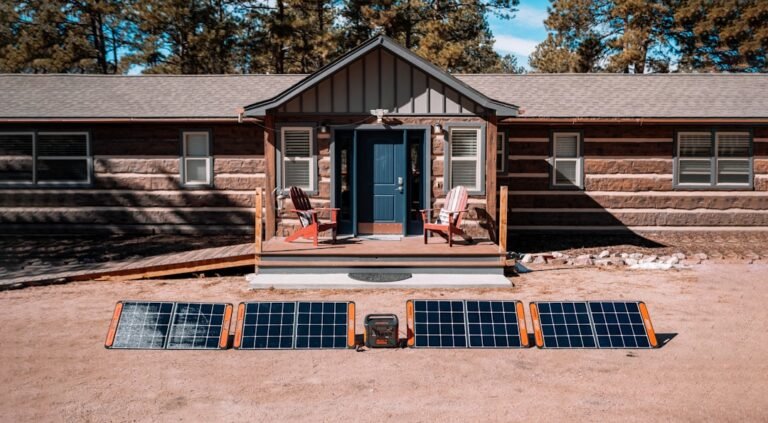
Portable panels — especially foldable briefcase-style units — have gotten dramatically better in the last few years. Brands like Bluetti, EcoFlow, Jackery, and BougeRV now ship 200W foldable panels that weigh under 20 lbs and fold into a form factor you can toss in a truck bed. Monocrystalline PERC cells have pushed efficiency into the 22–24% range, which means more watts per square foot than even budget rigid panels from five years ago.
Strengths:
– Zero installation. Unfold, kick out the stand, plug into your portable power station or charge controller. Done in two minutes.
– Sun-tracking by hand. You can physically reposition a portable panel throughout the day to follow the sun — a real advantage when you’re parked in a partially shaded campsite or when the best solar angle for winter power means tilting your panel steep (more on that below).
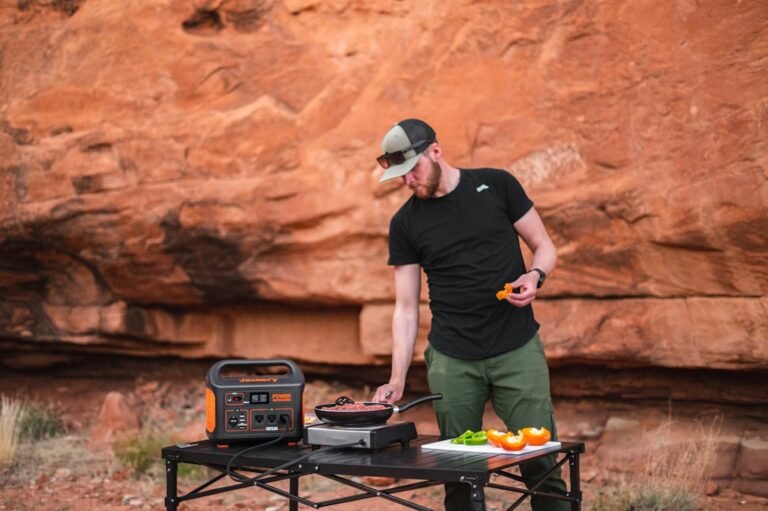
– Portability is the whole point. A foldable solar panel for travel off-grid means your power system goes wherever you go — truck camping, sailboat, emergency kit, seasonal property.
– Low financial risk. Spending $200–$500 to try solar is a lot less scary than a $10,000 roof array.
Weaknesses:
– You’re the tracking system. If you don’t move the panel, output drops. Nobody’s adjusting panels at 6 AM.
– Durability is a real concern. Hinges, folding joints, and exposed wiring take abuse. Community forums are full of reports of broken MC4 connectors after a season of heavy use. Most portable panels carry 1–2 year warranties vs. 25 years for rigid panels.
– Cost per watt is higher. You’re paying a premium for portability. A 200W foldable panel runs $300–$500. A 200W rigid panel costs $100–$150.
– Scaling is impractical. Running a full household on portable panels means buying 10+ units and babysitting them daily. That’s not a power system — it’s a part-time job.
Who it’s really for: Van lifers, RV travelers, seasonal campers, boat owners, and anyone building a bug-out or emergency power kit. Also a solid choice if you’re renting land or testing a site before committing to a permanent build.
Popular options worth researching:
– BougeRV Yuma 200W CIGS Flexible Panel
– Bluetti PV200 Foldable Solar Panel
– EcoFlow 220W Bifacial Portable Solar Panel
Deep Dive: Stationary (Fixed) Solar Arrays
A fixed solar array — roof-mounted or ground-mounted — is the backbone of any serious off-grid homestead. We’re talking rigid monocrystalline panels (typically 400–550W each) bolted to aluminum racking, wired through a charge controller to a battery bank, and fed through an inverter to your breaker panel. It’s a real electrical system, and it performs like one.
Strengths:
– Massive, consistent output. A modest 4kW array in a location with 5 peak sun hours produces ~20 kWh/day — enough to run a full-size fridge, well pump, lighting, laptops, and power tools. Scale up to 8–10kW and you can run a comfortable modern household.
– Set and forget. Once installed and angled correctly, a fixed array produces power every day without intervention. No repositioning, no unfolding, no babysitting.
– Built to last. Tier-1 panels from manufacturers like LONGi, Canadian Solar, and Q CELLS carry 25–30 year performance warranties. IEC-certified panels are tested against hail, wind (up to 140 mph), and heavy snow loads.
– Lower cost per watt at scale. Buying panels in bulk for a ground-mount array, you’ll pay $0.70–$1.20 per watt for the panels alone. Even with racking and labor, the installed cost per watt drops well below portable panels.
Weaknesses:
– Fixed solar array installation cost is significant. A professionally installed 5kW off-grid system (panels, racking, charge controllers, wiring) typically runs $8,000–$15,000 before batteries. DIY can cut that by 40–60%, but you need real electrical knowledge.
– You can’t take it with you. If you move, the array stays. That’s a major consideration if you’re on leased land.
– Shading and orientation are permanent problems. A tree that grows into your solar window doesn’t care about your ROI calculations. Fixed panels can’t dodge shade the way a portable unit can.
– Permitting and codes. Even off-grid properties in some counties require electrical permits for fixed solar installations.
Who it’s really for: Anyone with a permanent off-grid property — cabin, homestead, tiny house on owned land. If you’re running a well pump, refrigeration, or any 240V loads, portable panels won’t cut it. You need a fixed array.
Popular options worth researching:
– LONGi Hi-MO 6 555W Solar Panel
– Canadian Solar 545W BiHiKu7 Panel
– Rich Solar 400W Monocrystalline Panel
Head-to-Head Breakdown
1. Daily Power Output → Winner: Stationary Array
No contest. A 4-panel portable setup might produce 800–1,200 Wh on a good day. A modest fixed array produces 15–25 kWh. If your daily consumption exceeds about 1.5 kWh, the math starts favoring a permanent installation fast.
2. Total Cost of Ownership (5-Year) → Winner: Stationary Array
This surprises people. Yes, fixed solar array installation cost is higher upfront. But run the numbers over five years: a 200W portable panel at $400 lasts maybe 5 years and produces ~365 kWh/year. That’s $0.22/kWh. A fixed 400W panel at $200 (plus ~$150 in racking) lasts 25+ years and produces ~730 kWh/year. That’s $0.02/kWh over its lifetime. The gap is enormous.
3. Flexibility & Mobility → Winner: Portable Panel

If you move — seasonally or permanently — portables win outright. A foldable solar panel for travel off-grid fits in a truck, straps to a kayak, or stores in a closet between trips. You can also angle them manually throughout the day to maximize output, which matters when you’re trying to hit the best solar panel angle for winter power (typically latitude + 15° in winter months).
4. Winter Performance → Winner: Stationary Array (with proper tilt)
Winter is where fixed arrays earn their keep — if they’re angled correctly. The best solar panel angle for winter power is steeper than your latitude: add 10–15° to your site’s latitude. At 40°N latitude, that means tilting panels to 50–55° in winter. This captures low-angle winter sun more effectively and helps snow slide off. Adjustable ground mounts make seasonal tilt changes easy. Portable panels can technically be angled the same way, but you’re relying on kickstands and improvised propping — not a reliable long-term solution when it’s 15°F and windy.
Final Verdict
For permanent off-grid living, buy a stationary array. It’s not close. The economics, reliability, and output capacity of a fixed system make it the only serious choice for powering a household. If you’re building or buying an off-grid cabin, budget for a properly sized ground-mount or roof-mount array from the start. A system built around Rich Solar 400W panels or LONGi 550W panels paired with a quality MPPT charge controller will serve you for decades.
For mobile, seasonal, or supplemental use, buy a portable panel. If you’re van-dwelling, truck camping, or just want emergency backup power, a quality foldable panel like the Bluetti PV200 or EcoFlow 220W paired with a portable power station is a excellent setup.
The hybrid approach is underrated. Many off-gridders we’ve seen in community forums run a fixed array for base load and keep a 200W foldable panel for the workshop, garden shed, or truck. That’s smart redundancy — and it means you’re never without power, even if your main system goes down for maintenance.
FAQ
Can I start with portable panels and upgrade to a fixed array later?
Absolutely — and it’s a common path. Portable panels let you learn your actual power consumption before committing to a system size. Just know that your portable panels and your fixed array will likely use different charge controllers and wiring, so you won’t directly “plug in” the old portables to the new system. They make great backup or satellite units, though.
What’s the best solar panel angle for winter power production?
Tilt your panels to your latitude plus 10–15 degrees. At 35°N, that means a 45–50° tilt in winter. At 45°N, aim for 55–60°. This steeper angle captures more energy from the low winter sun and sheds snow faster. If you have an adjustable ground mount, change the tilt seasonally: steeper in winter, flatter in summer (latitude minus 10–15°).
How much does a fixed solar array installation cost for off-grid?
For a typical 5kW off-grid system (panels, racking, charge controllers, and wiring — no batteries), expect $8,000–$15,000 professionally installed. DIY drops that to $3,500–$7,000 depending on your panel choice and racking. Batteries add another $4,000–$12,000 depending on capacity. Ground-mount systems cost slightly more than roof-mount due to additional racking and concrete footings.
Are foldable solar panels durable enough for full-time off-grid use?
For full-time stationary off-grid use, no — we wouldn’t recommend them. The hinges, fabric cases, and exposed wiring aren’t designed for continuous outdoor deployment. For full-time mobile off-grid use (van life, RV), they hold up reasonably well if you store them when not in use and handle the connectors carefully. Budget for replacement every 3–5 years with heavy daily use, compared to 25+ years for a fixed rigid panel.