Big Berkey 2026: Honest Review – Still Worth It?
Big Berkey Water Filter Review — 2026: Still Worth It, But With Eyes Open
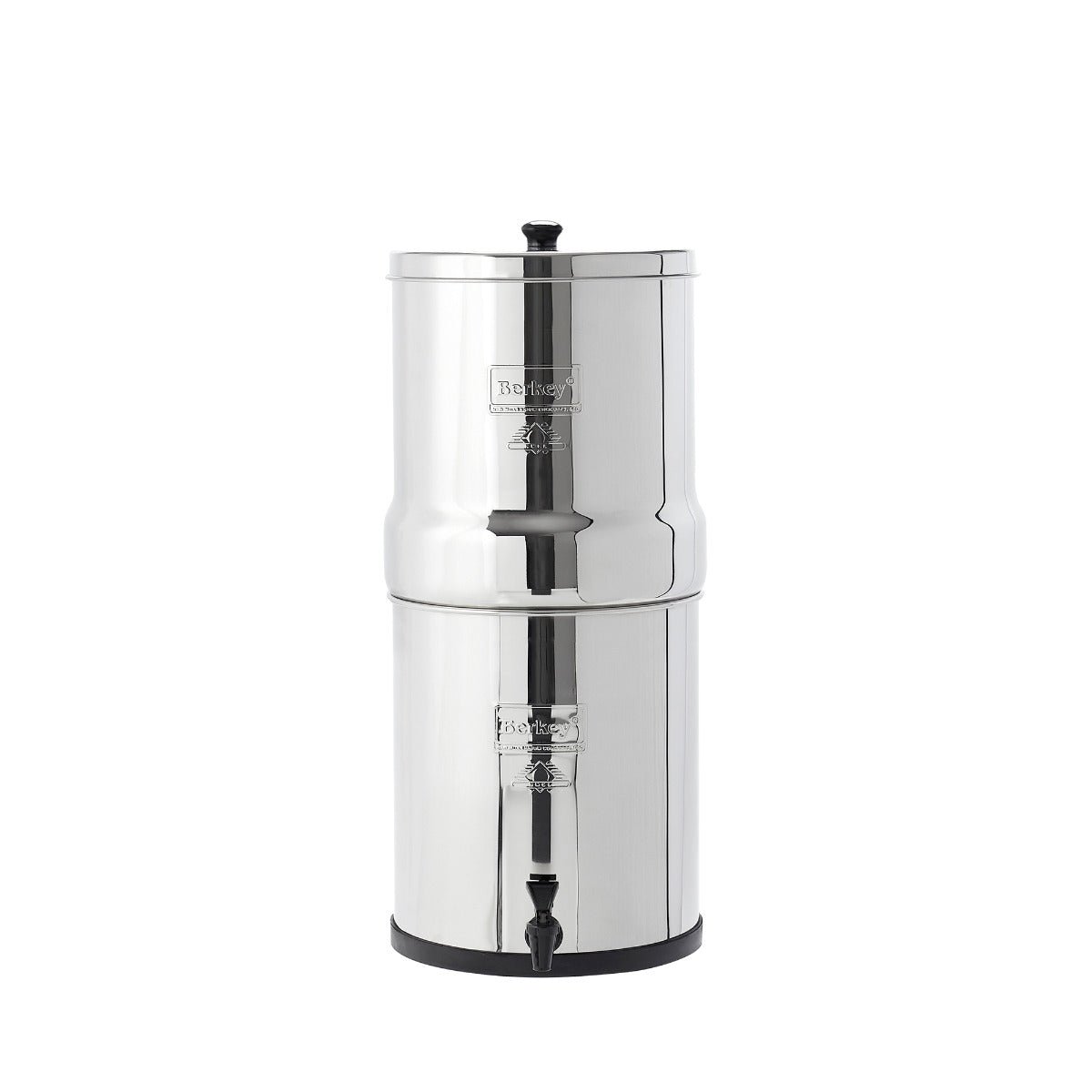
The Big Berkey has been the default recommendation in prepper, homesteading, and off-grid communities for over a decade — and for good reason. It works, it lasts, and it makes bad water taste dramatically better without any power or plumbing. But 2026 is a complicated year to buy one. An ongoing EPA regulatory dispute has effectively removed the original Black Berkey filter elements from the US market, a class action lawsuit is still active, and the certification questions that critics have raised for years haven’t gone away. Here’s what you actually need to know before spending $367 on a steel canister.
| Best For | Homesteaders and preppers filtering municipal or well water for chemical contaminants, heavy metals, and taste |
| Avoid If | You need NSF-certified virus removal, live in California or Iowa, or want a plug-and-play setup without a learning curve |
| Street Price | ~$367 (2-filter config) |
| Warranty | Lifetime on stainless chambers; 2 years on filter elements |
As an Amazon Associate, OffGridFoundry earns from qualifying purchases.


The Big Berkey’s stainless steel housing is excellent — durable, attractive, and built to last decades. The filtration performance for chlorine, chloramines, heavy metals, and chemical contaminants is well-documented and widely confirmed by long-term owners. Where it gets complicated is the certification picture, the current availability crisis for the original filter elements, and a set of known failure modes that require active user vigilance. For buyers who go in informed, it’s still a strong off-grid tool. For buyers who expect NSF-certified, no-maintenance water purification out of the box, there are better options in 2026.
What We Like
- Passive operation, no power required. No electricity, no plumbing connections, no filters that require a pressurized line. Fill the top chamber and gravity does the rest — a genuine advantage in off-grid and emergency scenarios.
- Exceptional taste and chemical contaminant removal. Chlorine, chloramines, trihalomethanes (THMs), pharmaceuticals, and pesticides are removed to below laboratory detectable limits in Berkey’s testing. Every long-term owner report we found confirms this — the taste difference on municipal water is immediately noticeable.
- Heavy metal performance is strong. Lead, mercury, chromium-6, cadmium, and arsenic all test at >99.9% reduction. For homesteaders on older well systems or in areas with known contamination, this is meaningful.
- Outstanding long-term cost per gallon. At 6,000 gallons per pair of elements and a replacement cost around $120, you’re filtering water for roughly $0.02 per gallon — among the lowest operating costs of any countertop filter system.
- Durable construction. The AISI 304 stainless steel chambers are virtually indestructible. Berkey offers a lifetime replacement warranty on hardware components (spigots, washers) — and owners with 8–10 years of use routinely report the chambers as perfect.
- Large capacity. The 2.25-gallon lower chamber handles 1–4 people daily without constant refilling. Emergency capacity is rated for up to 85 people per day — a legitimate standout for group scenarios.
What We Don’t Like
- The original filter elements are currently unavailable in the US. This is not a minor caveat. The EPA issued Stop Sale orders against Berkey’s distributors in 2022 under FIFRA, citing the silver antimicrobial claim in the Black Berkey elements. NMCL (Berkey’s manufacturer) sued the EPA; as of April 2026, the Fifth Circuit has denied injunctions twice and the case remains unresolved. The original Black Berkey elements are no longer in production and official US inventory is exhausted. If you buy the housing today, you’ll need alternative-compatible elements like BOROUX Foundation Filters or ProOne G2.0 elements to actually use it.
- No NSF certification — and that’s a real gap, not just a technicality. Berkey has long maintained they test “to” NSF protocols in contracted labs rather than pursuing certification. But independent testing by sources including the NYT Wirecutter found inconsistencies with Berkey’s self-reported results. The methodological concern is specific: NSF Standard 53 requires testing performance after 6,000 gallons of use. Some Berkey-cited lab tests ran only 2 liters through the filter before measuring results. That’s not a minor caveat when evaluating claims about heavy metal removal at end-of-filter-life.
- Virus removal claims require scrutiny. Berkey’s own lab tests show >99% (Log 4) virus reduction using MS2 and Fr coliphage under clean water conditions — meeting the NSF P248 military standard. However, these tests were conducted under ideal conditions, not after prolonged use. For municipal tap water users, this may be acceptable risk. For anyone filtering surface water, rainwater, or sources with possible viral contamination, the independent verification gap matters. The internal research note is accurate: add chemical treatment (iodine tabs, diluted bleach) if viral pathogens are a real concern.
- Real-world flow rate is well below spec. The theoretical 3.5 gallons/hour assumes ideal input water. Real-world flow with average municipal water is 1–2 gallons/hour. With hard well water or any sediment load, that can drop below 0.5 gallons/hour. Filters need periodic scrubbing with a non-metallic pad every 6–12 months, followed by re-priming.
- Air lock and priming create a steep first-use learning curve. New filter elements are filled with air, and water surface tension can block flow entirely. Priming requires the included tool and patience — owners who skip this step often conclude the filter is broken. Assembly alignment of the wing nuts and rubber washers at element stems is also fiddly; improper tightening is the single most common source of leaks.
- Silent failure mode from element cracking. A Black Berkey element that cracks at the stem base allows unfiltered water to bypass the element with no visible indication. Berkey’s red food-dye test catches this, but it must be performed regularly and proactively. Owners who don’t test have reported unknowingly consuming unfiltered water for extended periods.
Specs That Matter
Off-Grid Insider
Get off-grid guides & gear picks in your inbox — free
| Spec | Value |
|---|---|
| System capacity (lower chamber) | 2.25 gallons (8.5 L) |
| Height (in use / stored) | 19.25 in / 13 in |
| Diameter | 8.5 in |
| Weight (empty) | 7 lbs |
| Flow rate (2 elements, real-world) | ~1–2 gal/hr |
| Flow rate (2 elements, theoretical) | 3.5 gal/hr |
| Filter lifespan per pair | 6,000 gallons |
| Cost per gallon (filter amortized) | ~$0.02 |
| Chamber material | AISI 304 stainless steel |
| Fluoride removal | Requires PF-2 add-on filters (~$50/pair) |
| NSF certification | None |
| Bacteria/protozoa removal | >99.9999% (Log 6) |
| Virus removal (lab conditions) | >99% (NSF P248 protocol) |
| Heavy metal removal (lead, mercury, arsenic) | >99.9% |
| Not sold in | California, Iowa |
Real-World Performance
Long-term owner reports across multiple forums — including Permies, Homesteading Today, and survivalist boards — are generally positive but follow a consistent pattern. Owners who invested time in proper first-setup (priming, dye testing, correct washer alignment) report years of trouble-free use. One Permies.com member with a decade of continuous use described changing their filter elements only once. The water taste improvement on chlorinated municipal water is the single most universally praised feature across every review source.
The gap between theory and practice is most apparent with flow rate. Independent owners consistently report 1 gallon/hour as a more realistic figure than the 3.5 gal/hr specification — and hard well water users note they may need to clean and re-prime filters every few weeks as sediment accumulates on the element surface. This isn’t a flaw so much as a property of gravity-fed carbon filtration: it works slowly because the contact time is what drives contaminant removal.
One underappreciated quirk worth noting: TDS (total dissolved solids) meters show no change before and after Berkey filtration. This is correct and intentional — Berkey preserves beneficial minerals like calcium and magnesium, targeting chemical contaminants and pathogens rather than dissolved mineral content. New owners frequently interpret a flat TDS reading as filter failure and seek warranty replacements they don’t need. Additionally, filtered water that appears to produce white residue when boiled or frozen is experiencing normal mineral precipitation from the slightly raised pH the filter imparts — not a performance issue.
The class action lawsuit filed in late 2022 — alleging the filters “do not perform as advertised” — is still active as of this writing and has not produced any settlements or findings. We note it for disclosure, not as a definitive indictment.
Who Should Buy This
The Big Berkey is the right tool for homesteaders and off-grid households with a primary concern about chemical contamination of municipal or treated well water — chlorine, heavy metals, pharmaceuticals, VOCs, and taste/odor compounds. If you’re filtering city water, well water with known chemical exposure, or stored water supplies for a household of 1–4 people, the Berkey’s passive gravity operation, low per-gallon cost, and durable steel build make it a compelling long-term investment.
It’s also well-suited to emergency preparedness contexts where electrical power cannot be assumed. The housing requires no power, no installation, and no maintenance schedule beyond periodic cleaning — making it one of the more resilient water treatment options for extended outages or evacuation scenarios.
Important 2026 note: Given the current unavailability of Black Berkey elements in the US, buyers purchasing the housing today should plan to use BOROUX Foundation Filters (12,000 gal/pair, ~$0.012/gal, compatible with Berkey chambers) or ProOne G2.0 elements as their filter media. Both are available through US retailers and eliminate the supply chain risk associated with the EPA dispute.
Who Should Look Elsewhere
If NSF certification is non-negotiable, the ProOne BIG+ is the closest comparable gravity filter with actual NSF 42 and 53 certifications on file. The trade-off is a shorter filter lifespan (1,000 gallons vs. 6,000) and higher ongoing operating cost.
If you’re on a tighter budget and mainly want chlorine and sediment removal, the Alexapure Pro at roughly $280 offers comparable capacity in the same gravity-fed format at a meaningfully lower upfront cost — though it also lacks NSF certification.
If you already own a Berkey housing, the BOROUX Foundation Filter is the most practical path forward — longer filter life than the original Black Berkey elements, no regulatory dispute, and direct drop-in compatibility with existing stainless chambers.
Bottom Line
The Big Berkey earns its reputation for chemical contaminant removal, long-term durability, and low operating cost — but 2026 buyers are purchasing into a product line in regulatory limbo, with the original filter elements off the US market and certification questions that have never been fully resolved. The stainless housing remains a legitimate decade-plus investment; the filter element question requires informed sourcing. Buy it for what it demonstrably does well — taste, chlorine, heavy metals, and passive off-grid operation — use compatible third-party elements until the EPA dispute resolves, and add chemical treatment if viral pathogens are a real concern in your water source.
→ Buy the Big Berkey on Amazon