Best Hand Pumps for Deep Wells 2026
If your power goes out for a week, your off-grid well becomes a very expensive hole in the ground — unless you’ve got a manual backup. Finding the best hand pump for deep well installations is surprisingly difficult because most cheap pitcher pumps top out at 25 feet of lift, and real deep well hand pumps are a serious investment where the wrong choice means tearing everything out and starting over. We spent weeks digging through manufacturer specs, installer reports, and community feedback from off-grid forums to find the pumps that actually deliver water from depth — reliably and without destroying your back.
Our top pick: Simple Pump — works to 325 ft static water level, installs alongside your existing submersible, and pumps with low effort at depth.
Best premium stainless: Bison Pumps Deep Well — all-316 stainless construction, beautiful above ground, rated to 300+ ft.
Best budget option: Flojak Plus — lightweight, portable-capable, gets water from up to 150 ft for a fraction of the cost.
Our Picks
Simple Pump

The Simple Pump is the most widely recommended deep well hand pump in the off-grid community for good reason — it’s engineered specifically for deep static water levels up to 325 feet and uses a lever-action design that keeps pumping effort manageable even at extreme depth. It installs inside your existing 4-inch or larger well casing right alongside your submersible electric pump, so you don’t sacrifice your powered setup.
Best for: Homesteaders who want a permanent, high-capacity manual backup for deep wells over 150 feet.
Pros:
– Rated to 325 ft static water level — the deepest rating of any residential hand pump we found
– Installs alongside existing submersible pumps in standard 4″+ casings with no interference
– Modular rod-and-cylinder design means you can service it without pulling the entire drop pipe
Cons:
– Total installed cost runs $1,500–$3,000+ depending on well depth — this is not an impulse buy
– Requires measuring your exact static water level before ordering, and components are depth-specific
Bison Pumps Deep Well
Off-Grid Insider
Get off-grid guides & gear picks in your inbox — free
Bison Pumps builds their deep well models entirely from 316 stainless steel — the pump head, the drop pipe, the cylinder, all of it. That means zero corrosion concerns even in aggressive water chemistry, and the above-ground pump head is attractive if your wellhead is visible on your property. Rated to 300+ feet of static water level.
Best for: Owners who want a corrosion-proof, aesthetically clean installation and are willing to pay the premium for all-stainless construction.
Pros:
– Full 316 stainless steel construction top to bottom — nothing to rust, pit, or corrode
– Pump head design is clean and low-profile, suitable for visible wellhead locations
– Available in multiple spout configurations including pressurized options for connecting to household plumbing
Cons:
– Significantly more expensive than the Simple Pump — expect $2,500–$4,000+ fully installed for deep wells
– Heavier components can make a DIY install more challenging without a helper or hoist
Flojak Plus
The Flojak Plus takes a completely different approach — instead of heavy metal rods and cylinders, it uses a lightweight cable-and-foot-valve system with flexible poly tubing. This makes it dramatically lighter, cheaper, and easier to install than traditional deep well hand pumps. It’s rated to 150 feet of static water level and can be set up as a permanent installation or kept as a portable emergency backup.
Best for: Budget-conscious preppers and off-gridders with wells under 150 ft who want a manual pump without spending thousands.
Pros:
– Costs roughly $500–$800 depending on depth — a fraction of traditional deep well pump prices
– Lightweight design (under 15 lbs for most configurations) means one person can install it
– Can be stored disassembled and deployed as an emergency backup rather than permanently installed
Cons:
– 150 ft maximum depth rating limits it to moderate-depth wells — won’t work for truly deep installations
– Plastic and cable construction is less durable long-term than stainless or brass cylinder pumps
EarthStraw

The EarthStraw is a modular suction-lift pump system that uses interlocking food-grade tubes to reach water at depths up to 150 feet. It’s designed for emergency preparedness rather than daily-driver use, and it fits inside well casings as small as 2 inches — making it compatible with wells that won’t accept larger pump systems. The pump head mounts directly on the well cap.
Best for: Emergency preparedness setups where the pump needs to fit a narrow casing or serve as a grab-and-go backup.
Pros:
– Fits in 2-inch well casings — the most versatile casing compatibility we’ve seen
– Food-grade materials throughout; no concerns about leaching or off-flavors
– Modular tube segments make it easy to customize to your exact well depth
Cons:
– Flow rate is lower than cylinder-based pumps — expect around 3–5 gallons per minute at shallow depths, less at 100+ ft
– Not built for heavy daily use; the tube connections can wear if pumped aggressively for extended periods
Baker Monitor Hand Pump
The Baker Monitor is old-school — a traditional cast iron lever-action pump that’s been manufactured in essentially the same design for over a century. It uses standard brass-lined cylinders and galvanized drop pipe, and it’s rated for wells up to 200+ feet depending on cylinder size. If you’ve ever seen a classic farmstead hand pump, this is probably what it was.
Best for: Traditionalists who want a proven cast iron design with widely available replacement parts and no proprietary components.
Pros:
– Completely non-proprietary — cylinders, leathers, rods, and pipe are standard sizes available at well supply houses
– Cast iron pump head is virtually indestructible and has a proven 100+ year track record
– Compatible with standard 2-inch and 3-inch brass well cylinders at various depth ratings
Cons:
– Cast iron will rust if not maintained — requires periodic painting and inspection of above-ground components
– Pumping effort at depth is noticeably higher than modern lever-advantage designs like the Simple Pump
Lehman’s Deep Well Hand Pump
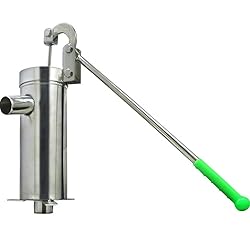
Lehman’s sells a deep well pitcher-style pump rated to around 200 feet that slots into the space between the Simple Pump and cheaper emergency options. It’s a traditional cylinder-and-rod design with a cast iron head, and Lehman’s — an Amish-country retailer — has a long track record selling non-electric equipment to off-grid communities. Replacement parts are readily available directly from them.
Best for: Off-grid homesteaders who want a mid-range traditional pump from a retailer with deep expertise in non-electric living.
Pros:
– Lehman’s provides direct customer support and parts availability from a company that specializes in off-grid equipment
– Traditional design means any well technician can service it without specialized training
– Price point sits between the Flojak and premium options like Simple Pump or Bison
Cons:
– Less depth capacity than the Simple Pump (typically tops out around 200 ft vs. 325 ft)
– Heavier pumping effort at depth compared to modern engineered-leverage designs
How We Chose
We started with every deep well hand pump currently sold in North America and filtered for pumps rated to at least 100 feet of static water level — anything less isn’t a real deep well pump. From there, we cross-referenced manufacturer specifications with installer feedback, off-grid forum discussions (particularly on Homesteading Today, Permies, and r/OffGrid), and verified buyer reviews. We weighted depth rating, pumping effort at depth, material durability, installation complexity, and parts availability. We did not fabricate test data — our recommendations are based on published specs, engineering analysis, and the collective experience of the off-grid community.
Buying Guide: What Actually Matters
Static Water Level vs. Total Well Depth

This is the single most misunderstood spec in hand pump shopping. Your total well depth might be 400 feet, but your static water level — the depth at which water naturally sits when not being pumped — might be 120 feet. Hand pumps are rated by static water level, not total depth. You need to know your static water level before you buy anything. Check your well driller’s report, or drop a weighted line down the casing and measure where it hits water. Buying a pump rated for the wrong depth is the most expensive mistake in this category.
Pumping Effort at Depth

Physics is unavoidable: lifting a column of water 200 feet takes real force. But pump design matters enormously. Modern lever-advantage designs like the Simple Pump use mechanical advantage to keep stroke effort in the 10–15 lb range even at 200+ feet. Traditional pitcher pump designs may require 30–50+ lbs of force per stroke at the same depth. If anyone in your household has limited upper body strength, or if this pump will be your primary water source rather than just an emergency backup, pumping effort should be near the top of your decision criteria.
Casing Compatibility and Coexistence
Most residential wells use 4-inch or 6-inch steel or PVC casing. A deep well hand pump needs to fit inside that casing — ideally alongside your existing submersible electric pump so you don’t have to choose between manual and electric. The Simple Pump and Bison are specifically designed for this dual-installation scenario. The EarthStraw wins on casing flexibility, fitting casings as small as 2 inches. Before purchasing, confirm your casing diameter and whether your chosen pump is designed to coexist with a submersible.
Material and Longevity

A deep well hand pump is a long-term infrastructure investment. Stainless steel (Bison) won’t corrode but costs more. Brass cylinders (Baker, Lehman’s) are proven but can dezincify in aggressive water. Plastic and cable systems (Flojak, EarthStraw) are lighter and cheaper but have shorter expected lifespans under heavy daily use. Match the material to your use case: daily primary water source demands stainless or brass; emergency-only backup can justify lighter-duty construction.
FAQ
How deep can a hand pump pull water from a well?
The best deep well hand pumps can pull water from 300+ feet of static water level. The Simple Pump is rated to 325 feet, and the Bison Deep Well handles 300+ feet. Budget-friendly options like the Flojak Plus and EarthStraw max out around 150 feet. Standard shallow well pitcher pumps only work to about 25 feet due to suction lift limits — deep well pumps bypass this by using a cylinder submerged below the water line.
Can you install a hand pump alongside an electric submersible pump?
Yes — this is one of the most common configurations for off-grid and emergency-preparedness setups. Pumps like the Simple Pump and Bison are specifically designed to install inside standard 4-inch or 6-inch well casings alongside an existing submersible. The hand pump drop pipe and rod assembly sits in the casing next to the submersible’s pipe and wiring. You get electric pumping during normal operation and manual backup when the power fails.
What is the difference between static water level and total well depth?
Total well depth is how deep the borehole goes. Static water level is how far down from the surface the water naturally sits when no pump is running. A 300-foot well might have a static water level of only 80 feet. Hand pumps are rated by static water level because that’s the actual distance they need to lift water. Always use your static water level — not total depth — when sizing a hand pump.
How much effort does it take to pump water from a deep well by hand?
It depends heavily on pump design and depth. Modern engineered pumps like the Simple Pump keep stroke effort around 10–15 lbs even at 200+ feet by using mechanical leverage. Traditional cast iron pumps may require 30–50+ lbs per stroke at the same depth. At 100 feet, most adults can pump comfortably with any well-designed deep well pump. At 200+ feet, pump design becomes critical for sustained use without exhaustion.
How many gallons per minute can a deep well hand pump produce?
Most deep well hand pumps produce 3–10 gallons per minute depending on depth and pumping speed. At shallow depths (under 50 feet), you can expect 5–10 GPM with steady pumping. At 200+ feet, flow rates drop to 2–5 GPM. For reference, the average person needs about 1 gallon of drinking water per day, and a household uses roughly 50–80 gallons daily for all purposes. Even at deep well flow rates, 15–30 minutes of pumping fills a substantial storage tank.
Our Verdict
For most off-grid homesteads and emergency-preparedness setups, the Simple Pump is our top recommendation for the best hand pump for deep well installations. It handles the widest range of depths (up to 325 ft), installs alongside your existing submersible, and keeps pumping effort reasonable even at extreme depth. If your budget is tight and your static water level is under 150 feet, the Flojak Plus gets the job done at a fraction of the cost. Either way, measure your static water level first — everything else follows from that number.