EcoFlow Delta 2 2026: Honest Review
EcoFlow Delta 2 Review — 2025: The Best All-Around 1 kWh Power Station
The EcoFlow Delta 2 has quietly become the benchmark that every 1 kWh power station gets measured against — and it’s easy to see why. With an 80-minute full charge, LFP battery chemistry rated for 3,000+ cycles, a 5-year warranty, and a street price that has dropped to roughly half its original MSRP, this unit offers a combination of speed, longevity, and value that no direct competitor has matched. Whether you’re a weekend camper, a prepper building home backup redundancy, or a van-lifer who needs reliable daily-use power, the Delta 2 earns serious consideration.
| Best For | Campers, preppers, and home backup users who need fast recharging and long battery life in a 1 kWh portable unit |
| Avoid If | You need dead-silent operation, medical-grade UPS (<20ms switchover), or a backpackable form factor |
| Street Price | ~$449–$499 (MSRP $999, consistently on sale) |
| Warranty | 5 years |
As an Amazon Associate, OffGridFoundry earns from qualifying purchases.

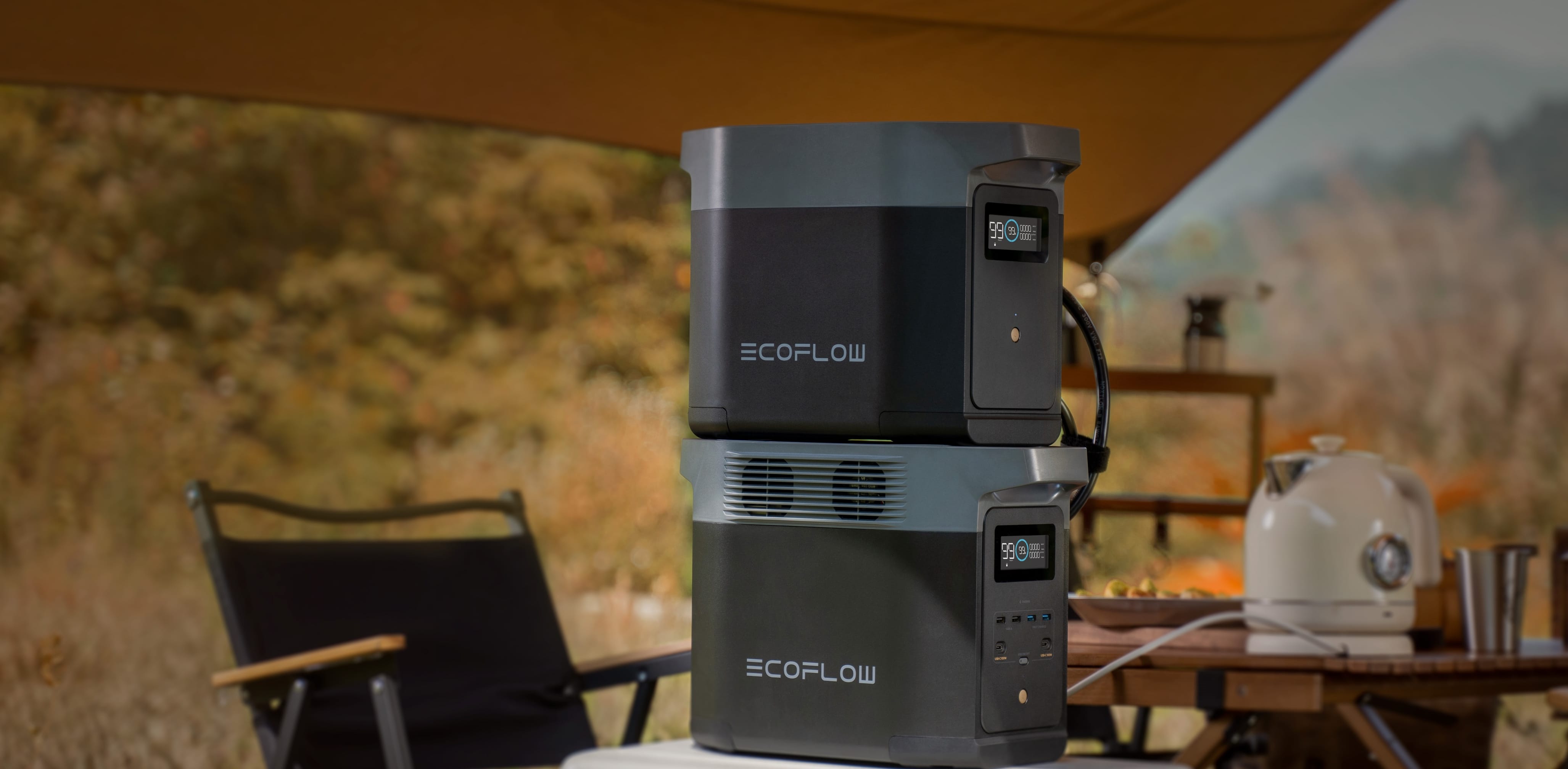
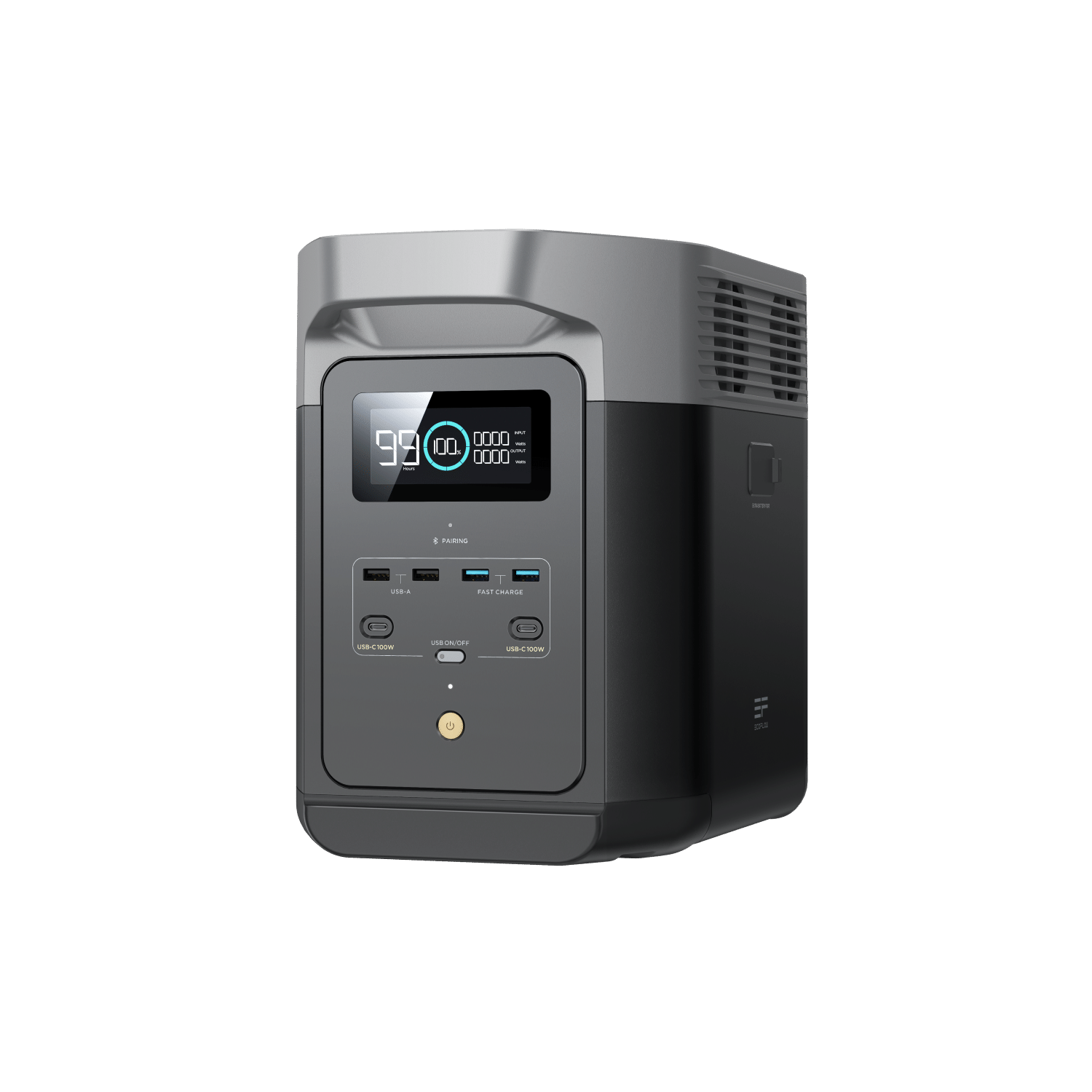
At its current street price, the Delta 2 is one of the best-value power stations on the market. The LFP battery will outlast most competitors by a factor of six in cycle count, the 80-minute full recharge from a wall outlet is faster than anything else in this class, and EcoFlow’s X-Boost feature lets the 1800W inverter safely power appliances rated up to 2200W — a genuine edge over Jackery and Goal Zero equivalents. The fan noise during fast charging is real and measurable (57 dBA at 3 feet per PCWorld’s testing), and EcoFlow’s customer service has a mixed reputation. Neither issue is a dealbreaker, but both are worth factoring in before you buy.
What We Like
-
80-minute full recharge from wall power. EcoFlow’s X-Stream fast-charging hits 1200W input and takes the Delta 2 from 0–80% in under 50 minutes and 0–100% in roughly 72–80 minutes. The next closest competitor, the Bluetti AC180, takes about an hour for full charge. The Jackery Explorer 1000 Pro takes 5–6 hours. For anyone who needs to top up quickly before a storm, a trip, or a grid outage, this gap is enormous.
-
LFP chemistry with 3,000–4,000 cycle life. The Delta 2 uses lithium iron phosphate cells rather than the NMC (lithium-ion) chemistry found in competing units like the Jackery Explorer 1000 Pro and Goal Zero Yeti 1000X. LFP chemistry is inherently more thermally stable, and EcoFlow rates the Delta 2 for 3,000+ cycles to 80% capacity (the official user manual references 4,000 cycles). At one full cycle per day, that’s roughly 8–10 years of daily use. By comparison, NMC units typically rate 500–1,000 cycles — meaning the Delta 2’s cells may last six times longer.
-
X-Boost powers appliances above the inverter rating. This is an underappreciated feature. The Delta 2’s inverter is rated for 1800W continuous output, but EcoFlow’s X-Boost technology uses smart wattage management to power appliances rated up to 2200W — things like hair dryers, toaster ovens, and certain coffee makers that would otherwise exceed the inverter limit. No comparable feature exists in Jackery or Goal Zero units at this price point.
-
Six AC outlets and 15 simultaneous output ports. The Delta 2 ships with 6 standard US AC outlets, 2 USB-C ports at 100W each, 4 USB-A ports (2 standard, 2 fast-charge at 18W), 2 DC5521 barrel ports, and a 12V car outlet. Competing units are considerably stingier: the Jackery Explorer 1000 Pro has 3 AC outlets; the Goal Zero Yeti 1000X has only 2. For basecamp setups or home backup scenarios where multiple devices need simultaneous power, the Delta 2’s port density is a real advantage.
-
5-year warranty at a sub-$500 street price. The Jackery Explorer 1000 Pro offers 3 years. The Goal Zero Yeti 1000X offers only 2 years. EcoFlow’s 5-year coverage on the Delta 2 is the best warranty in this segment by a meaningful margin, and at current pricing the value-per-dollar is exceptional.
-
EPS mode with 30ms switchover. The Delta 2 can act as an uninterruptible power supply, detecting grid outages and switching to battery in under 30 milliseconds — fast enough for most consumer electronics, laptops, routers, and medical devices like CPAP machines. None of the direct competitors (Jackery Explorer 1000 Pro, Bluetti AC180, Goal Zero Yeti 1000X) offer this feature at equivalent pricing.
-
Expandable capacity. The Delta 2 can pair with EcoFlow’s Delta 2 Smart Extra Battery (+1024Wh) or Delta 2 Max Extra Battery (+2048Wh), taking total system capacity up to 3072Wh. This makes it a credible foundation for growing off-grid builds — you’re not locked into a fixed capacity ceiling at purchase.
What We Don’t Like
-
Fan noise during fast charging is legitimately loud. PCWorld measured 57 dBA at 3 feet during 1200W fast-charge mode — described as “shrill” small-fan noise. That’s louder than ambient conversation, and noticeably disruptive in a tent, bedroom, or small van. Fans also spin up during discharge loads above approximately 120W. The good news: the EcoFlow app lets you cap the AC charge rate at 500W or below, which significantly reduces fan speed and noise at the cost of slower charging. But you shouldn’t have to modify default behavior to get a tolerable noise level, and this issue is the single most documented complaint across professional reviews and owner forums.
-
Only 80% of rated capacity is typically usable under load. PCWorld’s measured real-world output at a 200W steady load was approximately 821 Wh — about 80% of the rated 1024 Wh. At higher loads (800W+), efficiency drops further to around 71% of rated capacity. This is normal for power stations and the Delta 2 is not an outlier, but it’s worth calibrating expectations: plan around 800–850 Wh of practical runtime energy, not 1024 Wh.
-
Customer service consistency is a known risk. Owner reports skew bimodal: some users receive warranty replacements within days with minimal friction; others report extended delays, inconsistent support responses, and refurbished-unit replacements (which EcoFlow discloses in their warranty terms but which owners consistently find frustrating). EcoFlow’s BBB rating has been flagged as problematic by owners on Reddit (we were unable to independently verify the current BBB rating before publication). If warranty service is a top priority for your purchase decision, this is worth weighing against the 5-year coverage duration.
-
27 lbs is a two-hand lift. Not a complaint unique to EcoFlow — all 1800W-class power stations in this capacity range are heavy — but worth stating plainly. The Delta 2 is not a unit you’ll comfortably carry more than a short distance at a time, and it is not a backpacking option. The built-in handle is solid, but placement in awkward spaces (under a truck bed, on a shelf) requires care.
Specs That Matter
Off-Grid Insider
Get off-grid guides & gear picks in your inbox — free
| Spec | EcoFlow Delta 2 |
|---|---|
| Capacity | 1024 Wh |
| AC Output (continuous) | 1800W |
| AC Surge | 2700W |
| X-Boost Max | 2200W |
| Battery Chemistry | LFP (LiFePO4) |
| Cycle Life | 3,000–4,000 to 80% capacity |
| Wall Charge (0–100%) | ~72–80 minutes |
| Wall Charge (0–80%) | ~50 minutes |
| Solar Input Max | 500W (11–60V, 15A max) |
| AC Outlets | 6 |
| USB-C Ports | 2 × 100W |
| USB-A Ports | 4 (2 standard, 2 fast-charge 18W) |
| Car Outlet | 12.6V / 10A (126W) |
| Total Output Ports | 15 |
| EPS Switchover | <30ms |
| Max Expandable Capacity | 3,072 Wh |
| Weight | 27 lbs (12 kg) |
| Dimensions | 15.7 × 8.3 × 11.1 in |
| Operating Temp (discharge) | 14°F to 113°F (-10°C to 45°C) |
| Warranty | 5 years |
| Current Street Price | ~$449–$499 |
Real-World Performance
Independent lab testing and long-term owner reports align closely on what you can actually expect from the Delta 2. At a moderate 200W steady load — representative of a camping setup running a small fridge, a laptop, and lights simultaneously — PCWorld measured approximately 821 Wh of usable output, yielding a round-trip efficiency of about 81%. That’s slightly below some competitors but acceptable for a unit at this price. At a 60W fridge-equivalent load, nomadwatts.com reports roughly 15 hours of runtime; a CPAP machine paired with a laptop pulls similar numbers at around 14 hours.
On the solar side, one long-term tester achieved a peak of 449W from a 530W panel array — close to the 500W maximum, and meaningfully better than the 400W ceiling on the Jackery Explorer 1000 Pro. In practice, solar input depends heavily on panel voltage matching (11–60V, 15A max input range), and users have noted that hitting the 500W ceiling typically requires EcoFlow’s own higher-voltage panels rather than commodity panels. With a single 220W panel, expect a realistic 3–6 hour recharge window depending on conditions.
The fan noise behavior deserves elaboration because it affects real-world use scenarios. Fans engage during discharge at loads above roughly 120W — meaning normal use in a camping or backup scenario will involve audible fan noise for much of the time. During 1200W fast charging the fans are loud enough (57 dBA measured at 3 feet) that sleeping in the same room is uncomfortable. The app’s charge rate throttle is a workable mitigation, and long-term owners report adapting their charging habits accordingly — charging during the day outside or in a vehicle, then topping off at lower rates overnight. An overlanding owner documenting long-term use reported the unit surviving repeated gravel-road vibration, freezing overnight temperatures, and 85°F desert heat across multiple years with only cosmetic wear and no electrical failures — a strong signal of genuine durability.
Who Should Buy This
The EcoFlow Delta 2 is the right choice for campers, car-campers, overlanders, and preppers who need a capable 1 kWh unit that recharges fast and lasts. The 80-minute wall recharge is the defining differentiator: if you’re charging before a camping trip, recovering from a grid outage, or topping up during a lunch break in a vehicle, no competing unit in this price tier comes close to that speed. Paired with the LFP battery’s 3,000+ cycle rating, this unit will serve a decade of regular use without meaningful capacity degradation — a claim that NMC competitors simply cannot make.
It’s also the right choice for anyone building a modest home backup system. The 30ms EPS mode will protect your router, NAS, refrigerator, and CPAP machine through typical short outages, and the expandable battery architecture means you can grow the system’s capacity over time without buying a new base unit. At ~$449–$499, the cost-per-watt-hour and cost-per-cycle are among the best available in portable power today.
Who Should Look Elsewhere
If you need near-silent operation — for overnight bedroom CPAP backup or a quiet workspace — the Delta 2’s fan noise is a real obstacle. The Bluetti AC200P or AC180 have been reported as quieter under comparable loads; if silence under moderate discharge is non-negotiable, evaluate those units directly before committing.
If you need medical-grade UPS protection — such as for infusion pumps, ventilators, or other equipment requiring switchover times under 20ms — the Delta 2’s 30ms EPS does not meet that threshold. Look at dedicated UPS units from APC or CyberPower for this use case.
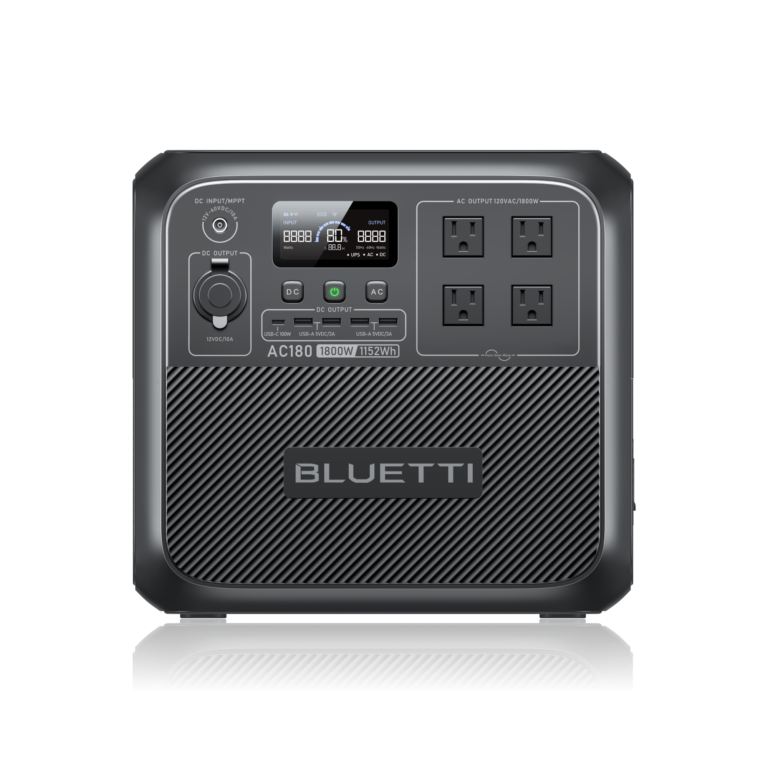
If you want maximum capacity in the same form factor, the Bluetti AC180 offers 1152 Wh at a heavier 36 lbs and current pricing around $699–$799. It’s a meaningful capacity step up, though its slower charging and higher price dilute the advantage at current Delta 2 pricing.
→ Buy the EcoFlow Delta 2 on Amazon
Bottom Line
The EcoFlow Delta 2 earns its reputation as the best all-around 1 kWh power station on the market. The 80-minute full recharge from wall power is unmatched in this class, the LFP chemistry means you’ll be cycling this unit long after competitors have degraded, and the 5-year warranty at a sub-$500 street price makes the long-term value calculation straightforward. The fan noise is real, customer service has rough edges, and you’re not getting 1024 Wh of actual runtime energy — but these are known, manageable limitations, not dealbreakers. For campers, preppers, and home backup users who want the best combination of charging speed, longevity, and value in a 1 kWh portable station, the Delta 2 is the unit to beat in 2025.