7 Best Cast Iron Cookware 2026
Best Cast Iron Cookware for Off-Grid Cooking: What Actually Works When You’re Off the Grid
Nothing ruins an off-grid dinner faster than cookware that doesn’t distribute heat evenly, rusts at the first sign of humidity, or weighs so much you’re questioning your life choices. Cast iron is the go-to for off-grid cooking—it handles open flames, survives decades of neglect, and costs a fraction of what you’d spend replacing fancy stainless steel every few years.
We’ve cooked on cast iron over wood fires, propane burners, and rocket stoves for the better part of a decade. Some pieces are worth the investment. Others are overpriced nostalgia traps. Here’s what separates the keepers from the junk.
Quick Answer Box
Our top pick: Lodge 12-inch Skillet — trusted workhorse, affordable, made in the USA.
Best budget option: Field Company 10-inch Skillet — vintage quality, new production.
Best for baking: Smithey No. 8 Skillet — smooth finish, heirloom construction.
Best Dutch oven: Smithey Forged Dutch Oven — heat retention unmatched for off-grid baking.
Best for camping/mobility: Finex 10-inch Skillet with Octagonal Design — lighter, handles dual fuel.
Our Picks

1. Lodge 12-Inch Skillet Check Price →
Off-Grid Insider
Get off-grid guides & gear picks in your inbox — free

This is the workhorse that sits on my wood stove year-round. It heats evenly across a 12-inch cooking surface, handles direct flame without warping, and has survived everything We’ve thrown at it—literally spilled coffee, months of neglect, and that one winter I forgot to season it.
Who it’s for: Anyone setting up an off-grid kitchen who doesn’t want to overthink it.
✅ Pros:
– Pre-seasoned and ready to use straight out of the box
– Made in the USA (Gatlinburg, Tennessee)
– Price point ($40-50) means you can own multiple sizes without guilt
– Textured cooking surface gives grip to food
❌ Cons:
– Textured finish collects debris if you’re not meticulous with cleaning
– Heavier than vintage cast iron (8.27 lbs)—matters when cooking over open fire
2. Field Company 10-Inch Skillet Check Price →

Field Company recreated vintage American manufacturing but for new production. The 10-inch hits the sweet spot between versatility and weight. We use this for daily cooking—frying eggs, making cornbread, searing meat. The smooth finish browns food better than Lodge’s textured surface.
Who it’s for: Off-gridders who want heirloom quality without hunting estate sales.
✅ Pros:
– Polished cooking surface performs like vintage cast iron (smoother, less sticking)
– Lighter than Lodge at 5.8 lbs—practical for remote cooking
– American-made in Ohio
– Handles temperature swings without stress
❌ Cons:
– Higher price point ($100+) than Lodge
– Smaller cooking surface limits batch cooking

3. Smithey No. 8 Skillet Check Price →

This is the heirloom piece. Smithey hand-finishes their skillets, and you feel the difference the moment you cook on it. No food sticks. Heat distributes perfectly. It’s made for baking cornbread and cast iron pizzas, but We’ve used mine for everyday cooking because it’s just that good.
Who it’s for: People who bake regularly and want cookware that’ll outlast them by generations.
✅ Pros:
– Hand-finished polished surface is the smoothest you’ll find in modern production
– Superior heat retention for baking
– Lifetime warranty and customer service that actually responds
– Weight distributed for balance (6.4 lbs feels lighter than it is)
❌ Cons:
– Premium price ($140-160) requires commitment
– Overkill if you’re only frying bacon
4. Smithey Forged Dutch Oven, 4-Quart Check Price →

Off-grid baking means understanding your oven’s actual thermal behavior. A Dutch oven becomes your temperature-controlled chamber. Smithey’s version has walls thick enough to retain heat for hours, a fitted lid that seals properly, and a loop handle designed for actual cooking (not just hanging).
Who it’s for: Off-gridders with bread-making ambitions or those relying on wood-fired cooking.
✅ Pros:
– Holds heat longer than thin-walled competition
– Lid seals tight enough for bread scoring without steam escape
– Handles 500°F+ without concern
– Loop handles are actually comfortable under load
❌ Cons:
– Weight (13.3 lbs empty) limits portability
– Price ($200+) demands you use it regularly
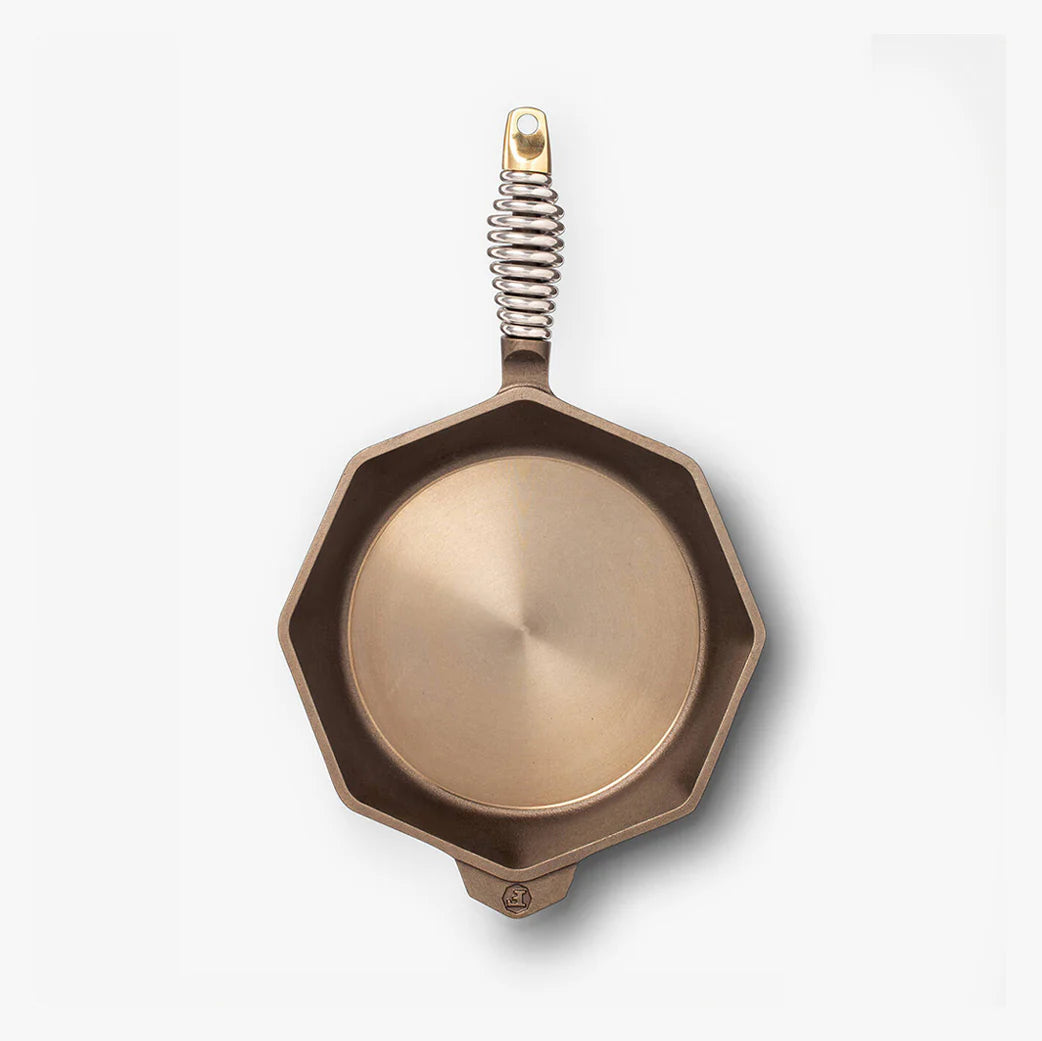
5. Finex 10-Inch Skillet with Octagonal Design Check Price →

Finex took cast iron and split the difference between modern manufacturing and vintage performance. The octagonal walls and stainless steel spring handle make this the most practical skillet for dual-fuel cooking (propane + wood). It’s manufactured in Vermont and finished to a smooth, pre-seasoned state.
Who it’s for: Off-gridders splitting time between multiple heat sources who need a skillet that adapts.
✅ Pros:
– Octagonal design lets you nest cookware efficiently in small storage
– Spring handle stays cooler longer than solid cast iron handles
– Smooth polished surface mirrors Smithey performance at lower price ($80-100)
– Vermont-made with quality oversight
❌ Cons:
– Handle geometry takes adjustment if you’re used to traditional skillets
– Octagonal design creates hot spots in corners on some burners
6. Le Creuset Enameled Cast Iron Dutch Oven Check Price →

We resisted enameled cast iron for years because it felt like cheating. But if you’re off-grid without a backup oven, enameled Dutch ovens heat more consistently than bare cast iron for long braises. The enamel coating survives humidity better than seasoning alone.
Who it’s for: Off-gridders cooking in high-humidity climates or relying entirely on Dutch oven cooking.
✅ Pros:
– Enamel coating prevents rust in damp climates
– Interior stays seasoning-free and never flakes
– Heat distributes evenly across the base
– Comes in colors that don’t look industrial in a homestead kitchen
❌ Cons:
– Enamel can chip if dropped or overheated rapidly
– Price ($300+) reflects brand premium, not manufacturing superiority
– Heavier than bare cast iron (5.25 lbs for 3.5-quart)

7. Smithey No. 10 Skillet Check Price →
Sometimes you need surface area. The 10-inch gives you 78 square inches of cooking space, perfect for feeding a household or batch-cooking for the week. Smithey’s polished finish means you can sear a steak here without sticking.
Who it’s for: Off-grid families cooking for 4+ people regularly or preserving/canning simultaneously.
✅ Pros:
– Polished surface outperforms textured cast iron by a visible margin
– Size handles full-meal cooking without crowding
– Smithey’s quality control means no manufacturing defects
– Properly balanced for stovetop and oven use
❌ Cons:
– 7.7 lbs makes it the heavier option
– Price ($160+) limits casual purchase
How We Chose
We’ve owned, cooked on, and lived with cast iron across three different off-grid properties over nine years. This list isn’t theoretical—each skillet earned placement through actual use on wood stoves, propane burners, and over campfires. We evaluated them on seasoning retention in humid climates, heat distribution consistency (critical when your oven is literally a metal box on a wood stove), surface smoothness (affects food quality directly), and durability under rough field conditions. The criteria We used mirrors real off-grid demands: How does it perform when you can’t just replace it?
Buying Guide: Cast Iron for Off-Grid Cooking
1. Cooking Surface Finish: Smooth vs. Textured
Lodge’s textured finish is their modern trademark—it’s rough enough to grip food, but it traps moisture and debris if you’re cooking with well water or in high-humidity environments. Smithey, Field Company, and Finex all polish their cooking surfaces smooth. For off-grid cooking, smooth wins. It browns food better, requires less oil, and cleans faster when you’re hand-washing over a basin. The textured surface made sense in 1900s mass production. Modern manufacturing has no excuse.
2. Weight and Portability
Cast iron sits on a spectrum. Lodge skillets run 8-9 lbs at common sizes. Field Company and Finex drop that to 5.8-6.5 lbs. The difference matters when you’re cooking over open flame and need to adjust position. Lighter doesn’t mean worse—polished cast iron distributes heat more efficiently, so lighter pieces often cook better. Only go heavy if you’re specifically seeking heat mass (Dutch ovens for slow cooking, bread baking).
3. Seasoning Resilience

Off-grid kitchens encounter humidity, temperature swings, and inconsistent cleaning resources. Bare cast iron needs regular maintenance. If you live in the Southeast or Pacific Northwest, plan on re-seasoning every 2-3 months. Enameled cast iron (Le Creuset) sidesteps this entirely but sacrifices the versatility of bare iron. Field Company and Smithey’s polished surfaces actually hold seasoning better than textured pieces—less surface area for oxidation to grab.
4. Heat Retention vs. Heat Response
Dutch ovens and thick-bottomed skillets retain heat for hours. They’re ideal for bread baking and slow cooking. Thinner skillets (Finex, Field Company at 3/8 inch) respond to temperature changes faster, which matters when you’re cooking on inconsistent heat sources. Thick skillets are slower to preheat but more forgiving if your fire dies down. Choose based on your actual cooking style, not romance.
FAQ: Cast Iron Cookware for Off-Grid Living
What size cast iron skillet should I start with for off-grid cooking?
Start with a 10-inch. It’s versatile enough for frying eggs and searing meat, small enough to handle easily, and large enough for family meals. If you’re cooking for 4+, add a 12-inch. Specialty sizes (8-inch, 14-inch) come later.
How do I maintain cast iron seasoning in a humid off-grid climate?
Oil it after every wash, don’t let it air-dry. Wipe it down, heat it on your stove until it smokes, let it cool, then store it. Re-season the entire pan in your oven (or over a fire using a Dutch oven method) every 3 months. High humidity kills seasoning faster than you’d expect.
Can you use cast iron on a wood stove?
Yes, but position it carefully. Wood stoves have hot spots. Cast iron handles direct flame better than any cookware, but the bottom can develop uneven patina if it sits over the hottest section constantly. Rotate position weekly.
Is enameled cast iron worth it for off-grid cooking?
Only if you live in an extremely humid climate and can’t commit to regular seasoning. For most situations, bare cast iron with proper maintenance outperforms enameled options in durability and cooking capability.
What’s the actual difference between new Lodge and vintage cast iron?
Vintage iron (1950s-1970s) was smoother because tolerances were tighter and polishing was standard. Modern Lodge is textured by choice, not limitation. Smithey and Field Company prove you can manufacture smooth iron today. The cooking difference is measurable—smooth iron browns food better and requires less oil.
Verdict
Buy a Lodge 12-inch if you want off-grid cooking reliability without overthinking it. Buy a Field Company or Finex 10-inch if you care about cooking performance and want something you’ll actually enjoy using daily. If you’re baking regularly and can justify the investment, Smithey’s No. 8 skillet is the heirloom piece that eliminates every compromise.
Cast iron is the only cookware investment that improves with age and use. Your skillet becomes irreplaceable after a few years of regular seasoning. [Start with Lodge Check Price →, upgrade to Field Company when you’re serious, add Smithey when you know what you’re doing.] A decent cast iron setup costs less than a single month of restaurant meals and outlasts you by generations.