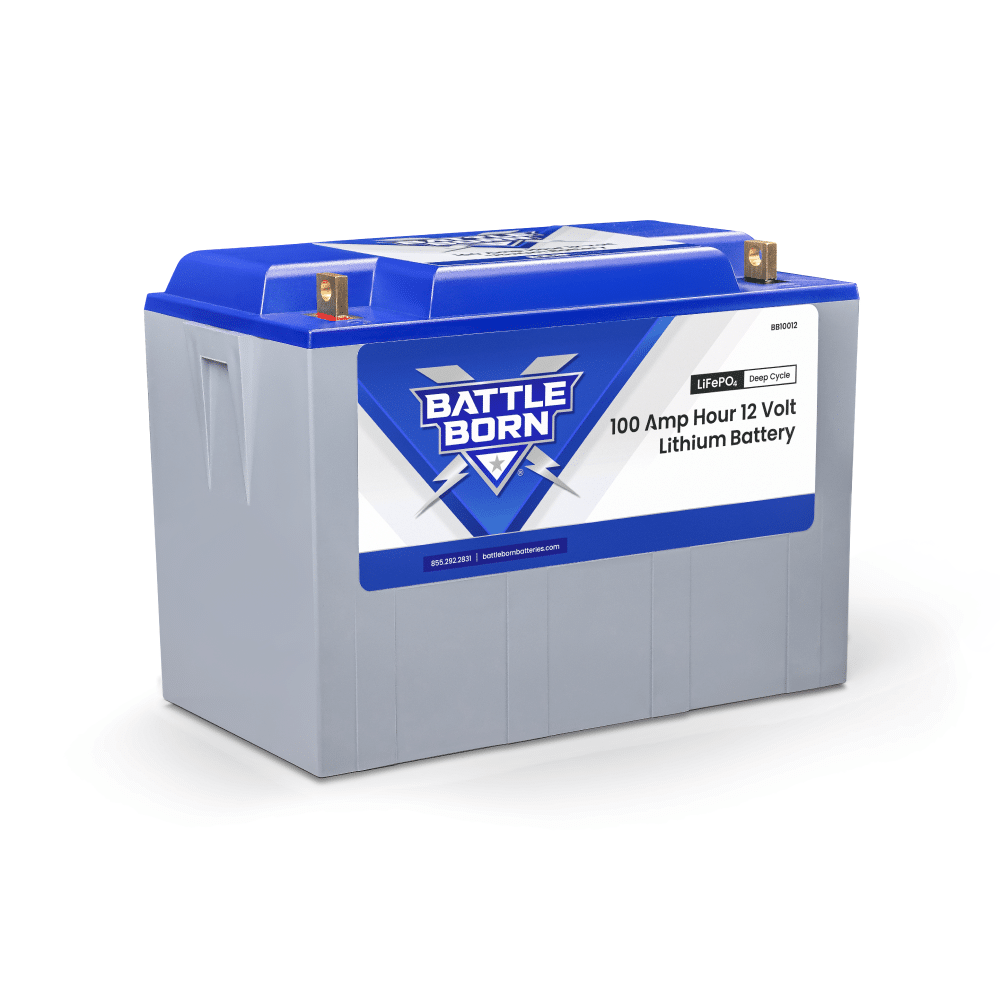
Battle Born 12V 100Ah: Honest Review 2026
Battle Born 12V 100Ah Review — 2025: Still Worth the Premium?
The Battle Born 100Ah was, for several years, the default answer when anyone asked what LiFePO4 battery to buy. Built in Reno, Nevada, backed by a 10-year warranty, and tested in tens of thousands of RV, boat, and off-grid installations, it earned its reputation honestly. But the landscape has changed dramatically since 2021. This review is for buyers who want to know whether it still earns that premium price in 2025 — or whether the brand is coasting on legacy.
| Best For | RV and van lifers upgrading from lead-acid, marine installs, buyers who need 24V/48V series expansion |
| Avoid If | You’re budget-conscious, doing a fresh DIY solar install, or planning a 4+ battery bank |
| Street Price | ~$799 (MSRP $949; sale pricing is frequent) |
| Warranty | 10 years limited |
As an Amazon Associate, OffGridFoundry earns from qualifying purchases.

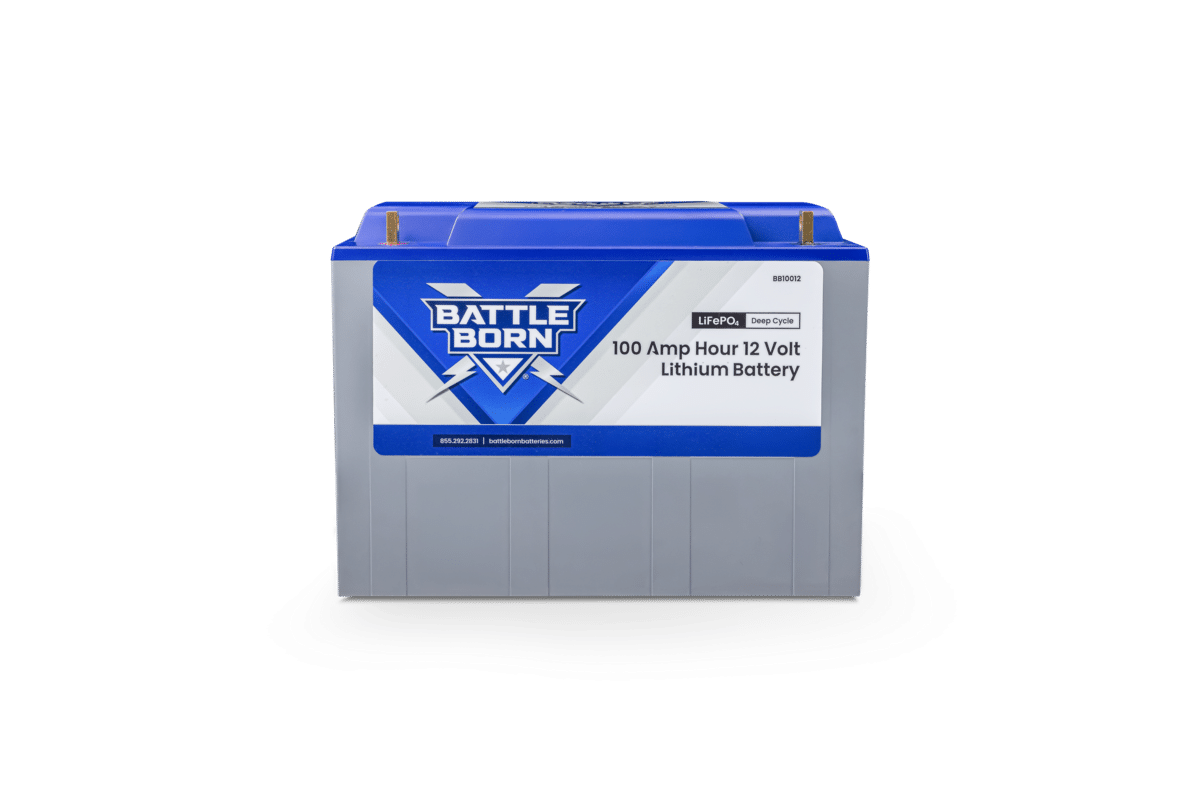
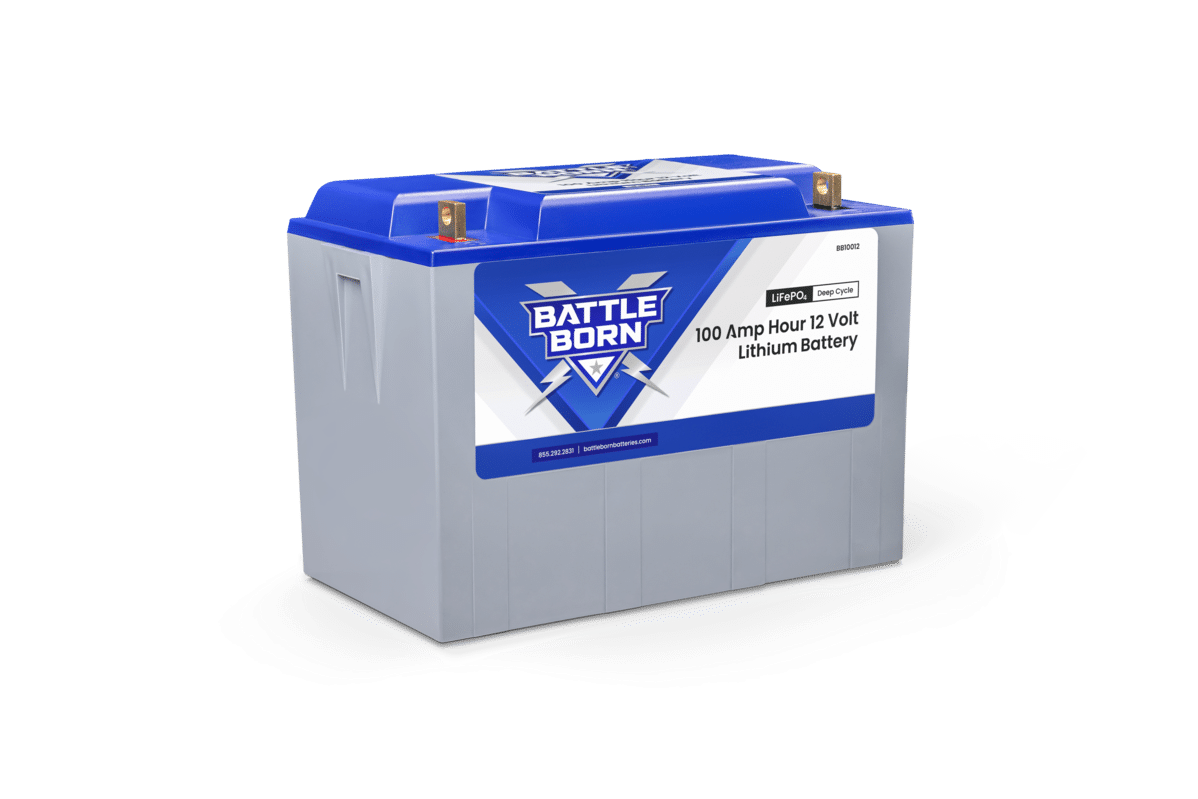
The Battle Born 100Ah is a legitimately well-built battery that delivers real-world capacity slightly above its rating (~110Ah in third-party bench tests), handles surge loads better than most budget competitors, and has been proven across thousands of real-world installs. Where it gets complicated: a documented positive terminal design controversy, a warranty reputation that has noticeably degraded since 2022, and a market that has largely caught up at 40–60% lower prices. It’s not a bad battery — it’s a battery that’s harder to recommend unconditionally than it used to be.
What We Like
- Tested over-capacity. Third-party bench tests consistently pull ~110–111Ah from a rated 100Ah battery. Battle Born builds in margin.
- Superior surge handling. Under a 1,500W continuous inverter load, the BMS sustained discharge for ~33 seconds before tripping — significantly longer than Renogy’s BMS (under 10 seconds). This matters for motor starts, inverter spikes, and high-draw appliances.
- Flat discharge curve. The battery holds near 12.8V until roughly 10% state of charge. RV appliances run at full performance longer; inverters trip low-voltage alarms far less often. This is the single biggest real-world upgrade over AGM for most owners.
- Series support to 48V. Up to four batteries can be wired in series for 24V or 48V systems. Many budget competitors (including Renogy’s standard 100Ah) explicitly prohibit series wiring — a major flexibility limitation.
- Any-orientation mounting. No off-gassing, no liquid electrolyte, no venting requirements. Installs in sealed compartments, on its side, inverted. Meaningfully easier to route in tight RV or marine applications.
- Phone support and US assembly. Battle Born maintains customer service lines and assembles in Reno, Nevada. For buyers who want to talk to a human when something goes wrong, this still matters.
What We Don’t Like
- The positive terminal controversy is real. Battle Born publicly acknowledged that ~700 units out of 175,000+ sold (roughly 0.4% of sales through late 2025) experienced a “thermal interrupt event” at the positive terminal. The root cause is a dissimilar-metals terminal design — brass contact, stainless bolt, aluminum oxidation pathway — that can generate resistance and heat under high continuous current, particularly in multi-battery banks. Battle Born reframes this as an intentional safety shutoff mechanism. Community teardowns tell a less flattering story: epoxy heat discoloration, arcing evidence, loose terminals. The 0.4% failure rate sounds small; the pattern of failures in high-current, multi-battery applications is what has the DIY solar community on edge.
- Warranty claims have gotten harder. The 2019–2022 era had Battle Born’s warranty as a genuine differentiator — quick, no-questions-asked replacements were commonly reported. From 2023 onward, the forum record has shifted. Warranty denials citing “user error” or “improper installation” are now the more common report. Multiple users document $350+ shipping and handling charges for warranty returns, making the claim process economically unattractive for a single battery. A law firm (Milberg PLLC) was investigating potential class action claims from 2020–2025 purchasers as of early 2026.
- Parent company financial instability. Dragonfly Energy Holdings (NASDAQ: DFLI) — Battle Born’s parent — reported $58.6M in revenue but a net loss of $70.8M in 2025, and the stock fell from ~$146 in 2022 to $0.15 before a 1-for-10 reverse split. The company remains operational with growing OEM contracts (Werner Enterprises, PACCAR), but a 10-year warranty is only as good as the company standing behind it.
- Price premium is hard to defend. When Battle Born launched around 2017, there were almost no alternatives. In 2025, SOK 100Ah ($300–$350, 7-year warranty, metal case, cells accessible for replacement) and Epoch 100Ah (~$299–$350, 10-year warranty) deliver comparable specs at less than half the price. The premium for “US assembly” and brand recognition has a ceiling.
- Heaviest in class. At 31 lbs, the BB10012 is 5 lbs heavier than Renogy’s equivalent and 7–8 lbs heavier than Ampere Time/LiTime. In a four-battery bank, that’s an extra 28 lbs of dead weight.
Specs That Matter
Off-Grid Insider
Get off-grid guides & gear picks in your inbox — free
| Spec | Value |
|---|---|
| Chemistry | LiFePO4 (cylindrical cells) |
| Nominal Voltage | 12V (12.8V operating) |
| Capacity | 100Ah (1,200Wh) |
| Actual Tested Capacity | ~110–111Ah (third-party) |
| Max Continuous Discharge | 100A |
| Surge Current | 200A for 30 seconds |
| Recommended Charge Current | 50A (0.5C) |
| Bulk/Absorption Charge Voltage | 14.2–14.6V |
| Cycle Life | 3,000–5,000 deep cycles |
| Discharge Temp Range | -4°F to 135°F (-20°C to 57°C) |
| Charge Temp Cutoff | 32°F (0°C) — BMS blocks charging below freezing |
| Weight | 31 lbs |
| Dimensions | 12.76 × 6.86 × 8.95 in |
| Series Support | Yes, up to 48V (4S) |
| Warranty | 10-year limited |
| Self-Discharge | ~2–3% per month |
Important charger note: The BMS hard-blocks all charging below 32°F. In cold climates, owners frequently discover their battery appears dead on a freezing morning — this is intentional protection, not a defect. Discharge down to -4°F is still permitted.
Real-World Performance
Owner reports from iRV2, Airstream forums, and the DIY Solar Forum paint a consistent picture for pre-2022 buyers: the battery simply works. Common threads include long-term owners describing 9–18 months of daily solar cycling with zero issues, compressor fridges running continuously without the voltage sag that plagued AGM setups, and meaningful weight savings over multi-battery lead-acid banks. A frequently cited real-world test: running a 12V compressor refrigerator for 48+ hours on a single Battle Born while the display held near-full charge — something impossible with a comparably rated AGM at 50% usable depth.
The picture for 2023–2025 buyers is more variable. The positive terminal failure pattern tends to surface in high-current applications: large inverter banks, shore power charging at max current, parallel battery banks where one battery can “carry” a degraded neighbor and mask the issue. Owners running modest solar-fridge-LED setups at conservative current levels report no issues. Owners running 2,000W+ inverters on 4-battery parallel banks are disproportionately represented in the failure reports. If your use case is the former — a single-battery RV or boat setup with a properly configured MPPT controller — the odds are strongly in your favor.
One installation reality check that shows up repeatedly in forum posts: most older RV converters charge to only 13.6V, which is insufficient for a LiFePO4 battery (needs 14.2–14.6V bulk). Owners who don’t upgrade or reprogram their converter effectively never fully charge the battery, then report the battery “only delivers 50% capacity.” This isn’t a Battle Born problem — it’s a lithium drop-in gotcha — but it generates enough negative reviews to be worth flagging.
Who Should Buy This
The Battle Born 100Ah makes its strongest case for the buyer upgrading a single-battery RV, boat, or camper van from AGM or flooded lead-acid. The flat voltage curve alone transforms the experience of running 12V appliances — compressor fridges, fans, and inverters all behave more predictably. If you’re adding a single battery to a modest existing system and want something with proven track record, documented US support, and a single-vendor warranty, this remains a defensible buy at the $799 sale price.
It also makes sense for buyers who specifically need series expansion. If your system will eventually need 24V or 48V architecture, Battle Born’s series support to 48V keeps that door open. Budget alternatives like Renogy explicitly prohibit series wiring, which forces a full system redesign later.
Finally, for marine installs where ABYC E-13 compliance is required, the Smart version (BB10012i, ~$949) checks the certifications box while adding Bluetooth monitoring through Battle Born’s app — useful for boats with difficult battery access.
Who Should Look Elsewhere
If you’re building a fresh multi-battery DIY solar bank — four batteries, say, for a full-time off-grid cabin or a high-capacity vehicle — the math is brutal. Four Battle Born 100Ah batteries at $799 each = $3,196. Four SOK 100Ah batteries at $340 each = $1,360. The SOK carries a 7-year warranty, supports series, uses a metal case (cells are accessible for future replacement), and has become the dominant recommendation on DIY Solar Forum for exactly this use case. The $1,836 difference buys a lot of backup equipment — or a fifth battery.
Budget buyers doing their first lithium upgrade should look at the Ampere Time/LiTime 100Ah (~$249–$299, Amazon) as an entry point. It won’t match Battle Born’s surge handling or brand depth, but it delivers a solid real-world introduction to LiFePO4 at a fraction of the cost.
Bottom Line
The Battle Born 12V 100Ah is a quality battery with a legitimate track record — just no longer the obvious choice it once was. Buy it if you’re doing a single-battery drop-in upgrade, need series expansion to 48V, or specifically want US-assembled product with phone-accessible support. Think twice if you’re building a large bank, watching your budget, or are uncomfortable with the terminal controversy and evolving warranty reputation. The off-grid battery market has never been more competitive, and Battle Born’s premium now demands more scrutiny than it did when it had no real competitors.
→ Buy the Battle Born 100Ah on Amazon