Best 2-Way Radios for Property 2026: 7 Top Picks
If you’ve got more than a few acres, yelling across the property stops working fast. Cell service is spotty or nonexistent on most rural land, and trying to coordinate chores, livestock checks, or emergencies without reliable communication wastes time and creates real safety gaps. The right two-way radio for property communication bridges that gap without monthly fees, cell towers, or internet — but most radios marketed with “35-mile range” will barely cover a quarter mile through trees and terrain.
We spent weeks digging through FCC specs, manufacturer data, and hundreds of verified buyer reports from homesteaders, ranchers, and off-grid property owners to find the radios that actually perform on real land with hills, timber, and buildings in the way.
Our Top Picks at a Glance
| Category | Pick | Why |
|---|---|---|
| Best Overall | Midland GXT1000VP4 | 50 GMRS channels, best real-world range for the price |
| Best Budget | Retevis RT22 | Dead simple, surprisingly clear audio, under $30/pair |
| Best for Large Acreage | Midland MXT275 MicroMobile | 15W GMRS mobile unit, true multi-mile property coverage |
| Best Handheld + Base Combo | Midland MXT115 + GXT1000 | Vehicle-mount base plus handheld walkabout |
| Best for Rough Conditions | Motorola T800 Talkabout | Bluetooth, waterproof, built-in GPS sharing |
| Best Ham Option | BaoFeng BF-F8HP | 8W output, massive flexibility, requires license |
Our Picks
Midland GXT1000VP4
Off-Grid Insider
Get off-grid guides & gear picks in your inbox — free
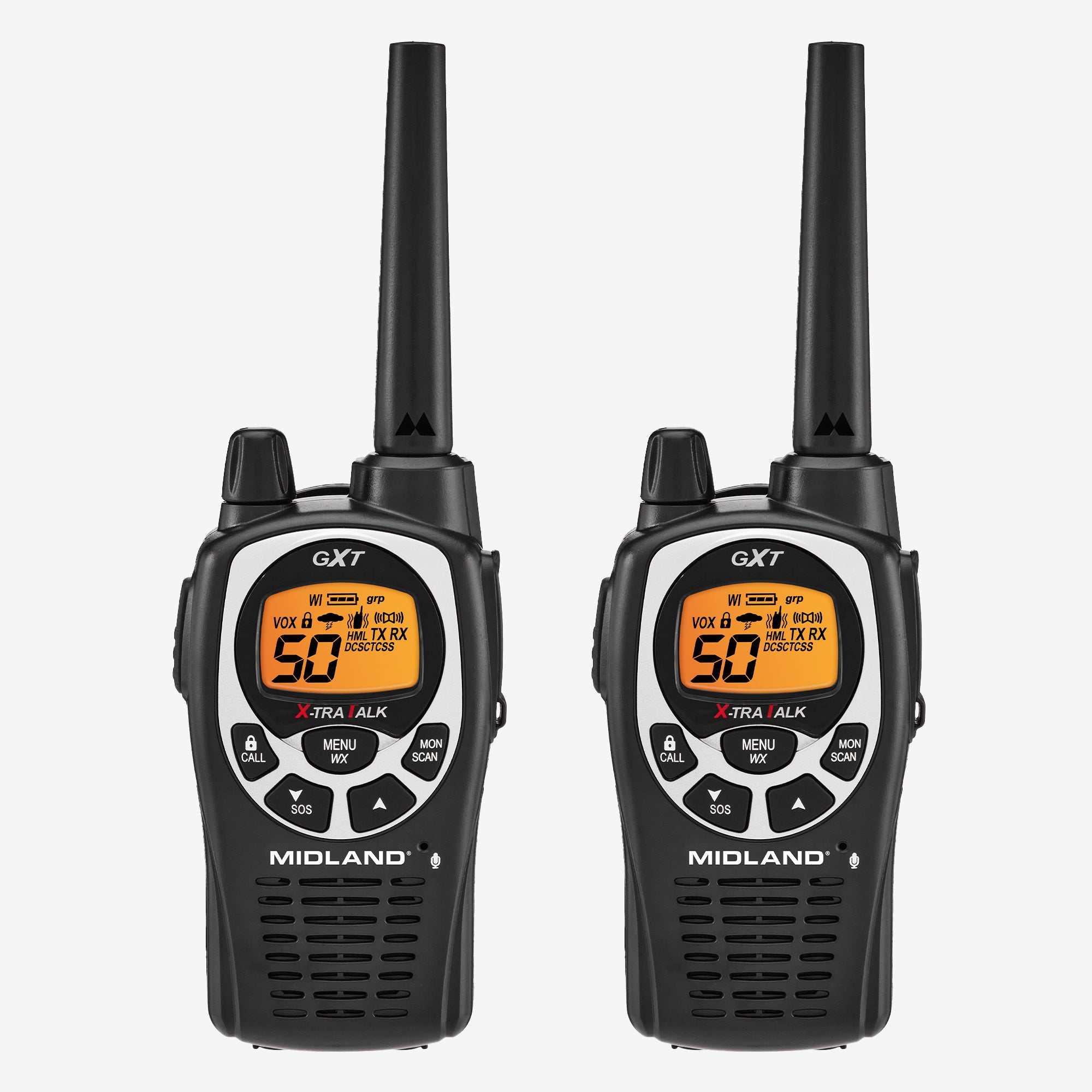
The Midland GXT1000VP4 is the radio we recommend to most property owners first. It runs on GMRS frequencies with up to 5 watts of output power, giving it meaningfully better range through trees and over hills than any FRS-only walkie-talkie.
Who it’s for: Homesteaders and rural property owners who need reliable handheld communication across 1–5 acres of wooded or hilly terrain without fuss.
Pros:
– 50 GMRS channels with 142 privacy codes, so interference from neighbors is virtually eliminated
– Includes two radios, rechargeable battery packs, desktop charger, earbuds, and belt clips — everything you need out of the box
– NOAA weather alert channels with automatic storm warnings, critical for off-grid property owners
Cons:
– Advertised “36-mile range” is pure open-water fantasy — expect 2–4 miles in wooded, hilly terrain with the included antennas
– GMRS requires an FCC license ($35 for 10 years, no exam), which catches some buyers off guard
Retevis RT22

If you just need cheap, reliable walkies for coordinating around the homestead, the Retevis RT22 punches way above its price. Audio clarity is sharp, the form factor is tiny enough to clip on a belt and forget, and the controls are dead simple — no manual required.
Who it’s for: Budget-conscious property owners who need short-range communication (under 1 mile) around buildings, gardens, and outbuildings.
Pros:
– Usually under $30 for a pair, making it painless to buy extras for family members or farmhands
– Ultra-compact and lightweight at just 3.5 oz — easy to carry all day during chores
– VOX hands-free mode lets you transmit by voice activation while your hands are full
Cons:
– FRS-only at 2 watts max, so real-world range tops out around half a mile to one mile in most terrain
– No weather channels or emergency alerts
Midland MXT275 MicroMobile

For anyone managing a larger rural property — say 20 acres or more with mixed terrain — a handheld radio alone often isn’t enough. The MXT275 is a 15-watt GMRS mobile unit that mounts in a truck, ATV, or as a base station in your cabin. At 15 watts, it delivers roughly three times the output power of the best handhelds, and the range difference is dramatic.
Who it’s for: Owners of large acreage, ranchers, or anyone who needs a fixed base station or vehicle-mounted radio to reach across the entire property.
Pros:
– 15 watts of GMRS power gives true 5–10+ mile range depending on terrain and antenna setup
– Works as a vehicle mount or stationary base station with the included hardware
– 15 GMRS repeater channels allow you to set up a repeater system for even greater coverage across valleys and ridgelines
Cons:
– Requires external 12V power (vehicle battery, solar system, or dedicated power supply) — not a grab-and-go solution
– At $150+, it’s a bigger investment than a pair of handhelds
Midland MXT115 + GXT1000VP4 Combo
This isn’t a single product — it’s the setup we see recommended most often by experienced off-grid property owners in forums and community groups. Pair a Midland MXT115 (15W mobile/base unit) in the cabin with GXT1000VP4 handhelds for walking the property. The base unit anchors your communication range, and anyone with a handheld can reach it from much further out than two handhelds talking to each other.
Who it’s for: Families or teams managing medium-to-large properties who want a central base station plus mobile walkabout capability.
Pros:
– Base-to-handheld range is significantly better than handheld-to-handheld, often doubling or tripling effective distance
– All Midland GMRS radios share the same channel plan, so pairing is seamless
– The MXT115 runs on 12V, making it straightforward to power from an off-grid solar battery bank
Cons:
– Buying both the mobile unit and a handheld pair pushes the total cost to $200+
– Requires some basic installation for the base station antenna, which may mean mounting a small external antenna on your roof or a pole
Motorola T800 Talkabout

Motorola’s T800 adds Bluetooth connectivity and a companion app that lets you share GPS locations and send short text-like messages between radios — features no other radio on this list offers. It’s also IPX4 water-resistant, which matters when you’re working outside in weather.
Who it’s for: Property owners who value the safety of GPS location sharing, especially on larger or more remote parcels where someone could get turned around or injured.
Pros:
– Built-in GPS location sharing via Bluetooth app — you can see where other radio users are on a map, even without cell service
– IPX4 water resistance handles rain, mud, and splashes during outdoor work
– Dual power: runs on the included rechargeable pack or 3 AA batteries as backup
Cons:
– Only 2 watts on FRS channels (the T800 does not transmit on full GMRS power without repeater channels), limiting range compared to a true 5W GMRS handheld
– The Bluetooth app is reported by many buyers as buggy and inconsistent on both Android and iOS
BaoFeng BF-F8HP

The BaoFeng BF-F8HP is the favorite of the ham radio community for good reason: 8 watts of output power, tri-power selectable (1W/4W/8W), and access to an enormous range of frequencies. If you hold an amateur radio license (Technician class, $15 exam), this radio unlocks capabilities no GMRS or FRS radio can match — including the ability to hit local repeaters that can extend your range to 50+ miles.
Who it’s for: Licensed ham operators or property owners willing to get a Technician license who want maximum flexibility, power, and range for the lowest possible price.
Pros:
– 8 watts of output power — the highest of any handheld on this list — delivers noticeably better range through obstacles
– Under $40 for a single unit, making it the cheapest high-power option available
– Programmable across VHF and UHF bands, so it can be configured for GMRS, MURS, or amateur frequencies (legal use depends on your license)
Cons:
– Requires an amateur radio (ham) license to transmit legally on most frequencies — using it on GMRS without a GMRS license or on ham bands without a ham license is an FCC violation
– The menu system and programming interface are notoriously unintuitive; most users need the CHIRP software on a computer to set it up properly
How We Chose
We started by filtering for radios that actual rural property owners and homesteaders recommend in communities like r/offgrid, r/GMRS, r/amateurradio, and multiple homesteading forums. We cross-referenced those recommendations with FCC-certified power output specs, verified buyer reviews on Amazon (focusing on reviews from rural and farm users), and manufacturer technical documentation. We prioritized radios with proven real-world range in wooded and hilly terrain — not the inflated “up to 36 miles” marketing claims that assume flat water with zero obstructions. Every radio on this list has a strong track record in community feedback from people using them on actual property, not in laboratory conditions.
Buying Guide: What Actually Matters for Property Communication

Power Output (Watts) and Frequency Type

This is the single biggest factor determining how far your radio will reach. FRS radios are capped at 2 watts. GMRS handhelds go up to 5 watts, and GMRS mobile units reach 15–50 watts. Ham handhelds like the BaoFeng BF-F8HP hit 8 watts. More power means the signal pushes further through trees, walls, and terrain. For property communication across anything larger than a few flat acres, we strongly recommend GMRS (5W minimum handheld) or a GMRS mobile base station.
Real-World Range vs. Marketing Range
Every radio box says “up to 35 miles.” Ignore that number completely. That spec assumes zero obstructions — basically two people standing on mountain peaks with line of sight. On a typical wooded, hilly property, expect roughly:
- FRS (2W): 0.25–1 mile
- GMRS handheld (5W): 1–4 miles
- GMRS mobile (15W) with external antenna: 5–15 miles
- Ham handheld (8W): 2–6 miles (direct); 50+ miles via repeater
If your property has significant elevation changes or dense timber, lean toward higher power or a base station with a mounted antenna.
Antenna Options

The stock rubber-duck antenna on most handhelds is the weakest link in the system. Upgrading to a longer whip antenna on a handheld, or mounting an external antenna on your cabin roof or a pole, can double or triple your effective range without changing radios. For base stations and vehicle mounts, antenna height and quality matter more than raw wattage. A 15W radio with a properly mounted external antenna at 20 feet will outperform a 50W radio with a poor antenna at ground level.
Licensing Requirements
- FRS: No license required. Limited to 2W, 22 channels.
- GMRS: Requires FCC license ($35, valid 10 years, no exam, covers your entire immediate family).
- Ham (Amateur): Requires passing the Technician exam ($15 sitting fee). Most flexible option but the steepest learning curve.
For most property owners, the GMRS license is the sweet spot — cheap, no exam, family-wide coverage, and it unlocks significantly more powerful radios. The best two way radio for property communication will almost always be a GMRS unit for this reason.
FAQ
How far will a two-way radio actually reach on my property?
Forget the range claims on the box. On a typical wooded, hilly property, an FRS walkie-talkie reaches about a quarter mile to one mile. A 5-watt GMRS handheld typically covers 1–4 miles. A 15-watt GMRS base station with a mounted antenna can reach 5–15 miles depending on terrain and antenna height.
Do I need a license to use a two-way radio on my property?
If you stick with FRS radios (like the Retevis RT22), no license is needed. GMRS radios require a $35 FCC license that lasts 10 years and covers your whole household — no exam, just an online application. Ham radios require passing a Technician-class exam. For most homesteaders, the GMRS license is the best value.
What is the best two-way radio for a large rural property with hills and trees?
For large properties with challenging terrain, a GMRS mobile or base station like the Midland MXT275 paired with handheld units gives the best results. The higher power output (15W vs. 5W or 2W) and ability to mount an external antenna high on your cabin or a pole makes a dramatic difference in cutting through obstacles.
Can I use two-way radios instead of cell phones on my off-grid property?
Absolutely — that is exactly what most off-grid property owners do. Two-way radios require no cell towers, no internet, no monthly fees, and no infrastructure beyond the radios themselves and batteries or a charging source. For daily property communication, coordinating work, and emergency contact between family members, GMRS radios are the most practical replacement for cell phones.
How do I extend the range of my two-way radio on hilly terrain?
Three proven methods: First, upgrade to a higher-power radio (GMRS mobile at 15W vs. handheld at 5W). Second, mount an external antenna as high as possible — roof-mounted or on a pole is ideal. Third, set up a GMRS repeater on the highest point of your property; many Midland GMRS radios support repeater channels natively. Combining a high-mounted antenna with a base station is the most effective approach and is standard advice in off-grid communication communities.
Our Verdict
For most property owners, the Midland GXT1000VP4 is the best starting point — it delivers strong GMRS range, includes everything you need in the box, and the $35 GMRS license covers your whole family for a decade. If you’re managing a larger spread with hills or heavy timber, step up to the Midland MXT275 as a base station and pair it with GXT1000 handhelds for the best property-wide coverage you can get without a ham license. Reliable property communication is a safety issue, not a luxury — get the right radios and stop depending on cell signals that were never built for your land.