7 Best Rainwater Systems 2026: Safe Drinking Water
Most people living off-grid assume their well or spring is the only reliable water source — until they price out drilling, pump maintenance, and the electricity to run it all. Rainwater collection is the obvious alternative, but turning roof runoff into something you’d actually drink without second-guessing every glass? That’s where most systems fall apart. Between debris, bacteria, chemical leaching from roofing materials, and inadequate filtration, a badly designed setup is worse than no setup at all.
We spent weeks comparing tanks, diverters, filtration stages, and real-world reports from off-grid homesteaders who rely on rainwater as their sole drinking source. Below are the components and systems that consistently deliver safe, potable water — no municipal backup required.
Our Top Picks at a Glance
| Category | Pick | Why |
|---|---|---|
| Best Overall Filter | Berkey Big Berkey Gravity-Fed Water Filter | Gold standard gravity filtration — no power, no plumbing |
| Best Storage Tank | WaterPrepared 160-Gallon Water Storage Tank | BPA-free, UV-resistant, fits standard roof gutter system for rainwater harvesting |
| Best First Flush Diverter | Rain Harvesting First Flush Diverter | Automatically dumps the dirtiest initial runoff |
| Best Budget Filter | Alexapure Pro Stainless Steel Water Filter | Solid gravity filtration at a lower price point |
| Best Space-Saving Tank | Bushman 265-Gallon Slimline Rainwater Tank | Tucks against walls, ideal for small cabins |
| Best Inline Filtration | Pentair Big Blue Whole House Filter Housing | Handles high flow rates between tank and point-of-use |
| Best Berkey Alternative | ProOne Big+ Gravity Water Filter | Comparable performance, easier filter sourcing |
Our Picks
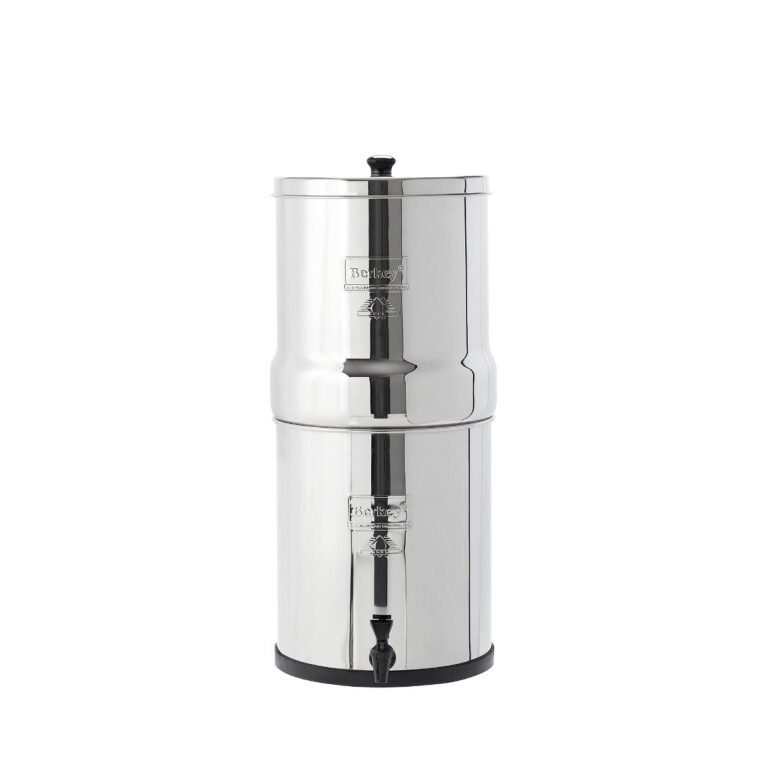
Berkey Big Berkey Gravity-Fed Water Filter
Off-Grid Insider
Get off-grid guides & gear picks in your inbox — free
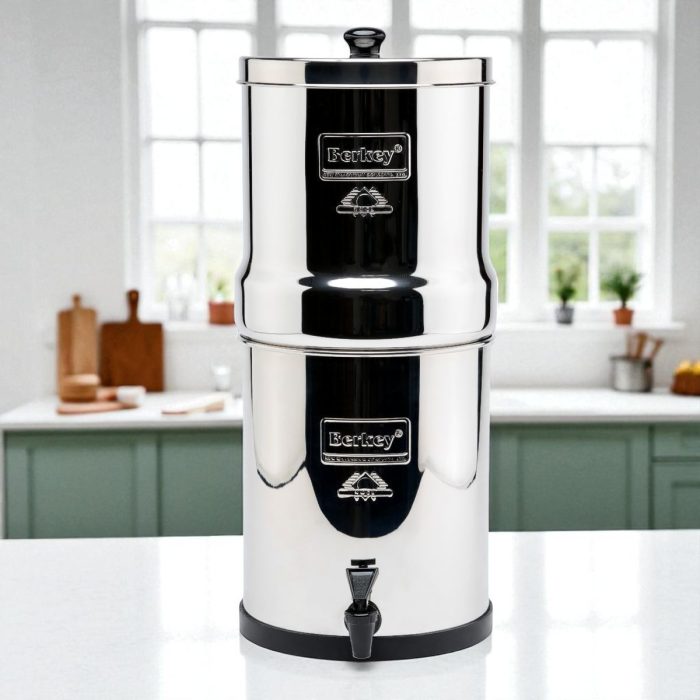
The Big Berkey is the most recommended gravity filter in the off-grid community for a reason: it removes over 99.99% of bacteria and 99.9% of viruses according to manufacturer testing, handles pathogenic cysts, heavy metals, and pesticides, and requires zero electricity or water pressure. For anyone building a potable rainwater filtration methods setup from scratch, this is the final stage that turns stored rainwater into drinking water you can trust.
Best for: Off-gridders who need a proven, electricity-free point-of-use drinking water filter.
Pros:
– Black Berkey elements have a rated lifespan of 3,000 gallons per element (6,000 gallons per pair), keeping long-term costs low
– Completely gravity-fed — works during power outages and in cabins with no plumbing
– Stainless steel housing resists rust and doesn’t leach chemicals into filtered water
Cons:
– Flow rate is slow at roughly 1 gallon per hour with two elements — not ideal for large families without planning ahead
– Upper and lower chambers take up significant counter space at 21 inches tall
WaterPrepared 160-Gallon Emergency Water Storage Tank
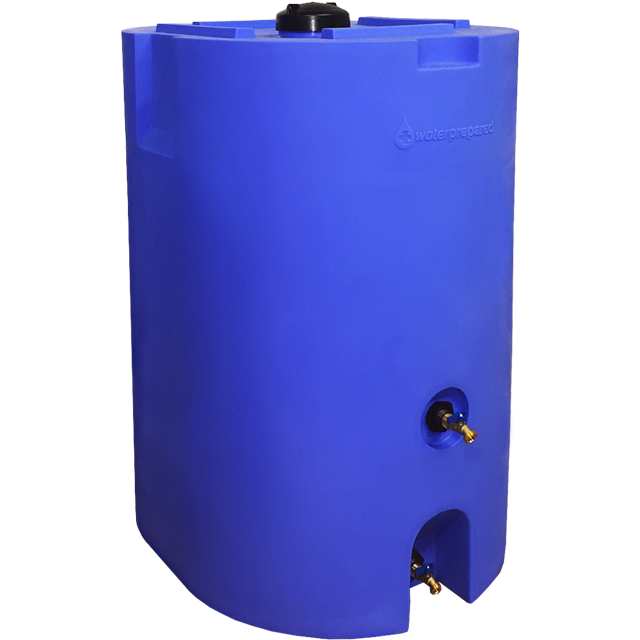
If you’re doing a rainwater tank installation off-grid and need a mid-size storage solution that won’t require a concrete pad or heavy equipment, the WaterPrepared 160-gallon tank hits the sweet spot. It’s made from BPA-free, UV-stabilized polyethylene, includes a screened vent, and connects easily to standard downspout adapters.
Best for: Small to mid-size off-grid cabins collecting from a single roof section.
Pros:
– Stackable design lets you expand capacity without additional footprint
– Built-in brass spigot and overflow fitting reduce the number of extra parts to source
– FDA-approved food-grade plastic rated for potable water storage
Cons:
– At 160 gallons, a single unit won’t sustain a household through extended dry spells — most users need two or more
– Round profile makes it harder to tuck against a wall compared to slimline designs
Rain Harvesting First Flush Diverter

The first flush — that initial surge of water that washes bird droppings, dust, pollen, and debris off your roof — is the single dirtiest part of every rain event. This diverter automatically captures and diverts that initial volume away from your storage tank, then resets itself via a slow-drain valve. If you’re building a roof gutter system for rainwater harvesting intended for drinking, a first flush diverter isn’t optional. It’s the most cost-effective way to dramatically reduce contamination before water ever hits your tank.
Best for: Anyone connecting roof gutters to a storage tank who plans to use the water for drinking or cooking.
Pros:
– Self-resetting slow-drain valve means zero manual intervention between rain events
– Clear inspection cap lets you visually check captured debris without disconnecting
– Standard PVC pipe fitting makes integration into any downspout run straightforward
Cons:
– The slow-drain valve can clog with fine sediment if not cleaned quarterly
– Single diverter only handles one downspout — multi-downspout roofs need one per line
Alexapure Pro Stainless Steel Water Filter
The Alexapure Pro is the go-to budget gravity filter for off-gridders who want solid potable rainwater filtration methods without the Berkey price tag. It uses a single gravity block filter that the manufacturer claims removes up to 99.99% of contaminants including bacteria, viruses, and heavy metals. The single-filter design means slower throughput than a dual-element Berkey, but for a one- or two-person household, it’s plenty.
Best for: Budget-conscious off-gridders or couples who need reliable drinking water filtration without a big investment.
Pros:
– Priced roughly 30-40% lower than comparable Berkey setups at time of research
– Single filter element rated for up to 5,000 gallons before replacement
– Stainless steel construction is durable and doesn’t impart taste
Cons:
– Single filter element means roughly half the flow rate of dual-element systems
– Fewer third-party lab tests publicly available compared to Berkey’s documentation

Bushman 265-Gallon Slimline Rainwater Tank
When your rainwater tank installation off-grid needs to fit against a cabin wall or under eaves without eating up your limited outdoor space, the Bushman slimline is the go-to. Its narrow, flat-backed profile sits flush against structures and still holds 265 gallons — enough to bridge a two-week dry spell for a conservative household. Made from food-grade polyethylene with UV stabilizers for longevity in direct sun.
Best for: Tight-footprint properties, tiny homes, or anyone who needs wall-adjacent tank placement.
Pros:
– Only 18 inches deep — tucks under eaves or against walls without blocking walkways
– Includes mosquito-proof screen, overflow outlet, and 1-inch brass outlet as standard
– UV-stabilized polyethylene rated for 20+ years of outdoor exposure per manufacturer
Cons:
– Narrow profile makes it more top-heavy than squat round tanks — securing to a wall or fence is recommended
– 265 gallons fills fast in heavy rain regions, and the single overflow port can struggle during cloudbursts
Pentair Big Blue Whole House Filter Housing

Gravity filters handle drinking water, but what about the shower, the kitchen sink, and washing dishes? The Pentair Big Blue housing accepts standard 4.5″ x 20″ filter cartridges — sediment, carbon block, or pleated — and handles flow rates up to 15 GPM. Installed inline between your storage tank and your cabin’s plumbing, it strips sediment, taste, and odor from every tap in the house. Pair a 5-micron sediment cartridge with a carbon block cartridge in a two-housing series for the best results.
Best for: Off-grid homes with pressurized plumbing that want whole-house pre-filtration before a point-of-use drinking filter.
Pros:
– Accepts widely available standard-size cartridges — no proprietary filters to track down
– Pressure relief button on the housing cap makes filter changes easy without special tools
– 1-inch NPT inlet/outlet fittings connect directly to standard off-grid plumbing runs
Cons:
– Requires at least some water pressure (typically from a 12V pump) — not gravity-compatible without elevated tank placement
– Housing only — you’ll need to source and replace cartridges separately every 3-6 months depending on water quality
ProOne Big+ Gravity Water Filter
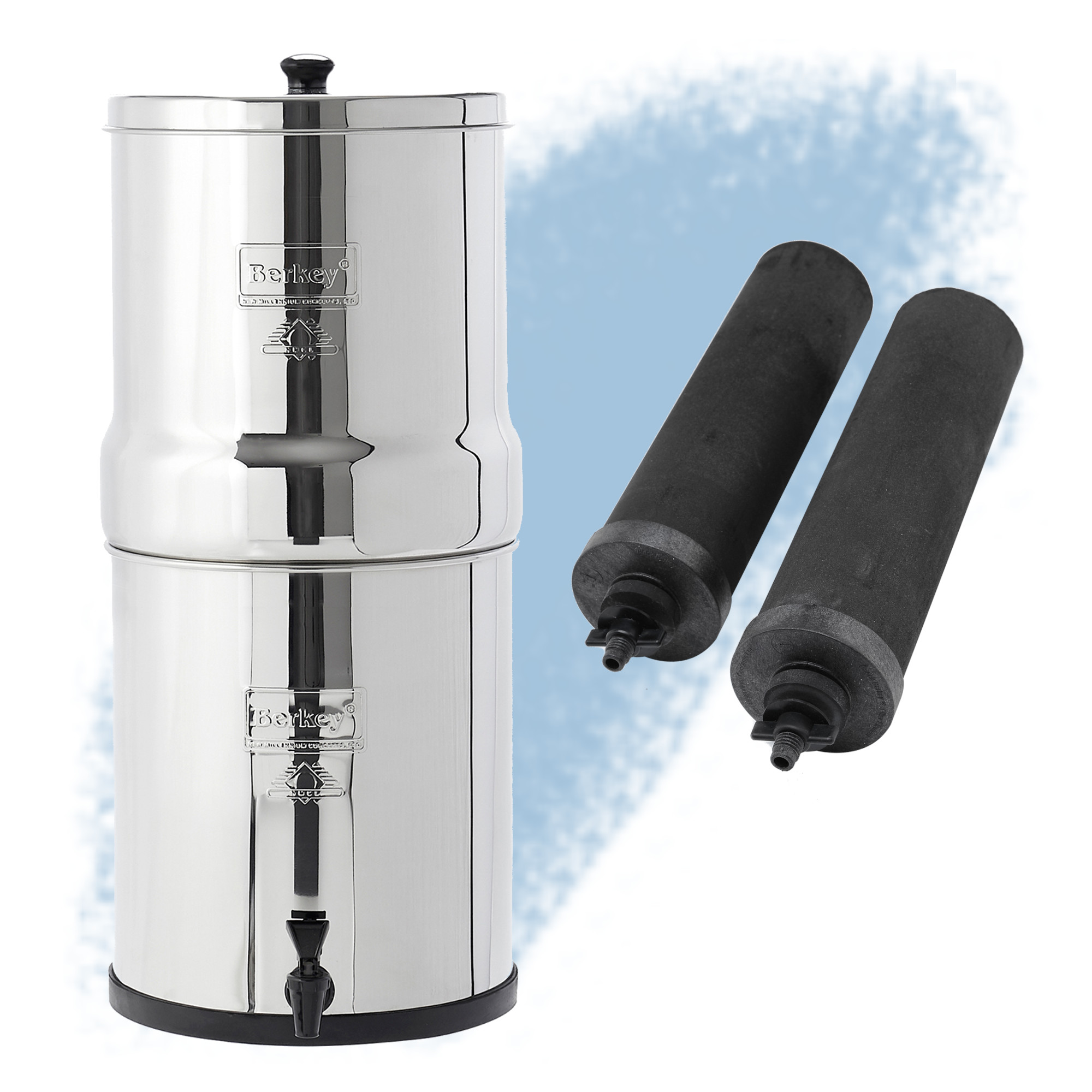
Since Berkey faced supply chain disruptions and regulatory scrutiny in recent years, the ProOne Big+ has emerged as the strongest alternative for potable rainwater filtration methods. It uses silver-infused ProOne G2.0 filter elements that the manufacturer rates to remove bacteria, viruses, heavy metals, fluoride, and pharmaceuticals. The brushed stainless housing holds 2.75 gallons and fits two elements for faster flow.
Best for: Anyone who wants Berkey-class performance with more readily available replacement filters.
Pros:
– ProOne G2.0 elements are NSF/ANSI 42 and 53 certified components — more third-party validation than some competitors
– Built-in fluoride and arsenic reduction without needing a separate lower filter
– Replacement elements are consistently in stock through multiple retailers
Cons:
– Slightly smaller capacity (2.75 gallons) than the Big Berkey’s 2.25-gallon upper + 2.25-gallon lower setup
– Less established track record in off-grid communities — fewer long-term user reports to draw from
How We Chose
We focused on three criteria: Can the system produce potable water from roof-collected rainwater? Can it function fully off-grid — meaning no municipal water pressure and minimal or no electricity? And do real users in off-grid and homesteading communities confirm reliable long-term performance? We cross-referenced manufacturer spec sheets, NSF/ANSI certifications where available, and buyer feedback across forums, homesteading groups, and retail reviews. We excluded any product that required grid power without a practical 12V or solar alternative, and any storage tank not rated food-grade for potable use.
Buying Guide: What Actually Matters
Roof Material Compatibility
Not all roofs are safe to collect drinking water from. Asphalt shingles can leach petroleum compounds, and treated wood shakes may contain preservative chemicals. Metal roofing (galvanized steel, aluminum, or coated steel) is the gold standard for a roof gutter system for rainwater harvesting intended for drinking. If you’re stuck with asphalt, a robust multi-stage filtration setup and first flush diversion become non-negotiable rather than optional.
Storage Tank Material and Sizing
For any rainwater tank installation off-grid, the tank must be food-grade polyethylene, fiberglass, or stainless steel — never repurposed industrial containers. Size your storage based on a simple formula: average monthly rainfall (inches) × roof catchment area (sq ft) × 0.623 = gallons collected per month. Then compare that to household consumption (typically 50-80 gallons per person per day for all uses, or 1-2 gallons per person per day for drinking only). Most off-grid households collecting solely for drinking need at minimum 500 gallons of storage to handle two-week dry spells.
Filtration Stages
Potable rainwater demands at minimum three stages: pre-filtration (first flush diverter + leaf screens), sediment filtration (5-micron or finer inline filter to remove particulates), and biological/chemical filtration (gravity filter with certified pathogen removal or UV sterilization). Skipping any stage puts you at risk. A first flush diverter handles the bulk of gross contamination, a sediment filter protects your final-stage filter from premature clogging, and the gravity or UV filter handles the invisible threats — bacteria, viruses, protozoa, and dissolved chemicals.
Maintenance Frequency
Every potable rainwater filtration methods setup requires regular maintenance. First flush diverters need quarterly cleaning. Sediment cartridges need replacement every 3-6 months. Gravity filter elements last 6-12 months under typical use. Tanks should be inspected and cleaned annually. Budget both the cost and the time for this maintenance before committing to a system — a neglected system produces water that’s potentially more dangerous than an untreated stream.
FAQ
Is it safe to drink rainwater directly off a roof without filtering it?
No. Even on a clean metal roof, rainwater collects airborne pollutants, bird and animal waste, dust, pollen, and potentially harmful bacteria. At minimum, you need a first flush diverter, a sediment filter, and a final-stage filter rated for bacterial and viral removal before drinking. Raw roof runoff should never be consumed without treatment.
How much does a complete off-grid rainwater collection system for drinking cost?
A basic but effective system — gutters, first flush diverter, 500-gallon food-grade tank, sediment filter, and gravity drinking water filter — typically runs between $1,500 and $3,500 depending on tank size and filter choice. Larger systems with multiple tanks, UV sterilization, and whole-house filtration can reach $5,000-$8,000. The ongoing cost is primarily filter replacement cartridges, which average $100-$200 per year.
What size rainwater tank do I need for drinking water off-grid?
For drinking water only (not bathing or laundry), a two-person household typically needs 1-2 gallons per person per day. A 275-gallon tank provides roughly a 2-3 month drinking water reserve for two people. However, most off-gridders install 500-1,000 gallons minimum to account for cooking, dry spells, and the reality that you’ll use more than you estimate. Size up, not down.
Can I use a rainwater collection system in freezing climates?
Yes, but it requires winterization. Above-ground tanks and exposed plumbing lines will freeze and potentially crack. Options include burying tanks below the frost line, insulating above-ground tanks with heat tape, or draining the system before winter and relying on stored water. Many off-gridders in cold climates use a hybrid approach — rainwater collection in spring through fall, and melted snow or stored reserves in winter.
Do I need a permit to collect rainwater for drinking off-grid?
Regulations vary widely. Most US states allow residential rainwater collection, but some (notably Colorado and Utah, though both have loosened restrictions in recent years) have specific volume limits or permit requirements. A handful of states actually offer tax incentives for rainwater harvesting systems. Check your state and county regulations before installing. For off-grid properties, local health departments may also have requirements around potable water systems if you’re filing for a certificate of occupancy.
The Bottom Line
For most off-grid households building a rainwater-to-drinking-water system from scratch, the Berkey Big Berkey Gravity-Fed Water Filter remains our top pick for the final filtration stage — it’s proven, electricity-free, and trusted by thousands of off-gridders as their sole drinking water filter. Pair it with a Rain Harvesting First Flush Diverter, a properly sized food-grade storage tank, and an inline sediment pre-filter, and you have a complete potable rainwater system that operates independently of any grid connection. If Berkey availability is a concern in your area, the ProOne Big+ delivers comparable performance with better filter sourcing. Start with the filtration — you can always add tank capacity later, but you can’t un-drink contaminated water.