7 Best Portable Water Filters 2026
Dirty water will make you sicker, faster than almost anything else off-grid. Whether you’re filtering creek water at a remote cabin, running a gravity fed water filter for homestead use, or building a bug-out kit, the wrong filter means giardia, cryptosporidium, or worse. We dug into flow rates, filter longevity, micron ratings, and thousands of verified buyer reports to find the portable filtration systems that actually hold up when you’re miles from municipal water.
Our top pick: Sawyer Squeeze — best balance of weight, flow rate, and filter life for most off-grid users.
Best gravity-fed: Platypus GravityWorks 4L — hands-free filtering for basecamp and cabin use.
Best budget: Survivor Filter PRO — triple-stage filtration under $50.
Best for longevity: Katadyn Pocket — rated for 13,000 gallons with a 20-year warranty.
Best for questionable sources: MSR Guardian — meets NSF P248 military purification standard.
Our Picks

Sawyer Squeeze Water Filter System
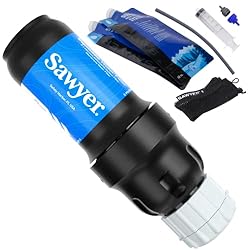
The Sawyer Squeeze is the workhorse of off-grid portable filtration for good reason — it filters down to 0.1 microns absolute, handles bacteria, protozoa, and microplastics, and the hollow-fiber membrane is rated for 100,000 gallons. At roughly 3 ounces, it packs into any kit without a second thought.
Best for: Solo users, couples, and anyone who needs a lightweight daily-driver filter for creek, spring, or rainwater catchment.
Pros:
– 0.1-micron absolute filtration removes 99.99999% of bacteria and 99.9999% of protozoa per manufacturer testing
– Rated for 100,000 gallons — effectively a lifetime filter for most off-grid users
– Versatile setup: inline, squeeze pouch, gravity-fed with adapters, or directly on a hydration bladder
Cons:
– Included squeeze pouches are flimsy and tear at the seams; most experienced users replace them with CNOC Vecto bags or smartwater bottles
– Must be protected from freezing — ice crystals compromise the hollow fibers with no visible indication of damage
Platypus GravityWorks 4L Complete Kit
Off-Grid Insider
Get off-grid guides & gear picks in your inbox — free

If you want hands-free filtration at a cabin or basecamp, this is the system to beat. Hang the dirty reservoir, walk away, and come back to 4 liters of clean water in about 2.5 minutes — no pumping, no squeezing, no effort.
Best for: Families, groups, or anyone running a gravity fed water filter for homestead daily use where convenience matters more than packability.
Pros:
– True gravity-fed operation — fill, hang, and forget
– 4-liter capacity handles cooking, drinking, and washing needs for a small household
– Hollow-fiber filter (0.2 microns) is backflushable and rated for 1,500 liters before cleaning is needed
Cons:
– Bulkier than squeeze-style filters — not ideal for mobile use or bug-out bags
– Hose connections can loosen over time; carry a small hose clamp as backup
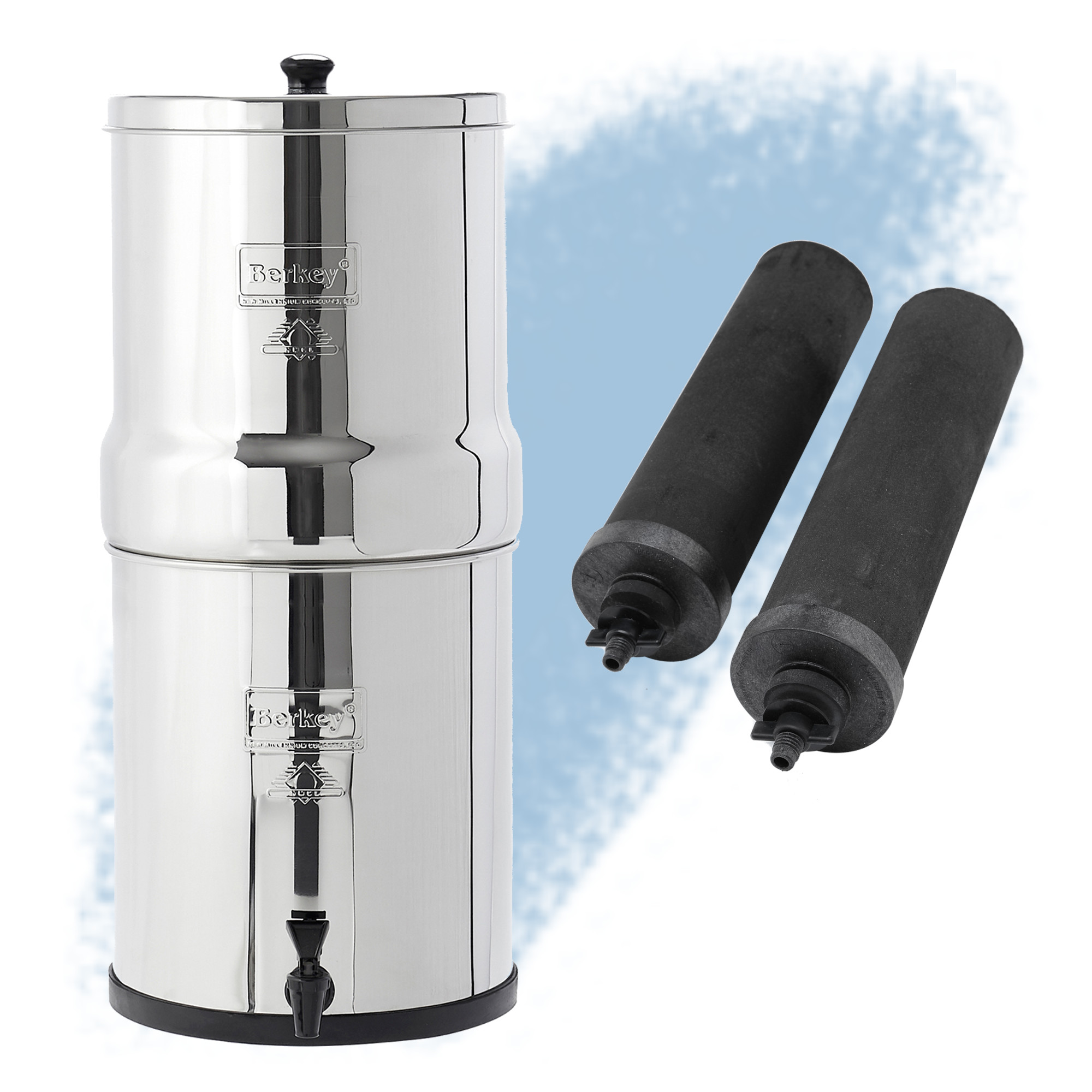
Katadyn Pocket Water Filter

The Katadyn Pocket is the overbuilt tank of portable water filters. Its silver-impregnated ceramic element is rated for 13,000 gallons, it comes with a 20-year manufacturer warranty, and the all-metal housing can handle drops onto rock without cracking. This is the filter you buy once and hand down to your kids.
Best for: Long-term off-grid residents and preppers who want a single filter purchase that outlasts everything else in their kit.
Pros:
– 13,000-gallon ceramic element — the highest-capacity portable filter we found at this size
– 0.2-micron ceramic filtration with silver impregnation to prevent bacterial growth inside the element
– 20-year warranty backs up the longevity claim; military and expedition teams have relied on this design for decades
Cons:
– Heavy at 20 ounces — this is a basecamp filter, not a daypack filter
– Pump action requires real effort, especially as the ceramic element loads up; expect 1 liter per minute initially, dropping over time before cleaning
MSR Guardian Purifier

The Guardian is the only portable pump filter we’ve found that meets the NSF P248 military standard for water purification — meaning it handles viruses in addition to bacteria and protozoa. If you’re pulling water from sources with potential human waste contamination (livestock ponds, downstream of settlements, flood runoff), this is the filter that actually purifies.
Best for: Off-gridders sourcing water from high-risk or unknown sources where viral contamination is a realistic concern.
Pros:
– Meets NSF Protocol 248 — removes viruses, bacteria, protozoa, and particulates in a single pass
– Self-cleaning mechanism on every pump stroke extends cartridge life and maintains flow rate
– 2.5 liters per minute flow rate — fastest pump purifier in its class
Cons:
– Expensive — typically $300+, making it the priciest option on this list by a wide margin
– At 17.3 ounces, it’s heavy for mobile use; better suited as a dedicated station filter

Survivor Filter PRO
The Survivor Filter PRO punches well above its price with a triple-stage filtration system: a pre-filter, carbon filter, and 0.01-micron ultra-filter membrane. For under $50, you get virus-level filtration in a compact, hand-pump package.
Best for: Budget-conscious off-gridders and preppers who want multi-stage protection without the MSR Guardian price tag.
Pros:
– Triple-stage filtration including a 0.01-micron ultra filter — one of the finest filtration ratings in portable systems
– Individually replaceable filter stages keep long-term costs low
– Compact and lightweight at 6.2 ounces — easy to stash in any bag
Cons:
– 500ml per minute flow rate is slower than competitors — fine for personal use, tedious for group filtering
– Carbon filter needs replacement every 2,000 liters, adding ongoing cost that the upfront price doesn’t reflect
LifeStraw Mission 12L Gravity Purifier

The Mission 12L is built for groups, work crews, and families who need high-volume gravity filtration. Its 12-liter capacity and hollow-fiber membrane can produce enough clean water for 10+ people per fill, and the collapsible reservoir packs flat when you’re not using it.
Best for: Large families, community water stations, or seasonal camps where volume matters most.
Pros:
– 12-liter capacity — by far the highest volume gravity filter on this list
– 0.02-micron hollow-fiber membrane meets EPA standards for bacteria and protozoa removal
– Collapsible design stores flat; weighs under 12 ounces empty
Cons:
– Takes 15-20 minutes to filter a full 12-liter fill — you need to plan ahead
– Does not remove viruses or chemicals; for high-risk sources, pair it with chemical treatment
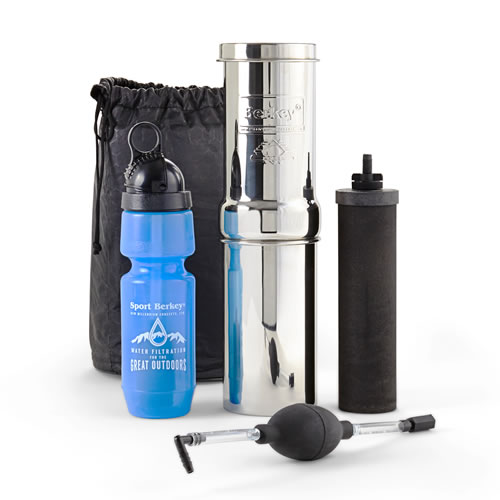
Berkey Go Berkey Kit

The Go Berkey brings the gravity-fed Berkey experience into a portable, single-person format. Its Black Berkey purification element handles bacteria, viruses, pharmaceuticals, and heavy metals — a broader contaminant removal profile than any hollow-fiber filter on this list.
Best for: Solo off-gridders who want chemical and heavy metal removal in addition to biological filtration, particularly those drawing from well water or questionable ground sources.
Pros:
– Black Berkey element removes viruses, heavy metals, pharmaceuticals, and VOCs — far beyond what hollow-fiber filters address
– 1-gallon stainless steel housing doubles as a clean water container
– Each element is rated for 3,000 gallons before replacement
Cons:
– Slow — gravity flow through the purification element produces roughly 1 gallon per hour
– Stainless housing makes it heavier and bulkier than soft-sided gravity systems; this is a cabin-counter filter, not a trail filter
How We Chose
We started by compiling every portable water filter with a meaningful presence in off-grid, homesteading, and prepper communities — forums, Reddit threads, YouTube long-term reviews, and verified purchase feedback on major retailers. We cross-referenced manufacturer specs (micron rating, flow rate, filter capacity, certifications) against real-world reports of failures, clogging, and durability issues. We prioritized systems with transparent third-party testing or recognized certifications (NSF, EPA protocol compliance). Finally, we weighted for off-grid-specific factors: Can it run without electricity? Is it field-serviceable? Does it work in freezing conditions? These criteria matter more for off-grid users than for weekend backpackers.
Buying Guide: What to Look For
Filtration Level: Filter vs. Purifier

This distinction matters. A filter (like the Sawyer Squeeze at 0.1 microns) removes bacteria and protozoa but not viruses. A purifier (like the MSR Guardian or Survivor Filter PRO) also handles viruses. For most off-grid freshwater sources in North America — springs, creeks, rainwater — a filter is sufficient. If you’re downstream of livestock, near human settlements, or traveling internationally, spend up for purification.
Flow Rate and Volume
Think about how many people you’re supporting. A Sawyer Squeeze at 1.7 liters per minute is fine for one or two people. A family of five filling cooking pots, water bottles, and wash basins needs the volume of a Platypus GravityWorks or LifeStraw Mission. Match the filter to your actual daily water demand — most off-grid households use 5-15 gallons per person per day when you include cooking and basic hygiene.
Filter Longevity and Replacement Cost
The upfront cost of a filter is only part of the equation. The debate around lifetime water filter vs Sawyer Squeeze off-grid usually comes down to the Katadyn Pocket (13,000 gallons, ceramic, field-cleanable) versus the Sawyer (100,000 gallons rated, but real-world reports suggest flow degradation well before that). Ceramic elements can be scrubbed and restored; hollow-fiber membranes cannot — once flow drops, backflushing only does so much. Factor in replacement element costs over 5-10 years of off-grid use, not just the sticker price.
Freeze Resistance

If you live anywhere with winter, this is non-negotiable. Hollow-fiber filters (Sawyer, Platypus, LifeStraw) are destroyed by a single hard freeze — and you won’t know it happened. The fibers develop micro-tears that pass pathogens without any visible change in flow. Ceramic filters (Katadyn Pocket) survive freezing. If your system lives in an unheated cabin or vehicle, ceramic is the safer bet, or you need a disciplined routine of bringing your filter inside every night.
Portable Filtration vs. Whole-House Systems
It’s worth understanding where portable filters fit in your overall water strategy. A portable system handles drinking and cooking water, but it won’t cover showers, laundry, or toilet flushing. For whole house water filtration off-grid living, you’re looking at permanently installed multi-stage systems — sediment pre-filters, carbon blocks, and UV sterilization — fed by well pumps or pressurized rainwater catchment. Many off-gridders run both: a whole-house sediment and carbon system for general use, plus a portable filter like the Sawyer or Berkey as a final-stage drinking water polisher or backup during system maintenance. The picks in this article are the portable side of that equation.
FAQ
What is the best portable water filter for off-grid living?
The Sawyer Squeeze is the best all-around portable water filter for off-grid use. It filters to 0.1 microns, weighs 3 ounces, costs under $40, and is rated for 100,000 gallons. It handles the vast majority of biological contaminants found in freshwater sources and adapts to squeeze, gravity, or inline setups.
Can you drink river water with a portable filter?
Yes, but only with a filter rated for at least 0.2 microns absolute (not nominal). This removes bacteria like E. coli and protozoa like giardia and cryptosporidium. If viral contamination is a concern — such as water downstream of human habitation — you need a purifier, not just a filter. The MSR Guardian and Survivor Filter PRO both handle viruses.
How long do portable water filters last off-grid?
It depends on the technology. Hollow-fiber filters like the Sawyer Squeeze are rated for 100,000 gallons but may lose flow rate after several thousand gallons of turbid water. Ceramic filters like the Katadyn Pocket are rated for 13,000 gallons and can be physically scrubbed to restore flow. Carbon elements in systems like the Survivor Filter PRO need replacement every 2,000 liters. Plan for the filter medium that matches your maintenance tolerance.
Is a gravity water filter better than a pump filter for homesteading?
For stationary homestead use, gravity filters are generally better because they require no effort and can process water unattended. A gravity fed water filter for homestead use — like the Platypus GravityWorks or LifeStraw Mission — lets you fill the dirty bag, hang it, and walk away. Pump filters make more sense for mobile use or when you need to pull water from shallow sources where you can’t submerge a bag.
Do portable water filters remove chemicals and heavy metals?
Most portable filters do not. Standard hollow-fiber and ceramic filters remove biological contaminants but pass chemicals, heavy metals, pesticides, and pharmaceuticals through. The Berkey Go Kit with its Black Berkey element is the notable exception on this list — it’s designed to reduce heavy metals, VOCs, and pharmaceuticals. If chemical contamination is a concern for your water source, get your water tested and consider adding a carbon or specialized media stage to your system.
Our Verdict
For most off-grid users, the Sawyer Squeeze is the filter to start with — it’s light, cheap, effective against biological threats, and adapts to almost any setup from squeeze bags to gravity rigs. If you’re filtering for a family at a fixed location, step up to the Platypus GravityWorks 4L for hands-free convenience. And if you want to buy one filter and never think about it again, the Katadyn Pocket with its 20-year warranty and field-cleanable ceramic element is the buy-it-for-life choice. Whatever you pick, get it before you need it — filtering muddy creek water through a bandana is not a plan.