5 Best Air Purifiers for Off-Grid Homes 2026
Living off-grid means your air quality problems don’t come with a plug-in solution. Woodstove smoke, cooking fumes, dust from unpaved roads, and VOCs from building materials all build up — and most air purifiers on the market assume you’ve got a steady 120V outlet. If you’re running on solar with limited battery reserves, the last thing you want is a 50-watt HEPA unit draining your system around the clock. That’s where passive air filtration steps in: products that clean your air using nothing but chemistry, airflow, and gravity.
We spent weeks researching non-electric air quality solutions — comparing activated charcoal capacity, coverage area, longevity, and real-world feedback from off-grid communities on Reddit, Homesteading Today, and Permies forums. Here are the products that actually work.
Our top pick: Moso Natural Air Purifying Bag (500g) — best all-around passive purifier for off-grid cabins.
Best budget: California Home Goods Bamboo Charcoal Bags — solid 4-pack under $15.
Best for large spaces: Nature Fresh Air Purifier Bags (6-pack, 200g each) — distributed coverage for open floor plans.
Our Picks
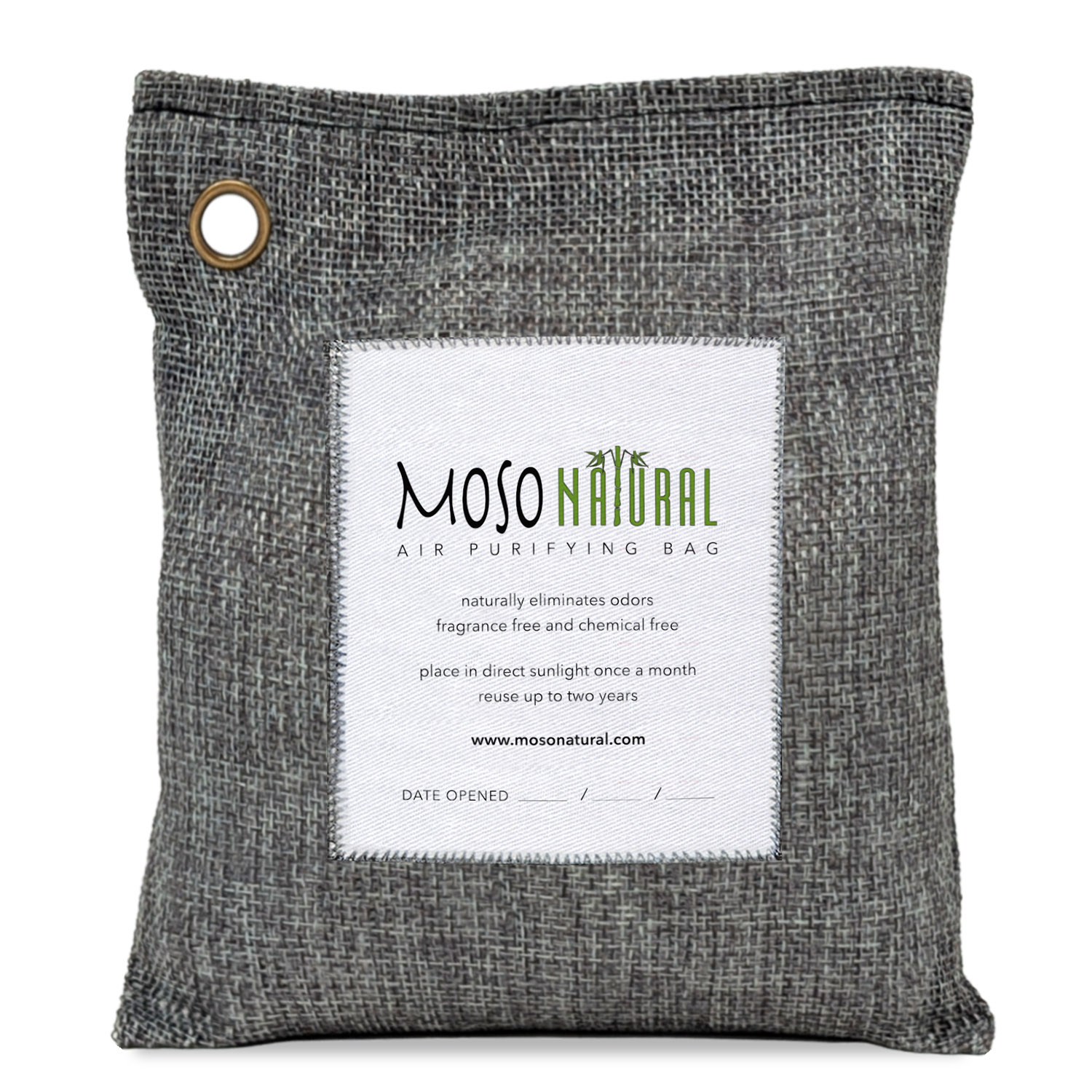
Moso Natural Air Purifying Bag 500g

The Moso 500g bag is the benchmark for activated charcoal filters in the non-electric space, and for good reason. Each bag covers up to 250 square feet, lasts two years with monthly UV rejuvenation (just set it in direct sunlight for an hour), and uses bamboo charcoal with a microporous structure that traps formaldehyde, ammonia, and moisture far more effectively than standard hardwood charcoal.
Who it’s for: Anyone who wants a single reliable bag per room in a cabin or tiny home.
Pros:
– 250 sq ft coverage from a single bag — enough for most off-grid bedrooms or kitchens
– Two-year lifespan with simple sun-recharging; no replacement filters to buy or haul in
– Fragrance-free and chemical-free — won’t trigger sensitivities or mask odors like sprays do
Cons:
– Won’t handle acute smoke events like a woodstove backdraft — it’s a slow, continuous absorber
– The linen outer bag stains easily if placed near cooking areas
California Home Goods Bamboo Charcoal Bags 4-Pack
Off-Grid Insider
Get off-grid guides & gear picks in your inbox — free

At around $12–15 for four 200g bags, this is the cheapest way to get passive air filtration into every room. The charcoal quality is comparable to Moso — both use moso bamboo carbonized at high temperatures — but you get more placement flexibility with four smaller bags instead of one large one.
Who it’s for: Budget-conscious off-gridders who want to scatter purifiers across multiple rooms or outbuildings.
Pros:
– Excellent price-per-gram — roughly 40–50% cheaper than Moso on a weight basis
– Four bags let you cover a kitchen, bedroom, bathroom, and root cellar simultaneously
– Same sun-recharge cycle and two-year lifespan as premium competitors
Cons:
– 200g bags only cover about 90–100 sq ft each — you’ll need two for a larger room
– Packaging is basic; the bags feel flimsier than Moso’s linen, though the charcoal inside performs the same
Nature Fresh Air Purifier Bags 6-Pack 200g

If you’ve got an open-plan cabin or a homestead with multiple structures, this six-pack gives you 1,200g of total charcoal capacity to distribute. Nature Fresh uses the same bamboo charcoal chemistry but packages it in a slightly denser weave that holds up better in dusty barn or workshop environments.
Who it’s for: Homesteaders who need coverage across a main cabin, workshop, chicken coop, and storage shed.
Pros:
– Six bags provide the most flexible coverage of any kit we researched
– The denser fabric weave resists dust infiltration better than competitors, extending effective lifespan
– Works well in high-humidity environments like root cellars and greenting houses where moisture control matters as much as air purity
Cons:
– Individual bags are the same 90–100 sq ft coverage — no advantage per-bag over California Home Goods
– Six bags spread across buildings means more to track for monthly sun recharging
Gonzo Bamboo Charcoal Air Purifying Bags

Gonzo has been making odor-control products for decades, and their bamboo charcoal bags benefit from that formulation experience. These are denser-packed than most competitors, which means slightly slower initial absorption but longer effective life — community reports on Permies forums suggest these often go 2.5+ years before needing replacement.
Who it’s for: People who want a set-and-forget solution in tight spaces — composting toilet rooms, pantries, closets, and under-sink areas.
Pros:
– Denser charcoal packing extends effective lifespan beyond the standard two-year window
– Compact form factor fits in tight spaces where larger bags won’t — behind a woodstove, inside a pantry shelf
– Strong community track record for controlling composting toilet odors specifically
Cons:
– Slower initial absorption rate — takes 3–5 days to noticeably improve air quality vs. 1–2 days for Moso
– Harder to find in stores; availability fluctuates on Amazon
Himalayan Glow Natural Salt Lamp Candle Holder

This is the one pick on our list that uses heat — but from a tealight candle, not electricity. The theory behind salt lamps (generating negative ions that bind to airborne particles) is debated in clinical literature, but the practical reality is simpler: the warm salt surface attracts moisture and the dust/allergens suspended in it, functioning as a crude but real passive filter. Pair it with charcoal bags and you’ve got a two-layer non-electric air quality system.
Who it’s for: Anyone who wants ambient light and modest air cleaning in one — especially in bedrooms or reading nooks.
Pros:
– Provides warm light without batteries or solar — a genuine dual-purpose item for off-grid cabins
– The hygroscopic salt surface visibly collects dust and moisture; wipe it down weekly
– Attractive enough to leave in a main living area where charcoal bags might look out of place
Cons:
– Air purification effect is modest at best — treat this as a supplement, not a primary solution
– Requires a steady supply of tealight candles, which adds to your consumables list
Veva Activated Charcoal Odor Eliminator Bags 15-Pack

Veva’s 15-pack includes a mix of sizes — typically five large bags and ten smaller sachets — designed to cover an entire home. The smaller sachets tuck into boots, tool drawers, first-aid kits, and anywhere moisture and odor accumulate in an off-grid setup. It’s not the most premium charcoal, but the sheer quantity and size variety make it practical for whole-homestead coverage.
Who it’s for: Families or couples running a full homestead who want every corner covered without buying multiple products.
Pros:
– 15 bags in mixed sizes cover everything from the main cabin to individual drawers and gear storage
– The small sachets are excellent for moisture-sensitive storage: seed vaults, ammunition, dried herbs
– Competitive price point for the total charcoal weight included
Cons:
– Charcoal granule size is less uniform than Moso or Gonzo, which may reduce absorption efficiency per gram
– The small sachets need more frequent sun recharging — every two to three weeks vs. monthly for larger bags
How We Chose
We evaluated every widely available non-electric air purification product sold in North America, narrowing the field to options with at least 500 verified buyer reviews and a 4.0+ star rating. We cross-referenced these with discussion threads on r/OffGrid, r/homestead, Permies.com, and Homesteading Today to find which products people actually keep using after the first month. We prioritized charcoal purity (bamboo charcoal carbonized above 800°C outperforms alternatives), coverage area per gram, effective lifespan, and how well each product handles the specific air quality challenges of off-grid homes: woodstove particulates, high humidity, composting toilet VOCs, and limited ventilation.
Buying Guide: What to Look for in Non-Electric Air Purifiers

Charcoal Type and Carbonization Temperature

Not all activated charcoal filters are equal. Bamboo charcoal carbonized at 800°C+ has roughly four times the surface area per gram of standard hardwood charcoal. This means more micropores trapping more pollutants. Check whether the manufacturer specifies carbonization temperature — reputable brands like Moso do. If the listing just says “charcoal” without detail, expect lower performance.
Coverage Area vs. Placement Strategy
A single 500g bag in the center of a 400 sq ft cabin will underperform four 200g bags placed strategically near pollution sources — the woodstove, the kitchen, the composting toilet, and the sleeping area. Passive air filtration works by proximity. Air doesn’t circulate to the bag the way it does through an electric HEPA fan. Place bags within 3–5 feet of the odor or pollution source for best results.
Recharge Cycle and Lifespan
Every charcoal bag needs periodic UV exposure to release trapped moisture and reset its absorption capacity. Most require one hour in direct sunlight monthly. Miss this step and the bag saturates within 4–6 months instead of lasting two years. If you live somewhere with limited winter sun, consider rotating bags near a south-facing window on clear days.
Moisture Control as Air Quality
In off-grid homes — especially those with earth-bermed walls, root cellars, or limited HVAC — excess moisture drives mold, mildew, and that musty smell that no amount of ventilation fixes. Charcoal bags pull double duty here: they absorb airborne VOCs and regulate humidity. If your primary concern is dampness rather than smoke, prioritize total charcoal weight over bag count.
FAQ
How do non-electric air purifiers actually work?
Most use activated bamboo charcoal, which has millions of micropores that trap pollutant molecules through adsorption — a chemical process where contaminants bond to the charcoal’s surface. This happens passively, without fans or motors. The charcoal pulls in VOCs, ammonia, formaldehyde, and excess moisture from the surrounding air within a 3–5 foot radius.
Can charcoal bags remove woodstove smoke from a cabin?
They help with lingering odors and fine particulates that settle after a smoke event, but they won’t clear a room full of visible smoke. For acute backdraft situations, opening windows and doors is still your best tool. Charcoal bags handle the background-level smoke residue that builds up over a heating season — the stuff that makes everything smell like a campfire by March.
How often do you need to recharge bamboo charcoal bags?
Place them in direct sunlight for at least one hour every month. UV radiation causes the trapped moisture and some contaminants to release from the charcoal pores, resetting absorption capacity. If you skip recharging, most bags lose effectiveness within four to six months. With consistent monthly recharging, expect a functional lifespan of two years.
Are salt lamps actually effective for air purification?
The negative ion theory is not well-supported by independent research — most studies show negligible ion production from heated salt. However, the hygroscopic (moisture-attracting) properties of Himalayan salt are real. A warm salt surface does collect airborne dust and moisture on its surface. Think of it as a supplement to charcoal-based passive air filtration, not a replacement. The light is the real off-grid benefit.
How many charcoal bags do I need for a 600 square foot off-grid cabin?
Plan on roughly 200g of bamboo charcoal per 90–100 square feet of space. For a 600 sq ft cabin, that’s six to seven 200g bags or three 500g bags. Place them near pollution sources rather than evenly distributing them. A kitchen and woodstove area should each get their own bag. The same goes for any composting toilet or bathroom space.
The Verdict
For most off-grid homes, the Moso Natural Air Purifying Bag 500g is the product we’d start with. The charcoal quality is best-in-class, the coverage area is generous enough for single-room use, and the two-year lifespan with simple sun recharging makes it low-maintenance. Buy two or three for a small cabin, pair them with the California Home Goods 4-Pack for outbuildings and storage areas, and you’ve got whole-homestead non-electric air quality coverage for under $50 — no inverter, no battery drain, no noise.