LifeStraw Community 2026: We Tested It
LifeStraw Community Review — 2025: The Best Off-Grid Group Filter That Isn’t for Everyone
If you’re running a homestead, prepping a retreat for a small community, or building a disaster-ready water station, the LifeStraw Community does something almost no competing gravity filter can: it removes viruses. At 0.02 micron ultrafiltration, it’s in a different technical league than the Sawyer Squeeze, Platypus GravityWorks, or even most Berkey configurations. That single capability — genuine virus removal with zero electricity — makes it the go-to filter for high-risk source water or international deployments. But at $379 MSRP, with a 1-year warranty, a non-return policy, and documented issues with chemical taste out of the box, it demands careful consideration before you pull the trigger.
| Best For | Off-grid homesteads, small communities, and disaster prep stations needing virus-rated group filtration without electricity |
| Avoid If | You need chemical or heavy metal removal, portability, or are sourcing from municipal water |
| Street Price | ~$350–$379 |
| Warranty | 1 year |
Check Current Price on Amazon →
As an Amazon Associate, OffGridFoundry earns from qualifying purchases.
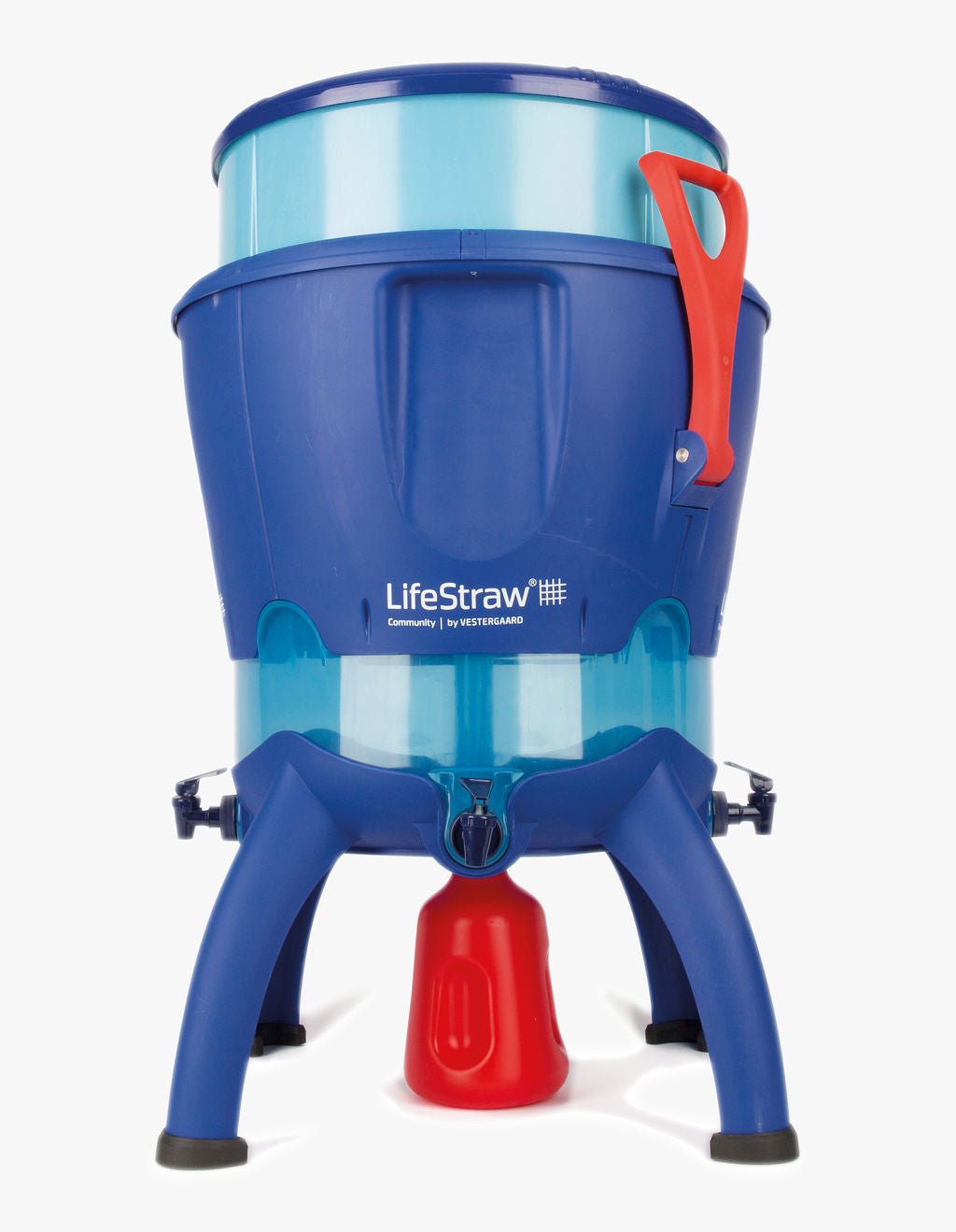
The LifeStraw Community earns its place as the benchmark off-grid group filter because its 0.02 micron hollow-fiber membrane is one of the few consumer-accessible options that legitimately eliminates viruses — 99.999% log-5 removal, validated by WHO, EPA protocol testing, and NSF/ANSI P231 compliance. For a homestead drawing from a pond, stream, rainwater cistern, or compromised well, that distinction matters. Its 26,000-gallon filter life means a family of four could run it for decades before replacing the membrane. The gravity-fed design, four simultaneous taps, and 25-liter clean-water storage tank make it a practical, no-fuss daily-use system. The caveats are real but manageable: it won’t touch chemicals, heavy metals, or off-flavors, and a subset of buyers have reported persistent chemical taste on first use — a significant problem given the product is non-returnable.
What We Like
- Genuine virus removal at 0.02 micron — Removes 99.999% of viruses (rotavirus, norovirus) and 99.999999% of bacteria. Most gravity filters on the market — Sawyer, Platypus, MSR Trail Base — stop at 0.1–0.2 micron and cannot filter viruses. This is the Community’s defining advantage.
- 26,000-gallon filter lifetime — That’s 100,000 liters before the membrane needs replacement. At 10 gallons per day for a family, you’re looking at 7+ years of use. Far outlasts the Platypus GravityWorks (~396 gallons) and more than quadruples the Berkey Black Elements’ 6,000-gallon pair rating.
- Zero electricity, zero consumables — Fully gravity-fed. No pump, no batteries, no chemical tablets. Fill the 25L dirty-water reservoir, walk away, collect clean water from any of four taps. In a grid-down scenario, it keeps working indefinitely.
- Fail-safe end-of-life design — When the membrane reaches rated capacity, pores naturally clog and flow stops rather than passing contaminated water. This passive safety mechanism is especially valuable in community or unmonitored deployments.
- Four simultaneous taps + 25L clean storage — The multi-tap design enables real community throughput. At 12 liters per hour, the system can serve 75–100 school children per day per LifeStraw’s field deployment data — credible given the storage capacity.
- Third-party certified — WHO “highly protective” household water treatment classification, EPA protocol, and NSF/ANSI P231. The certifications are cleaner and more independently verified than some competing claims in this category.
What We Don’t Like
- No chemical or heavy metal filtration — The 0.02 micron UF membrane removes biological threats but is blind to pesticides, herbicides, industrial runoff, lead, arsenic, and fluoride. For a homestead with agricultural neighbors or older plumbing, this is not a complete solution without a pre- or post-treatment stage.
- Chemical taste and odor on first use — This is documented across multiple owner reports. New units — and units stored dry for an extended period — can produce filtered water that smells and tastes of chemicals, believed to be off-gassing from food-grade plastics or manufacturing residue. The manufacturer’s recommended bleach wash does not always resolve it. Given that the product is explicitly non-returnable on LifeStraw.com, this is a meaningful financial risk.
- Membrane drying kills the filter — If the hollow-fiber membrane dries out between uses (during storage or after the unit sits idle for weeks), flow drops dramatically and may become permanently impaired. Long-term storage requires specific prep: keeping the membrane wet or using glycerin treatment per manufacturer instructions. This isn’t widely communicated at point of sale.
- No taste or odor improvement — Single-stage UF with no activated carbon means turbid, mineral-heavy, or organically tainted water will taste exactly the same coming out as going in — just safe. The LifeStraw Go filter bottle’s dual-stage design addresses this; the Community does not.
- 1-year warranty for a $379 fixed installation — For a stationary community system priced at nearly $400, a 1-year warranty is thin. The replacement membrane cartridge runs ~$90–$120 separately, adding to total cost of ownership. Customer service responsiveness for the Community model has been reported as slow to nonexistent in documented cases.
- Non-returnable policy — Per the official LifeStraw site, the Community is not eligible for returns. Combined with the documented taste/odor risk on first use, buyers have limited recourse if the unit arrives with problems.
Specs That Matter
Off-Grid Insider
Get off-grid guides & gear picks in your inbox — free
| Spec | Value |
|---|---|
| Filtration technology | Ultrafiltration (UF) hollow-fiber membrane |
| Pore size | 0.02 micron |
| Bacteria removal | 99.999999% (8-log) |
| Virus removal | 99.999% (5-log) |
| Protozoa/parasite removal | 99.999% (5-log) |
| Microplastics removal | 99.999% (5-log) |
| Chemical/heavy metal removal | None |
| Filter lifetime | 26,000 gallons (100,000 liters) |
| Flow rate | 12 liters/hour (gravity-fed) |
| Dirty-water reservoir | 25 liters |
| Clean-water storage | 25 liters |
| Number of taps | 4 simultaneous |
| Assembled dimensions | 22″ × 22″ × 33.5″ |
| Weight (empty) | 17 lbs (8 kg) |
| Power required | None |
| Certifications | WHO, US EPA protocol, NSF/ANSI P231 |
| Materials | BPA-free, FDA 21 CFR food-grade plastic |
| Replacement cartridge | Available separately (~$90–$120) |
Real-World Performance
Owner reports from forum threads and review aggregators reveal a consistent pattern: when the LifeStraw Community works, it works well. Field deployments in humanitarian contexts — sub-Saharan Africa, disaster relief operations — document reliable performance in high-turbidity, biologically contaminated water under demanding conditions. Homesteaders using it as a stationary filtration station fed from rainwater tanks or stream-fed reservoirs report that the four-tap design and 25-liter storage make it usable as a daily household system rather than an emergency-only item. The fill-and-forget gravity operation is consistently praised: fill the dirty reservoir, go about your day, collect clean water as needed.
The failure modes are concentrated in two areas. First, membrane management: the hollow-fiber membrane’s sensitivity to drying is the most frequently reported real-world issue. Owners who stored the unit in an outbuilding over winter, or took it out of long-term storage without proper rehydration, report flow rates dropping to a trickle or stopping entirely. This is recoverable in some cases — the manufacturer recommends a specific rehydration and backflushing protocol — but the instructions are not prominently documented and the issue catches owners off guard. The semi-automatic backflush handle addresses clogging from turbid source water, and regular users in sediment-heavy environments report needing to use it frequently. Second, the chemical taste issue on first use appears in a meaningful number of reports: this isn’t a fringe problem, and the combination of a non-returnable policy and slow customer service makes it a legitimate risk to factor into the purchase decision.
For off-grid homesteaders sourcing from biologically compromised but chemically clean water — a seasonal stream, a rainwater cistern, a shallow well with no agricultural runoff — the Community performs as advertised. For those drawing from sources with chemical contamination risk, the single-stage UF limitation is a genuine gap, not a minor asterisk.
Who Should Buy This
The LifeStraw Community is the right buy for a specific and well-defined buyer: a homestead, small retreat community, or disaster prep installation that needs stationary, electricity-free, virus-rated group filtration at a fixed location. If your source water is biologically suspect — a stream, pond, rainwater collection, or compromised shallow well — and you need a system that can passively serve multiple users across the day without monitoring, this is the most credible option in its category. The virus removal capability matters most in scenarios where source water may be contaminated with human or animal waste, which describes a large proportion of off-grid water sources globally and in post-disaster contexts domestically.
The 26,000-gallon membrane lifetime means that for a typical homestead family of four drawing 10–15 gallons per day for drinking and cooking, the filter represents a buy-once investment that could last a decade or more before membrane replacement. At $379 plus a ~$100 replacement cartridge down the road, the total cost of ownership per gallon is exceptionally low. The four simultaneous taps and 25-liter storage reservoir are genuine operational advantages when multiple family members or community members need access without queuing.
Who Should Look Elsewhere
If portability matters — for a bug-out bag, group camping, or a mobile retreat — the Community’s 17-pound footprint and 22″ × 22″ × 33″ assembled size make it a fixed installation, not a mobile asset. For those needs, the Sawyer Squeeze Water Filter (~$45) paired with a gravity bag delivers reliable 0.1-micron filtration at a fraction of the weight and cost, though without virus removal. For backpacking-scale groups, the Platypus GravityWorks 4L flows at roughly nine times the rate and weighs under 12 ounces.
If your source water has chemical contamination risk — agricultural runoff, industrial proximity, older infrastructure with lead pipes — the Community’s inability to filter chemicals or heavy metals is a hard limitation. In that scenario, a Big Berkey Water Filter (~$350–$450) with Black Berkey elements offers comparable virus-removal claims plus activated carbon for chemicals and heavy metals, making it the stronger permanent installation for homesteads with complex source water chemistry. Note that Berkey’s certification documentation has faced more scrutiny than LifeStraw’s third-party validated claims — but for chemical filtration, it remains the more complete system.
Bottom Line
The LifeStraw Community is the most capable virus-rated group water filter available at this price point, and for a stationary off-grid homestead or community drawing from biologically contaminated source water, it’s the clear choice. Buy it with eyes open: store it wet, follow the rehydration protocol if it sits idle, accept that it won’t address chemicals or improve taste, and order from a seller with favorable return policies given the documented first-use taste risk. For the buyer who fits the profile, it will likely be the last water filter purchase you make for a very long time.
“`
→ Buy the LifeStraw Community on Amazon