5 Best Solar Well Pumps for 2026
Finding a reliable solar well pump system shouldn’t require an engineering degree, but that’s exactly what it feels like when you start shopping. Between mismatched panels, undersized controllers, and pumps that can’t actually reach your water table, most off-grid property owners end up over-spending on a system that underdelivers — or worse, cobbling together components that were never designed to work together.
We spent weeks digging through manufacturer spec sheets, installer forums, and hundreds of verified buyer reports to find the best solar well pump systems that actually deliver water when you need it. Whether you’re pumping from a shallow hand-dug well or a 600-foot borehole, these are the systems worth your money.
Our top pick: RPS 200 — a complete, American-designed kit that covers most residential off-grid wells up to 200 feet. Best budget: ECO-WORTHY Deep Well Pump Kit — solid entry point for shallow wells under 150 feet. Best for deep wells: Grundfos SQFlex — the commercial-grade submersible that professionals trust for 600+ foot depths.
Our Picks
RPS 200 Solar Well Pump Kit

The RPS 200 is the system we recommend to most off-grid homesteaders, and it’s not close. It ships as a true complete kit — pump, controller, panels, wire, and hardware — so you’re not hunting for compatible parts or hoping your panel voltage matches your controller input.
Who it’s for: Homesteaders with wells 50–200 feet deep who want a plug-and-play system with real tech support.
Pros:
– Complete kit includes everything from panels to wire connectors — no guesswork on compatibility
– Brushless DC motor rated for 20+ year lifespan with zero maintenance
– US-based company with actual phone support (they’ll help you size the system before purchase)
Cons:
– Higher upfront cost than pieced-together systems (around $1,800–$2,200 depending on configuration)
– Panel rack not included — you’ll need to mount or ground-mount separately
Grundfos SQFlex Solar Submersible Pump
Off-Grid Insider
Get off-grid guides & gear picks in your inbox — free

If you need to pull water from serious depth, the Grundfos SQFlex is what well drillers and off-grid professionals actually install. This is a commercial-grade submersible that handles up to 650 feet of total dynamic head and runs on solar, wind, or generator power interchangeably.
Who it’s for: Properties with deep wells (200–600+ feet) or high-volume water demands like livestock operations.
Pros:
– Handles extreme depths that no consumer-grade solar pump can touch
– Multi-power input accepts solar panels, wind turbines, or AC generator without separate controllers
– Built-in dry-run protection prevents motor burnout if water level drops
Cons:
– Pump only — you’re sourcing panels, wiring, and mounting separately (or through an installer)
– Price point starts around $2,500 for the pump alone, pushing full system cost to $4,000+
ECO-WORTHY Solar Deep Well Pump Kit
For shallow wells under 150 feet, the ECO-WORTHY kit delivers surprisingly strong performance at roughly half the cost of premium systems. The 24V DC submersible pump pairs with included solar panels and a basic controller, making it a legitimate entry-level solar well pump system for budget-conscious homesteaders.
Who it’s for: Budget-minded off-gridders with shallow wells (under 150 feet) who want a functional starter system.
Pros:
– Full kit with panels typically runs under $800 — the lowest cost of entry on this list
– 24V DC pump is efficient enough to run on two 100W panels in partial sun
– 3-inch diameter fits standard 4-inch well casings with room for the safety rope
Cons:
– Flow rate drops significantly past 100 feet — not ideal for deep wells
– Controller is basic with no built-in low-water shutoff (add a float switch yourself for ~$20)
Shurflo 9300 Solar Well Pump

The Shurflo 9300 has been a staple in the off-grid water community for years, and for good reason. It’s a slow-and-steady workhorse — a diaphragm pump that delivers about 1 GPM at up to 230 feet of lift, running directly off a single solar panel with no controller required.
Who it’s for: Cabins, tiny homes, or seasonal properties with moderate water needs and wells under 230 feet.
Pros:
– Runs directly from a single solar panel — no controller, no batteries, no complexity
– Self-priming diaphragm design handles sediment and small particles better than centrifugal pumps
– Field-serviceable with readily available rebuild kits (around $60–$80)
Cons:
– Flow rate maxes out around 1 GPM — too slow for high-demand households
– Diaphragm is a wear part that needs replacement every 3–5 years depending on sediment levels
DCHOUSE Solar Well Pump Kit
The DCHOUSE kit slots between the ECO-WORTHY budget option and the RPS premium tier. It includes a 400W submersible pump, MPPT controller, and panels — and buyer reports consistently note that the MPPT controller makes a noticeable difference in cloudy-day performance compared to cheaper PWM units.
Who it’s for: Mid-budget buyers who want better cloudy-day performance than entry-level kits without jumping to the $2,000 price tier.
Pros:
– Included MPPT controller extracts more power in low-light conditions than PWM alternatives
– Stainless steel pump body resists corrosion in mineral-heavy well water
– Kit is available in multiple configurations for wells from 100–300 feet
Cons:
– Documentation is thin — expect to reference YouTube install videos rather than the manual
– Customer support response times are inconsistent based on buyer feedback
Sunrotor Solar Well Pump
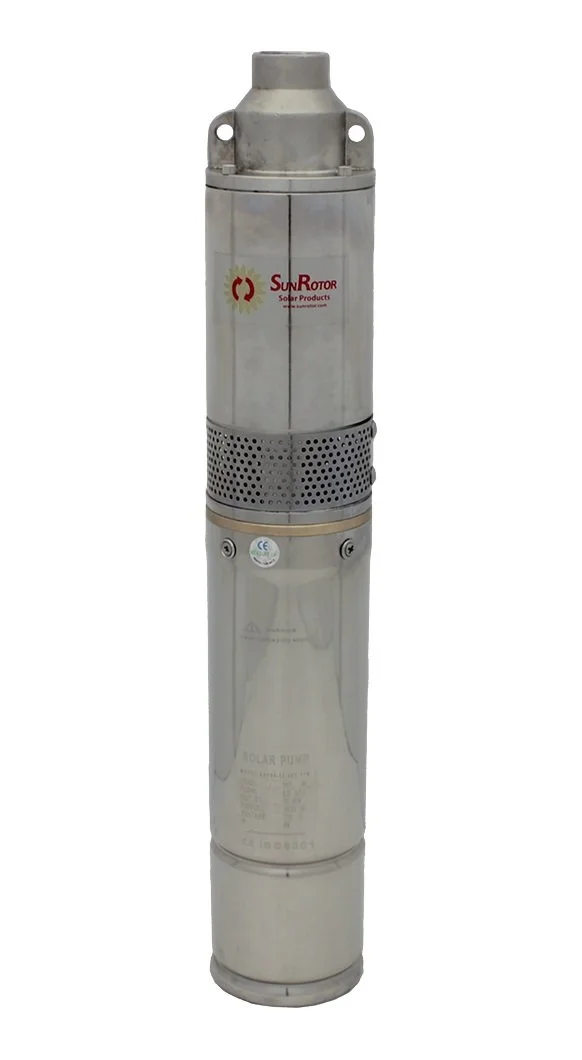
Sunrotor is another US-based manufacturer that builds pumps specifically for solar direct-drive applications. Their helical rotor design is inherently more efficient than centrifugal pumps at low flow rates and high heads, making them a strong pick for deep, narrow wells where you don’t need high volume.
Who it’s for: Off-gridders with deep, low-yield wells who prioritize efficiency and longevity over flow rate.
Pros:
– Helical rotor design delivers consistent output even at 300+ feet without oversized panel arrays
– All stainless steel construction with no wearing seals or diaphragms to replace
– Direct-drive design (no controller needed) simplifies installation
Cons:
– Flow rates are modest (0.5–2 GPM depending on depth) — pair with a storage tank for peak demand
– Smaller company means limited dealer network for hands-on support
VEVOR Solar Submersible Well Pump

VEVOR’s solar well pump has become the go-to “just get water flowing” option for budget builds, and the sheer volume of buyer reviews gives us a solid data set. It’s a basic DC submersible that gets the job done for shallow applications, but you should go in with realistic expectations.
Who it’s for: DIYers on a tight budget who need water from a shallow well (under 100 feet) and don’t mind basic build quality.
Pros:
– Lowest price point on this list — often under $300 for the pump and controller
– Huge aftermarket availability means easy replacement parts
– Works with panels you may already own (12V/24V DC input)
Cons:
– Build quality is visibly cheaper than RPS or Grundfos — expect a shorter service life
– Pump performance claims in the listing often exceed real-world output by 20–30% based on buyer reports
How We Chose
We cross-referenced manufacturer specifications with verified buyer feedback across Amazon, off-grid forums (particularly r/OffGrid, r/SolarDIY, and HomesteadingToday), and installer recommendations from certified well professionals. We weighted total system completeness heavily — a pump that ships without a compatible controller or properly sized panels isn’t really a “system.” We also prioritized products with documented long-term reliability from multiple independent sources rather than relying on any single reviewer or marketing claim.
Buying Guide: What Actually Matters in a Solar Well Pump System
Total Dynamic Head (TDH) — Not Just Well Depth
Your well might be 150 feet deep, but your pump needs to push water beyond that — up through piping, through any elevation changes, and past friction losses. Calculate your TDH by adding static water level + vertical rise to your tank + friction loss (roughly 5% of total pipe run). Undersizing here is the single most common mistake in solar well pump installations.
Flow Rate vs. Storage Strategy
Most solar well pumps produce 1–5 GPM — far less than a conventional AC pump. That’s fine if you pair the system with a properly sized storage tank (we recommend 2–3 days of water storage minimum). The pump fills the tank slowly throughout sunny hours, and you draw from the tank on demand. Trying to run a solar pump as an on-demand pressure system without storage is a recipe for frustration.
Panel Sizing and Direct-Drive vs. Battery-Backed

Direct-drive systems (pump runs only when the sun shines) are simpler, cheaper, and have fewer failure points. Battery-backed systems let you pump at night or during extended cloud cover but add cost, complexity, and another component that eventually needs replacement. For most off-grid wells, direct-drive with adequate storage is the smarter play. Size your panels at 1.5x the pump’s rated wattage to ensure adequate power even in suboptimal conditions.
System Completeness and Compatibility
A “solar well pump kit” means wildly different things across brands. Some include everything down to the wire nuts. Others ship a bare pump and call it a “system.” Before buying, verify exactly what’s included: pump, controller (if needed), panels, wiring, and mounting hardware. Mismatched voltage between panels and pump is a common and expensive mistake.
FAQ
How deep can a solar well pump push water?
Most residential solar well pump systems handle wells between 100 and 400 feet. High-end commercial units like the Grundfos SQFlex can reach 650+ feet. Your real limiting factor is the panel array size — deeper wells need more power to lift water, so budget for additional panels as depth increases.
How many solar panels do I need to run a well pump?
For a typical residential solar well pump system drawing from 100–200 feet, two to four 100-watt panels are standard. Deeper wells or higher-volume pumps may need 600–1,000 watts. Always check the pump manufacturer’s minimum and recommended wattage — running a pump on insufficient power causes strain and premature failure.
Can a solar well pump work on cloudy days?
Yes, but with reduced output. An MPPT controller helps extract maximum power in low-light conditions. Direct-drive pumps will slow down or stop during heavy overcast, which is why we stress pairing any solar well pump system with a storage tank. On an average partly cloudy day, expect about 50–70% of rated output.
Do solar well pumps work in winter?
Solar well pumps operate year-round as long as panels receive sunlight and the well and piping don’t freeze. Shorter winter days mean less pumping time, so increase your storage capacity if you’re in a northern climate. Burying supply lines below the frost line and insulating exposed piping are non-negotiable for cold-climate installations.
How long does a solar well pump last?
Brushless DC submersible pumps (like the RPS 200 and Grundfos SQFlex) typically last 15–25 years based on manufacturer data and long-term user reports. Diaphragm pumps like the Shurflo 9300 have a shorter rebuild cycle (3–5 years for the diaphragm) but the motor itself lasts much longer. Budget pumps from VEVOR or no-name brands generally show higher failure rates after 3–5 years of continuous use.
The Verdict
For most off-grid homesteaders, the RPS 200 Solar Well Pump Kit remains our top recommendation. It’s a complete system with reliable components, real tech support, and a track record across thousands of off-grid installations. If you’re on a tighter budget and have a shallow well, the ECO-WORTHY kit gets water flowing without breaking the bank. And if your well goes deep, the Grundfos SQFlex is the professional’s choice for a reason — nothing else in the residential-accessible market matches its depth capability and multi-source power flexibility.