5 Best Mobile Hotspots for Rural 2026
If you’ve ever tried to get reliable internet on a rural property, you already know the frustration. DSL tops out at 3 Mbps (if it’s available at all), satellite has brutal latency, and the nearest cable drop might as well be on Mars. A mobile hotspot is often the only realistic path to usable internet — but picking the wrong one means dead zones, throttled speeds, and money wasted on hardware that can’t pull a signal where you actually need it.
We spent weeks digging through spec sheets, FCC filings, carrier coverage maps, and hundreds of verified buyer reviews from people actually living on rural acreage — not testing from a suburban backyard. Here’s what we found.
Our top pick: Netgear Nighthawk M6 Pro — the best mobile hotspot for rural property overall, with excellent antenna ports and carrier flexibility.
Best for fixed wireless setups: Pepwave MAX BR1 Pro 5G — overkill for casual use, but unmatched if you need rock-solid connectivity on remote land.
Best budget option: T-Mobile 5G Gateway (T-Mobile Home Internet) — cheapest path to usable rural internet if T-Mobile covers your area.
Best pocket hotspot: Inseego MiFi X PRO 5G — portable with strong band support.
Best for weak signal areas: MOFI5500-4GXeLTE — purpose-built for fringe coverage with external antenna support that actually matters.
Our Picks
Netgear Nighthawk M6 Pro

The Nighthawk M6 Pro is the mobile hotspot we recommend to most rural property owners. It supports both Sub-6 and mmWave 5G plus full 4G LTE fallback, and — critically — it has two TS-9 external antenna ports, which is the single most important feature for anyone dealing with marginal signal on a rural homestead.
Best for: Property owners who want a portable unit that can also serve as a semi-permanent home internet solution with external antennas.
Pros:
– Dual TS-9 external antenna connectors let you attach a high-gain directional or MIMO antenna, often turning an unusable signal into a workable 20–50 Mbps connection
– WiFi 6E support with up to 32 connected devices — handles a cabin full of gear without choking
– Unlocked model works on AT&T, T-Mobile, and Verizon, giving you carrier flexibility to chase the strongest local tower
Cons:
– Battery life is mediocre under heavy use (roughly 6–8 hours streaming); you’ll likely run it plugged in most of the time
– Premium price point — expect to pay $350–$400 for the unlocked version before adding an antenna setup
Pepwave MAX BR1 Pro 5G
Off-Grid Insider
Get off-grid guides & gear picks in your inbox — free
This is not a pocket hotspot — it’s a cellular router built for permanent or semi-permanent installations on rural and remote properties. The Pepwave MAX BR1 Pro 5G is what we’d recommend when internet connectivity is mission-critical: running a home business, monitoring off-grid solar systems remotely, or maintaining security cameras on a large acreage.
Best for: Off-grid homesteaders who need enterprise-grade reliability and are willing to invest in a proper fixed installation.
Pros:
– Dual SIM support lets you failover between two carriers automatically — if one tower goes down or gets congested, traffic switches without intervention
– Purpose-built external antenna connectors (SMA) are far more robust than TS-9 ports; pairs perfectly with roof-mounted MIMO antennas
– SpeedFusion VPN bonding can combine multiple WAN connections (cellular + satellite, for example) into a single reliable pipe
Cons:
– Expensive — the router alone runs $700–$900, and you’ll need to budget for antennas and mounting hardware on top of that
– Configuration has a learning curve; the web admin panel is powerful but not beginner-friendly
T-Mobile 5G Gateway

T-Mobile Home Internet is the best budget option for rural property owners — if T-Mobile has usable coverage at your location. The 5G Gateway (typically the Arcadyan KVD21 or newer Nokia unit) is provided at no hardware cost with a $50/month flat-rate plan that includes unlimited data with no throttling or caps. That pricing alone makes it worth trying first.
Best for: Budget-conscious rural property owners in areas with T-Mobile coverage who want a simple, plug-and-play solution.
Pros:
– No upfront hardware cost and $50/month flat rate with truly unlimited data — the cheapest usable rural internet option available right now
– No contracts; you can cancel anytime if it doesn’t work at your location
– Surprisingly strong internal antennas for a carrier-provided unit; many rural users report 25–75 Mbps where LTE-only hotspots struggled
Cons:
– No external antenna ports on most provided units — if the signal is marginal, you have limited options to improve it without hardware modifications
– Only works on T-Mobile’s network; if their nearest tower is 10+ miles away or behind terrain, you’re out of luck
Inseego MiFi X PRO 5G
The MiFi X PRO is the best pocket-sized hotspot for rural property use. It’s compact enough to toss in a truck glovebox but supports 5G SA/NSA with wide band coverage and TS-9 antenna ports — a rare combination in a truly portable form factor. Carrier-locked versions (typically through Verizon or UScellular) are cheaper, but the unlocked model gives you the freedom to shop carriers.
Best for: Property owners who split time between a rural homestead and another location and need a hotspot that travels well.
Pros:
– pocketable at under 5 oz while still supporting external antennas via dual TS-9 ports
– Supports up to 30 simultaneous WiFi connections with WiFi 6 — more than enough for a small cabin or RV setup
– Large touchscreen makes setup and signal monitoring easy without needing to connect to a management app
Cons:
– Battery capacity (4,500 mAh) means about 5–7 hours of active use; not a full-day device under load
– 5G performance is heavily dependent on carrier and tower proximity; in many rural areas, you’ll be on LTE most of the time regardless
MOFI5500-4GXeLTE
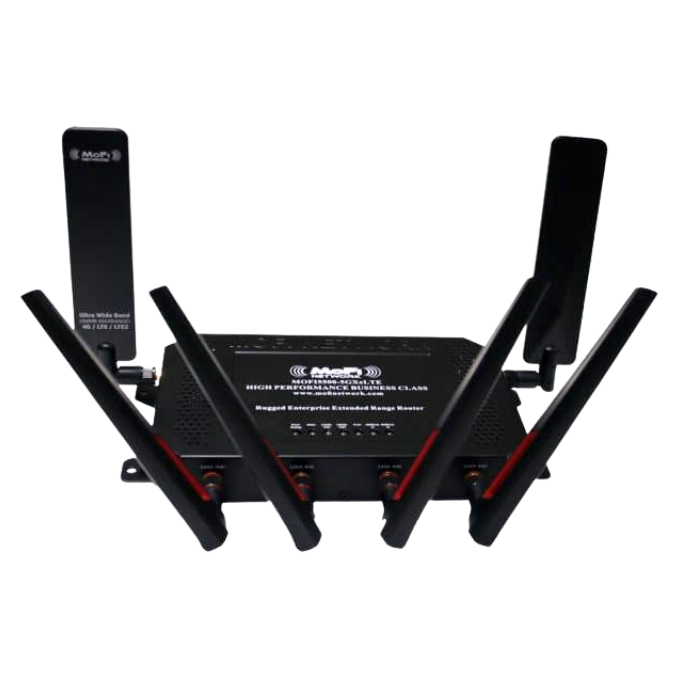
The MOFI5500 is a niche product that’s earned a cult following in the rural internet community for one reason: it’s specifically designed to pull usable speeds from weak, distant tower signals. It’s a 4G LTE router (not 5G) with four SMA external antenna connectors, band-locking capability, and a Cat 12 modem that squeezes every bit of throughput out of marginal connections.
Best for: Rural property owners in true fringe coverage areas — 5+ miles from the nearest tower — where other hotspots show one bar or no signal at all.
Pros:
– Four SMA antenna ports support full 4×4 MIMO external antenna setups, which is the gold standard for pulling signal in weak coverage areas
– Band-locking feature lets you force the modem onto a specific LTE band, preventing it from jumping between bands and dropping connection — a critical feature in fringe areas
– Built-in router with Ethernet ports means you can wire in devices directly for more stable connections than WiFi
Cons:
– No 5G support — this is a 4G LTE-only device, which limits peak speeds even in areas where 5G is available
– Industrial appearance and wall-plug-only power; this is not a portable device — it’s a stay-at-the-cabin unit
GL.iNet Beryl AX (GL-MT3000)

The Beryl AX isn’t a cellular hotspot by itself — it’s a travel router that you pair with any USB tethered phone or hotspot device to create a full-featured WiFi network. We’re including it because it solves a specific problem many rural property owners face: you already have a phone with an unlimited plan and decent signal, but phone hotspot mode is crippled by carrier throttling, limited device connections, or poor WiFi range.
Best for: Property owners who want to extend their existing phone’s cellular connection into a proper WiFi network with VPN, Ethernet, and better range.
Pros:
– WiFi 6 with up to 3 Gbps throughput and dual Ethernet ports — turns a basic phone hotspot into a legitimate home network
– OpenWrt-based firmware with built-in WireGuard and OpenVPN support; helpful for masking hotspot traffic from carrier TTYL detection
– Compact and affordable at under $80 — the cheapest option in our list by a wide margin
Cons:
– Requires a separate cellular device (phone or hotspot) for connectivity — it’s a network extender, not a standalone solution
– No external antenna ports for the cellular side; signal improvement depends entirely on the connected device’s capabilities
How We Chose
We focused on the factors that actually matter for rural property use, which are fundamentally different from what matters in a city. Urban hotspot reviews obsess over 5G mmWave speeds and portable design — neither of which is relevant when your nearest tower is 4 miles away through tree cover. Instead, we prioritized external antenna support (the single biggest factor in rural performance), carrier band compatibility, data plan flexibility, and real-world reports from rural users in forums like r/Rural_Internet, r/cellboosters, and the MOFI and Pepwave user communities. We cross-referenced manufacturer specs with FCC filing data to verify actual band support claims, because some vendors overstate their device capabilities.
Buying Guide: What Actually Matters for Rural Hotspot Selection

External Antenna Support

This is the number one factor, and it’s not close. A mobile hotspot with even mediocre internal antennas can deliver usable speeds in a city. On a rural property, you’re often dealing with tower distances of 3–15 miles, tree cover, terrain obstructions, and building materials that kill signal. An external MIMO antenna mounted on a roof or pole can improve your effective signal by 10–20 dB — that’s the difference between “no connection” and “streaming video.” Prioritize devices with SMA or TS-9 external antenna ports. If a hotspot doesn’t have external antenna connectors, think carefully before buying it for permanent rural use.
Carrier and Band Compatibility
Not all carriers cover all rural areas equally. Before buying any hotspot hardware, check actual coverage maps for AT&T, T-Mobile, Verizon, and UScellular at your property’s exact coordinates — not just your zip code. Better yet, ask neighbors what carrier works on their property. Then verify that the hotspot you’re considering supports the specific bands that carrier uses in your area. Low-band frequencies like Band 71 (T-Mobile), Band 14 (AT&T FirstNet), and Band 13 (Verizon) travel farther and penetrate obstacles better — these are the bands that matter most for rural properties. An unlocked device that works across carriers gives you the most flexibility.
Data Plans and Throttling Policies
Hardware is only half the equation. The best mobile hotspot for rural property use is useless if your data plan throttles you to 600 Kbps after 50 GB. Look for plans that offer at least 100 GB of high-speed data, or unlimited plans without deprioritization. T-Mobile Home Internet ($50/month, truly unlimited) is the benchmark. For other carriers, business and reseller plans from providers like Calyx Institute or Nomad Internet often offer better terms than consumer hotspot plans. Always read the fine print on “unlimited” — carrier definitions vary wildly.
Fixed vs. Portable Use

Decide upfront whether this hotspot will live permanently at your property or travel with you. Fixed-installation routers like the Pepwave or MOFI5500 pair with proper external antennas and deliver the best possible performance, but they’re not coming with you to town. Portable units like the Nighthawk M6 Pro or MiFi X PRO offer flexibility — use them at the property with an antenna, then grab them when you leave. The tradeoff is that portable units typically have less robust antenna connections (TS-9 vs. SMA) and lower maximum throughput.
FAQ
What is the best mobile hotspot for a rural property with no cell service?
If you have truly zero cell signal at ground level, a mobile hotspot alone won’t fix the problem — you need a high-gain external antenna mounted on a tall mast or roof peak. Paired with the right antenna, the MOFI5500-4GXeLTE or Pepwave MAX BR1 Pro 5G can pull usable signal from towers up to 10–15 miles away. Start by identifying your nearest tower using CellMapper.net, then point a directional antenna at it.
How much data do you need for off-grid living with a mobile hotspot?
A typical off-grid household doing email, web browsing, video calls, and moderate streaming uses 100–300 GB per month. If you’re working remotely with frequent video calls, budget for 200+ GB minimum. Avoid plans that throttle after low caps. T-Mobile Home Internet’s unlimited plan or business-tier data plans are the safest bets.
Can you use a mobile hotspot as your only internet on a rural homestead?
Yes — thousands of rural homesteaders use mobile hotspots as their primary and only internet connection. The keys to making it work are choosing a device with external antenna support, investing in a quality outdoor MIMO antenna, and selecting a data plan with sufficient high-speed data. It’s not as fast or reliable as fiber, but with the right setup, 25–75 Mbps is achievable in many rural areas.
Does 5G work in rural areas for mobile hotspots?
Low-band 5G (like T-Mobile’s Extended Range 5G on Band n71) does reach rural areas and offers modest speed improvements over LTE. However, the ultra-fast mmWave and mid-band 5G that carriers advertise is almost exclusively urban and suburban. On most rural properties, your hotspot will operate on 4G LTE or low-band 5G most of the time. Don’t pay a premium for 5G-only hardware — make sure it also has strong LTE band support.
What external antenna works best with a mobile hotspot on rural property?
For most rural properties, a directional MIMO panel antenna like the Waveform 4×4 MIMO panel or the XPOL-2-5G delivers the best results. Mount it as high as possible — every 10 feet of elevation gain matters — and point it directly at your nearest cell tower. If you have towers in multiple directions, an omnidirectional antenna trades some gain for 360-degree coverage. Use CellMapper.net to locate towers before deciding on antenna type.
Our Verdict
For most rural property owners, the Netgear Nighthawk M6 Pro is the best mobile hotspot for rural property use. It hits the sweet spot between portability and performance, with external antenna ports that transform marginal coverage into usable internet and carrier flexibility that lets you chase the strongest signal. If you’re on a tight budget and T-Mobile covers your area, start with T-Mobile Home Internet — it’s low-risk at $50/month with no hardware cost. And if you’re building a permanent off-grid homestead where connectivity is non-negotiable, the Pepwave MAX BR1 Pro 5G is the investment-grade solution that won’t let you down.