Best Gravity Water Filters 2026
If you’ve ever hauled jugs of water to a remote cabin or tried to make questionable well water drinkable without electricity, you already know the frustration. Finding a gravity water filter that actually performs at a cabin — where there’s no water pressure, no power, and sometimes no running water at all — means sorting through a pile of marketing claims and survivalist hype. We dug into specs, third-party lab data, and thousands of verified buyer reports to find the gravity water filters that earn a spot in your cabin.
Our top pick: ProOne Big+ 2.75-Gallon. Best budget: Alexapure Pro. Best ceramic option: AquaCera Pioneer SS4.
Our Picks
ProOne Big+ 2.75-Gallon Gravity Water Filter

The ProOne Big+ is the best gravity water filter for cabin use right now, full stop. Its G2.0 filter elements are independently tested to NSF/ANSI 42, 53, and 401 standards, removing over 200 contaminants including fluoride, lead, chlorine, and VOCs — without needing separate fluoride filters.
Best for: Cabin owners who want one system that handles everything out of the box.
Pros:
– 2.75-gallon capacity handles a small household or weekend group without constant refilling
– G2.0 elements last up to 2,275 gallons each — roughly a year of daily cabin use before replacement
– Stainless steel construction stands up to freezing temperatures and rough handling during seasonal transport
Cons:
– Priming the filters takes some patience the first time; expect 10–15 minutes of flushing
– At around $300+, the upfront cost is higher than competitors, though per-gallon cost is competitive
Alexapure Pro Stainless Steel Gravity Water Filter
Off-Grid Insider
Get off-grid guides & gear picks in your inbox — free
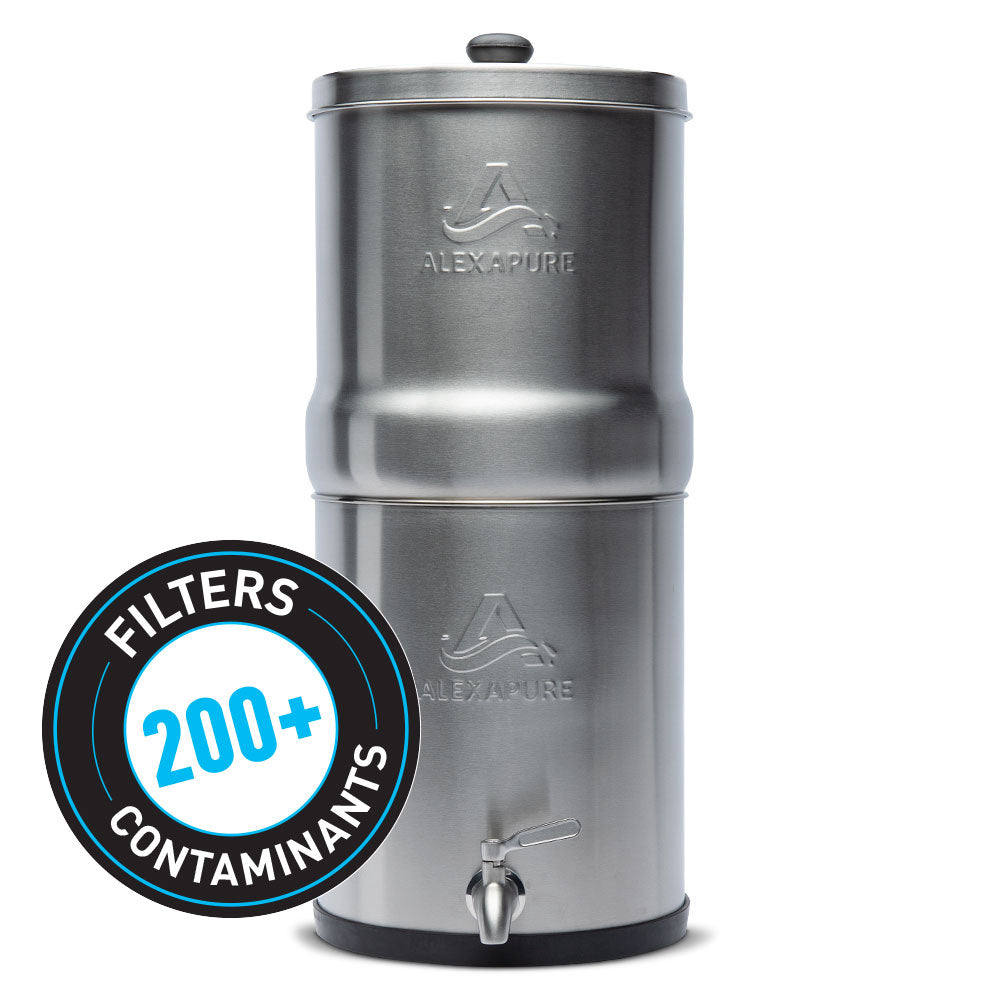
The Alexapure Pro punches well above its price point with a single-filter design that removes up to 99.9999% of bacteria and 99.99% of viruses according to the manufacturer’s third-party lab results. It’s the best gravity water filter for cabin owners watching their budget.
Best for: Budget-conscious cabin owners who want solid filtration without the premium price tag.
Pros:
– Typically $100–150 less than comparable stainless steel systems
– Single gravity block filter simplifies setup — no pairing or balancing flow rates
– 2.25-gallon capacity is enough for two to four people over a weekend
Cons:
– Single filter element means slower flow rates compared to dual-element systems (roughly 0.5 gallons per hour)
– Replacement filters are proprietary and run around $70–80 each
Big Berkey 2.25-Gallon Water Filter System
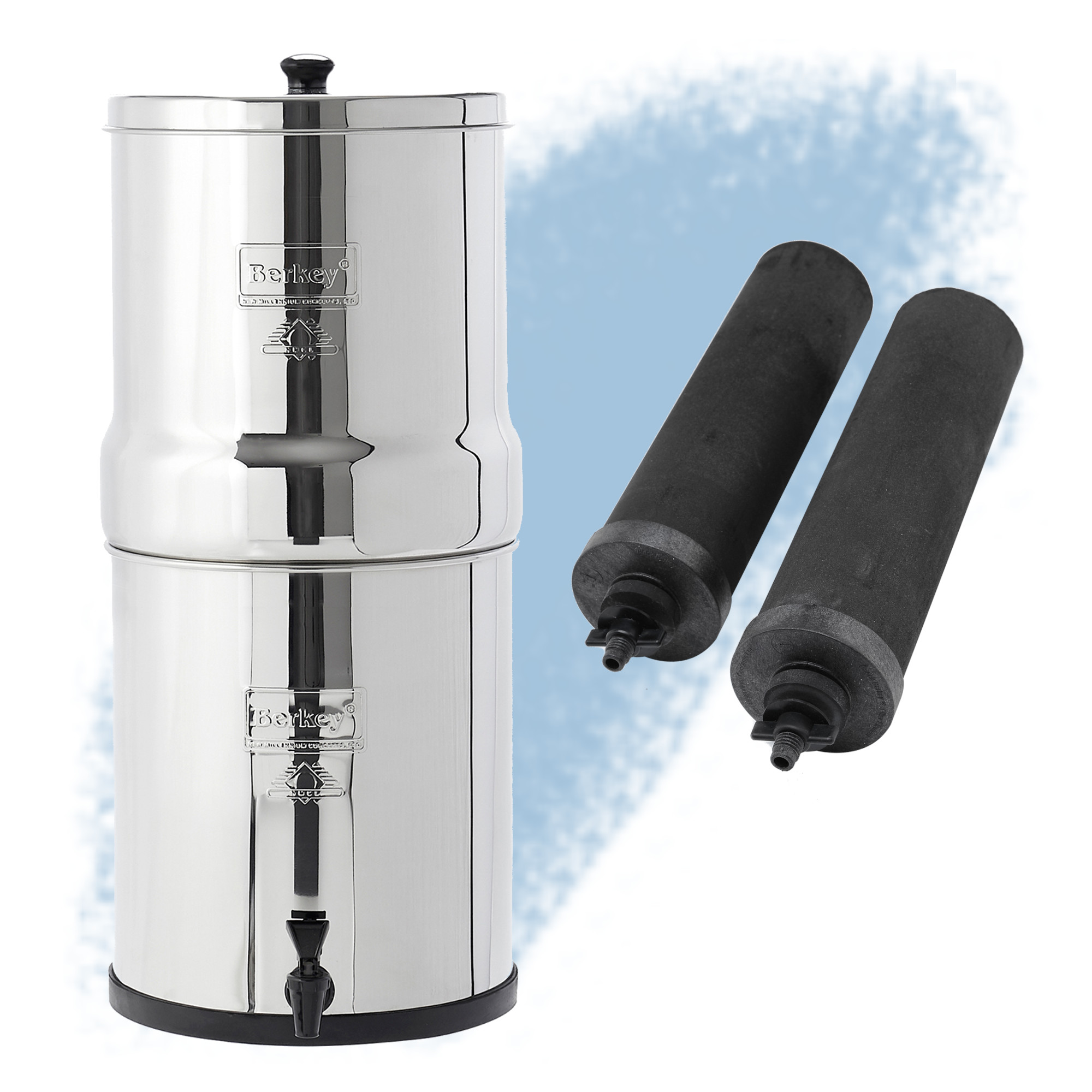
The Big Berkey is the name most people associate with gravity water filtration, and for good reason — its Black Berkey elements have a long track record in off-grid communities. However, the company has faced regulatory scrutiny from the EPA regarding unregistered pesticide claims on its filters, which led to temporary sales halts. The filters are back on the market, but we think transparency matters, so we’re noting it here.
Best for: Owners who already have Berkey elements or want the massive aftermarket community and accessory ecosystem.
Pros:
– Enormous owner community means troubleshooting help, accessories, and replacement parts are easy to find
– Black Berkey elements have a rated lifespan of 3,000 gallons each (6,000 per pair)
– Compact footprint fits on a cabin countertop without dominating the space
Cons:
– Recent EPA enforcement action over filtration claims has shaken buyer confidence — do your own due diligence on current certifications
– Fluoride removal requires purchasing separate PF-2 add-on filters, which adds $50+ and reduces flow rate
AquaCera Pioneer SS4 Gravity Water Filter

The AquaCera Pioneer SS4 uses CeraMetix ceramic filter elements — a technology with decades of proven use in British Berkefeld systems. Ceramic is arguably the best filter media for cabin use because you can scrub and re-use the elements dozens of times before replacement.
Best for: Remote cabins where replacement filter availability is uncertain and you need elements that can be field-maintained.
Pros:
– Ceramic elements are cleanable with a Scotch-Brite pad, extending their usable life significantly
– Four-element configuration delivers the fastest flow rate in this roundup — roughly 1.5+ gallons per hour
– CeraMetix elements include silver impregnation for bacteriostatic protection between uses
Cons:
– Ceramic elements are more fragile than carbon block — transport them carefully if you haul the system seasonally
– The four-element setup is larger and heavier than dual-element competitors
Platypus GravityWorks 6-Liter Water Filter System

The Platypus GravityWorks is a bag-based gravity water filter designed for backcountry use, but it’s become a quiet favorite among seasonal cabin owners who pull water directly from streams, ponds, or rain barrels. It’s lightweight, packable, and dead simple.
Best for: Seasonal or primitive cabins where you’re sourcing water from surface sources and need a portable, no-fuss option.
Pros:
– Weighs just 11.5 ounces — you can throw it in a bag and forget about it until you need it
– Hollow-fiber filter processes 1.75 liters per minute with a full gravity head
– No priming required; just fill, hang, and let gravity do the work
Cons:
– Hollow-fiber filters remove bacteria and protozoa but do NOT remove viruses, chemicals, or heavy metals — it’s a microbiological filter, not a purifier
– 6-liter (1.6-gallon) capacity is small for anything beyond one or two people
Survivor Filter Gravity Water Filter System

The Survivor Filter Gravity system is a solid backup or secondary filter for cabin setups. It uses a three-stage filtration process (hollow fiber, carbon, and internal ultra-filter) in a bag-fed design that packs down small and costs under $80.
Best for: Cabin owners who want a reliable backup system or a portable option for outbuildings and guest use.
Pros:
– Three-stage filtration in a gravity bag system at a price point that undercuts most competitors significantly
– Internal 0.01-micron ultra-filter adds a layer of protection beyond basic hollow-fiber systems
– Weighs under a pound, making it easy to stash in a cabin closet between visits
Cons:
– Capacity is limited — the bags hold about 2 liters, so you’ll be refilling often for a group
– Build quality of the bag connectors gets mixed reviews from long-term users; carry spare O-rings
How We Chose
We started with every gravity water filter currently available in the US that has published third-party lab data or recognized certifications (NSF/ANSI 42, 53, 401, or P231). We cross-referenced manufacturer claims against independent test results where available, then pulled buyer feedback from Amazon, cabin-living forums, and off-grid community groups to identify real-world failure modes — slow flow, cracked housings, premature filter degradation in cold or silty water. Finally, we weighted our recommendations toward factors that matter specifically for cabin use: no-power operation, durability during seasonal transport, ease of winterization, and per-gallon cost over time.
Buying Guide: What to Look for in a Gravity Water Filter for Your Cabin

Filtration Scope vs. Your Water Source
This is the single most important factor. If you’re filtering treated municipal water hauled in jugs, a basic carbon block filter handles taste and chlorine just fine. If you’re pulling from a well, spring, or rain catchment system — as most cabin owners are — you need a filter rated for bacteria, protozoa, and ideally heavy metals and chemicals. Check whether the system is a filter (removes particulates and microorganisms) or a purifier (also addresses viruses and dissolved contaminants). For cabins relying on surface water, a purifier-grade system like the ProOne or AquaCera is worth the extra cost.
Capacity and Flow Rate
A gravity water filter for a cabin that sleeps four needs to produce at least 2 gallons in a reasonable timeframe. Dual- or quad-element stainless systems generally deliver 1–2 gallons per hour. Single-element systems can drop below half a gallon per hour, which becomes a bottleneck during cooking, cleaning, and drinking. Match the capacity to your typical group size — 2.25 gallons is fine for a couple; if you’re hosting, look at 2.75-gallon or larger models.
Durability and Winterization
Cabin life is hard on gear. Stainless steel housings survive bumpy truck rides and temperature swings that would crack plastic pitchers. More critically, if your cabin gets below freezing in winter, you need to either drain the system completely or remove the filter elements. Hollow-fiber filters (like the Platypus) are destroyed by a single freeze if water is left inside. Ceramic and carbon block elements are more forgiving but should still be stored dry. Factor winterization into your routine.
Long-Term Filter Cost

The sticker price of the unit is only part of the equation. Calculate the cost per gallon over the filter’s rated lifespan. ProOne G2.0 elements run about $120 per pair and filter around 4,550 gallons — roughly $0.026 per gallon. Berkey Black elements cost about $110 per pair for 6,000 gallons — roughly $0.018 per gallon. The Alexapure single element is around $75 for 5,000 gallons — $0.015 per gallon. Over several years of cabin use, these differences add up, and the cheapest unit upfront isn’t always the cheapest to run.
FAQ
What is the best gravity water filter for an off-grid cabin?
The ProOne Big+ 2.75-Gallon is our top recommendation for off-grid cabin use. It combines independently tested filtration across 200+ contaminants, a durable stainless steel housing, and a capacity large enough for small groups — all without requiring electricity or water pressure.
Can you use a gravity water filter with rain water at a cabin?
Yes. Gravity water filters like the ProOne, Berkey, and AquaCera are designed to handle untreated water sources including rainwater. However, you should use a pre-filter screen on your rain catchment to remove leaves and large debris before it reaches the gravity filter. This dramatically extends filter element life and prevents clogging.
How often do you need to replace gravity water filter elements?
It depends on usage and source water quality. Most gravity filter elements are rated for 2,000 to 6,000 gallons. For a cabin used on weekends, a set of elements can last one to three years. Sediment-heavy or turbid source water will shorten element life. Ceramic elements can be scrubbed clean to extend their lifespan — a major advantage for remote cabin use.
Do gravity water filters work in freezing temperatures?
Gravity water filters will operate in cold temperatures, but they must not freeze with water inside the elements. Hollow-fiber filters are permanently damaged by a single freeze. Carbon block and ceramic elements are more resilient but should still be drained and stored dry if your cabin drops below 32°F. Always winterize your gravity filter before closing up a seasonal cabin.
Is a gravity water filter better than a UV purifier for a cabin?
For a cabin without reliable electricity, a gravity water filter is the better choice — it requires zero power and handles both microbiological and chemical contaminants depending on the filter type. UV purifiers kill pathogens effectively but need electricity or batteries and do nothing to remove chemicals, heavy metals, or sediment. If you have solar power at your cabin, combining a gravity pre-filter with a UV stage gives you the best of both worlds, but a quality gravity system alone is sufficient for most cabin setups.
Our Verdict
For most cabin owners, the ProOne Big+ 2.75-Gallon is the gravity water filter to buy. It delivers certified, comprehensive filtration without add-on filters, it’s built to survive the realities of cabin life, and its per-gallon cost is reasonable over the long haul. If budget is the priority, the Alexapure Pro gets you 90% of the way there for significantly less money — just budget extra patience for the slower flow rate.