Size Your Off-Grid Solar Inverter Right (Step-by-Step)
Picking the wrong inverter size is one of the most expensive mistakes in off-grid solar. Go too small and your system trips out every time you run a coffee maker and a well pump at the same time. Go too big and you waste hundreds of dollars on capacity you’ll never touch — plus oversized inverters draw more standby power, quietly draining your battery bank overnight. The sweet spot exists, and finding it is more math than guesswork.
We’ve dug into manufacturer specs, installer forums, and real-world load data from off-grid homesteaders to put together this sizing guide. No fluff — just the numbers and methods you need.
What You’ll Learn
- How to calculate your actual watt requirements (continuous and surge)
- Why inverter sizing isn’t just about adding up appliance watts
- The difference between continuous, surge, and peak ratings — and which one matters most
- Specific inverter recommendations for common off-grid setups
Step 1: List Every Load You’ll Run Simultaneously
Inverter sizing starts with your simultaneous load, not your total load. You don’t run every appliance at once. Grab a notebook and list the appliances you’d realistically run at the same time during your heaviest-use period — usually morning or evening.
Here’s a realistic example for a modest off-grid cabin:
| Appliance | Running Watts | Surge Watts |
|---|---|---|
| Refrigerator | 150 W | 600 W |
| Well pump (½ HP) | 500 W | 1,200 W |
| LED lighting (6 bulbs) | 60 W | 60 W |
| Laptop charger | 65 W | 65 W |
| Ceiling fan | 75 W | 120 W |
| Total | 850 W | 2,045 W |
Your continuous load here is 850W. Your worst-case surge — if the fridge compressor and well pump kick on simultaneously — is around 2,045W.
Where to Find Appliance Wattage
Off-Grid Insider
Get off-grid guides & gear picks in your inbox — free
Check the label on the back or bottom of each appliance. Look for the watt rating or calculate it: volts × amps = watts. For motor-driven appliances (pumps, compressors, power tools), the surge or startup draw is typically 2–3× the running watts. Some tools spike even higher — a table saw can surge to 4× its rated wattage.
Step 2: Understand the Three Inverter Ratings
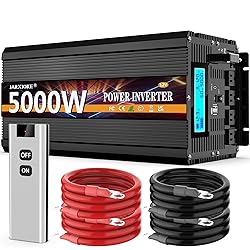
Inverter spec sheets list multiple wattage numbers, and confusing them will burn you.
Continuous (Rated) Watts
This is what the inverter can deliver indefinitely without overheating. This is your primary sizing number. Your total simultaneous running load must stay below this rating with headroom to spare.
Surge (Peak) Watts
The maximum the inverter can handle for a few seconds — typically 5–10 seconds — to cover motor startup spikes. Most quality inverters offer surge capacity at 2× their continuous rating. A 3,000W inverter usually handles 6,000W surge.
30-Minute Rating
Some manufacturers list a 30-minute rating between continuous and surge. This covers appliances like microwaves that run hard for short bursts. Not all inverters publish this spec, but it’s useful when available.
Step 3: Apply the 25% Headroom Rule

Never size an inverter exactly to your calculated load. Running an inverter at 100% capacity generates excess heat, shortens its lifespan, and leaves zero margin for the appliance you forgot to list.
The standard rule: multiply your continuous load by 1.25.
Using our cabin example: 850W × 1.25 = 1,062W minimum continuous rating.
For surge: make sure the inverter’s peak rating exceeds your worst-case surge total. Our example needs at least 2,045W surge capacity — a 1,500W inverter with 3,000W surge handles this comfortably.
When to Add More Headroom
If you plan to add loads in the next 1–2 years — a chest freezer, a washing machine, power tools — size for those now. Adding a chest freezer (100W running, 400W surge) and a washing machine (500W running, 1,200W surge) to our example pushes the continuous load to 1,450W and surge to 3,645W. Suddenly you’re looking at a 2,000W inverter minimum.
Step 4: Choose Pure Sine Wave vs. Modified Sine Wave
This isn’t optional for most off-grid setups. Go pure sine wave.
Modified sine wave inverters are cheaper — a 3,000W modified unit might cost $150–$250 versus $400–$800 for pure sine — but they cause problems with:
- Refrigerator and freezer compressors (run hotter, shorter lifespan)
- Variable-speed tools and CPAP machines (won’t run properly or at all)
- Electronics with AC adapters (buzzing, overheating, potential damage)
- Microwave ovens (reduced output, uneven heating)
Modified sine wave has a narrow use case: running purely resistive loads like incandescent lights or basic heaters in a workshop or outbuilding. For a primary residence inverter, pure sine wave is the only serious option.
Step 5: Match Inverter Voltage to Your Battery Bank
Inverters come in 12V, 24V, and 48V DC input configurations. This must match your battery bank voltage exactly.
| System Size | Recommended Voltage | Why |
|---|---|---|
| Under 2,000W | 12V or 24V | Simpler wiring, widely available components |
| 2,000–4,000W | 24V or 48V | Lower current means smaller (cheaper) cables |
| Over 4,000W | 48V | High-current 12V systems require impractically thick cabling |
A 3,000W inverter on a 12V bank draws 250 amps at full load. That demands 4/0 AWG cables and beefy fusing. The same inverter on 48V draws only 62.5 amps — manageable with much lighter, cheaper wiring. For any system above 2,000W, 24V or 48V keeps your wiring practical and safe.
Common Inverter Sizing Mistakes
1. Ignoring Surge Requirements
A 1,000W inverter can run an 800W continuous load all day, but if your well pump surges to 1,500W on startup, the inverter faults out. Always check surge ratings against your motor-driven loads.
2. Sizing for Average Instead of Peak
Your “average” daily consumption might be 500W, but if you run a microwave (1,200W) and a toaster (900W) at the same time for three minutes, that’s a 2,100W draw. Inverters don’t care about averages — they care about what’s happening right now.
3. Buying Massively Oversized
A 10,000W inverter for a 1,500W cabin wastes money upfront and draws 30–75W in standby power — 24/7, that’s 720–1,800 Wh per day consumed doing nothing. That’s meaningful in an off-grid system. Size for your realistic future needs, not the theoretical maximum.
4. Forgetting Efficiency Losses
Inverters are not 100% efficient. Most quality units run 90–95% efficient under load. A 3,000W inverter delivering 3,000W to your appliances is actually pulling roughly 3,150–3,330W from your batteries. Factor this into your battery bank sizing.
Our Recommendations
Best for Small Cabins (Under 2,000W): Victron Phoenix 12/1200

Victron’s Phoenix line has earned a strong reputation in the off-grid community for reliability and clean power output. The 1,200W continuous / 2,400W peak model handles a fridge, lights, fans, and small electronics without breaking a sweat. Efficiency sits at 93–95% under typical loads. Compact, well-built, and Victron’s monitoring ecosystem is a genuine advantage for troubleshooting.
Victron Phoenix 1200W Inverter on Amazon
Best Mid-Range (2,000–5,000W): Victron MultiPlus-II 48/3000

For a full-time off-grid home with a well pump, full kitchen, and power tools, the MultiPlus-II 3000 is a workhorse. It’s an inverter/charger combo — 3,000W continuous, 6,000W surge, 48V input, with integrated transfer switch and generator input. Built-in programmable relay, temperature compensation for charging, and integration with Victron’s GX monitoring system. It’s not cheap (typically $1,400–$1,800), but the reliability data from the off-grid community is consistently strong.
Victron MultiPlus-II 48/3000 on Amazon
Best Budget Option: AIMS Power 3000W Pure Sine Wave
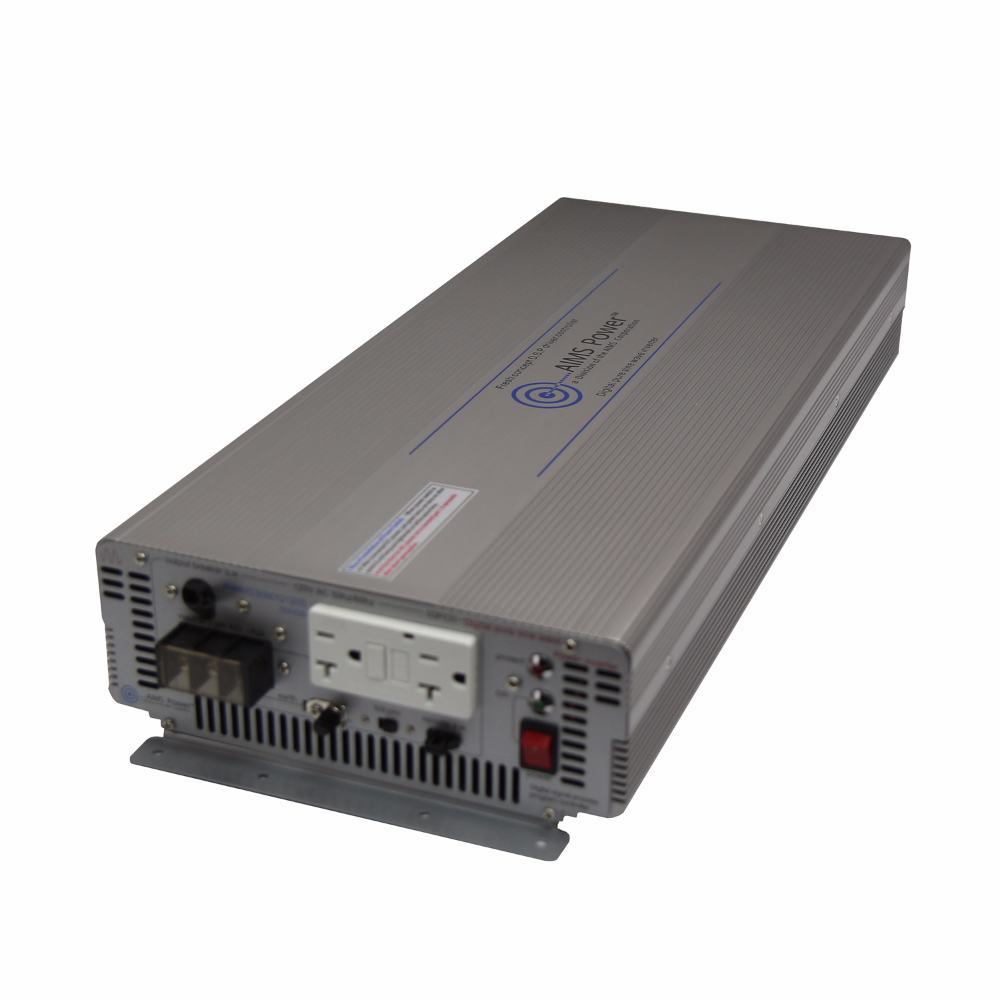
AIMS Power offers solid value for budget-conscious builds. Their 3,000W pure sine wave inverter (6,000W surge) comes in 12V, 24V, and 48V configurations. Build quality is a step below Victron, but for the price — typically $400–$600 — it’s a reliable entry point. The cooling fan can be audible under heavy loads, which matters if it’s inside your living space.
AIMS Power 3000W Pure Sine Wave Inverter on Amazon
Frequently Asked Questions
Can I run two smaller inverters instead of one large one?
Yes, and many off-gridders do this intentionally. A small 1,000W inverter handles everyday loads (fridge, lights) efficiently, while a larger unit powers heavy equipment only when needed. This reduces standby losses significantly. Just make sure they feed separate circuits — don’t parallel inverters unless they’re specifically designed for it (Victron and Outback both offer paralleling capabilities on certain models).
What size inverter do I need for a well pump?
It depends on the pump’s HP rating. A ½ HP submersible well pump typically runs at 500–750W with a 1,200–1,800W surge. A 1 HP pump runs at 1,000–1,500W with surges up to 3,000W. Size the inverter’s surge capacity to handle the pump startup with your baseline loads already running. A soft-start add-on ($50–$100) can reduce pump surge by 50–70%, making a smaller inverter viable.
Does altitude or temperature affect inverter sizing?
Yes. Most inverters are rated at 25°C (77°F). Above that, many manufacturers derate output by 2–5% per 10°C increase. At 40°C (104°F), you might only get 90–95% of rated capacity. High altitude (above 5,000 feet) also reduces cooling efficiency. If you’re in a hot climate or at elevation, add an extra 10–15% to your sizing calculation.
How do I know if my inverter is too small for my setup?
Warning signs: the inverter shuts off or faults when certain appliances start, you see low-voltage warnings on the display, the unit runs hot to the touch constantly, or appliances behave erratically (lights dimming, motors running slow). Most quality inverters have overload indicator lights or fault codes — check your manual for specifics.
Should I get an inverter/charger combo or a standalone inverter?
If you have or plan to add a backup generator, an inverter/charger combo (like the Victron MultiPlus or Outback Radian series) simplifies your system. It handles AC charging from the generator, automatic transfer switching, and inverting in one unit. Standalone inverters make sense for simple setups where solar is your only charging source and you have a separate charge controller.