How to Size Off-Grid Solar Batteries (Never Run Out)
Sizing your off-grid battery bank wrong means one of two things: you either run out of power on a cloudy Tuesday afternoon, or you spend thousands extra on capacity you’ll never touch. Neither is a good outcome, and both are surprisingly common because most guides hand you a formula without explaining the real-world variables that blow up neat calculations.
We’ve dug through manufacturer spec sheets, installer forums, and hundreds of verified buyer reports to put together a practical framework for choosing the right battery storage capacity — whether you’re powering a small cabin or a full-time homestead.
What You’ll Learn
- How to calculate your actual daily energy consumption (not the textbook version)
- Why “usable capacity” matters more than the number on the label
- How days of autonomy, depth of discharge, and climate affect your real-world sizing
- Which battery chemistries match which use cases — and what to buy right now
Step 1: Calculate Your Real Daily Energy Use
Everything starts here. Skip this step or estimate loosely and your entire system will be off.
List every device you run, its wattage, and how many hours per day you use it. Multiply watts × hours to get watt-hours (Wh). Add them up for your daily total.
Sample Load Audit for a Modest Off-Grid Cabin
Off-Grid Insider
Get off-grid guides & gear picks in your inbox — free

| Device | Watts | Hours/Day | Wh/Day |
|---|---|---|---|
| LED lighting (6 bulbs) | 60 | 5 | 300 |
| Refrigerator (efficient DC) | 65 | 12 | 780 |
| Laptop + router | 80 | 6 | 480 |
| Water pump | 150 | 1 | 150 |
| Phone charging (×2) | 20 | 3 | 60 |
| Misc (fans, small tools) | 100 | 2 | 200 |
| Total | 1,970 Wh |
Round up. Real consumption is almost always 10–20% higher than your spreadsheet says, because phantom loads, inverter inefficiency (typically 10–15% loss), and the occasional “I forgot to list the toaster” add up. For this example, we’d plan around 2,200–2,400 Wh/day.
A full-time off-grid home with a well pump, washing machine, and power tools commonly lands between 5,000 and 10,000 Wh/day. If you’re north of 8,000 Wh daily, you should seriously consider whether propane can offset some of that load (water heating, cooking, clothes drying) before you try to battery-bank your way through it.
Step 2: Understand Usable Capacity vs. Rated Capacity
This is where most newcomers get burned. A battery labeled “200Ah at 12V” holds 2,400 Wh on paper. But you can’t use all of it — or at least you shouldn’t.
Depth of Discharge (DoD)
- Lead-acid (FLA/AGM): Should only be discharged to about 50%. That 2,400 Wh battery gives you roughly 1,200 Wh of usable energy. Go deeper regularly and you’ll kill the bank in 1–3 years.
- Lithium iron phosphate (LiFePO4): Safe to discharge to 80–90% regularly. That same 2,400 Wh label gives you ~2,000–2,160 Wh of usable capacity. Most LiFePO4 manufacturers rate cycle life at 80% DoD.
This single factor is why LiFePO4 batteries dominate new off-grid installs despite the higher sticker price. You need roughly half as many amp-hours of lithium to get the same usable energy as lead-acid.
Step 3: Choose Your Days of Autonomy

Days of autonomy means how many days your battery bank can power your home with zero solar input — overcast skies, snow-covered panels, or a system fault.
| Scenario | Recommended Autonomy |
|---|---|
| Grid-tied backup / sunny climate | 1–2 days |
| Off-grid cabin, moderate climate | 2–3 days |
| Full-time off-grid, northern latitude | 3–5 days |
| Critical loads (medical equipment, livestock) | 5+ days or generator backup |
For our 2,400 Wh/day cabin in a moderate climate, planning for 3 days of autonomy means:
2,400 Wh × 3 days = 7,200 Wh of usable capacity needed
Step 4: Size the Actual Battery Bank

Now divide your usable capacity requirement by the battery’s usable DoD percentage to get the total rated capacity you need to buy.
LiFePO4 (80% DoD):
7,200 Wh ÷ 0.80 = 9,000 Wh rated capacity
At 48V nominal, that’s 187.5 Ah — so two 48V 100Ah (5,120 Wh) batteries in parallel, or a single 48V 200Ah unit.
Lead-Acid (50% DoD):
7,200 Wh ÷ 0.50 = 14,400 Wh rated capacity
At 12V, you’d need 1,200 Ah — six 12V 200Ah batteries wired in a 24V or 48V configuration. That’s a lot of weight (about 400 lbs) and a lot of floor space.
This math is exactly why the off-grid community has largely moved to lithium for new builds.
Step 5: Factor in Temperature and Aging

Cold Climate Derating
Battery capacity drops in the cold. LiFePO4 cells lose roughly 10–20% of capacity below 32°F (0°C), and most have a built-in BMS that prevents charging below freezing entirely. Lead-acid loses about 20–30% at the same temps.
If your battery compartment isn’t climate-controlled and you’re in a cold region, add 20% to your calculated bank size. Some LiFePO4 models — like the Victron Smart and certain SOK units — include integrated low-temperature cutoff and self-heating features that address this, but they cost more.
Capacity Degradation Over Time
LiFePO4 batteries are typically rated for 4,000–6,000 cycles at 80% DoD before capacity drops to 80% of original. That’s roughly 10–15 years of daily cycling. Lead-acid batteries last 500–1,200 cycles at 50% DoD — meaning replacement every 2–5 years.
When you factor in replacements, LiFePO4 almost always costs less per kWh over the system’s lifetime, even at 2–3× the upfront price.
Step 6: Match Battery Voltage to Your System
| System Voltage | Best For | Notes |
|---|---|---|
| 12V | Tiny cabins, RVs, under 2,000 Wh/day | Simple wiring, but high amperage on larger loads |
| 24V | Small to mid-size cabins, 2,000–5,000 Wh/day | Good balance of cost and efficiency |
| 48V | Full-time homes, 5,000+ Wh/day | Lower amperage = thinner cables, less heat loss, more inverter options |
Most modern off-grid inverter-chargers (Victron MultiPlus, EG4 18kPV, Sol-Ark 15K) run on 48V. If you’re building a system from scratch, 48V is the default choice unless your loads are very small.
Common Mistakes
1. Sizing for average days, not worst-case days. Your panels produce far less in December than June. If you’re in the Pacific Northwest or upper Midwest, winter production can drop to 25–30% of summer peak. Size your bank (and panel array) for your worst month, not your best.
2. Ignoring inverter surge requirements. A well pump or table saw can draw 3–5× its rated wattage on startup. Make sure your battery bank’s continuous and peak discharge rates can handle your largest surge load, not just total Wh.
3. Buying the cheapest lithium cells off Amazon with no-name BMS boards. A poorly designed battery management system can fail to balance cells, fail to cut off at low voltage, or catch fire. Stick with manufacturers that publish full BMS specs and have real warranty support.
4. Forgetting to budget for a charge controller and properly sized wiring. Your battery bank is only as good as the weakest link. Undersized cables create voltage drop and heat; an undersized charge controller leaves solar capacity on the table.
Our Recommendations
Best Overall: EG4 LifePower4 48V 100Ah Server Rack Battery
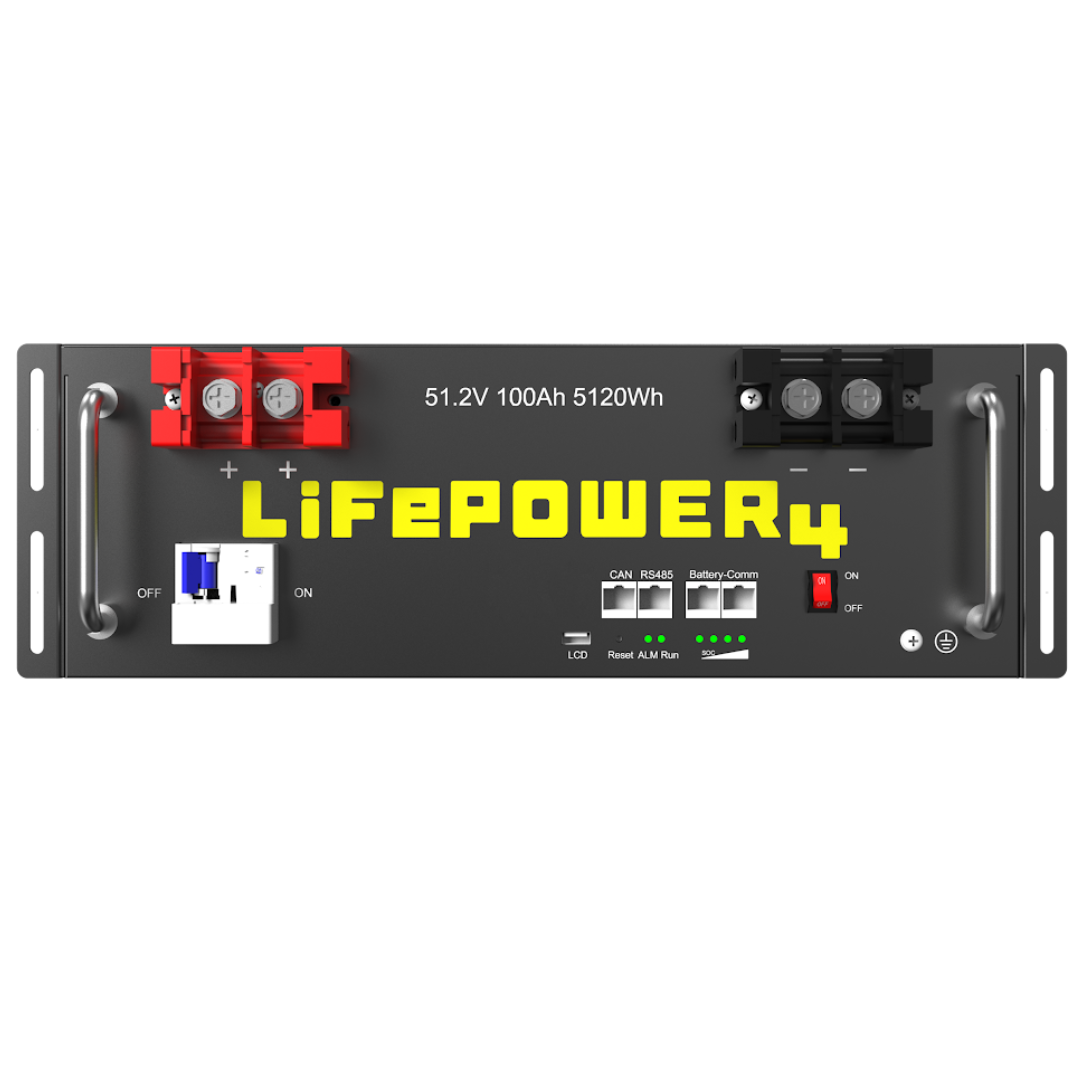
At 5,120 Wh per unit and a solid BMS with Bluetooth monitoring, this has become one of the most popular batteries in the off-grid community. Stackable in parallel for easy expansion. Rated for 7,000+ cycles at 80% DoD. Typically runs $750–$900 per unit.
Browse EG4 LifePower4 batteries on Amazon
Best Budget Option: SOK 12V 206Ah LiFePO4
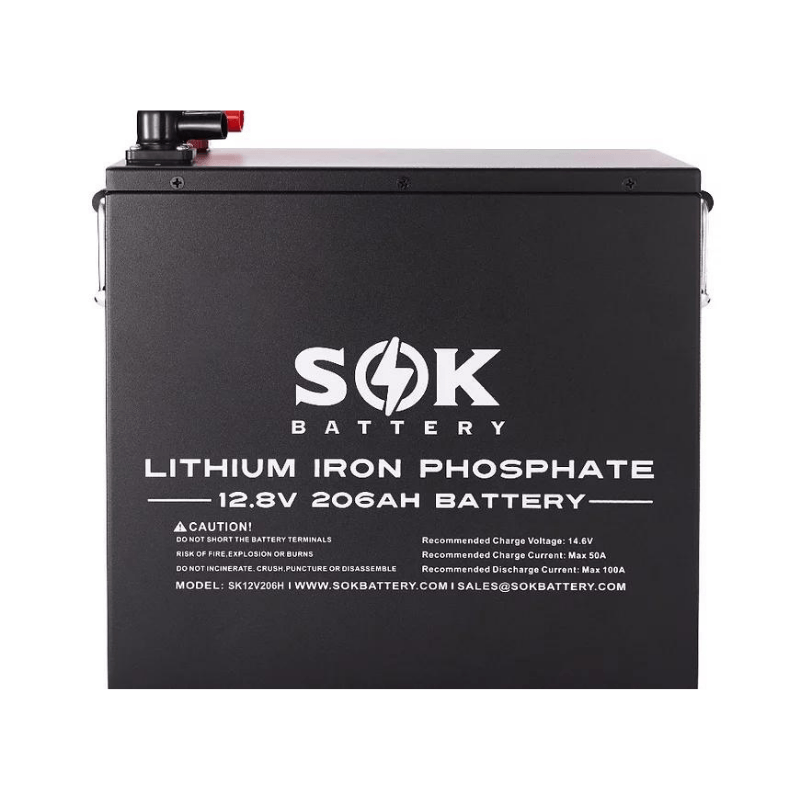
If you’re building a smaller 12V or 24V system on a tighter budget, SOK has built a strong reputation for reliable BMS design and consistent capacity. Roughly 2,636 Wh per battery. Good community support and a 7-year warranty.
Browse SOK 12V 206Ah LiFePO4 batteries on Amazon
Best Premium / Whole-Home: Victron Energy Lynx Smart BMS with 24V 200Ah Smart Batteries
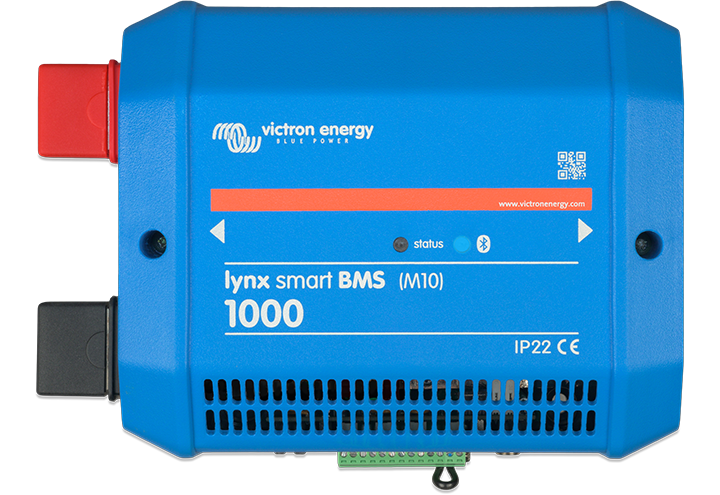
Victron is the gold standard for system integration. Their batteries communicate with Victron inverters and charge controllers via a shared data bus, which means automatic charge optimization, remote monitoring through their VRM portal, and rock-solid protection logic. You pay a premium — roughly $2,000+ per 4.8 kWh unit — but the ecosystem is unmatched for full-time off-grid reliability.
Browse Victron Smart LiFePO4 batteries on Amazon
FAQ
How many batteries do I need for a typical off-grid home?
It depends entirely on your daily load, but a common full-time off-grid home using 5,000–8,000 Wh/day with 3 days of autonomy needs roughly 20–30 kWh of rated LiFePO4 capacity. That’s four to six 48V 100Ah units.
Can I mix old and new batteries in the same bank?
We strongly advise against it. Batteries of different ages, brands, or chemistries have different internal resistances and charge/discharge curves. Mixing them leads to uneven cycling, premature failure of the weakest battery, and potential safety issues. Start matched, expand matched.
Is lead-acid ever still the right choice?
For seasonal cabins used a few weekends per year, lead-acid AGM can make financial sense because the upfront cost is much lower and cycle count demands are minimal. For anything approaching daily use, LiFePO4 wins on cost-per-cycle, weight, and usable capacity.
How do I know if my battery bank is too small?
If your battery voltage regularly drops below the recommended cutoff (typically 2.5V per cell for LiFePO4, or 11.8V for a 12V lead-acid bank) before morning, you’re undersized. Most modern BMS units and inverters will log minimum voltage readings — check those logs monthly.
Should I add a backup generator instead of more batteries?
Often yes. Beyond about 3–5 days of autonomy, adding more battery capacity gets very expensive for diminishing returns. A small propane or dual-fuel generator (2,000–4,000W) as a backup charging source is often more cost-effective than doubling your battery bank for those rare extended cloudy stretches. Many off-gridders pair a 15–20 kWh battery bank with a generator they run 10–20 hours per year.