Reuse Sink Water to Water Plants (Step-by-Step)
If you’re running an off-grid kitchen or bathroom sink, the water going down that drain has to go somewhere — and dumping it on the ground isn’t just wasteful, it can create mosquito breeding pools, kill soil biology, and potentially violate local health codes even on rural property. A properly designed greywater system turns that sink water into a resource, irrigating fruit trees, garden beds, or landscaping without touching your freshwater supply.
We’ve dug into plumbing specs, state greywater regulations, and real-world builds from the off-grid community to put together a practical guide for setting up a sink greywater system that actually works long-term — not just a bucket under the drain.
In this guide, you’ll learn:
- How to design a gravity-fed greywater system specifically for kitchen and bathroom sinks
- Which filtration stages you need (and which ones are overkill for sink water)
- Exact pipe sizes, fittings, and materials that won’t fail in two seasons
- How to route greywater to plants safely without contaminating soil or groundwater
Understanding Sink Greywater
Greywater from sinks falls into two categories, and the distinction matters for your system design.
Bathroom sink greywater is the easiest to reuse. It contains soap residue, toothpaste, and minor organic matter. Most states classify this as “light greywater” and regulate it minimally.
Kitchen sink greywater is harder. It carries food particles, grease, and higher bacterial loads. Some states (notably Arizona and California) treat kitchen greywater differently in their codes — California’s 2024 greywater standards, for example, require kitchen sink water to pass through a grease trap before entering any irrigation system.
Before you build anything, check your state and county regulations. Around 30 states now have some form of greywater-friendly code, but requirements vary widely. The key document to search for is your state’s “greywater reuse” or “alternative onsite wastewater” regulation.
How Much Water Are We Talking About?
A typical off-grid household uses 5–15 gallons per day through sink drains. That’s 150–450 gallons per month — enough to sustain 3–6 fruit trees or a 200-square-foot garden bed in moderate climates. This volume is small enough that a simple gravity-fed system handles it without pumps, which is exactly what you want off-grid.
Designing Your Gravity-Fed Sink Greywater System
Off-Grid Insider
Get off-grid guides & gear picks in your inbox — free
The basic architecture is straightforward: sink → trap → filter → surge tank → distribution to plants. Every component needs to work without electricity.
Step 1: The Drain and Initial Plumbing

Your sink drain should connect to standard 1.5-inch PVC (Schedule 40) through a P-trap — this is non-negotiable for preventing sewer gas backflow. From the P-trap, transition to 2-inch PVC for the main run. The upsizing prevents clogs as water velocity drops in the horizontal run.
Critical slope requirement: Maintain a 1/4-inch drop per foot of horizontal run (2% grade). Less than this and solids settle and clog. More than 1/2-inch per foot and water outruns solids, also causing clogs. Use a 2-foot level with a 1/2-inch spacer at one end to check your grade during installation.
If your sink is on a slab or low foundation, you may not have enough elevation for a full gravity system. You need at minimum 12 inches of vertical drop between the sink drain outlet and your distribution point. Measure this before buying materials.
Step 2: Grease Trap (Kitchen Sinks)
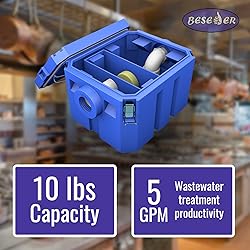
For kitchen sinks, install a grease trap between the P-trap and your filter. A 10–20 GPM commercial grease interceptor works well for residential sink flow rates. The Endura XL-15 Grease Trap is a common choice in off-grid builds — it’s rated for 15 GPM and has a compact footprint that fits under most sinks or in a utility closet.
Clean your grease trap every 2–4 weeks depending on cooking volume. Scrape the collected grease into your trash — never your compost.
Bathroom sinks can skip this component entirely.
Step 3: Filtration

You need a filter that catches hair, food particles, and debris without requiring pressure or electricity. The simplest effective approach is a two-stage gravity filter:
Primary filter: A mesh screen (1/16-inch or finer) catches large particles. You can build this from a standard 4-inch PVC cleanout fitting with stainless steel mesh siliconed inside. Clean it weekly.
Secondary filter: A mulch basin or constructed wetland cell. This is where the real biological filtration happens. A 5-gallon bucket filled with layers of landscape fabric, pea gravel (1/2-inch), and wood chip mulch creates an effective biofilter that handles soap and fine organics.
For a ready-made option, the Aqua2use GWDD Greywater Diversion Device is a purpose-built greywater filter rated for 50 gallons/day. It’s pricier than DIY (~$200–280) but saves significant build time and includes a diverter valve to send water to sewer/septic when you don’t need irrigation.
Step 4: Surge Tank
A surge tank buffers the flow between your sink (which discharges in bursts) and your irrigation lines (which work best with slow, steady output). A standard 35-gallon HDPE drum works well. Install the inlet at the top and the outlet 3 inches above the bottom — this keeps settled sediment from reaching your irrigation lines.
Important: Greywater must not be stored for more than 24 hours. Beyond that, anaerobic bacteria multiply and the water turns septic (you’ll smell it). Size your surge tank so a normal day’s water drains out completely within 12–18 hours. For most off-grid sinks producing 5–15 gallons daily, a 1/2-inch outlet valve provides adequate drain-down rate.
Step 5: Distribution to Plants

From the surge tank, run 1-inch polyethylene irrigation tubing to your plants. At each plant, use a mulch basin — a shallow depression (12 inches wide, 6 inches deep) filled with wood chips. The greywater flows into the mulch, which filters it further before it reaches root zones.
Never use drip emitters with greywater. They clog within weeks, even with good filtration. Mulch basins are the standard for a reason.
Space your outlets at least 3 feet from tree trunks and 6 inches from plant stems. Cover all mulch basins with a layer of straw or additional wood chips to prevent contact with greywater on the surface — this is a health code requirement in most jurisdictions.
Plants That Thrive on Greywater
Greywater tends to be slightly alkaline (pH 7.5–8.5) due to soap. Choose plants accordingly:
- Fruit trees: Citrus, figs, stone fruit, banana, and mulberry all handle greywater well
- Perennials: Comfrey, artichoke, rhubarb, lavender, rosemary
- Avoid: Acid-loving plants (blueberries, azaleas) and root vegetables that contact the soil directly
Soaps and Detergents That Won’t Kill Your Plants

Standard dish soaps contain sodium salts and boron that build up in soil over time. Switch to greywater-compatible products:
- Oasis Biocompatible Dish Soap — specifically formulated for greywater systems, low sodium, no boron
- Dr. Bronner’s Sal Suds — biodegradable, minimal plant-toxic residues
- Avoid anything with “antibacterial” labeling — triclosan and similar compounds nuke the soil biology your mulch basins depend on
Use plant-based greywater-safe dish soap and your system will run for years without soil degradation.
Common Mistakes
1. No three-way diverter valve. You need a way to send water to a septic or drywell when you don’t want greywater going to plants — during freezing weather, when you’re using bleach or harsh chemicals, or when the soil is already saturated. Install a three-way valve before your filter stage. This is also a code requirement in most states.
2. Burying distribution lines without cleanouts. Every horizontal run over 10 feet and every 90-degree bend needs a cleanout fitting. Greywater systems clog — it’s not a matter of if, but when. Plan for easy maintenance access.
3. Oversizing the system for your actual flow. A 5-gallon-per-day sink doesn’t need a 200-gallon surge tank and 150 feet of distribution line. Oversized systems let water sit too long and go septic. Match your system to your actual measured output — run your sink into a marked bucket for three days and average it.
4. Using the wrong pipe cement. Standard PVC primer and cement work fine for pressurized lines, but for gravity greywater lines, ensure all joints are properly primed and cemented with Schedule 40-rated products. Loose-fit connections invite root intrusion and leaks that contaminate surrounding soil.
Our Recommendations
Best Complete Kit for Beginners

The Aqua2use GWDD Greywater System handles filtration and diversion in a single wall-mounted unit. It connects directly to your sink’s drain line, includes a three-way valve, and outputs to standard 1-inch irrigation tubing. Rated for up to 50 gallons/day, which covers most off-grid households. Expect to spend $200–280, plus another $50–80 in distribution plumbing.
Best Budget DIY Build
A complete gravity-fed system using Schedule 40 PVC, a homemade mulch filter with a 4-inch PVC cleanout body, a 35-gallon HDPE drum, and 1-inch poly tubing can be built for $75–120 total. This requires more maintenance (weekly filter cleaning) but uses no proprietary components — everything is replaceable at any hardware store.
Best Grease Trap for Kitchen Sink Systems

The Endura XL-15 Grease Interceptor is compact (fits under most sinks), rated for 15 GPM, and built from chemical-resistant thermoplastic. It’s overkill for flow rate but its small physical footprint and easy-clean design make it the go-to for residential kitchen greywater setups. Around $150–200.
FAQ
Do I need a permit for a sink greywater system?
It depends entirely on your state and county. Arizona, California, Montana, New Mexico, Texas, and Wyoming have the most permissive greywater codes — many allow simple single-fixture systems (like one sink) without a permit if you follow published guidelines. Other states require full permits or lump greywater with wastewater. Check your county environmental health department before building.
Can I use greywater on vegetable gardens?
For above-ground crops (tomatoes, peppers, beans, squash), greywater irrigation to the soil — not the leaves — is generally considered safe when filtered through mulch basins. Avoid greywater on root vegetables (carrots, radishes, potatoes) and leafy greens (lettuce, spinach) that contact the soil directly. Most state codes prohibit greywater for spray irrigation of any edible crop.
What happens to the system in winter?
In freezing climates, you need to divert greywater away from your irrigation lines from first freeze through last frost. This is where your three-way diverter valve earns its keep — switch it to route water to your septic or a drywell. Drain all above-ground lines and the surge tank before the first hard freeze. Buried lines below your local frost depth (typically 18–48 inches depending on region) can remain in place.
How do I prevent odor from the surge tank?
Odor means water is sitting too long and going anaerobic. Make sure your surge tank drains completely within 24 hours. If it doesn’t, increase your outlet size or reduce distribution line length. Keep the tank covered but vented — a screened 2-inch vent pipe prevents mosquitoes while allowing airflow. If odor persists, you’re generating more greywater than your distribution system can handle and need to either add irrigation zones or divert some flow to septic.
Will greywater damage my soil over time?
With greywater-compatible soaps and proper mulch basin distribution, long-term soil studies show minimal impact over 10+ years. The main risk is sodium buildup from conventional soaps, which degrades soil structure. Switching to low-sodium, plant-based products eliminates this problem. If you notice water pooling on previously absorbent soil, test your sodium levels — you may need to flush the area with clean water and add gypsum to restore soil permeability.