Select Cabin Logs: Avoid $50K+ Mistakes (Guide)
Choosing the wrong species of log — or milling at the wrong moisture content — is the single most expensive mistake in off-grid cabin building. Logs that are too green shrink unpredictably, open gaps that defeat your chinking, and invite rot within a few seasons. Logs that are too dry can crack and check so deeply they compromise structural integrity. Getting wood selection and moisture management right from the start saves you years of patching, resealing, and heating losses.
What You’ll Learn
- Which wood species perform best for off-grid log cabins and why moisture content at milling matters more than species alone
- How to properly dry, stack, and monitor logs before and during construction
- The right chinking and sealing materials to handle inevitable log movement
- How to winterize a log home for extreme cold, including wood stove hearth protection requirements
Choosing the Right Wood Species

Not all timber is created equal for cabin building. The best species balance workability, rot resistance, natural insulation value, and availability in your region.
Top Species for Log Cabins
Off-Grid Insider
Get off-grid guides & gear picks in your inbox — free
Eastern White Pine — The most popular cabin log in North America for good reason. It’s lightweight (around 25 lbs per cubic foot dry), easy to peel and notch with hand tools, and relatively straight-grained. The drawback: low natural rot resistance, so it demands good foundation clearance and roof overhang.
Western Red Cedar — Outstanding natural rot and insect resistance thanks to high thujaplicin content. It’s lighter than pine and has superior insulation value (R-1.35 per inch vs. pine’s R-1.25). The trade-off is cost — cedar logs typically run 30–50% more than pine in most markets.
Douglas Fir — Stronger and harder than pine, making it excellent for structural logs, sill logs, and anywhere you need load-bearing capacity. It’s moderately rot-resistant and machines well but is heavier to work by hand.
White Oak — Extremely durable and rot-resistant, but heavy (around 47 lbs per cubic foot dry) and prone to significant checking. Best reserved for sill logs and ground-contact applications rather than full wall construction.
What to Avoid
Avoid hemlock, red maple, and poplar for primary wall logs. These species have poor rot resistance and tend to twist significantly during drying. Spruce is common in kit cabins but checks heavily and has almost no natural decay resistance — not ideal for off-grid builds where you’re handling your own maintenance.
Moisture Content: The Most Critical Variable

Here’s the number that matters more than species: moisture content (MC) at the time of construction. Green logs fresh from the forest can have MC above 100% (the water weight exceeds the wood weight). Your target for construction is 19% MC or below for milled logs, and below 15% MC is ideal for dimensional stability.
How to Measure It
A pin-type moisture meter is non-negotiable. The Wagner Orion 930 is a pinless option favored by log home builders for checking deeper into the log profile. For budget builds, the General Tools MMD4E gives reliable pin-type readings for under $30.
Always measure in at least three spots per log — both end grain and the center of the face — and average the readings. End grain dries faster, so face readings give you the truest picture of core moisture.
Air-Drying Logs Properly
If you’re harvesting your own timber (the whole point of off-grid building), plan for 6–12 months of air drying for softwoods and 12–18 months for hardwoods, depending on your climate and log diameter.
Stacking rules:
- Elevate the bottom course at least 18 inches off the ground on concrete blocks or treated timbers
- Use 1-inch stickers (spacer strips) between every course, spaced no more than 4 feet apart
- Align stickers vertically so weight transfers straight down
- Cover the top with metal roofing or tarps, but leave all four sides open for airflow
- Seal the end grain immediately after felling with Anchorseal 2 or a thick coat of latex paint to prevent end checking
Expect 4–8% shrinkage in diameter as logs dry from green to equilibrium MC. This shrinkage is exactly why your chinking and sealing strategy must accommodate movement.
Log Cabin Chinking Materials and Sealing
Chinking fills the gaps between logs. Traditional cabins used mud-and-moss daubing, but modern synthetic chinking dramatically outperforms it in durability and flexibility.
Modern Chinking Options

Permachink Systems Log Jam — The industry standard. This acrylic-latex chinking stays flexible through repeated freeze-thaw cycles and bonds well to most wood species. It’s applied over a closed-cell backer rod (typically Grip Strip foam backer rod) that prevents three-point adhesion, allowing the chinking to stretch as logs move.
Sashco Conceal — A textured caulk designed for tighter joints (under 2 inches). Better for milled or D-shaped logs where gaps are uniform and smaller.
Sealing Technique That Lasts

- Install closed-cell backer rod in every joint — size it so it’s slightly wider than the gap and compresses about 25%
- Apply chinking in a continuous bead over the backer rod, adhering only to the top and bottom log faces (two-point adhesion)
- Tool the chinking smooth with a wetted spatula or spoon within 15 minutes of application
- Apply in temperatures between 40°F and 80°F for proper curing
- After chinking cures (48–72 hours), apply a borate-based wood preservative like Bora-Care to all exposed log surfaces to prevent insect damage
Plan to inspect and touch up chinking annually. In off-grid settings without climate control, logs experience wider seasonal moisture swings, so flexible modern chinking is worth every dollar over rigid alternatives.
Wood Stove Hearth Protection Requirements

Most off-grid log cabins rely on wood stoves for primary heat. In a log structure, hearth protection isn’t optional — it’s the difference between a warm home and a house fire.
Clearance and Materials

The baseline standard (NFPA 211) requires:
- 36 inches of clearance from the stove to any combustible wall surface, reduced to 12 inches with an approved heat shield
- A non-combustible hearth pad extending 18 inches beyond the front of the stove and 8 inches beyond each side
- Hearth pad thickness of at least 3/8-inch of non-combustible material (cement board, natural stone, or brick) over a combustible floor
For log walls specifically, we recommend going beyond minimums. Install a heat shield using 26-gauge sheet metal with 1-inch spacers behind it to create a ventilated air gap. This air gap is what actually does the thermal protection — the metal alone is not enough.
Recommended Hearth Materials
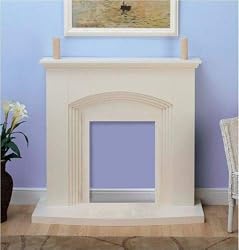
- Cement board underlayment (Durock or HardieBacker, 1/2-inch) as a base layer, then natural stone or tile on top
- Fire brick laid in a sand bed — provides thermal mass that helps regulate stove output
- Avoid ceramic tile directly on a wood subfloor without cement board underneath
Always follow the stove manufacturer’s specific clearance requirements, as many exceed NFPA minimums. The Imperial Stove Board is a cost-effective UL-listed option for floor protection if you want a simpler install than masonry.
Log Home Winterization for Extreme Cold
Off-grid cabins in cold climates (USDA zones 3–5, where winter temperatures regularly drop below -20°F) need winterization that accounts for both thermal performance and the unique behavior of log walls.
Roof and Ceiling

Heat loss through the roof dwarfs wall losses. Aim for R-49 to R-60 in the ceiling — blown cellulose is the most cost-effective option for off-grid builds and can be installed with a rented blower. Ensure a continuous vapor barrier on the warm side and adequate soffit-to-ridge ventilation above the insulation.
Foundation and Floor
An uninsulated floor over a crawl space can account for 15–20% of total heat loss. Use 2-inch rigid XPS foam board against the foundation walls and seal the crawl space perimeter. If the cabin sits on piers, enclose the skirt area and insulate between floor joists with R-30 mineral wool batts — they resist moisture better than fiberglass in exposed locations.
Windows and Doors
Double-pane windows are the minimum. In extreme cold, triple-pane with a U-factor below 0.20 is worth the investment. Seal window and door frames with low-expansion spray foam, then cover with trim. Install insulated window coverings or Insulated Window Quilts to cut nighttime heat loss dramatically.
Plumbing Protection

Bury water lines below your local frost line (4–6 feet in most northern climates). For any exposed runs, use self-regulating heat tape with a thermostat — Frost King heat cable is a reliable, widely available option. Insulate all exposed pipes with minimum 1-inch wall foam pipe insulation.
Common Mistakes
Building with green logs and no settling plan. Green-log construction is possible, but you must design for 6–8 inches of vertical settling per 8-foot wall height. That means slip joints on all vertical members, floating window and door frames, and settling jacks on porch posts. Most first-time builders underestimate this.
Skipping end-grain sealing. Unprotected end grain loses moisture 10–12 times faster than face grain, causing deep radial cracks that become entry points for water and insects. Seal ends immediately after cutting — before the logs even go on the drying stack.
Using rigid sealant instead of flexible chinking. Standard silicone caulk and concrete-based mortars crack as logs move seasonally. Always use purpose-built log home chinking with backer rod.
Insufficient wood stove clearances in a log structure. Log walls are combustible and they dry out further near a heat source, increasing fire risk over time. Don’t shortcut the clearances or omit heat shields — the consequences are catastrophic.
Our Recommendations
Stihl Woodsman Chainsaw Filing Kit — If you’re harvesting your own logs, a properly maintained chain makes cleaner cuts that dry more evenly. This kit keeps your chain at factory-spec geometry.

Permachink Log Jam Chinking — The most flexible and durable chinking we’ve found in builder feedback. Available in multiple colors to match your log tone. A 5-gallon bucket covers roughly 45 linear feet at a 4-inch width.
Wagner Orion 930 Moisture Meter — Pinless scanning means you can check moisture deep in the log without leaving probe holes. Essential for monitoring your drying stack and verifying logs before they go into the wall.
FAQ
How long should logs dry before building?
For most softwoods (pine, cedar, fir) in a well-ventilated stack, plan on 6–12 months to reach 19% MC or below. Hardwoods take 12–18 months. Climate matters — arid regions dry faster. Always verify with a moisture meter rather than relying on time alone.
Can I build with green logs?
Yes, but it requires designing every joint, opening, and vertical connection to accommodate 6+ inches of settling. Swedish cope and saddle-notch techniques handle green-log settling best. It’s a viable approach but significantly more complex than building with dried logs.
How often should I re-chink a log cabin?
Inspect annually in spring. Modern acrylic chinking like Permachink typically lasts 20–30 years before full replacement, but touch-ups to cracked or separated sections should happen yearly, especially during the first five years as logs reach equilibrium moisture content.
What R-value do log walls provide?
A solid 6-inch pine log wall provides approximately R-7.5; an 8-inch wall about R-10. That’s below code minimum in most cold climates, which is why ceiling insulation, hearth efficiency, and air sealing (chinking quality) matter so much. The thermal mass of logs provides some buffering benefit that R-value alone doesn’t capture, but don’t rely on it as a substitute for proper insulation elsewhere.
Do I need a building permit for an off-grid log cabin?
In most U.S. counties, yes — even on remote private land. Requirements vary significantly by jurisdiction. Some rural counties have minimal codes; others enforce the full IRC. Check with your county building department before breaking ground. Unpermitted structures can create problems with insurance, resale, and even property tax assessments.