7 Best Off-Grid Garden Tools 2026
Finding reliable garden tools when you’re miles from the nearest hardware store isn’t just inconvenient — it’s a real threat to your food supply. Cheap big-box tools snap mid-season, ergonomic nightmares wreck your back before the beds are even prepped, and half the “homestead” gear online is rebranded suburban patio stuff. We dug into manufacturer specs, verified buyer feedback from off-grid growers, and cross-referenced community forums to find the tools that actually hold up season after season without grid-powered sharpening stations or next-day replacement shipping.
Our Top Picks at a Glance
Best overall: Meadow Creature Broadfork — unmatched for deep soil prep without machinery.
Best multi-purpose hand tool: Nisaku Hori Hori Knife — does the work of five tools in one sheath.
Best for heavy clearing: Rogue Hoe 575G Field Hoe — built for new-ground breaking.
Best spading fork: Leonard Forged Spading Fork — lifetime-grade for double digging.
Best ergonomic shovel: Radius Garden Root Slayer Shovel — saves joints on long dig days.
Best budget spade: Fiskars Xact Digging Spade — solid performer under $40.
Best hand cultivator: DeWit Dutch Hand Hoe — precision weeding with zero power tools.
Our Picks
Meadow Creature Broadfork
This is the tool that replaces a rototiller on an off-grid homestead — no fuel, no electricity, no maintenance beyond occasional sharpening. The Meadow Creature’s 14-inch tines penetrate compacted clay and rocky subsoil that lesser broadforks bounce off of, making it the backbone of any broadfork double dig technique off-grid growers swear by.
Who it’s for: Anyone prepping 500+ square feet of garden beds annually without power equipment.
Pros:
– Heat-treated steel tines rated for rocky and clay soils — won’t bend like tubular-steel competitors
– Five-tine, 20-inch-wide head covers ground faster than four-tine models
– Welded-steel construction with no bolts or fasteners to loosen over time
Cons:
– Heavy at roughly 21 lbs — not ideal if you have shoulder or mobility issues
– Premium price point (typically $200+), though the buy-it-once argument is strong
Nisaku Hori Hori Knife
Off-Grid Insider
Get off-grid guides & gear picks in your inbox — free
If we could only grab one hand tool heading to a remote homestead, this would be it. The Nisaku’s 7.25-inch stainless steel blade handles transplanting, weeding, cutting twine, prying rocks, sawing small roots, and even soil depth measurement with its etched ruler — a genuine hori hori knife for homestead gardening that earns its belt real estate every single day.
Who it’s for: Every off-grid gardener, period. This belongs in your tool belt whether you’re running raised beds or managing a quarter-acre plot.
Pros:
– One serrated edge and one smooth edge eliminate the need to carry separate cutting and digging tools
– Full-tang stainless steel blade resists rust even without regular oiling
– Concave blade profile scoops soil efficiently for transplanting seedlings
Cons:
– Leather sheath quality varies by batch — some buyers report needing to replace it within a year
– Not a substitute for a real saw on roots thicker than about 1 inch
Rogue Hoe 575G Field Hoe

When you’re converting pasture, clearing sod, or chopping through root-matted soil for new beds, the Rogue Hoe is brutally effective. Handmade in the USA from recycled agricultural disc blades, the 575G’s aggressive 7-inch blade and 40-inch handle let you break new ground that would stall a standard garden hoe in seconds.
Who it’s for: Homesteaders establishing new garden plots from unworked land, especially in root-heavy or grassy soil.
Pros:
– Forged from recycled high-carbon steel disc blades — harder and more durable than stamped-steel competitors
– Aggressive blade geometry chops through sod, roots, and compacted soil efficiently
– 40-inch handle length qualifies it among long handled tools reducing strain off-grid during extended clearing sessions
Cons:
– Overkill for light weeding between established rows — it’s a clearing tool, not a precision cultivator
– High-carbon steel requires occasional oiling to prevent rust in humid storage conditions
Leonard Forged Spading Fork
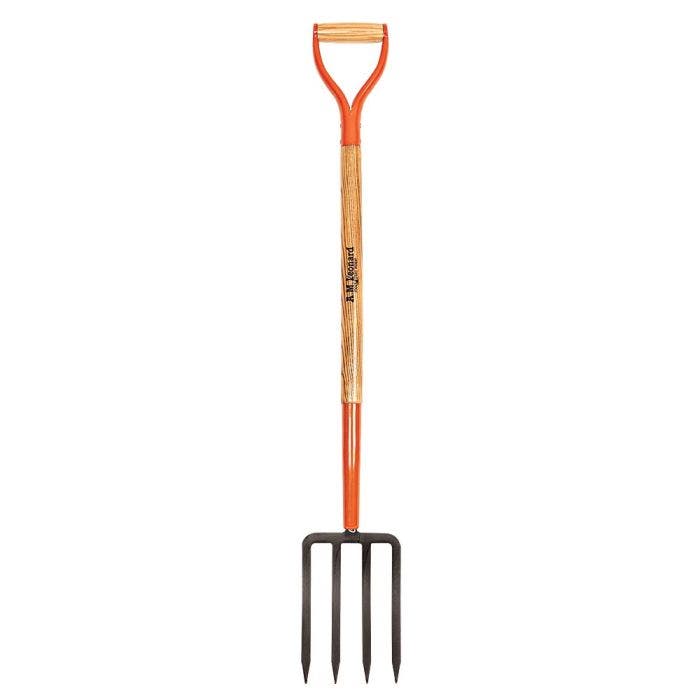
A quality spading fork is non-negotiable for double-digging beds, turning compost, and harvesting root crops without slicing them in half. The Leonard features four forged-steel tines on a D-grip ash handle — a traditional design that’s persisted because it works. Paired with a broadfork, this is how you execute the full broadfork double dig technique off-grid without any powered equipment.
Who it’s for: Gardeners who double-dig beds, maintain compost piles, or harvest potatoes, carrots, and other root crops by hand.
Pros:
– Forged (not stamped) tines resist bending even in heavy clay and rocky soils
– D-grip handle provides control and leverage for prying and turning motions
– Flat tine profile lifts root vegetables cleanly with less crop damage than curved-tine forks
Cons:
– Ash handles can crack if stored in direct sun and weather — needs to live under cover
– Heavier than fiberglass-handle alternatives, which matters on long harvest days
Radius Garden Root Slayer Shovel

This is the shovel that converts people who thought they hated digging. The Root Slayer’s O-shaped handle eliminates wrist torque, and serrated blade edges cut through roots without needing a separate saw. For anyone dealing with joint pain, carpal tunnel, or just the accumulated wear of daily manual labor, this is one of the best long handled tools reducing strain off-grid we’ve come across in buyer reviews.
Who it’s for: Gardeners with wrist, hand, or back issues who still need to dig planting holes, edge beds, and cut through root zones.
Pros:
– Patented O-handle design distributes force across both hands, dramatically reducing wrist strain
– Inverted-V blade tip with serrated edges penetrates root zones without a separate root saw
– Lifetime warranty from Radius Garden backs the ergonomic and structural claims
Cons:
– The O-handle takes a few sessions to feel natural if you’ve used D-grip or straight handles for years
– Blade is thinner than a traditional nursery spade — not the right tool for prying boulders
Fiskars Xact Digging Spade
Not everyone needs a $200 broadfork or a $60 specialty hoe right out of the gate. The Fiskars Xact is a sharp, well-balanced digging spade that handles bed edging, transplanting, and general digging at a price point that won’t wreck a tight homestead budget. The boron steel blade holds an edge longer than standard carbon steel, and the fiberglass-reinforced shaft won’t snap like cheap wooden handles.
Who it’s for: New off-grid gardeners building their first tool kit on a budget, or anyone who needs a dependable general-purpose spade.
Pros:
– Boron steel blade stays sharper longer than standard stamped-steel spades
– Fiberglass-reinforced shaft resists snapping under prying loads
– Typically available under $40 — an accessible entry point for a quality digging tool
Cons:
– Not as comfortable for all-day use as ergonomic-handle designs like the Root Slayer
– Narrower blade than a nursery spade — not ideal for moving large volumes of soil quickly
DeWit Dutch Hand Hoe
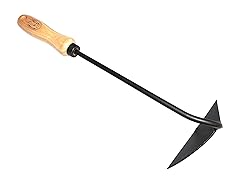
Precision weeding between tight rows and around delicate seedlings demands a hand tool with a thin, sharp blade and enough reach to work without crawling on your knees. The DeWit’s forged Dutch steel blade slices weeds just below the soil surface on both push and pull strokes, and the short ash handle gives you fine motor control that long-handled hoes can’t match.
Who it’s for: Gardeners maintaining established beds with tight row spacing who want to eliminate weeds without disturbing crop roots.
Pros:
– Push-pull cutting action weeds in both directions, roughly doubling speed versus single-direction hoes
– Hand-forged in the Netherlands from high-carbon steel — holds a razor edge
– Compact size fits in a tool belt or apron pocket for grab-and-go use throughout the day
Cons:
– Requires kneeling or bending — not suited for gardeners who need to stay upright (pair with a long-handled stirrup hoe instead)
– High-carbon blade will rust if left wet; needs a quick wipe and occasional oiling
How We Chose
We focused on three non-negotiable criteria for off-grid tool selection: durability without access to easy replacements, effectiveness without power equipment, and ergonomics for people doing sustained manual labor day after day. We cross-referenced manufacturer material specs (forged vs. stamped steel, handle composition, joint construction) with long-term buyer reviews from verified purchasers on major retail platforms, prioritizing feedback from users who specifically mention homestead, off-grid, or heavy-use scenarios. Tools that showed patterns of handle breakage, tine bending, or premature edge dulling under real working conditions were eliminated regardless of brand reputation.
Buying Guide: What Actually Matters
Material and Construction Method

The single biggest predictor of tool longevity off-grid is how the metal components are made. Forged steel (heated and hammered into shape) is denser and more resistant to bending than stamped steel (cut from flat sheet stock). For any tool that contacts soil — forks, hoes, spades — forged is worth the premium. For handles, ash and hickory are traditional and repairable (you can sand and re-oil them), while fiberglass is lighter and immune to rot but irreparable if it cracks.
Handle Length and Ergonomics
This matters more than most people realize until their second season. Short handles force you into bent-over postures that compound into back injuries over months of daily use. Look for handles in the 40–48 inch range for standing tools — these are the long handled tools reducing strain off-grid by keeping your spine neutral during repetitive motions like hoeing, raking, and cultivating. D-grip and O-grip handles add leverage and reduce wrist fatigue for digging tools.
Repairability and Maintenance
Off-grid means you can’t just order a replacement handle for next-day delivery. Prioritize tools with standard-dimension handles that you can carve or source locally. A tool with a bolted tang (where the blade attaches to the handle with a bolt through a socket) is field-repairable. A tool with a welded or molded-in handle is not. Similarly, high-carbon steel takes a better edge and is easier to sharpen with a file, but it rusts faster — stainless steel resists corrosion but is harder to sharpen without powered equipment.
Versatility vs. Specialization
A hori hori knife for homestead gardening can replace five single-purpose hand tools. A broadfork eliminates the need for a rototiller. When building a tool kit for a remote property, every tool that serves double or triple duty is one less thing to haul, store, and maintain. Start with versatile tools and add specialty items only as your operation demands them.
FAQ
What are the most essential garden tools for off-grid vegetable production?
Start with a broadfork, a spading fork, a hori hori knife, a quality hoe, and a digging spade. These five tools handle soil preparation, planting, weeding, harvesting, and general maintenance without any electricity or fuel.
How do you prepare garden beds off-grid without a rototiller?
The broadfork double dig technique off-grid is the most effective method. Use a broadfork to loosen the top 12–14 inches of soil, then follow with a spading fork to turn and aerate each layer. This creates deep, loose beds with better drainage and root penetration than rototilling, and it doesn’t destroy soil structure.
What is a hori hori knife used for on a homestead?
A hori hori knife is a Japanese multi-purpose garden tool with a serrated edge, a smooth edge, and a pointed tip. On a homestead it handles transplanting, weeding, cutting twine and roots, dividing plants, measuring planting depth, and even light prying — making it arguably the most versatile single hand tool you can carry.
How do you prevent back pain when gardening off-grid all day?
Choose long-handled tools (40–48 inches) for any task done while standing — hoeing, raking, cultivating. Use ergonomic grip designs like O-handles or D-grips on digging tools. Alternate between standing and kneeling tasks throughout the day, and use a broadfork instead of a shovel for primary soil breaking, since the stepping motion is far easier on your lower back.
How often should you sharpen off-grid garden tools?
Most digging and cutting tools benefit from a quick touch-up with a flat mill file every 3–5 uses and a more thorough sharpening monthly during the growing season. High-carbon steel tools sharpen faster and hold a finer edge than stainless steel. Keep a 10-inch mill bastard file and a diamond hone in your tool shed — no power required.
Our Final Verdict
For most off-grid vegetable growers, the Meadow Creature Broadfork is the single most impactful tool purchase you can make — it replaces powered tillage equipment entirely and lasts decades with zero maintenance beyond sharpening. Pair it with a Nisaku Hori Hori Knife for daily hand work, and you’ve covered about 70% of what a productive off-grid garden demands. Add the rest as your beds expand and your growing operation tells you what it actually needs — not before.