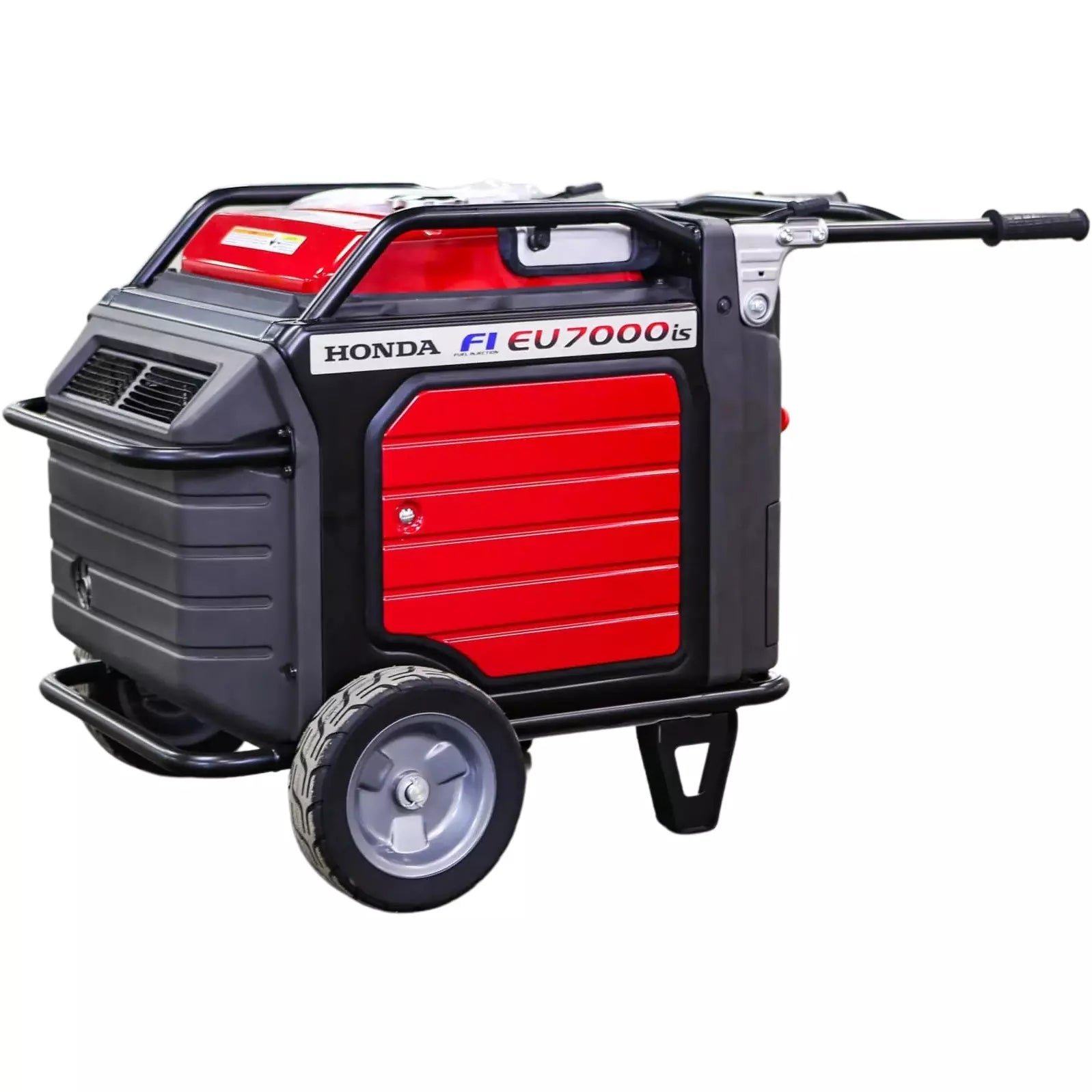
Honda EU7000iS 2026: Worth It?
Honda EU7000iS Generator Review — 2025: The Gold Standard, If You Can Stomach the Price
The Honda EU7000iS is the generator off-grid homesteaders argue about most — not because it’s controversial, but because the price is. At $4,399 MSRP (street closer to $3,999–$4,399), it costs three to four times what a capable inverter generator runs. What you get for that premium is a machine with documented 10,000–22,000-hour lifespans, whisper-quiet operation, and a fuel-injected GX390 engine that Honda has spent decades refining. This review is for serious off-grid buyers who need to know whether it’s worth it.
Check Current Price on Amazon →
As an Amazon Associate, OffGridFoundry earns from qualifying purchases.
The EU7000iS earns its reputation. It is almost certainly the most reliable portable generator you can buy, and for a homestead where the generator is the primary backup power source during a grid outage or a critical component of a solar+generator hybrid system, that reliability has real dollar value. But $4,399 is a difficult pill to swallow when the Westinghouse iGen7500 delivers comparable noise levels and clean power for under $950. The honest answer: if the budget exists, there is no better choice. If budget is a constraint, there are legitimate alternatives that most people will never outgrow.
What We Like
- Fuel injection that actually matters: The EU7000iS runs a 389cc Honda GX390 engine with electronic fuel injection — not a carburetor. The practical effect is immediate cold starts, no carb jets to gum up, and consistent performance across temperature ranges. For homesteaders who pull the generator out after months in storage, EFI is a genuine operational advantage over every carbureted competitor.
- Noise levels that don’t disrupt work: Honda rates the EU7000iS at 52–60 dBA depending on load. At 25% load — typical for running lights, a fridge, and charging — it runs at the quieter end of that range. At a conversational distance, you can have a normal conversation standing next to this generator. Verified across dozens of owner reports and forum threads.
- Clean power for sensitive electronics: Total harmonic distortion (THD) is rated at under 3%, and independent testing confirms the EU7000iS consistently delivers <2% THD. This matters when running variable-speed well pumps, inverter-based HVAC systems, or any grid-tied solar equipment that’s sensitive to power quality. Multiple off-grid solar forum users on OutBack Power and DIY Solar Forum have reported running this unit directly alongside inverter/charger systems without issues.
- Documented longevity that no competitor can match: This is where the Honda premium becomes tangible. Forum research turns up verified owner reports of units hitting 7,400, 14,000, and 22,000+ hours. Honda claims the GX390 platform is rated for 10,000+ hours of service life. No other portable generator in this class has this kind of documented long-term field record.
- Parallel-capable and grid-tie friendly: The EU7000iS can be paralleled with a second unit for up to 14,000W combined output. It also plays well with off-grid solar setups — inverter-charger compatibility is one of the most-cited reasons homesteaders in solar forums choose it over conventional generators.
- Auto-throttle (Eco Throttle): At light loads the engine automatically reduces RPM, dropping fuel consumption and noise. At 25% load, Honda rates runtime at 16–18 hours on the 5.1-gallon tank — competitive with any generator in the class and critical for overnight operation without refueling.
What We Don’t Like
- 263 pounds: The EU7000iS is the heaviest generator in its class. It ships with a wheel kit and folding handle, and those wheels are non-negotiable — you are not hand-carrying this unit. On flat ground it’s manageable; across a field or down a gravel path, it’s difficult. If you’re moving your generator regularly, this is a real quality-of-life issue. The Yamaha EF6300iSDE weighs about 200 lbs and is meaningfully easier to manage.
- No 50-amp outlet: The EU7000iS tops out at a 30A twist-lock outlet (NEMA L14-30). For homesteaders trying to feed a 50A main panel or run a large RV, this requires an adapter and derating to 30A. Several Amazon reviewers cite this as a dealbreaker for RV applications. A 50A option simply doesn’t exist on this unit.
- Gasoline only — no dual-fuel: In extended grid-down scenarios, propane is often more accessible and more easily stored long-term than gasoline. The EU7000iS offers no dual-fuel capability from the factory. Third-party conversion kits exist but void the warranty. Competitors like the Champion 100520 offer dual-fuel at a fraction of the price.
- Cold-weather fuse failure below -15°C (5°F): This is a documented issue acknowledged in service bulletins but never factory-resolved. At extreme cold, the GCU (Generator Control Unit) protection fuse can blow, shutting the unit down. Honda dealers have a known fix (fuse relocation), but it requires a service visit. For homesteaders in northern climates who need the generator most during cold-weather outages, this is worth knowing before purchase.
- GCU board failures: The most expensive non-engine repair is GCU/inverter board failure, which runs $290–$790 in parts and labor. This appears to affect a small minority of units, but it shows up repeatedly in forum threads on PowerEquipmentForum and Reddit. It’s worth factoring in when comparing total cost of ownership against competitors — Honda’s build quality reduces frequency, but it doesn’t eliminate the possibility.
- Price: At $4,399, the EU7000iS costs roughly 4.5x the Westinghouse iGen7500 and 1.5x the Honda EU6500iS. The premium is defensible for certain buyers, but it is real money.
Specs That Matter
Off-Grid Insider
Get off-grid guides & gear picks in your inbox — free
| Spec | Value |
|---|---|
| Rated Output | 5,500W (120V) |
| Peak/Surge Output | 7,000W |
| Engine | 389cc Honda GX390, EFI |
| Fuel Tank | 5.1 gallons |
| Runtime @ 25% Load | 16–18 hours |
| Runtime @ 100% Load | ~6 hours (est.) |
| Noise Level | 52–60 dBA (load-dependent) |
| THD | <3% (measured typically <2%) |
| Outlets | (2) 120V 20A duplex, (1) 30A twist-lock L14-30, (1) 12V DC |
| 50A Outlet | No |
| Parallel Capable | Yes (up to 14,000W combined) |
| Weight | 263 lbs (with oil/fuel) |
| Dimensions | 29.3″ L × 28.0″ W × 26.9″ H |
| CARB / EPA | Compliant |
| Warranty | 3 years residential |
Real-World Performance
Owner reports across Reddit’s r/generators, r/homestead, OutBack Power Forum, and DIY Solar Forum paint a consistent picture: the EU7000iS is dependable in a way that becomes emotional for people who’ve been burned by cheaper generators at critical moments. The most common thread is variation of the same story — someone bought a $800 generator, it failed during an ice storm or a days-long grid outage, they switched to the Honda, and they don’t think about it anymore. That psychological reliability premium is underrated in spec comparisons.
At realistic off-grid loads — refrigerator, chest freezer, well pump, lighting, device charging — the EU7000iS typically runs at 25–40% capacity, keeping it in the quiet and efficient range. Several homesteaders report running it for 6–10 hours overnight on a single tank in Eco Throttle mode without needing to refuel. The EFI system earns consistent praise from users in cold climates who’ve switched from carbureted units; first-pull cold starts in the 20s (°F) are reported as routine, versus the carburetor-tuning hassle that plagues competitors in winter.
The one consistent performance complaint is weight and mobility. Multiple Amazon reviewers and forum users mention that the wheel kit, while functional, struggles on soft terrain — gravel, mud, grass. Several owners have fabricated custom carts or purchased aftermarket wheel kits to address this. For a generator that lives in a stationary shed or outbuilding and rarely moves, it’s not an issue. For anyone who needs to relocate it regularly, plan for the logistics.
Long-term failure data from owner reports suggests the engine itself is the last thing to fail. GCU board failures — roughly $400–$700 to repair out of warranty — appear to be the most common non-routine repair, surfacing around the 2,000–5,000 hour range on some units. This is an important caveat: Honda’s warranty covers 3 years, but at 10,000+ hour expected lifespans, there’s significant post-warranty service life where repairs fall on the owner.
Who Should Buy This
The EU7000iS is purpose-built for homesteaders and off-grid property owners for whom the generator is infrastructure, not a convenience. If your well pump, freezer, medical equipment, or business continuity depends on generator power during outages — and you need that power to simply work, every time, for years — this is the machine. The combination of EFI reliability, clean inverter output, and verified long-term durability makes it the rational choice for anyone running a solar+generator hybrid system, operating sensitive electronics, or living somewhere with extended grid outages where a generator failure carries real consequences.
It’s also the right call for buyers who plan to own one generator for 15–20 years. At $4,399 amortized over 15,000+ hours of service life, the cost per operational hour approaches parity with cheaper units that will need replacement in 5–7 years. If you’re thinking about total cost over a decade, the math is closer than the sticker price suggests.
Who Should Look Elsewhere
If you’re running a homestead with a tight budget or the generator is a secondary backup that rarely runs, the Westinghouse iGen7500 ($800–$950) is the most credible alternative. It runs at a comparable 52 dBA, delivers <3% THD clean power, includes remote start, outputs 240V, and carries a 3-year warranty. It lacks the Honda’s long-term reliability ceiling and EFI, but for buyers who will put 200–400 hours per year on a generator, it will last a decade with basic maintenance. At less than a quarter of the Honda’s price, the money saved can fund years of professional service.
If you specifically want Honda quality but need to stretch the budget, the Honda EU6500iS ($3,399–$3,799) is technically capable. It produces 5,500W rated and uses the same core Honda inverter platform. That said, at only $600 less than the EU7000iS street price, it’s hard to recommend — you’re giving up 500W of surge capacity for a minor discount, and the resale value and feature parity of the EU7000iS is simply better. Shop for a deal on the EU7000iS before settling for the EU6500iS.
Bottom Line
The Honda EU7000iS is the generator you buy when you are done thinking about generators. The GX390 EFI engine, sub-3% THD clean power, and verified 10,000–22,000 hour service life represent a standard that no competitor at any price currently matches for portable inverter output at this wattage. The caveats — 263-lb weight, no 50A outlet, no dual-fuel, cold-weather fuse issue, and a $4,399 price tag — are real and buyer-dependent. For a homestead where reliable power is mission-critical, they’re acceptable trade-offs. Buy it once, maintain it on schedule, and it will likely outlast the property.
→ Buy the Honda EU7000iS on Amazon