Bluetti AC180 2026: Still Worth It?
Bluetti AC180 Review — 2026: The Best Value LFP Power Station Under $500
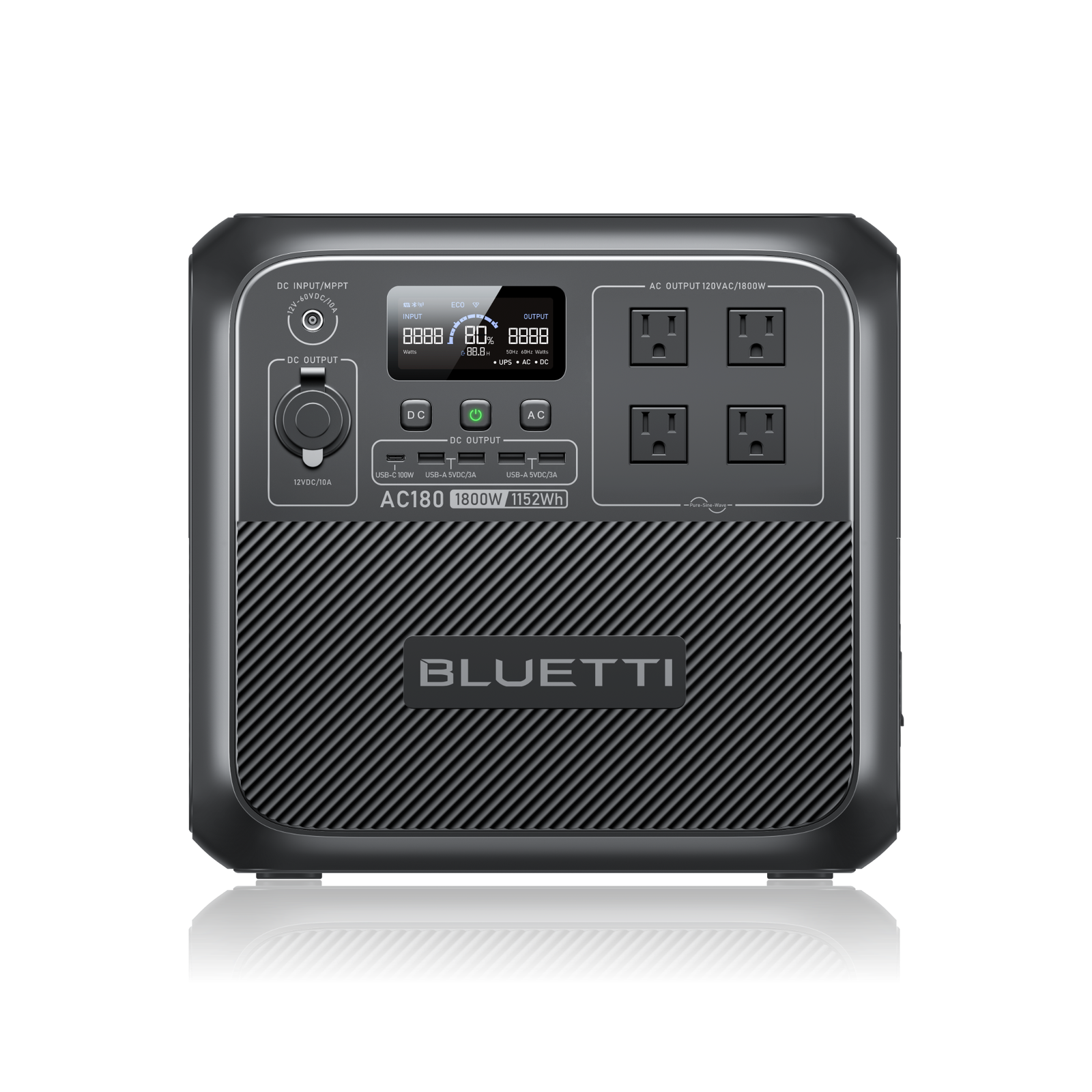
At a street price that has hovered around $449–$499 for the past 18 months, the Bluetti AC180 punches well above its weight class. With a 1,152 Wh LiFePO4 battery, a genuine 1,800W pure sine wave inverter, and fast AC charging that can take you from dead to 80% in roughly 90 minutes, this unit is the one we recommend most often to weekend campers and emergency-preparedness buyers who want serious capability without the $799+ MSRP its competitors charge. It is not without real flaws — the fan behavior problem has frustrated enough owners to fill multiple forum threads — but the overall value proposition is hard to argue with.
| Best For | Weekend campers, RV users, 1–2 day emergency backup |
| Avoid If | You need quiet indoor operation or >500W solar input |
| Street Price | ~$449–$499 |
| Warranty | 5 years |
As an Amazon Associate, OffGridFoundry earns from qualifying purchases.
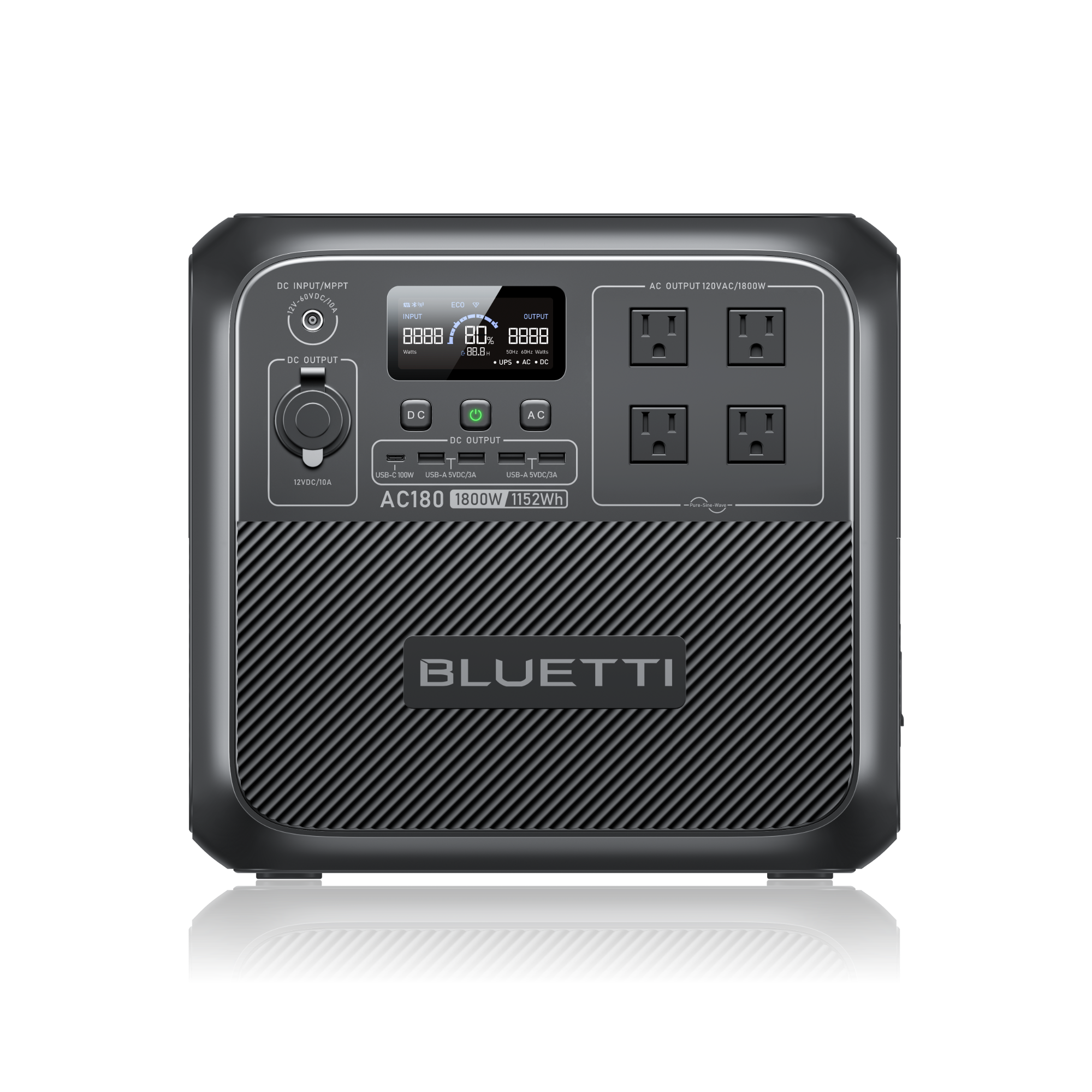
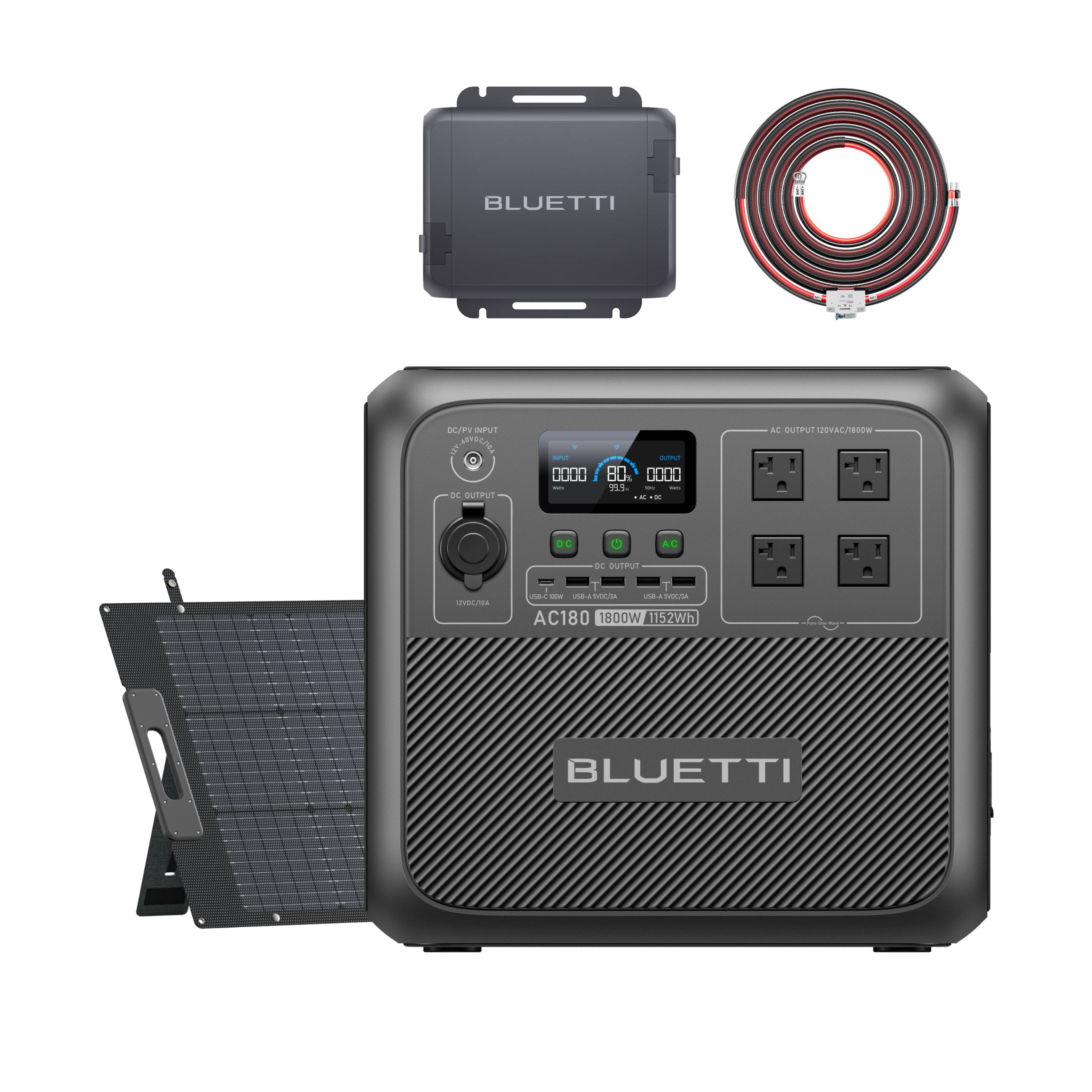
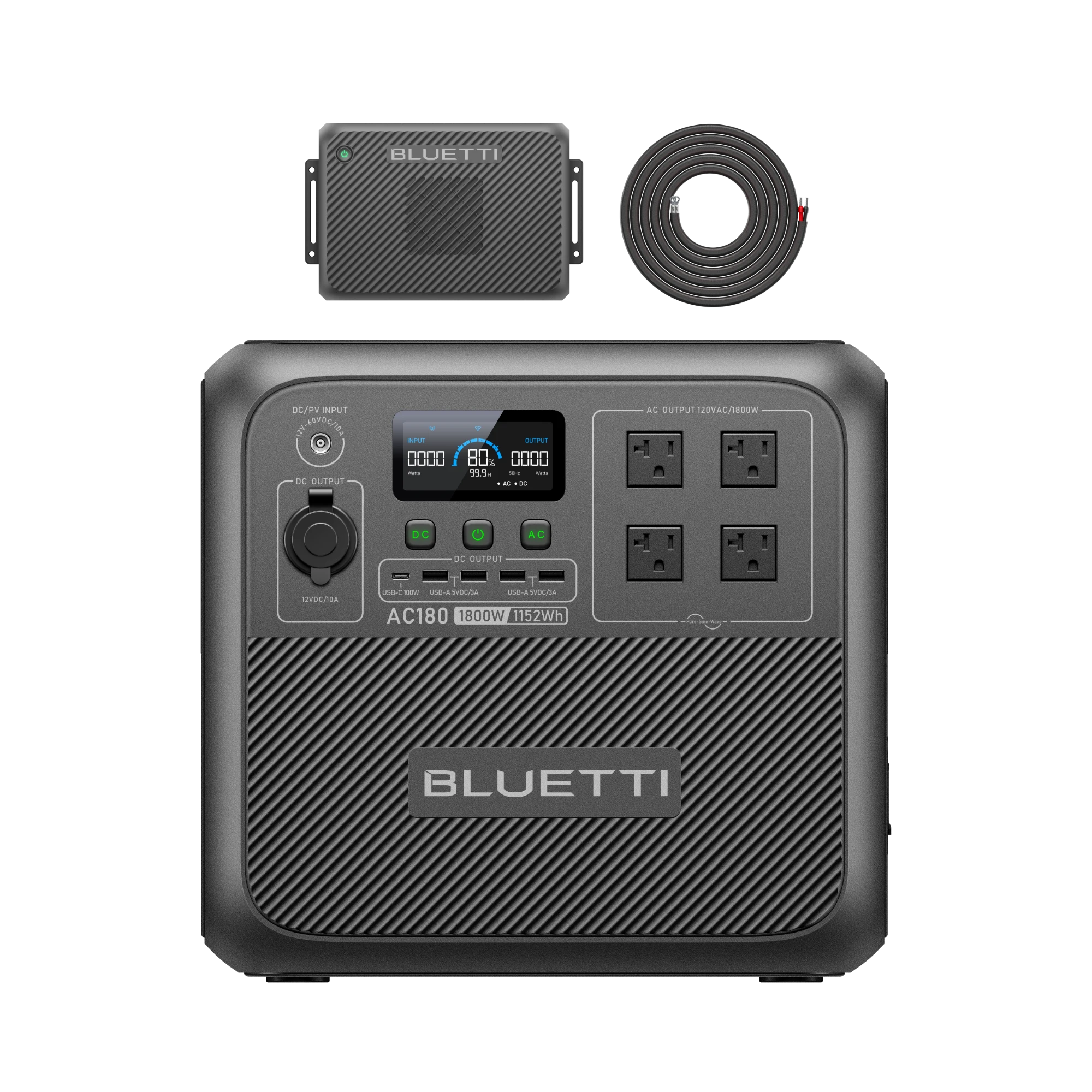
The AC180 earns its place as the best value 1 kWh LFP station on the market right now. The MSRP of $999 is effectively fiction — this unit has sold at $449–$499 for the majority of the past year and a half, and at that price, nothing else in the category delivers this combination of battery chemistry, inverter power, and charging speed. Buy it at $499 or under. If it’s over $600, wait for the next sale event.
What We Like
- LiFePO4 chemistry at this price point. Most competitors in the sub-$500 tier still ship with lithium-ion NMC cells. The AC180 uses LFP with a rated 3,500+ cycles to 80% capacity — roughly three to four times the lifespan of NMC alternatives. Paired with the 5-year warranty, the long-term cost per cycle is better.
- Fast AC charging is real and differentiating. In Turbo mode, the AC180 pulls up to 1,440W from the wall — independent tests clocked 0–80% in about 62–90 minutes and full charge in roughly 2.5 hours. That’s slower than Bluetti’s claimed 45-minute 0–80%, but still faster than almost everything else at this price. For a weekend camper or emergency-prep buyer, being able to fully recharge between uses quickly matters more than raw capacity.
- 1,800W continuous with real surge headroom. The pure sine wave inverter handles 1,800W continuous and 2,700W surge. In practice, owners consistently report running full-size RV compressor fridges, CPAP machines, and standard kitchen appliances without issue.
- Power Lifting mode works — for the right loads. The app-enabled Power Lifting mode allows resistive loads up to 2,700W (think space heaters, electric blankets, hair dryers) that would otherwise trip the inverter. Independent testing confirmed it handles a 1,725W air fryer without error when enabled. Important caveat: it’s only for pure resistive/heating loads, not motors or compressors, and it only works on battery — not during pass-through charging.
- Usable capacity is close to the rated figure. Independent tests delivered 1,039 Wh usable on AC loads — 90% of the 1,152 Wh rated capacity. That’s excellent inverter efficiency for this class. DC output efficiency is lower (~78%), so prefer AC output when running high-drain devices.
- Healthy Amazon rating at scale. 4.6 stars across 1,400+ reviews is not a small sample. The distribution of praise is consistent: fast charging, reliable inverter, build quality, and LFP longevity are the four pillars owners return to.
What We Don’t Like
- The fan noise problem is real and unresolved. This is the most documented complaint in the Bluetti community. Multiple forum threads with dozens of owner reports describe the fan running at full blast regardless of load — triggered by as little as 35–95W of draw. The behavior is binary: full speed or off, with no proportional response to thermal load. Bluetti acknowledged the issue in mid-2023 and pushed several firmware updates through at least late 2024. Community consensus is that updates improved it but did not fully resolve it. If you plan to run this unit indoors at night near a sleeping area, test the fan behavior early and request a warranty exchange if needed.
- 500W solar input ceiling is a meaningful constraint. The DC input accepts up to 500W at 12–60V open-circuit. That’s adequate for day camping and light off-grid use, but competitors like the EcoFlow Delta 3 accept 800W solar. If you’re planning extended off-grid runs with solar as the primary recharge source, the AC180 will extend your charge windows compared to what those panels could theoretically deliver.
- At 35.27 lbs, one-person carry is awkward. The AC180 is not a grab-and-go unit. It has a single top handle and no wheels. For in-vehicle use or stationary emergency backup, weight is a non-issue. For long camp walks or frequent repositioning, it becomes a real inconvenience. The Bluetti AC70P (20.7 lbs) is the better choice if portability is a priority.
- Bluetooth-only app means no remote monitoring. There’s no WiFi. You cannot check state of charge or adjust charge modes from across the house or from outside the vehicle. All charging mode configuration (Turbo, Standard, Silent) and Power Lifting mode require the app within Bluetooth range.
- ECO mode trips on low-draw devices. ECO mode cuts output when it detects “no load” — but its detection threshold is aggressive. Devices with low standby power draw (certain CPAP machines at idle, small routers, low-wattage LED setups) can trigger false shutdowns. The fix is to disable ECO mode, but this reduces overall runtime.
Specs That Matter
Off-Grid Insider
Get off-grid guides & gear picks in your inbox — free
| Spec | AC180 |
|---|---|
| Battery capacity | 1,152 Wh |
| Battery chemistry | LiFePO4 |
| Cycle life | 3,500+ cycles to 80% |
| AC output | 1,800W continuous / 2,700W surge |
| Inverter type | Pure sine wave |
| Power Lifting | Up to 2,700W (resistive loads only, battery mode) |
| Solar input | 500W max, 12–60V OCV |
| AC charging (Turbo) | 1,440W (0–10°C–30°C ambient required) |
| USB-C output | 100W PD |
| Wireless charging | 15W max |
| UPS switching | ≤20ms |
| Weight | 35.27 lbs / 16 kg |
| Warranty | 5 years |
Real-World Performance
Independent capacity tests put usable AC energy at 1,000–1,039 Wh — about 87–90% of the rated 1,152 Wh. That’s a strong result: inverter losses of 10–13% are normal and the AC180 sits at the better end of that range. Real-world runtime examples drawn from owner testing: roughly 17 hours on a 40W mini-fridge, 15 full laptop charges from a 65W adapter, and 22+ hours for a low-draw CPAP at 40W. For a 1-kWh station, these numbers track with expectations.
The fast AC charging is the feature that most owners comment on enthusiastically — and the independent data backs them up. While Bluetti’s “45 minutes to 80%” claim is aspirational (real-world tests land at 62–90 minutes), the AC180 is still substantially faster to recharge than most competitors in the class. This matters more than it might seem: for emergency backup or weekend camping where you’re topping off between uses, a unit that returns to full charge in under three hours is meaningfully more useful than one that takes five or six. The 1,440W Turbo mode does require ambient temperatures between 10°C and 30°C — in cold environments, charge speed will throttle automatically.
Solar performance is adequate but not a strength. With 400W of panels under ideal conditions, a full charge from 0% takes approximately six hours. In partial cloud or sub-optimal panel angles — the norm in real field use — expect eight to ten hours or more. Owners doing extended off-grid use on solar alone find this limiting, and the 500W ceiling leaves headroom on the table even with quality panels. The EcoFlow Delta 3 (800W solar input) is the direct comparison here if solar recharge speed matters to your use case.
Who Should Buy This
The AC180 is purpose-built for a specific buyer: someone who needs reliable, medium-capacity power for predictable weekend or emergency use and wants LFP longevity without paying $700+ for it. That includes car campers who want to run a fridge and charge devices for two to three days on a charge, RV owners who want a portable backup alongside their vehicle’s existing electrical system, and homeowners building a modest emergency preparedness kit for 24–48 hour outages. At $449–$499, the AC180 is the most cost-effective way to get LFP chemistry, a 1,800W inverter, and fast AC recharging in one package.
If you’re a first-time power station buyer coming from a generator background, the AC180 is also a natural entry point. The inverter handles nearly everything a household generator handles in a weekend context, but without fuel, fumes, maintenance, or startup noise.
Who Should Look Elsewhere
If portability is your primary driver — overlanding, backpacking, or any use case where you’re carrying the unit significant distances — consider the Bluetti AC70P instead. At 20.7 lbs, it’s nearly half the weight, still LFP, and priced around $349–$449. The trade-off is a 200W solar ceiling and lower inverter capacity, but for car camping with lighter loads, those constraints rarely bite.
If you’re powering a cabin or a full off-grid setup and need to scale storage, the Bluetti AC500 + B300S system ($3,699+ street) is the right architecture — 5,000W output and expandable LFP storage up to 18 kWh. The AC180 cannot expand beyond its internal 1,152 Wh.
Bottom Line
The Bluetti AC180 earns its reputation as the best value LFP power station in the 1 kWh class — not because it’s flawless, but because nothing else at $449–$499 offers this combination of battery chemistry, inverter power, and fast AC recharging. The fan noise issue is a genuine quality-control problem that Bluetti has not fully resolved, and the 500W solar ceiling will frustrate users with serious off-grid solar setups. But for the core use case — camping, RV backup, emergency preparedness — it delivers everything it promises. Buy it at $499 or below, download the app before you leave home, and disable ECO mode if you’re running anything with a low standby draw.
→ Buy the Bluetti AC180 on Amazon