Off-Grid Solar Cost: Real Budget Breakdown (2025)
Most people dramatically overestimate or underestimate what off-grid solar costs — and both mistakes lead to wasted money. Overestimate, and you never start. Underestimate, and you buy cheap gear that fails in two years. We’ve broken down every real cost category, from panels to permits, so you can build a realistic budget before you spend a dime.
What You’ll Learn
- Exactly what components make up a full off-grid solar system and what each one costs in 2026
- Three realistic budget tiers — bare-bones cabin, comfortable homestead, and full household replacement
- The hidden costs most beginners miss that can add 20–40% to your total
- How to prioritize spending so you get the most reliable system for your budget
Understanding the Core Components (and What Each Costs)
An off-grid solar system isn’t just panels on a roof. There are five major components, and skipping or skimping on any one of them creates problems down the line.
Solar Panels — $0.70–$1.20 per Watt
Off-Grid Insider
Get off-grid guides & gear picks in your inbox — free

Panels are actually the cheapest part of the system relative to their importance. For a beginner system, you’re looking at 400W rigid monocrystalline panels from brands like Rich Solar, Renogy, or Canadian Solar.
- Small cabin (1–2 kW): $700–$2,400
- Mid-size homestead (3–5 kW): $2,100–$6,000
- Full household (8–12 kW): $5,600–$14,400
Monocrystalline panels dominate the market right now for good reason — higher efficiency per square foot, better low-light performance, and 25-year output warranties are standard. Unless you have unlimited roof or ground-mount space, skip polycrystalline.
Battery Bank — $400–$800 per kWh (LiFePO4)
This is where the real money goes. Your battery bank typically represents 30–50% of total system cost. Lithium iron phosphate (LiFePO4) has become the clear standard for off-grid — longer cycle life (4,000–6,000 cycles vs. 500–800 for lead-acid), no maintenance, and roughly half the weight.
- Small cabin (5 kWh): $2,000–$4,000
- Mid-size homestead (10–15 kWh): $4,000–$12,000
- Full household (20–30 kWh): $8,000–$24,000
Lead-acid batteries cost less upfront ($150–$250 per kWh), but when you factor in replacement every 3–5 years, equalization charging requirements, and the 50% depth-of-discharge limit, LiFePO4 wins on lifetime cost by a wide margin. Community forums consistently report that lead-acid “savings” evaporate within 3–4 years.
Server rack batteries from brands like EG4 and SOK have become popular in the off-grid community for good reason — they stack neatly, include built-in BMS, and price competitively around $400–$550 per kWh at the 48V level.
Charge Controller — $150–$800

The charge controller sits between your panels and batteries, regulating voltage and current. You want an MPPT (Maximum Power Point Tracking) controller, not PWM. MPPT controllers extract 15–30% more energy from your panels compared to PWM — that efficiency gap pays for the price difference quickly.
- Small system (1–2 kW panels): Victron SmartSolar 100/30 or Renogy Rover 40A — $150–$250
- Mid-size (3–5 kW): Victron SmartSolar 150/60 or EPEver 60A — $300–$500
- Large system (8+ kW): Multiple controllers or an all-in-one inverter/charger — $500–$800+
Inverter — $300–$3,000

The inverter converts DC battery power to AC household power. Pure sine wave is non-negotiable — modified sine wave inverters cause problems with modern electronics, refrigerator compressors, and anything with a motor.
- Small cabin (2,000W): $300–$600
- Mid-size homestead (5,000W): $800–$1,500
- Full household (8,000W+): $1,500–$3,000
All-in-one inverter/chargers like the EG4 6000XP or the Victron MultiPlus-II combine the inverter, charge controller, and transfer switch into one unit. These simplify wiring and are increasingly the go-to choice for systems 5 kW and up.
Balance of System (BOS) — 15–25% of Component Costs
This is the category that blindsides beginners. BOS includes:
- Wiring and cables (copper isn’t cheap — budget $200–$800 depending on run lengths)
- Combiner boxes and disconnects — $50–$200
- Mounting hardware (roof mounts or ground-mount racking) — $200–$1,000+
- Breakers, fuses, bus bars — $100–$300
- Conduit and junction boxes — $50–$200
- Battery enclosure or shelving — $100–$400
- Monitoring system (Victron Cerbo GX, etc.) — $150–$400
For a 5 kW system with $10,000 in core components, expect $1,500–$2,500 in BOS costs.
Three Realistic Budget Tiers
Tier 1: Weekend Cabin — $3,500–$6,500
- 1–2 kW of panels
- 5 kWh LiFePO4 battery
- 30A MPPT charge controller
- 2,000–3,000W pure sine wave inverter
- Basic BOS
Powers: LED lighting, phone/laptop charging, a small 12V fridge, water pump, and occasional small appliance use. Not enough for air conditioning, electric cooking, or heavy power tools.
Tier 2: Comfortable Homestead — $12,000–$22,000

- 3–5 kW of panels
- 10–15 kWh LiFePO4 battery bank
- 60A MPPT controller or all-in-one inverter/charger
- 5,000W inverter
- Full BOS with monitoring
Powers: Full-size Energy Star refrigerator, chest freezer, well pump, washing machine, lighting throughout, electronics, and moderate power tool use. Propane or wood handles cooking and heating — a smart strategy that keeps your solar budget manageable.
Tier 3: Full Household Replacement — $25,000–$45,000

- 8–12 kW of panels
- 20–30+ kWh battery bank
- Multiple charge controllers or large all-in-one unit
- 8,000W+ inverter (or stacked inverters)
- Comprehensive BOS, monitoring, and possibly a backup generator auto-start
Powers: Essentially everything a grid-tied home runs, including electric cooking, mini-split heat pumps, and power-hungry tools. At this tier, professional design consultation is worth the $500–$1,500 it costs.
Hidden Costs Beginners Miss
Permits and Inspections — $0–$2,000
This varies wildly by county. Some rural areas have zero permitting requirements for off-grid solar. Others require full electrical permits, engineered stamped plans, and inspections. Call your county building department before budgeting — we’ve seen reports from community members who budgeted $8,000 for a system and then discovered $1,500 in permit fees.
Shipping on Heavy Gear
Batteries are heavy. A 200Ah 48V LiFePO4 battery weighs 90–130 lbs. Panels come in oversized boxes. Freight shipping on a full battery bank and panel set can run $200–$600, and it’s rarely included in the sticker price.
Tools and Consumables

Wire crimpers, a torque wrench for lugs, cable cutters rated for 4/0 AWG, a multimeter — if you’re DIY installing, budget $100–$300 for tools you might not already own.
Future Expansion

Design your system with expansion in mind. A charge controller rated for 60A when you currently only need 40A costs marginally more now but saves replacing the entire unit later. Same with inverter capacity — the EG4 6000XP can be stacked in parallel later, which makes it a strong choice for systems that might grow.
Common Mistakes
-
Buying panels first, batteries last. Panels without adequate storage just waste energy. Budget your battery bank first — it determines what you can actually run after dark, which is most of your usage.
-
Sizing for average solar production, not worst-case. Your system needs to get you through the shortest, cloudiest days of winter, not July. Use PVWatts (free NREL tool) to check your location’s worst-month production and size from there.
-
Ignoring wire gauge and run length. Undersized wires cause voltage drop, heat buildup, and wasted energy. A 30-foot run from panels to charge controller at 12V needs far thicker wire than the same run at 48V. This is a major reason we recommend 48V systems for anything beyond a tiny cabin.
-
Skipping a disconnect or fuse on the battery bank. LiFePO4 batteries can deliver enormous fault current. A Class T fuse rated for your bank’s capacity is a $30 safety essential — not optional.
Our Recommendations for Beginners
Best Entry-Level All-in-One Kit

The Renogy 2000W 12V Solar Kit bundles panels, a charge controller, mounting hardware, and wiring for roughly $1,200–$1,500. You still need batteries and an inverter, but it eliminates the component-matching guesswork that trips up first-timers. Solid choice for Tier 1 cabin setups.
Best Value Inverter/Charger for Mid-Size Systems
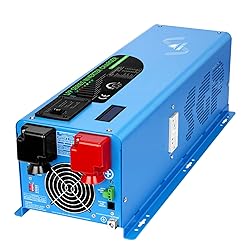
The EG4 6000XP at roughly $1,300–$1,500 handles 6,000W output, has a built-in 500V MPPT charge controller, and supports stacking for future expansion. The off-grid community on forums and YouTube consistently rates it as the best value in its class. 48V system — pair it with 48V rack batteries.
Best Budget LiFePO4 Battery

SOK 206Ah 12V LiFePO4 batteries run around $800–$900 each and carry a solid reputation in the off-grid community for reliable BMS and consistent capacity. For 48V systems, the EG4 LL 48V 100Ah server rack battery at roughly $1,100–$1,400 is hard to beat on a per-kWh basis.
FAQ
How much does a basic off-grid solar system cost for a small cabin?
Budget $3,500–$6,500 for a 1–2 kW system with 5 kWh of lithium battery storage. This covers LED lighting, a small fridge, phone and laptop charging, and a water pump. It won’t run air conditioning or electric cooking — plan on propane or wood for those.
Is DIY installation realistic for a beginner?
Yes, for Tier 1 and Tier 2 systems. The electrical concepts are learnable, and the off-grid solar community produces excellent walkthrough content. That said, if you’re not comfortable working with DC wiring that can deliver hundreds of amps of fault current, hiring an electrician for the battery-to-inverter connections specifically is money well spent — typically $500–$1,500 for a day of work.
How long do off-grid solar systems last before needing replacement?
Panels are warranted for 25 years and typically produce usable power well beyond that (with gradual degradation — expect about 80% output at year 25). LiFePO4 batteries last 10–15 years with proper use. Inverters and charge controllers typically last 10–15 years. Your total cost of ownership over 20 years is roughly 1.3–1.5x your initial investment, mostly due to one battery replacement.
Should I start with 12V, 24V, or 48V?
For anything above a very small cabin system (under 1 kW of panels), go 48V. Higher voltage means lower amperage for the same power, which means thinner wires, less voltage drop, less heat, and compatibility with the most capable inverter/chargers on the market. The 12V ecosystem is fine for RVs and tiny setups, but it becomes a bottleneck fast if you expand.
Can I add a generator backup to reduce battery costs?
Absolutely — and many experienced off-gridders recommend it. A $1,000–$2,000 propane or dual-fuel generator paired with an inverter/charger that supports AC input (like the EG4 6000XP) lets you cut your battery bank size by 30–50%. The generator covers extended cloudy stretches and peak loads, while solar handles day-to-day. This hybrid approach can drop a Tier 2 system from $18,000 to $12,000–$14,000.