Best Battery Monitors for Off-Grid 2026
Most off-grid systems die a slow, preventable death — not from panel failure or wiring issues, but from batteries that get quietly murdered by over-discharge. Without a reliable battery monitor for your off-grid system, you’re essentially flying blind. Voltage alone tells you almost nothing useful about actual state of charge, especially with lithium banks. A proper shunt-based monitor tracks real amp-hours in and out, giving you the data you need to protect your most expensive components.
We spent weeks digging through spec sheets, installation manuals, and hundreds of verified buyer reports across forums like DIY Solar Power Forum, the Will Prowse community, and r/OffGrid to find the monitors that actually deliver accurate readings in real-world off-grid conditions. Here’s what we found.
Our top pick: Victron SmartShunt 500A — best overall accuracy and ecosystem.
Best with built-in display: Victron BMV-712 Smart.
Best budget pick: Renogy 500A Battery Monitor.
Best multi-bank monitoring: Simarine Pico Rev2.
Best ultra-budget: Bayite DC 0-100V 50A Hall Effect Monitor.
Our Picks
Victron SmartShunt 500A
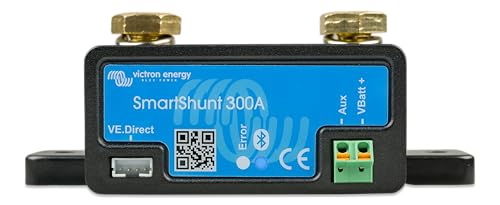
The SmartShunt is Victron’s shunt-only monitor — no display unit, just Bluetooth and the free VictronConnect app. It delivers the same measurement accuracy as the BMV-712 at a lower price point, and it integrates seamlessly into larger Victron systems via VE.Direct.
Who it’s for: Anyone building a serious off-grid power system who already uses a phone or tablet to manage their setup.
Pros:
– ±0.5% current accuracy with a 500A/50mV shunt — among the best in class
– Tracks state of charge, voltage, current, consumed Ah, and time-to-go with automatic tail current synchronization
– Integrates with Victron GX devices and Cerbo GX for remote monitoring via VRM portal
Cons:
– No standalone display — you need a phone or a GX device to read data
– Bluetooth range is limited to about 10 meters in practice, which can be tight in larger setups
Victron BMV-712 Smart
Off-Grid Insider
Get off-grid guides & gear picks in your inbox — free

The BMV-712 is the display-equipped version of the SmartShunt with a clean backlit screen that mounts in a standard 52mm round cutout. It adds a second input for monitoring a starter battery or midpoint voltage on larger banks, plus a programmable relay output.
Who it’s for: Off-gridders who want a dedicated, always-visible readout at their power panel without pulling out a phone.
Pros:
– Built-in display shows state of charge, voltage, current, power, and time remaining at a glance
– Programmable relay triggers alarms or automatic load disconnect at user-set thresholds
– Bluetooth plus VE.Direct gives you both local and system-level integration options
Cons:
– Costs $40–60 more than the SmartShunt for what is essentially the same shunt with a display
– The display unit requires panel mounting and additional wiring, which adds installation complexity
Renogy 500A Battery Monitor

Renogy’s monitor delivers solid shunt-based measurement at roughly half the price of the Victron units. It includes a wired display with a clear LCD, tracks all the essential metrics, and handles up to 500A — more than enough for most residential off-grid systems.
Who it’s for: Budget-conscious builders who want accurate shunt-based monitoring without paying the Victron premium.
Pros:
– Typically priced under $70 — hard to beat for a real shunt-based monitor with display
– Tracks voltage, current, power, Ah consumed, state of charge, and includes high/low alarms
– Straightforward installation with included shunt, wiring, and clear documentation
Cons:
– No Bluetooth or app connectivity — you get the wired display and that’s it
– Build quality of the display housing feels noticeably cheaper than Victron’s units based on widespread buyer feedback
Simarine Pico Rev2

The Pico Rev2 is the monitor you get when you want a full system dashboard, not just a battery gauge. It supports multiple shunts and voltage inputs simultaneously, meaning you can monitor your house bank, starter battery, solar input, and tank levels from one gorgeous color touchscreen.
Who it’s for: Builders with complex multi-bank systems (van builds, sailboats, large cabins) who want a single integrated display.
Pros:
– Supports up to 4 shunt modules and multiple tank sensors — true multi-source monitoring from one screen
– High-resolution color touchscreen with customizable layouts looks professional and reads clearly
– Wi-Fi connectivity with optional cloud monitoring and data logging
Cons:
– Price starts around $300+ with shunt modules sold separately — this is a premium investment
– The modular system means more components to wire and configure, steepening the learning curve
Bayite DC 0-100V 50A Hall Effect Monitor
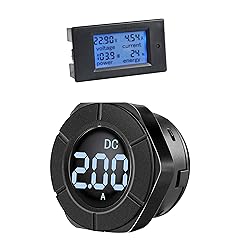
At under $20, the Bayite is the cheapest way to get real-time voltage, current, power, and energy readings on your off-grid system. It uses a hall effect sensor instead of a precision shunt, which means accuracy isn’t lab-grade — but for small systems or secondary monitoring, it gets the job done.
Who it’s for: Anyone running a small solar setup (under 1,000W) who just needs basic visibility without spending real money.
Pros:
– Under $20 — essentially disposable if it fails, and most buyers report years of reliable service
– Dead-simple installation with an inline hall effect sensor — no heavy shunt wiring required
– Bright LCD displays voltage, current, power, and cumulative energy consumption
Cons:
– Hall effect sensing is inherently less accurate than shunt-based measurement, especially at low currents
– No state-of-charge calculation, no Ah counting, no alarms — this is a meter, not a true battery monitor
Balmar SG200 EV Battery Monitor
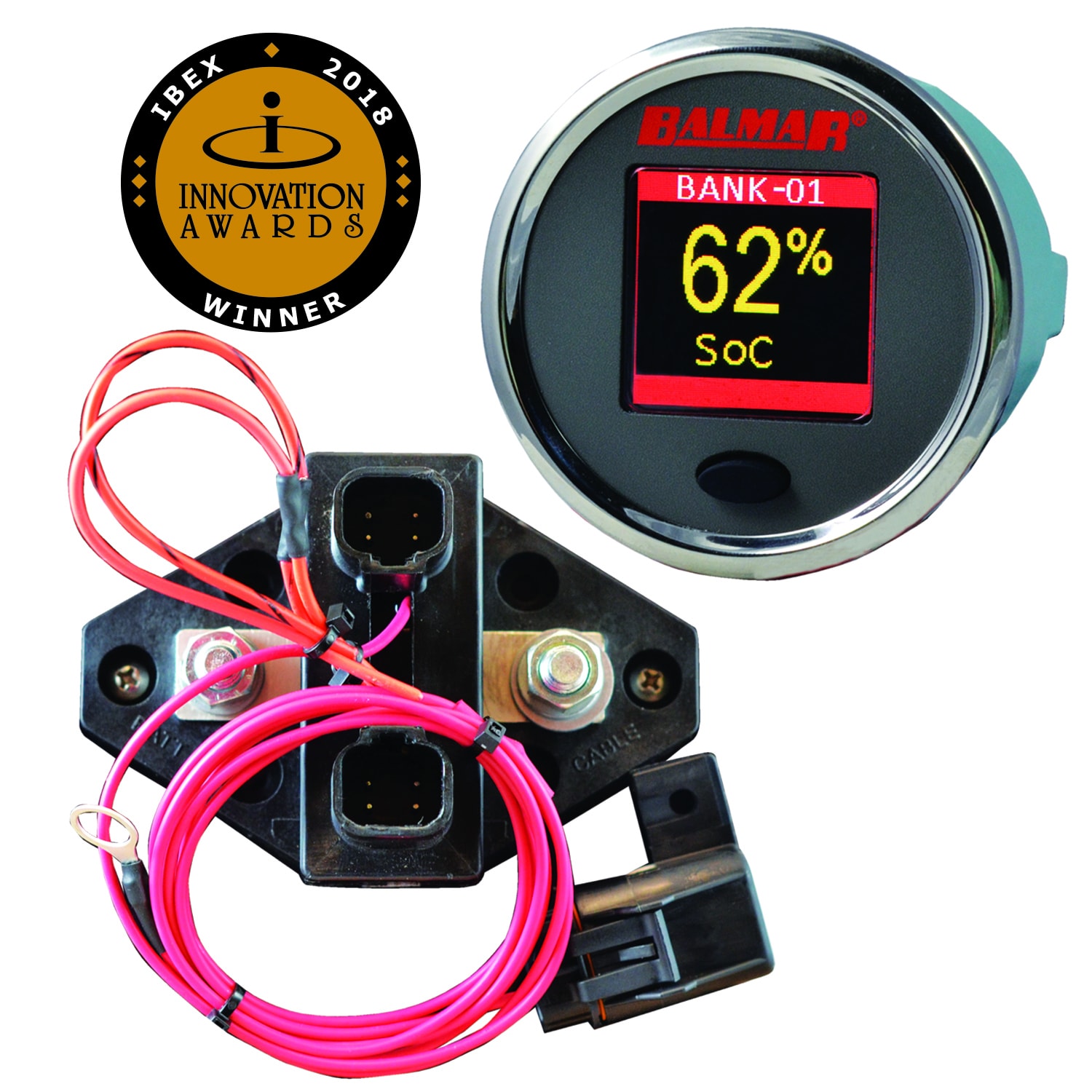
The SG200 takes a different approach — instead of just counting amp-hours, it also measures internal resistance and can detect battery degradation over time. Originally designed for marine use, it’s gained a following among off-gridders running lead-acid banks who want early warning of dying cells.
Who it’s for: Off-gridders with lead-acid or AGM banks who want degradation tracking and don’t mind paying for it.
Pros:
– Internal resistance monitoring provides early warning of cell degradation before capacity loss becomes obvious
– Temperature-compensated readings improve accuracy across seasonal temperature swings
– Robust build quality with IP67-rated components, designed for harsh marine environments
Cons:
– Priced at $250+ — expensive for what is primarily a lead-acid-optimized monitor
– The proprietary app and network protocol don’t integrate with Victron or other common off-grid ecosystems
How We Chose
We evaluated battery monitors based on four criteria: measurement accuracy (shunt-based vs. hall effect, published tolerance specs), feature depth (state of charge, alarms, relay outputs, connectivity), ecosystem compatibility (integration with common charge controllers and inverters), and real-world reliability as reported across DIY solar forums and verified Amazon reviews. We specifically weighted long-term accuracy reports — a monitor that drifts after three months of use is worse than one with slightly lower specs that stays calibrated. We excluded any product with fewer than 100 verified buyer reports or consistent complaints about shunt failure.
Buying Guide: What to Look For in a Battery Monitor for Off-Grid Systems
Shunt-Based vs. Hall Effect Measurement
This is the single most important distinction. A shunt-based battery monitor measures current by reading the tiny voltage drop across a precision resistor (the shunt) — this method is accurate to within 1% or better on quality units. Hall effect sensors measure the magnetic field around a conductor and are cheaper, but they’re less accurate, especially at low currents where off-grid systems spend most of their time. For any system over 500W, we strongly recommend shunt-based monitoring. The price difference has shrunk to the point where there’s little reason to compromise on accuracy.
State of Charge Algorithm and Synchronization
Raw amp-hour counting drifts over time because no measurement is perfectly accurate — small errors compound with every charge cycle. Good monitors use a synchronization algorithm: when the battery reaches a known full state (high voltage, low tail current), the counter resets to 100%. Look for monitors with configurable synchronization parameters — charged voltage threshold, tail current percentage, and charged detection time. If these aren’t adjustable, the monitor may never properly sync with your specific battery chemistry and charge profile, leading to increasingly inaccurate readings. This matters most for lithium batteries, where the voltage curve is flat through most of the state-of-charge range and voltage alone tells you almost nothing.
Connectivity and Integration
A standalone display is fine for a simple cabin setup, but if you’re running a Victron or similar ecosystem, you want a monitor that speaks the same protocol. VE.Direct compatibility lets a Victron SmartShunt feed data into a Cerbo GX or similar hub for remote monitoring, data logging, and automated control. Bluetooth is convenient for phone-based monitoring but has range limitations. Wi-Fi and cloud connectivity (as on the Simarine) are ideal for remote properties where you want to check your system from town. Consider what you need now versus what you’ll want as your system grows — upgrading a monitor later means re-running shunt wiring.
Shunt Sizing and Installation
Shunts are rated by maximum continuous current — 500A is the standard for residential off-grid. Oversizing slightly is fine; undersizing is dangerous. The shunt must be installed on the negative bus between the battery bank and all loads and charging sources — every amp must flow through it, or your readings will be wrong. This is the most common installation mistake we see reported in forums. If you have loads or chargers connected directly to battery terminals bypassing the shunt, your state of charge will drift permanently. Plan your wiring before buying.
FAQ
What is the best battery monitor for an off-grid solar system?
The Victron SmartShunt 500A is our top recommendation for most off-grid solar systems. It provides lab-grade accuracy, tracks all critical metrics including state of charge and time-to-go, and integrates with the broader Victron ecosystem for remote monitoring. If you want a built-in display, step up to the BMV-712 Smart.
Do I really need a battery monitor for off-grid living?
Yes — a battery monitor is one of the most cost-effective investments in an off-grid system. Without one, you’re guessing at state of charge based on voltage, which is unreliable especially for lithium batteries. Over-discharging batteries shortens their lifespan dramatically. A $70 monitor can prevent thousands of dollars in premature battery replacement.
What is the difference between a shunt-based and hall effect battery monitor?
A shunt-based monitor uses a precision resistor to measure exact current flow and is accurate to within 1% or better. A hall effect monitor uses a magnetic sensor and is typically accurate to within 2-5%, with worse performance at low currents. For any off-grid system where battery health matters, shunt-based is the right choice.
Can I use a battery monitor with lithium LiFePO4 batteries?
Absolutely. In fact, lithium batteries benefit more from proper monitoring than lead-acid because their voltage curve is nearly flat between 20% and 80% state of charge. A good shunt-based monitor with proper synchronization settings is the only reliable way to know your actual state of charge on a lithium bank. Most modern monitors including the Victron SmartShunt and Renogy 500A have specific lithium battery profiles.
How do I install a battery monitor shunt correctly?
The shunt must be placed on the negative cable between your battery bank’s negative terminal and everything else — all loads, inverters, charge controllers, and solar inputs must connect on the system side of the shunt, not directly to the battery. The only connection on the battery side of the shunt should be the battery negative terminal itself. Getting this wrong is the number one cause of inaccurate readings. Use appropriately sized cables and torque connections to manufacturer spec.
The Verdict
For most off-grid systems, the Victron SmartShunt 500A is the battery monitor to buy. The accuracy is excellent, the app is well-designed, and the ecosystem integration means it grows with your system. If you want a dedicated display without reaching for your phone, the Victron BMV-712 Smart is worth the modest premium. And if budget is tight, the Renogy 500A delivers real shunt-based monitoring for under $70 — there’s no reason to fly blind.