Solar Power a Container Home (Complete Guide)
Shipping container homes are having a moment in the off-grid world — and for good reason. They’re affordable, modular, and surprisingly tough. But here’s where most builds stall out: powering the thing. A container home isn’t wired like a stick-built house, the metal shell creates unique grounding and heat challenges, and undersizing your power system means you’re running a generator at 2 AM in January. We’ve dug into the specs, manufacturer data, and real-world reports from container home builders to put together a system-design guide that actually works.
What You’ll Learn
- How to calculate the real power load for a container home (not the optimistic version)
- Solar panel mounting options specific to corrugated steel roofs and container dimensions
- Battery bank sizing that accounts for off-grid realities like cloudy weeks and surge loads
- Inverter, charge controller, and wiring decisions that keep a metal-shell home safe and efficient
Calculating Your Actual Power Load
Before you buy a single panel, you need an honest load audit. Most container home builders underestimate by 30–50% because they forget about surge loads, phantom draws, and seasonal spikes.
The Load Audit Process
Off-Grid Insider
Get off-grid guides & gear picks in your inbox — free
List every device you’ll run. For each one, note its wattage and estimated daily hours of use. Multiply to get watt-hours per day. Here’s a realistic baseline for a single 40-foot container home:
| Load | Watts | Hours/Day | Wh/Day |
|---|---|---|---|
| LED lighting (6 fixtures) | 60 | 6 | 360 |
| Refrigerator (efficient DC) | 65 | 24 (cycling) | 840 |
| Laptop + phone charging | 80 | 4 | 320 |
| Well pump (1/2 HP) | 550 | 1.5 | 825 |
| Exhaust/ventilation fans | 40 | 8 | 320 |
| Microwave | 1,200 | 0.3 | 360 |
| Misc (router, lights, tools) | 100 | 4 | 400 |
| Total | ~3,425 |
That’s roughly 3.4 kWh per day — and this is a modest setup with no electric heating, no air conditioning, and no electric cooking. Add a mini-split heat pump and you’re looking at 6–10 kWh/day depending on climate.
The Multiplier Rule
Take your daily total and multiply by 1.3 to account for inverter inefficiency, wire losses, and the devices you forgot. So 3,425 Wh becomes roughly 4,450 Wh/day as your design target.
Solar Panel Mounting on Container Homes

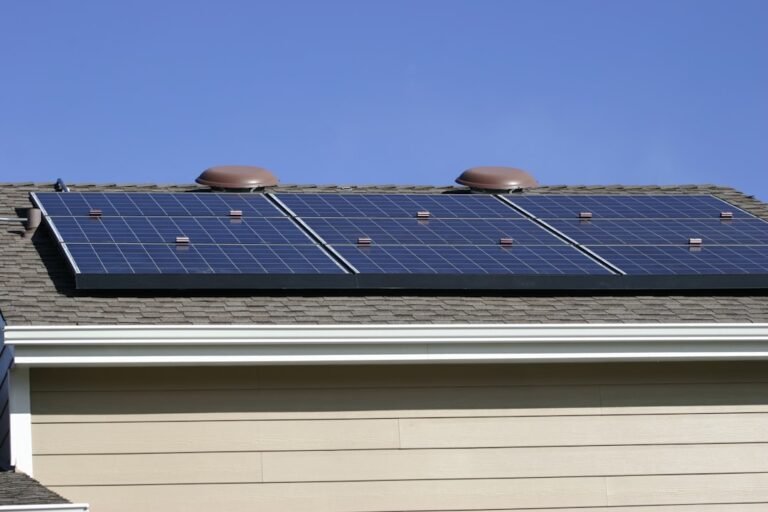
A standard 40-foot shipping container has a roof area of roughly 320 square feet (40 × 8 ft). That’s enough space for 6–8 standard 400W panels if you lay them flat, giving you 2,400–3,200 watts of nameplate capacity.
Flat Mount vs. Tilted Rack

Flat mounting directly to the corrugated roof is simpler and more wind-resistant, but you lose 10–25% production depending on your latitude. For locations below 35°N, the loss is tolerable. Above that, tilted racks pay for themselves.
Tilted racks bolted through the container ribs (not the flat panels between ribs — those flex) optimize angle and airflow. Leave at least 3–4 inches of gap between the panels and the roof for ventilation. Metal roofs get hot, and panel efficiency drops roughly 0.4% per degree Celsius above 25°C. Without that air gap, rooftop temperatures can hit 70°C on a summer day, costing you 15–18% of your output.
Mounting Hardware
Use stainless steel or hot-dip galvanized bolts — the container is Corten steel and will accelerate corrosion on bare carbon steel fasteners. Seal every roof penetration with a marine-grade polyurethane sealant like Dicor or Sikaflex. Standard silicone fails within 2–3 years under UV and thermal cycling.
For panels, we recommend looking at Renogy 400W monocrystalline panels for their balance of efficiency (22%+), size, and documented performance in off-grid builds.
Renogy 400W Solar Panel on Amazon
Battery Bank Sizing
Your battery bank is the backbone. Size it wrong and you’re either running a generator constantly or replacing dead batteries in three years.
The Formula
Battery capacity (Wh) = Daily load × Days of autonomy ÷ Depth of discharge
For our 4,450 Wh/day example with 2 days of autonomy (the minimum we’d recommend for most climates):
- Lithium (LiFePO4), 80% DoD: 4,450 × 2 ÷ 0.80 = 11,125 Wh → ~11.1 kWh
- Lead-acid (AGM), 50% DoD: 4,450 × 2 ÷ 0.50 = 17,800 Wh → ~17.8 kWh
This is why LiFePO4 dominates serious off-grid builds now. You need roughly 40% less capacity, they last 3,000–5,000 cycles vs. 500–800 for AGM, and they handle partial charge states without sulfation damage.
Practical Battery Picks

A 48V system is the standard for container homes pulling over 2 kW. Higher voltage means lower amperage, thinner wires, and less heat — all critical inside a metal box.
Two solid options from the community:
- EG4 LL-S 48V 100Ah server rack batteries — stackable, BMS-integrated, widely used in DIY off-grid builds. At 5.12 kWh per unit, two or three get you to your target range.
- SOK 48V 100Ah — another well-reviewed LiFePO4 option with Bluetooth monitoring and a solid warranty.
EG4 48V 100Ah LiFePO4 Battery on Amazon
SOK 48V 100Ah LiFePO4 Battery on Amazon
Inverter and Charge Controller Selection

Inverter
You need a pure sine wave inverter — not modified sine wave. Modified sine wave inverters cause humming in fans, can damage electronics with sensitive power supplies, and shorten the life of compressor-based appliances like refrigerators.
Size your inverter to handle your peak surge load, not just your continuous load. That 1/2 HP well pump pulls 550W running but can surge to 1,500–2,000W on startup. Add your other simultaneous loads and you probably need a 3,000–5,000W inverter for a single-container home.
The EG4 6000XP is a popular all-in-one inverter/charger in the container home community — it handles 6,000W continuous, integrates with 48V battery banks, and includes a built-in MPPT charge controller and transfer switch for generator backup.
Charge Controller
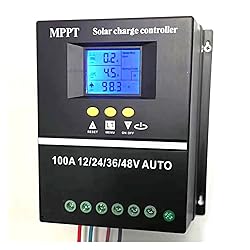
If you’re not using an all-in-one unit, you’ll need a standalone MPPT charge controller (not PWM — MPPT is 20–30% more efficient). Size it based on your array wattage divided by your battery voltage. A 3,200W array on a 48V system needs at least a 67A controller. Round up — a Victron SmartSolar 150/85 or EPEver 80A MPPT covers this comfortably.
Victron SmartSolar MPPT Charge Controller on Amazon
Grounding and Wiring in a Metal Shell

This is where container homes demand extra attention. The entire structure is conductive steel.
Grounding
The container frame must be bonded to your electrical system’s ground. Drive an 8-foot copper ground rod and run a #6 AWG bare copper wire from the rod to the container body, then bond the container body to your inverter’s grounding terminal. This isn’t optional — it’s what prevents the entire container from becoming energized if a hot wire contacts the shell.
Wire Routing
Never run wiring directly against the container wall without conduit or insulated standoffs. Vibration, condensation, and sharp edges at cut points will chafe through insulation over time. Use EMT conduit or properly rated liquid-tight flexible conduit for all runs. Keep DC wiring as short as possible — voltage drop matters more at lower voltages, and even at 48V, a 30-foot run of undersized wire can lose 3–5% of your power to heat.
Condensation
Metal containers sweat. Moisture and electricity don’t mix. Insulate the interior walls (closed-cell spray foam is the go-to — it insulates and creates a vapor barrier in one step) before running any wiring. All junction boxes should be rated NEMA 3R or higher.
Common Mistakes
1. Sizing solar for summer and forgetting winter. In northern states, December solar production can be 25–35% of June production. Design for your worst month, not your best, or plan for a backup generator.
2. Skipping the ground rod because “the container is metal.” A floating metal structure with no earth ground is a hazard, not a feature. Bond it properly.
3. Using automotive wire (CCA) instead of pure copper. Copper-clad aluminum wire has higher resistance, generates more heat, and corrodes at connection points. For a permanent off-grid system, use only pure copper wire rated for the amperage.
4. Mounting batteries inside the living space without ventilation planning. LiFePO4 batteries are safer than lead-acid, but they still need airflow for cooling and the BMS vents small amounts of gas in fault conditions. Dedicate a vented utility section at one end of the container.
Our Recommendations
Best All-in-One System for a Single Container Home

EG4 6000XP + 2× EG4 48V 100Ah batteries + 6× Renogy 400W panels
This gives you a 6kW inverter/charger, 10.24 kWh of LiFePO4 storage, and 2,400W of solar. It’s a solid starting point for a modest single-container build and leaves room to add a third battery or more panels later.
Best Budget Entry Point
Victron MultiPlus-II 48/3000 + 2× SOK 48V 100Ah + 4× Rich Solar 400W panels
Smaller system, lower cost, but Victron’s monitoring ecosystem (VRM portal) is best-in-class for tracking production and consumption remotely. Good for a minimal-load container build — lights, fridge, electronics, no heavy AC or heating.
Victron MultiPlus II 48V on Amazon
Best for Expandability
Sol-Ark 15K + EG4 server rack batteries
If you’re planning a multi-container compound or running heavy loads like a mini-split and power tools, the Sol-Ark 15K handles 15kW continuous, supports generator input, grid-tie (if you ever connect), and stacks batteries up to massive capacities. It’s more expensive upfront but eliminates the need to replace your inverter as you scale.
Sol-Ark 15K Inverter on Amazon
FAQ
How many solar panels do I need for a container home?
For a modest single-container home using 4–5 kWh/day, 6–8 panels rated at 400W each (2,400–3,200W total) is a solid starting point. Adjust upward for heavy loads like heat pumps or electric cooking, and factor in your location’s peak sun hours — 4 hours in the Pacific Northwest vs. 6+ in the Southwest.
Can I mount solar panels directly on a shipping container roof?
Yes, but mount through the structural ribs (the raised corrugations), not the flat panels between them. Use stainless steel hardware, seal all penetrations with marine-grade sealant, and leave a 3–4 inch air gap between panels and roof for ventilation and heat management.
Do I need a generator backup for an off-grid container home?
In most climates, yes — at least as insurance. A 2–3 day cloudy stretch in winter can drain even a well-sized battery bank. A small 3,500W dual-fuel generator (propane stores indefinitely) connected to your inverter/charger’s AC input provides reliable backup for under $1,000.
Is a shipping container safe for housing electrical systems?
Absolutely, provided you follow proper grounding and wiring practices. Bond the container body to an earth ground rod, run all wiring in conduit, insulate interior walls with closed-cell foam to prevent condensation, and use NEMA-rated junction boxes. The steel shell actually provides excellent EMI shielding.
What size inverter do I need for a container home?
For a single-container home without electric heating or AC, a 3,000–5,000W pure sine wave inverter covers most needs. If you’re running a mini-split heat pump, power tools, or plan to expand, step up to a 6,000W+ unit. Always size based on your peak simultaneous load plus the largest motor startup surge — not just your average draw.