How to Cook Off-Grid in Winter (Complete Guide)
Most off-grid cooking advice assumes you’re grilling outside in July. But what happens when it’s February, the propane tank is running low, and you need to feed a family three meals a day? Year-round off-grid cooking means building a system — not just owning a camp stove. You need redundant fuel sources, indoor-safe options for winter, and methods that don’t drain your solar battery bank. We researched specs, fuel efficiency data, and feedback from homesteaders across climate zones to put together a practical, season-by-season approach.
What You’ll Learn
- How to build a multi-fuel cooking system that works in every season
- Which stoves and ovens are safe and efficient for indoor winter cooking
- Fuel storage, sourcing, and consumption rates for realistic planning
- How to preserve cooking capacity when one method fails
Start With Your Primary: A Wood Cookstove
If you’re living off-grid full-time, a wood cookstove is the backbone of your kitchen from roughly October through April. It does double duty — cooking meals and heating your living space — which matters enormously when every BTU counts.
What to Look For
Off-Grid Insider
Get off-grid guides & gear picks in your inbox — free
The two models that dominate off-grid homesteader forums are the Kitchen Queen 480 and the Elmira Fireview. Both feature six-lid cooktops, a built-in oven, and a firebox large enough to accept 16–18 inch splits. The Kitchen Queen 480 produces roughly 40,000–50,000 BTUs and can heat 1,500+ square feet while you cook dinner.
Key specs to compare:
- Firebox size — Longer fireboxes (16–18″) mean less time splitting wood to odd lengths
- Oven capacity — Look for at least 1.5 cubic feet if you bake bread regularly
- Flue size — 6-inch flue is standard; make sure your chimney matches
- Cooktop material — Cast iron tops hold heat longer and distribute it more evenly than steel
A quality wood cookstove runs $2,500–$5,000 installed. That’s steep, but it eliminates propane costs for roughly half the year and provides heat you’d need anyway.
Browse wood cookstoves on Amazon
Fuel Planning for Wood
Hardwood is the standard — oak, hickory, maple. Softwoods like pine burn fast and leave creosote buildup. For a household cooking 2–3 meals a day plus heating, plan on 4–6 cords per winter season depending on your climate zone and insulation quality. One cord is 128 cubic feet of stacked wood.
Start splitting and stacking by late spring. Wood needs 6–12 months to season properly. Green wood burns at roughly half the efficiency of seasoned wood and produces far more creosote.
Your Warm-Weather System: Outdoor and Propane Options

Once temperatures climb above 65–70°F, firing up a wood cookstove indoors becomes miserable. This is where your secondary cooking methods take over.
Propane: The Reliable Backup
A two-burner propane stove like the Camp Chef Everest 2X puts out 40,000 BTUs total across both burners — enough to boil water fast and sear properly. For outdoor or well-ventilated covered-porch cooking, propane is hard to beat for convenience.
Fuel consumption matters for budgeting. A standard 20-lb propane tank holds roughly 430,000 BTUs. At moderate use (one burner on medium for an hour a day), that’s approximately 21–25 days per tank. A family cooking three full meals daily on propane will go through a 20-lb tank in 10–14 days.
For year-round propane users, a 100-lb or 250-gallon bulk tank is more cost-effective than swapping 20-pounders. But we recommend propane as a secondary fuel, not your primary — prices fluctuate, delivery can be unreliable in remote areas, and you’re still dependent on a supply chain.
Browse Camp Chef propane stoves on Amazon
Rocket Stoves for Summer Efficiency
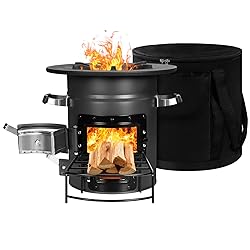
A rocket stove uses small-diameter wood — twigs, sticks, small splits — and burns them at extremely high temperatures in an insulated combustion chamber. The result is fast, hot cooking with very little fuel and minimal smoke.
The EcoZoom Versa is a popular manufactured option that handles wood, charcoal, or biomass. It boils a liter of water in about 8–10 minutes using a handful of sticks. For summer cooking outdoors, a rocket stove means you’re not burning through propane or your firewood stockpile.
You can also build a DIY rocket stove from concrete blocks or a five-gallon metal pail with vermiculite insulation for under $30 in materials. Plenty of proven designs exist in homesteading communities.
Browse rocket stoves on Amazon
Solar Cooking: Free Fuel, Weather Permitting

A parabolic or box-style solar cooker works surprisingly well from late spring through early fall in most of the continental US. The GoSun Sport evacuated-tube cooker reaches 550°F and can cook a meal for two in about an hour of direct sunlight. Box-style cookers like the All American Sun Oven reach 360–400°F and handle bread, casseroles, rice, and slow-cooked meats.
Solar cooking is free energy, but it’s weather-dependent and slow. Treat it as a fuel-saving supplement, not a standalone method. On clear summer days, using a solar oven for lunch or slow-cooking beans saves propane and wood for the meals that actually need fast, high heat.
Building Your Year-Round Rotation
Here’s the practical framework we recommend based on climate patterns in USDA zones 4–7 (the bulk of off-grid homesteading in the US):
Late Fall Through Early Spring (Nov–Mar)
- Primary: Wood cookstove for all meals — you’re already burning for heat
- Backup: Propane two-burner for quick reheats or when the fire is banked overnight
- Baking: Wood cookstove oven; learn your hot spots with an oven thermometer
Spring and Fall Shoulder Seasons (Apr–May, Sep–Oct)
- Primary: Propane or rocket stove outdoors on mild days; wood cookstove on cold days
- Baking: Solar oven on sunny days; wood cookstove oven when it’s lit anyway
Summer (Jun–Aug)
- Primary: Rocket stove or propane outdoors — keep heat out of the cabin
- Supplement: Solar cooker for midday meals, beans, rice, bread
- Backup: Propane for evening meals when the sun drops
Don’t Forget Preservation Cooking
Year-round off-grid cooking isn’t just about daily meals. Canning season (July through October) demands sustained, high-heat boiling — typically 10–15 minutes for water-bath canning and 75–90 minutes for pressure canning. A wood cookstove handles this well in cooler months, but in August you’ll want a high-output propane burner like the Bayou Classic SP10 (185,000 BTU) to do canning outdoors without turning your home into a sauna.
Plan your propane budget to include canning. A heavy canning season can burn through 40–60 lbs of propane over 6–8 weeks.
Browse outdoor propane burners for canning on Amazon
Common Mistakes
1. Going single-fuel. Relying entirely on propane, or entirely on wood, leaves you exposed. Propane deliveries get delayed. Firewood gets rained on. Build at least two independent cooking methods into your system.
2. Undersizing firewood supply. First-year homesteaders consistently underestimate wood consumption. If you think you need 4 cords, cut 6. Surplus seasoned firewood is never a problem — shortage is.
3. Cooking indoors with unsafe appliances. Camp stoves, charcoal grills, and unvented propane burners produce carbon monoxide. If it doesn’t have a flue or isn’t rated for indoor use, it stays outside. A battery-operated CO detector is non-negotiable in any off-grid home using combustion for cooking or heating.
4. Ignoring thermal mass cooking. A cast iron Dutch oven on a rocket stove or in a wood cookstove oven retains heat long after the fire dies down. Many homesteaders report cooking rice, stews, and beans by bringing them to temperature and then letting residual heat finish the job — saving significant fuel over time.
Our Recommendations
Best wood cookstove for year-round primary cooking: Kitchen Queen 480
Large firebox, proven oven, heats the home simultaneously. It’s an investment, but homesteaders in northern climates consistently rate it as the single most important appliance in their off-grid kitchen.
Search Kitchen Queen 480 on Amazon
Best portable propane stove for warm-weather backup: Camp Chef Everest 2X
High BTU output, solid build quality, stable pot supports. Runs on standard 1-lb canisters or adapts to a 20-lb tank with a hose. Excellent for outdoor summer cooking and canning-day prep.
Search Camp Chef Everest 2X on Amazon
Best solar cooker for supplemental summer use: All American Sun Oven
Reaches 360–400°F, handles bread and casseroles, folds flat for storage. No fuel cost, no emissions. The reflectors are durable and the leveling system tracks the sun easily.
Search All American Sun Oven on Amazon
FAQ
Can I use a regular kitchen range off-grid?
Only if it’s propane-compatible and you have reliable propane supply. Many residential propane ranges work fine off-grid, but they typically require electricity for ignition and clocks — you’ll need a small inverter or battery backup, and you’re still dependent on propane delivery.
How much does it cost to cook off-grid for a year?
With a wood cookstove as your winter primary and propane as your summer fuel, a family of four can expect roughly $300–$600 in propane annually (at average US prices) plus the labor of harvesting firewood. If you buy firewood, add $200–$300 per cord — so $800–$1,800 for 4–6 cords. Solar and rocket stove cooking reduces propane costs further.
Is it safe to use a wood cookstove indoors?
Yes, provided it’s properly installed with appropriate chimney clearances, a UL-listed chimney system, and a non-combustible floor pad. Follow the manufacturer’s clearance-to-combustibles specifications exactly. Install a CO detector and a smoke detector in the kitchen area. Have the chimney inspected and cleaned at least once per year — more often if burning softwood.
What’s the minimum cooking setup for someone just starting off-grid?
A two-burner propane stove and two 20-lb propane tanks will get you cooking immediately while you plan and install more permanent solutions. Add a cast iron Dutch oven and a cast iron skillet — they work on any heat source and last decades. From there, build toward a wood cookstove or rocket stove as your budget and timeline allow.
How do I bake bread without a conventional oven?
A Dutch oven over coals or inside a wood cookstove oven is the most reliable method. Preheat the Dutch oven, place your dough inside, and maintain roughly 350–400°F using coals on top and bottom (for campfire baking) or steady firebox management (for wood cookstove ovens). The All American Sun Oven also bakes bread well on clear days — many off-grid bakers report excellent crust development with solar.