Bluetti AC500 2026: Honest Review Worth It?
Bluetti AC500 Review — 2026: Maximum Power, Maximum Gotchas
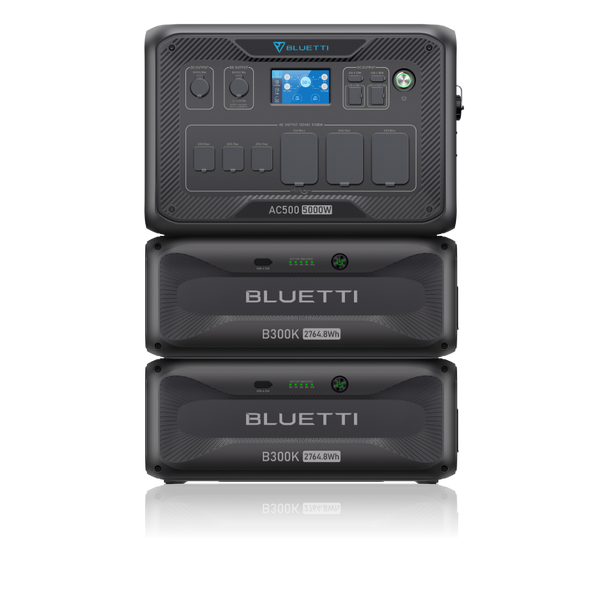
The Bluetti AC500 is a 5,000-watt modular power station built for one purpose: delivering serious, sustained AC power to a cabin, homestead, or whole-home backup setup where a Jackery or EcoFlow simply won’t cut it. It’s not a product you grab at a big-box store — it’s a system that demands planning, a solar array to match, and a budget to see it through. Done right, it’s one of the most capable portable power systems you can buy. Done wrong, it’s a very expensive brick.
| Best For | Stationary cabin or homestead backup with a large solar array (8+ panels), where 5,000W continuous output and expandable LFP storage matter more than portability |
| Avoid If | You need 240V from a single unit, you need wheels, or you’re comparing dollars-per-watt-hour |
| Street Price | ~$2,499–$2,599 (AC500 + 1x B300S); ~$3,699–$4,499 (AC500 + 2–3x B300S bundles) |
| Warranty | 4 years |
As an Amazon Associate, OffGridFoundry earns from qualifying purchases.
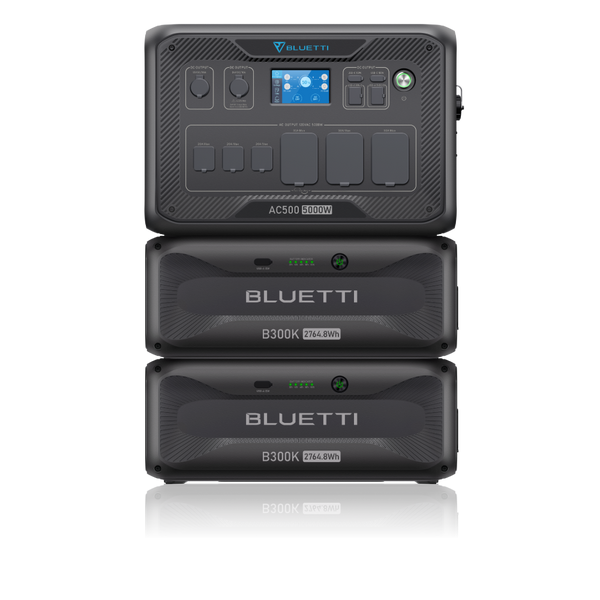
The AC500 earns its rating through class-leading output power and the best solar input specs in the modular power station category. But it ships without any energy storage, weighs more than a refrigerator once assembled, delivers only 120V from a single unit, and has a customer service record that should give any serious buyer pause. It’s powerful and capable — and it is also a product that’s been partially lapped by its own successors and competitors. Buy it with eyes open, on sale.
What We Like
- 5,000W continuous / 10,000W surge — Few portable systems touch this. The AC500 starts hard-draw motors that humbler stations can’t: 15K BTU heat pumps, well pumps, air compressors, RV air conditioners. Owner reports across forums consistently confirm it handles the loads its specs promise.
- 3,000W solar input across two independent MPPTs — At 1,500W per MPPT controller (12–150VDC, 15A max each), you can push a full 3kW of solar harvest into the AC500 simultaneously. With a single B300S battery attached, a good sunny day can recharge it from zero in roughly 1.2–1.5 hours. For a solar-heavy off-grid setup, no comparably priced system charges faster per unit.
- Genuine LFP chemistry — The B300S uses LiFePO4 cells rated for 3,500+ cycles to 80% capacity (the newer B300K pushes 4,000+ cycles). That’s 9–10 years of daily cycling. NMC competitors degrade faster and carry higher thermal risk. For permanent or semi-permanent installations, LFP is the right call.
- Port variety built for real-world wiring — A TT-30 RV shore power outlet, an L14-30 generator transfer outlet, and a NEMA 14-50R 50A outlet mean you can integrate the AC500 into an RV pedestal, a transfer switch panel, or an EV charging setup without running to the hardware store for adapters. These details matter on actual installs.
- Modular scalability up to 18.4 kWh — Connect up to six B300S batteries (3,072Wh each) to reach 18,432Wh of total LFP storage from a single AC500 inverter. For a cabin that needs 3–5 days of buffer storage, this architecture works. Very few competitors scale this high from one unit.
What We Don’t Like
- The AC500 ships with zero stored energy — This is the most important thing to know before purchasing. The AC500 is a pure inverter-and-control-hub; without at least one B300-series battery module ($800–$1,200), the unit cannot power a single lightbulb. Product listings that show “AC500” at a low price are selling the inverter shell only. Factor in at least one battery in your budget from day one.
- 120V only — 240V requires a second unit and fusion box — A single AC500 outputs 120V, full stop. Running a clothes dryer, electric range, central air conditioner, or 240V EV charger requires two AC500 units wired together with Bluetti’s PO30A fusion box. That’s a significant additional investment ($1,500–$2,000+) that competitors like the EcoFlow Delta Pro 3 eliminate by building native split-phase 240V output into a single unit.
- It is not portable in any practical sense — The AC500 inverter unit weighs 66 lbs and has no wheels or handle. Each B300S battery weighs 79–84 lbs. A two-battery setup approaches 230 lbs with no integrated means of moving it. This is a stationary appliance that happens to have plugs on it, not a portable power station.
- Customer service is the weakest link — Bluetti’s BBB profile shows 36 complaints over three years, with a recurring pattern of return and refund resistance — the company defaults to repair-or-replace rather than refund, and multiple customers report delayed or absent responses from support. Independent testing at The Solar Lab received two consecutive DOA units during evaluation. For a $3,000–$5,000 purchase, the support experience is a legitimate risk factor.
- The touchscreen display feels dated — Multiple reviewers flag the low-contrast color touchscreen as not keeping pace with competitors. It is legible indoors, but in direct sunlight during an actual outdoor installation it becomes difficult to read. The interface is functional but does not reflect the unit’s price point.
- Battery SoC balancing in multi-battery configs is imperfect — In three-or-more-battery configurations, individual modules can fall out of sync, with one battery depleting to near-zero while others remain partially charged — causing sudden total system shutdowns despite showing residual capacity. Bluetti acknowledged the issue and pushed BMS firmware updates, but the problem has been reported post-update and has not been fully resolved for all users. This is a concern for critical backup applications.
Specs That Matter
Off-Grid Insider
Get off-grid guides & gear picks in your inbox — free
| Spec | Bluetti AC500 |
|---|---|
| AC Output (continuous) | 5,000W pure sine wave |
| AC Surge | 10,000W |
| Battery Chemistry | LiFePO4 (external B300S or B300K modules) |
| Base Storage (AC500 + 1x B300S) | 3,072Wh |
| Max Storage (AC500 + 6x B300S) | 18,432Wh |
| Solar Input | 3,000W (2x MPPT, 12–150VDC, 15A each) |
| AC Charging Input | Up to 5,000W |
| Combined Solar + AC Input | Up to 8,000W simultaneous |
| UPS Transfer Time | <20ms |
| AC Outlets | 3x 120V/20A, 1x 30A L14-30, 1x TT-30 RV, 1x 50A NEMA 14-50R (120V) |
| USB-C | 2x 100W PD |
| Wireless Charging | 2x 15W |
| 240V Output | No (single unit) — requires 2x AC500 + PO30A fusion box |
| Weight (inverter only) | 66.2 lbs |
| Weight per B300S battery | 79–84 lbs |
| Battery Cycle Life (B300S) | 3,500+ cycles to 80% |
| Warranty | 4 years |
Real-World Performance
Owner accounts across the DIY Solar Forum, Bluetti’s own community forums, and Amazon reviews establish a consistent picture: the AC500 performs exactly as specced when the hardware is healthy and the firmware is current. Whole-home backup use during storms and outages is the most frequently reported use case, with multiple owners describing multi-day runs powering refrigerators, HVAC fans, well pumps, and lighting without interruption. The 10,000W surge capacity handling well pump and compressor startups is consistently confirmed — this is not a spec that disappoints in practice.
The 3,000W solar input is where the AC500 separates from the pack for off-grid fixed installations. Owners with 8–12 panel arrays describe recharging a depleted B300S battery in under 90 minutes on a clear day — a practical charging speed that reduces generator dependence. The two independent MPPT controllers also allow mixing panel strings with different orientations or partial shading without forcing the whole array onto one tracking curve.
The cautions are real, though. The SoC balancing problem in multi-battery setups has been reported post-firmware-update and has not fully resolved for all configurations — one forum user running four B300S batteries documented repeated shutdowns at 30% indicated charge due to one module hitting low-voltage cutoff while others remained at 60%+. Separately, solar harvest drops sharply — from ~2,100W down to ~650W — as a single battery approaches 90% state of charge. This is standard LFP charge-curve behavior, not a defect, but it means owners expecting to harvest full 3kW throughput until the battery is completely topped off will be disappointed. Adding more battery modules mitigates this, as the system can absorb full solar input longer before entering the trickle phase.
One widely-reported gotcha: the 24V DC car-style outlet is not 12V. Plugging a standard 12V accessory directly into it can damage or destroy the device. The labeling on this port is not prominently placed and owners on forums have reported fried coolers and accessories as a result.
Who Should Buy This
The AC500 is the right tool for a fixed off-grid installation — a cabin, homestead, or rural property — where you have a substantial solar array (six or more panels wired appropriately), need maximum continuous AC output to run real loads, and want LFP battery chemistry for decade-scale longevity. The modular architecture is compelling here: start with one B300S battery at ~$2,500 for the combo, add batteries as budget allows, and eventually reach 12–18 kWh of LFP storage without replacing the inverter unit.
It is also an honest choice for RV owners with a permanent or semi-permanent site setup — the dedicated TT-30 RV outlet and L14-30 generator transfer port mean the AC500 integrates into existing RV wiring cleanly. The caveat is that “portable” in the RV context must mean “stays in the basement storage bay and doesn’t move,” because nothing about the physical system encourages frequent relocation.
Who Should Look Elsewhere
If you need 240V output from a single unit — for a dryer, electric range, 240V EVSE, or central HVAC — look at the EcoFlow Delta Pro 3 (~$3,499 for the base unit, which ships with a built-in battery and native 240V output). The Delta Pro 3 also carries a 5-year warranty against the AC500’s 4 years, and at this point in 2026 represents a more current design. The trade-off is slightly less continuous output (4,000W vs. 5,000W) and slower solar input per unit (2,600W vs. 3,000W).
For buyers who want to stay in the Bluetti ecosystem, the Bluetti Apex 300 — Bluetti’s current-generation flagship for 2025 — is worth a hard look before committing to the AC500. The Solar Lab describes it as the AC500’s “worthy successor” that addresses several of the interface and usability gaps. New buyers who don’t have a specific reason to choose the AC500 over the Apex 300 should compare them directly at current street prices.
If pure value per watt-hour is the priority, the Anker Solix F3800 delivers 6,000W continuous output with 3,840Wh of built-in storage at a lower price point (~$2,400 street) and a 5-year warranty. The AC500’s solar input advantage (3,000W vs. 3,200W for the Solix — functionally equivalent) doesn’t justify paying more for less built-in capacity unless expandability beyond 6kWh is the plan.
Bottom Line
The Bluetti AC500 is a powerful, well-engineered power station for the specific buyer who needs 5,000W of continuous LFP-backed output in a modular system that can grow to 18+ kWh — and who plans to anchor it somewhere with a serious solar array rather than move it around. For that buyer, on sale at current street prices, it delivers. But it requires a clear-eyed understanding of what it is: a 120V-only inverter hub that ships with no battery, weighs over 60 lbs before a single watt-hour is attached, and is backed by customer service that has a documented pattern of frustrating owners when things go wrong. Buy it on a confirmed sale with a clear return window, verify the firmware is current before your warranty clock starts, and budget for at least two B300S batteries to get meaningful capacity and mitigate the solar throttling and SoC balancing issues that plague single-battery configurations.
Check current pricing on the Bluetti AC500 + B300S at Amazon or directly at BluetiPower.com. Prices on the AC500 ecosystem fluctuate significantly — sales of 30–40% off MSRP are common and worth waiting for.
→ Buy the Bluetti AC500 + B300S on Amazon