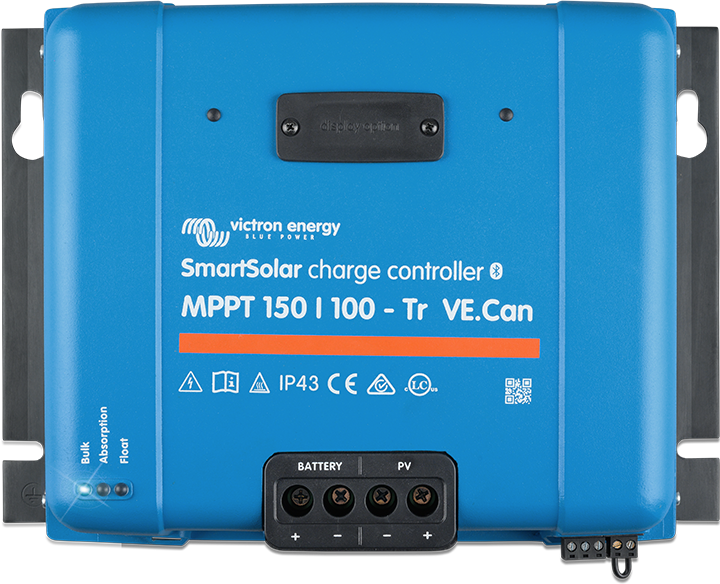
Victron SmartSolar MPPT 2026: Still Worth It?
Victron SmartSolar MPPT Review — 2025: The Best MPPT Charge Controller You Can Buy
The Victron SmartSolar MPPT is the charge controller that serious off-grid builders stop at and never leave. Spanning a wide lineup from the compact 75/15 to the commercial-grade 250/100, it earns a 4.7/5 across more than 1,000 Amazon reviews not by marketing, but by quietly working flawlessly for years inside everything from weekend camper vans to homestead solar arrays. If battery reliability is a non-negotiable, this is the controller the community keeps recommending — and the research backs that consensus up.
Check Current Price on Amazon →
As an Amazon Associate, OffGridFoundry earns from qualifying purchases.
The Victron SmartSolar MPPT is the product that proves premium pricing can be completely justified. You pay more than you would for a Renogy Rover or EPEver Tracer — in some cases two to three times more for the same output current — and you get a controller that communicates with your phone, integrates with every other Victron component, updates its own firmware over the air, and runs silently without a fan. Owners consistently describe it as the one part of their solar build they never worry about. That kind of confidence, backed by a 5-year warranty and a Dutch company with 50 years in the power conversion business, is worth real money. The weak points are genuine — no built-in display, mediocre wire terminals, and Bluetooth range that shrinks inside metal enclosures — but none of them are dealbreakers for the buyer this controller is designed for.
What We Like
- Built-in Bluetooth, no dongle required. Every SmartSolar ships with Bluetooth Smart (BLE) integrated. Renogy’s Rover charges ~$40 extra for the BT-1 module; EPEver has no wireless option at all. With Victron, you open the VictronConnect app and you’re looking at live PV voltage, charge current, battery voltage, state of charge, and daily yield graphs within seconds of install.
- VictronConnect app is best-in-class. Real-time monitoring, historical yield graphs, full charge parameter configuration, and OTA firmware updates — all from your phone. One full-time vanlifer described the switch to a Victron 100/30 as going “from a flip phone to an iPhone.” The app runs on iOS, Android, and Windows. No subscription, no cloud lock-in.
- 98% peak DC-to-DC conversion efficiency. Confirmed across the lineup — not a rounded marketing number. In a head-to-head test, the SmartSolar produced 146W of measured output against a Renogy Rover’s 142W and an EPEver Tracer’s 142W from the same panel array under the same conditions. That gap compounds across years of daily cycling.
- Silent fanless operation. Passive convection cooling only, rated to 40°C ambient at full load. There is no fan to fail, no noise in the van at 2 a.m., and no moving parts of any kind.
- VE.Smart networking. Multiple SmartSolar controllers can form a wireless Bluetooth mesh, synchronizing charge states across a shared battery bank without any hardwiring between units. Pair a Smart Battery Sense accessory (~$35) and the controller reads temperature and voltage directly at the battery terminals — eliminating the voltage drop error that causes chronic undercharging in long cable runs.
- 5-year warranty. Renogy gives you 2 years. EPEver gives you 1. Victron gives you 5 and sells a 10-year extended warranty because they’re confident enough in the hardware to underwrite a decade of use.
- Ecosystem depth is unmatched. Once you add a Cerbo GX system monitor, a BMV-712 battery monitor, and a Victron MultiPlus inverter/charger, every component communicates over VE.Direct, VE.Smart, or VE.Bus. The VRM portal gives you cloud-based remote monitoring accessible anywhere on earth. No other brand at this price point comes close to this integration depth.
What We Don’t Like
- No built-in LCD display. This is the most common complaint from first-time buyers. EPEver and Renogy both include screens. If you want to glance at your charging status without pulling out a phone, you’ll need to add a separate display — either the VictronConnect Bluetooth app (always), a GX Touch display (~$200+), or a Color Control GX. For a build where the controller lives in a lockbox or under a seat, this is often a non-issue. But for a wall-mounted installation where a walk-past status check matters, it’s a real gap.
- Wire terminals are the worst in class among comparably-priced competitors. Multiple independent testers cite the terminals as shallow and closely spaced. EPEver Tracer has the best terminals tested; Renogy finishes second. Victron finishes last. Heavy gauge wiring — the kind you’d run to a 50A or 100A controller — can feel cramped in the connection bay, especially in a confined enclosure.
- Bluetooth range shrinks to 2–5 meters inside metal enclosures. The rated range is 10–15 meters line-of-sight, but real-world inside a steel van body or aluminum electrical cabinet, some owners report needing to stand within arm’s reach. For systems with physical access this is a minor inconvenience; for anything permanently enclosed, it can be frustrating.
- Firmware updates can reset all settings to factory defaults. Documented on the 75/15: upgrading to firmware v1.4x wipes every custom charge parameter and turns the load output off. It is also a one-way upgrade — downgrading triggers Error 116 (calibration data lost), which renders the unit non-functional. Plan to document your settings before any firmware update.
- Premium price with no mid-tier option. There is no Victron product that gives you built-in Bluetooth, good terminals, and a built-in display. You either pay for the SmartSolar ecosystem or you step down to a competitor. That price gap is real — roughly $40–$80 more than a comparable Renogy Rover at the 30–50A tier, and the premium is steeper at higher amperages.
Specs That Matter
Off-Grid Insider
Get off-grid guides & gear picks in your inbox — free
| Spec | 75/15 | 100/30 | 100/50 | 150/35 | 150/45 | 250/100-Tr VE.Can |
|---|---|---|---|---|---|---|
| Max PV Input Voltage | 75V | 100V | 100V | 150V | 150V | 250V |
| Max Charge Current | 15A | 30A | 50A | 35A | 45A | 100A |
| Battery Voltage | 12/24V | 12/24V | 12/24V | 12/24/36/48V | 12/24/36/48V | 12–48V |
| Peak Efficiency | 98% | 98% | 98% | 98% | 98% | 98% |
| Self-Consumption | <10mA | <10mA | <10mA | 20mA (12V) / 10mA (48V) | 20mA (12V) / 10mA (48V) | — |
| Operating Temp | -30°C to +60°C | -30°C to +60°C | -30°C to +60°C | -30°C to +60°C | -30°C to +60°C | -30°C to +60°C |
| Full Output Temp | ≤40°C | ≤40°C | ≤40°C | ≤40°C | ≤40°C | ≤40°C |
| Connectivity | BT + VE.Direct | BT + VE.Direct | BT + VE.Direct | BT + VE.Direct | BT + VE.Direct | BT + VE.Direct + VE.Can |
| Load Output | Yes | No | No | No | No | No |
| Enclosure Rating | IP43 / IP22 | IP43 / IP22 | IP43 / IP22 | IP43 / IP22 | IP43 / IP22 | IP43 / IP22 |
| Approximate Street Price | ~$79–$139 | ~$128–$266 | ~$184–$381 | ~$232–$384 | ~$279–$450 | ~$782–$786 |
| Warranty | 5 years | 5 years | 5 years | 5 years | 5 years | 5 years |
All models: 8 pre-programmed battery profiles (GEL, AGM, flooded lead-acid, LiFePO4, and others); fully custom profile available. Certifications: EN/IEC 62109-1, UL 1741, CSA C22.2 NO.107.1-16.
Real-World Performance
The data from van lifers, boat owners, and off-grid homesteaders is unusually consistent for a product with this many models and use cases. The overwhelming theme: once installed, the SmartSolar disappears. Owners with ten or more Victron controllers in service — ranging from the 75/10 to the 250/60 — report zero failures across years of continuous operation. The DIY Solar Forum moderator sentiment matches: most documented failures trace to installation errors (reverse polarity is the most common, and because the unit is filled with protective epoxy, internal fuse replacement is effectively impossible — it’s a warranty claim, not a DIY fix). The hardware itself, barring wiring mistakes, appears to be long-lived.
The performance data that matters most is real-world harvest. One van owner switching from a PWM controller reported charge current jumping from 16A to 24A using the identical panel array under identical conditions — a 50% improvement consistent with the manufacturer’s claimed 30% gain over PWM. The SmartSolar’s MPPT tracking algorithm is widely credited as “ultra-fast” by the community, meaning it recovers more rapidly from cloud shadow events than slower-tracking competitors. In partial shading conditions, this difference is meaningful over the course of a full day of cycling. The VE.Smart temperature sensing through a Smart Battery Sense accessory eliminates a second common source of real-world underperformance — voltage drop between controller and battery — by reading voltage directly at the terminals and compensating automatically.
One caveat deserves attention for boat owners and anyone building into hot enclosed spaces: the fanless design, which earns near-universal praise for silence and reliability, relies on passive convection. In engine rooms or enclosed bays exceeding 60°C ambient, some owners report thermal derating. The correct fix is oversizing — using a 100/50 where a 100/30 would technically suffice at rated output, so the controller runs at 60% capacity and generates less heat. This is standard practice in marine installations and adds modest cost. For van and stationary builds where ambient stays below 40°C, it’s a non-issue.
Who Should Buy This
The Victron SmartSolar MPPT is the right choice for anyone building a system they intend to keep, expand, or monitor seriously. That covers a lot of ground: van conversions where you want to know what your panels produced while you were hiking; RV owners who want VRM remote monitoring accessible from a laptop; boat owners who need reliability in a corrosive environment; off-grid homesteaders who are combining this with a Victron MultiPlus inverter and Cerbo GX system monitor.
The ecosystem argument is particularly strong for anyone building multi-component systems. The moment you have a SmartSolar, a BMV-712 or SmartShunt, and a Cerbo GX on VE.Direct, you have a fully integrated monitoring and automation platform with cloud access, historical logging, and relay control — for far less complexity than wiring any other brand combination to achieve the same result. Forum consensus is blunt on this point: “No one ever got fired for buying Victron.” For buyers choosing between models within the lineup, the 100/30 at ~$130–$266 is the sweet spot for most 12/24V off-grid builds — enough headroom for expansion, load output via external relay, and native VE.Smart networking.
Who Should Look Elsewhere
If you want a glanceable display built into the controller itself, look at the EPEver Tracer AN series (~$60–$90 for 30A). It has better wire terminals, a built-in MT50-compatible display port, 98% claimed efficiency, and solid long-term reliability reports — one owner reports five years of trouble-free operation. You give up Bluetooth, the VictronConnect app, and the Victron ecosystem, but gain a simpler, self-contained unit that’s easier to read at a glance and meaningfully cheaper.
If you want Victron quality at a lower price point and don’t need Bluetooth, consider the Victron BlueSolar MPPT — same hardware as the SmartSolar, without built-in Bluetooth. It’s available at a modest discount and can have a Bluetooth dongle added later if your priorities shift. It’s a reasonable path for builds where remote monitoring isn’t important at install time but might matter later.
Bottom Line
The Victron SmartSolar MPPT is the charge controller we recommend without hesitation for any off-grid build where the system matters. The built-in Bluetooth, best-in-class VictronConnect app, 98% efficiency, silent fanless operation, and seamless integration into the full Victron ecosystem add up to a controller that earns every dollar of its premium over the competition. The terminal design and Bluetooth range in enclosed spaces are real limitations worth planning around, but they don’t change the bottom line: after years of community use, owner reports across van conversions, boats, and homesteads consistently arrive at the same conclusion — it just works, indefinitely, without drama. Buy the right size for your array, wire it correctly, and you won’t be thinking about your charge controller again for a decade.
Find the right model for your system on Amazon: Victron SmartSolar MPPT 75/15 · 100/30 · 100/50 · 150/35
→ Buy the Victron SmartSolar MPPT on Amazon