EcoFlow Delta Pro 2026: Honest Review
EcoFlow Delta Pro Review — 2026: Still the Best All-in-One Power Station?
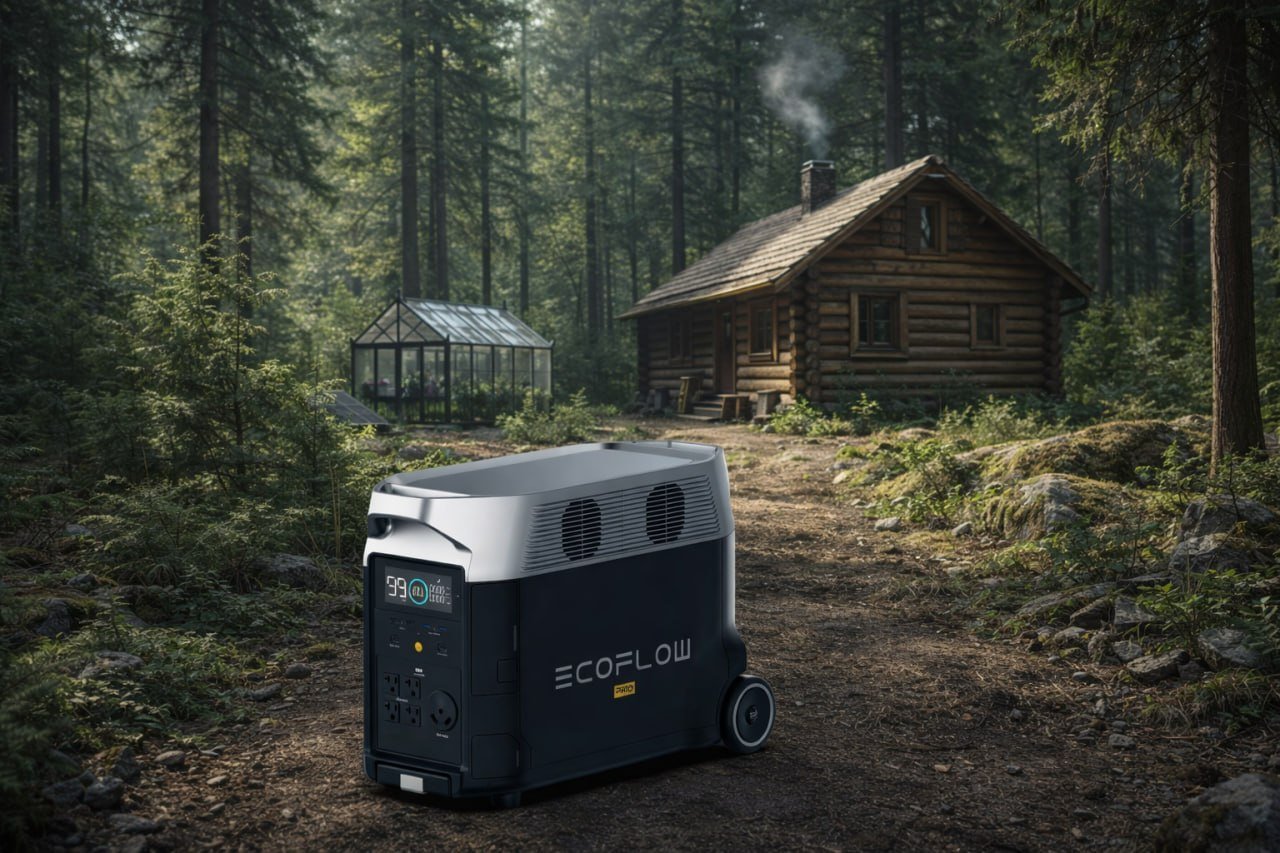
The EcoFlow Delta Pro arrived in 2021 as the power station that finally made off-gridders take portable units seriously. At 3,600 Wh with a 3,600W pure sine wave inverter, expandability to 25 kWh, and wall-to-full charging in under three hours, it set benchmarks that competitors spent years chasing. In 2026 — with the Delta Pro 3 now at retail and flash sale prices pushing the original below $1,600 — the question has shifted: is it still worth buying, and for whom?
| Best For | Off-grid homeowners, full-time RVers, and grid-tied households wanting whole-home backup |
| Avoid If | You need 240V output from a single unit, prioritize solar recharge speed, or live on stairs |
| Street Price | ~$1,597–$2,500 (heavily sale-dependent; check before buying) |
| Warranty | 5 years (requires free registration within 30 days of purchase) |
As an Amazon Associate, OffGridFoundry earns from qualifying purchases.


The Delta Pro is a excellent unit that earned every bit of its reputation — and then the software team spent three years chipping away at that reputation with cloud outages, firmware bugs, and an iOS app that crashed every time daylight saving time changed. Hardware-wise, it remains one of the most capable all-in-one power stations ever made. Software-wise, it is a cautionary tale about what happens when a manufacturer builds cloud dependency into a product that people rely on during emergencies. Buy it with open eyes: the hardware is outstanding, the cloud layer is a recurring liability, and at current sale prices the value is nearly unbeatable.
What We Like
- 3,600W continuous output with 7,200W surge — runs simultaneously demanding loads like a microwave, electric kettle, and chest freezer that would stall lesser units
- LFP battery chemistry with 3,500+ cycle rating — original 2021 buyers are still running their units in 2026 with no reported mass degradation; LFP is inherently safer and longer-lived than the NMC chemistry used in early Jackery and Goal Zero units
- Best-in-class AC recharge speed — 1,800W from a standard 15A outlet gets you full in ~2.7 hours; a 240V dryer outlet drops that to ~1.8 hours; an EV charging station hits full in ~1.7 hours; max combined input across all sources simultaneously reaches 6,500W
- Expandable to 25 kWh — bolt on extra battery modules without buying a new inverter unit; no comparable all-in-one product matches this ceiling
- X-Boost mode — manages power delivery to run devices rated up to 4,500W off a 3,600W inverter; useful for resistive loads like hair dryers and some electric heaters
- Quiet under light loads — measured below 50 dB at one meter during normal operation; fans spin up under heavy charging but baseline noise is livable indoors
- Wheels and telescoping handle — at 99 lbs this is not a liftable unit, but the built-in mobility system makes one-person repositioning indoors practical
What We Don’t Like
- No 240V from a single unit — this catches buyers off guard repeatedly. Running a well pump, clothes dryer, or standard EV charger requires either two Delta Pros paired with EcoFlow’s Double Voltage Hub, or integration into a Smart Home Panel. This is a real hidden cost for anyone planning whole-home backup.
- Solar input cap of 1,600W — adequate for the base unit, but if you expand to 7.2 kWh or beyond, you cannot meaningfully recharge via solar alone in a single day. Bluetti’s AC300 accepts 2,400W of solar input — a genuine functional advantage for serious off-grid use.
- Cloud dependency is a real risk — In June 2025, a 10+ hour EcoFlow server outage left users unable to control Smart Home Panels or check battery status. More seriously, that outage caused grid input to override BMS safety protocols, overcharging some batteries. In November 2025, a daylight saving time bug crashed the iOS app on startup for all iPhone and iPad users. These are not minor inconveniences in a product marketed for emergency backup.
- SoC display inaccuracy — State of Charge percentage and runtime estimates are unreliable mid-cycle, particularly after partial charges. The fix (drain to zero, charge to full uninterrupted) works, but it is a recurring maintenance task that users on diysolarforum have raised repeatedly.
- Fan noise under heavy charging — charge at 1 kW or above and the fans become disruptive. This matters if the unit lives in a bedroom or small RV interior.
- 99 lbs is semi-permanent in practice — wheels help on flat surfaces; they do not help getting the unit into a truck bed, up a garage step, or across gravel. Plan your placement before you need it.
Specs That Matter
Off-Grid Insider
Get off-grid guides & gear picks in your inbox — free
| Spec | Value |
|---|---|
| Usable Capacity | 3,600 Wh (real-world ~3,000–3,300 Wh under load) |
| Battery Chemistry | LiFePO4 (LFP) |
| Cycle Life | 3,500 cycles to 80% capacity |
| AC Output (continuous) | 3,600W pure sine wave |
| AC Output (surge) | 7,200W |
| AC Outlets | 4× standard 20A + 1× 30A (5 total) |
| Solar Input (max) | 1,600W (11–150V, 15A) |
| Solar Recharge Time | ~2.8–3 hours at full 1,600W |
| AC Recharge (standard outlet) | ~2.7 hours (1,800W) |
| AC Recharge (240V outlet) | ~1.8 hours |
| Max Combined Input | 6,500W (all sources simultaneous) |
| UPS Switchover | 10–30ms (load-dependent) |
| Weight | 99 lbs (45 kg) |
| Max Expansion Capacity | 25 kWh via battery modules |
| Warranty | 5 years (post-registration) |
Real-World Performance
Reviewers and forum users validate the specs where it counts. GearJunkie clocked wall-to-full recharge times at roughly the manufacturer’s claims — a 2.7-hour fill from a 15A outlet is a genuine differentiator; competing units at similar capacity can take 8–12 hours from the same source. OutdoorGearLab noted the display and app as “the best in class” among units tested, and original 2021 purchasers reported on thesolarlab.com and sustainability-success.com that their units remain fully functional four-plus years later without meaningful capacity degradation — an outcome that LFP chemistry makes plausible and that NMC-based competitors at the same vintage cannot claim.
Where real-world use diverges from the spec sheet is solar charging at scale. Multiple diysolarforum members running expanded systems (7–14 kWh) report that 1,600W solar input becomes a bottleneck quickly. A 14.4 kWh expanded system takes over nine hours to recharge via solar alone at maximum input — and that assumes ideal sun angles and no simultaneous load draw. These users consistently recommend pairing the Delta Pro with a separate MPPT controller and additional panels fed through the battery modules rather than the main unit, which adds cost and complexity the marketing materials do not advertise.
The software incidents require plain language: the June 2025 cloud outage is the most serious hardware-software integration failure in EcoFlow’s history. A power station marketed for outage protection overcharged batteries during an outage because the manufacturer’s servers went down. EcoFlow did not broadly publicize the overcharge issue. Users discovered it on forums. Local operation (no app, no cloud) continued to function normally — the Delta Pro’s inverter and BMS work offline — but any automation, remote monitoring, or Smart Home Panel integration does not. If you plan to use smart features, budget for the possibility that they will be unavailable exactly when you need them.
Who Should Buy This
The Delta Pro’s ideal buyer is a grid-tied homeowner or full-time RVer who needs substantial backup capacity, fast recharge between grid availability windows, and the option to grow the system over time without replacing the inverter. If you live in an area with frequent 8–24 hour outages — hurricanes, ice storms, wildfire-driven shutoffs — the Delta Pro can run essential circuits (refrigerator, freezer, select lights, phone/laptop charging, CPAP) for a full day from the base unit alone, and for multiple days if you add battery modules.
Full-time RVers benefit from the 30A output port, the EV station charging compatibility (useful at campgrounds with J1772 pedestal hookups), and the ability to top up in 2–3 hours at a shore power connection before heading off-grid. Buyers who are already in the EcoFlow ecosystem — owning a Delta 2 or River 2 for portability and wanting a home-base unit — will benefit most from app integration when it works and the compatible expansion modules.
At current sale prices in the $1,597–$1,900 range, the value calculation is straightforward: this is 3,600 Wh of LFP capacity with a 3,600W inverter and 5-year warranty at roughly what a mid-tier unit cost two years ago.
Who Should Look Elsewhere
Solar-primary off-grid users who cannot rely on grid top-ups should seriously consider the Bluetti AC300+B300S instead. Its 2,400W solar input ceiling and 3,000W inverter make it the better choice when panels are your primary source and you are managing a larger battery bank. Bluetti’s split inverter-plus-battery design also keeps the inverter unit at 47.6 lbs — manageable in ways the 99-lb Delta Pro is not.
Budget-conscious buyers who need solid backup without the scale should look at the EcoFlow Delta 2 — 1,024 Wh, 5-year warranty, 80-minute fast charge, rated 4.6/5 across 3,000+ Amazon reviews. At under $700 on sale, it covers most household emergency needs at less than half the price.
Anyone who specifically needs 240V output from a single unit should know upfront: the Delta Pro cannot do it alone. Either budget for two units plus the Double Voltage Hub, or look at the newer EcoFlow Delta Pro 3, which addresses several of the original’s limitations with 4,096 Wh capacity, 4,000W output, and 2,600W solar input.
Bottom Line
The EcoFlow Delta Pro is one of the most capable portable power stations ever made — fast-charging, LFP-durable, expandable, and validated by four-plus years of real-world owner use. Its software layer is its most significant liability, and the 240V single-unit limitation will surprise buyers who do not research carefully. At the $1,597–$1,900 sale prices now common, it is exceptional value for grid-tied homes and RVers who need serious backup capacity; at full $3,699 MSRP, the Delta Pro 3 is the smarter buy. Register for the 5-year warranty the day it arrives, run a full calibration cycle before deployment, and treat the cloud-connected smart features as a bonus rather than a dependency.
→ Buy the EcoFlow Delta Pro on Amazon