5 Best Off-Grid Outdoor Kitchens 2026
Cooking off-grid means no gas line, no outlet on the wall, and no pizza delivery as a backup plan. Building the best outdoor kitchen setup off-grid requires gear that runs on propane, wood, charcoal, or solar — and holds up to weather, bugs, and the reality that your nearest hardware store might be an hour away. Most “outdoor kitchen” listicles assume you have a backyard with a natural gas hookup; we built this list for people who don’t.
Our top pick: Camp Chef Explorer 2X Two-Burner Stove — the most versatile propane cooktop for off-grid base camps.
Best for baking: Camp Chef Deluxe Outdoor Camp Oven — a real oven that runs on propane, no electricity needed.
Best budget pick: Lodge 6-Quart Cast Iron Camp Dutch Oven — under $60, does everything, lasts forever.
Our Picks
Camp Chef Explorer 2X Two-Burner Stove

Best overall outdoor kitchen cooktop for off-grid living
This is the backbone of most serious off-grid outdoor kitchens, and for good reason. Each burner puts out 30,000 BTU, it runs on standard 20 lb propane tanks, and the detachable legs let you set it on a permanent table or stand it up freestanding — no electricity required for ignition or operation.
Who it’s for: Anyone building a semi-permanent off-grid cooking station who wants reliable two-burner propane cooking with room to expand.
Pros:
– 60,000 total BTU across two burners handles everything from simmering stock to high-heat stir fry
– Compatible with Camp Chef’s accessory system — griddle tops, BBQ boxes, and pizza ovens swap right on
– Wind baffles and a three-sided windscreen are included, which matters when you’re cooking exposed on a homestead
Cons:
– Propane dependency means you need a refill plan — at roughly 1 lb per hour on high, a 20 lb tank goes in about 20 hours of full-blast cooking
– No built-in work surface; you’ll need to build or buy a table around it
Camp Chef Deluxe Outdoor Camp Oven
Off-Grid Insider
Get off-grid guides & gear picks in your inbox — free
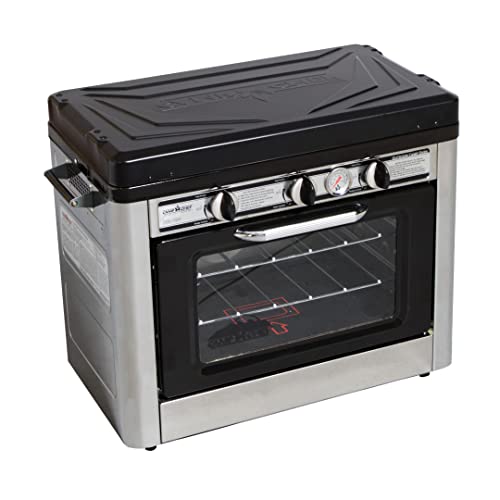
Best off-grid outdoor oven
If you want to bake bread, roast a chicken, or make casseroles off-grid, this is the simplest path. It’s a propane-powered oven with a two-burner stovetop on top, and the built-in thermometer actually tracks reasonably close to what an oven thermometer reads inside. No electricity, no complicated flue — just hook up a tank and light it.
Who it’s for: Off-grid homesteaders who miss having a real oven and don’t want to master Dutch oven baking over coals.
Pros:
– Oven reaches 400°F+ comfortably, with relatively even heat distribution for a portable unit
– Two-burner stovetop on top means you get oven and cooktop in one footprint
– Matchless ignition works without batteries or power — one less thing to fail
Cons:
– At roughly 55 lbs, it’s portable in theory but in practice you’ll want to give it a permanent spot
– Oven temperature regulation takes practice — hot spots exist near the burner, so rotating pans halfway through is standard procedure
Ooni Karu 12 Multi-Fuel Pizza Oven
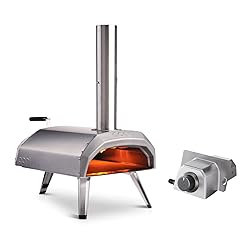
Best wood-fired cooking option
We included this because an off-grid outdoor kitchen doesn’t have to be purely utilitarian. The Karu 12 runs on wood, charcoal, or a propane attachment, hits 950°F in about 15 minutes on wood, and cooks a pizza in 60 seconds. But it’s not just for pizza — community feedback across homesteading forums shows people using it for naan, flatbreads, roasted vegetables, and even reheating cast iron dishes at high heat.
Who it’s for: Off-gridders who want wood-fired cooking without building a permanent brick oven, and who value fuel flexibility.
Pros:
– True multi-fuel capability: wood, charcoal, or propane (adapter sold separately) — use whatever you have on hand
– Reaches wood-fired oven temperatures that no propane grill or camp stove can match
– Compact and light at 26.4 lbs — easy to store under cover when not in use
Cons:
– Small 12-inch cooking surface limits you to one pizza or dish at a time
– Wood-fire management has a real learning curve; expect a few burnt pies before you dial it in
Blackstone 22-Inch Tabletop Griddle

Best flat-top griddle for off-grid meal prep
A flat-top griddle earns its spot in an off-grid kitchen faster than almost anything else. Breakfast for six, smash burgers, stir-fried garden vegetables, pancakes — the Blackstone 22-inch handles all of it on a single cooking surface with two independently controlled H-style burners. It runs on a 1 lb propane cylinder or adapts to a 20 lb tank with a standard hose.
Who it’s for: Families or groups cooking multiple portions at once who want fast, high-volume meal prep outdoors.
Pros:
– 339 square inches of flat cooking surface means you can cook a full meal — protein, vegetables, eggs — simultaneously
– Two independent heat zones let you run high heat on one side and low on the other
– Seasoned steel surface becomes naturally non-stick over time and cleans up with a scraper and oil
Cons:
– The rolled steel surface needs ongoing seasoning and must be kept dry or it rusts; a fitted cover is essentially mandatory
– Wind affects temperature control on open sites — you may need to build or buy a wind barrier
Lodge 6-Quart Cast Iron Camp Dutch Oven

Best budget off-grid cooking setup
If your budget is tight or you’re just getting started, a camp Dutch oven over a fire pit is the oldest and most proven off-grid kitchen there is. The Lodge 6-quart has three legs for sitting over coals, a flanged lid for stacking charcoal on top (turning it into a real oven), and costs under $60. Stews, bread, cobbler, roasts — there’s a reason this design hasn’t changed in centuries.
Who it’s for: Budget-conscious beginners, minimalists, or anyone who wants a single do-everything vessel that needs zero fuel infrastructure beyond a fire.
Pros:
– Under $60 gets you a pot, an oven, a bread baker, and a frying pan (using the lid inverted) — nothing else is this versatile per dollar
– Runs on wood, charcoal, or any open flame — true fuel independence
– Virtually indestructible with basic maintenance; Lodge’s casting quality is consistent across production runs
Cons:
– Heavy at 14 lbs — this stays at your outdoor kitchen station, it doesn’t travel casually
– Requires learning coal placement patterns for temperature control; there’s a real skill curve to baking with it
BioLite FirePit+

Best portable fire cooking with airflow control
The BioLite FirePit+ sits in an interesting middle ground: it’s a contained fire pit with a battery-powered fan system that controls airflow to the burn chamber, plus a slide-out grill grate for cooking directly over wood or charcoal. The mesh body gives you the campfire experience while the fan reduces smoke significantly. The rechargeable battery runs the fan for 10+ hours on low, and can be recharged via USB — compatible with a small solar panel.
Who it’s for: Off-gridders who want a contained, low-smoke wood fire for cooking and evening ambiance with better control than a simple fire ring.
Pros:
– Integrated fan system reduces smoke output, which matters when your outdoor kitchen is near your living space
– Dual-fuel — burns wood or charcoal with adjustable airflow via Bluetooth app or manual control
– Fold-out grill grate and optional accessory grates turn it into a functional cooking surface
Cons:
– At $250+, it’s an expensive fire pit compared to a basic steel ring — you’re paying for the airflow tech
– The grill surface is relatively small; this supplements your outdoor kitchen rather than anchoring it
Solo Stove Bonfire 2.0
Best open-fire base for cast iron cooking
If your off-grid outdoor kitchen strategy centers on cast iron and open flame, you need a fire base that burns efficiently and doesn’t fill your cooking area with smoke. The Solo Stove Bonfire’s double-wall airflow design creates a secondary burn that dramatically reduces smoke. Pair it with a cast iron grill grate (sold separately) or set a Dutch oven right on top, and you have a clean-burning wood-fired cooking station.
Who it’s for: Anyone whose outdoor kitchen plan is built around wood fire and cast iron who wants less smoke and more complete combustion.
Pros:
– Double-wall airflow produces a near-smokeless burn once the fire is established — a major quality-of-life improvement for regular outdoor cooking
– Stainless steel construction handles permanent outdoor placement without rust concerns
– 19.5-inch diameter accommodates standard cast iron skillets and Dutch ovens directly over flame
Cons:
– Airflow design burns through wood faster than a traditional fire pit — you’ll use more fuel per session
– No built-in grill grate; you’ll need to buy the Solo Stove cooking accessories or fabricate a grate
How We Chose
We reviewed manufacturer specifications, cross-referenced real buyer feedback across homesteading forums and verified purchase reviews, and prioritized gear that operates without any electrical hookup. Every product on this list runs on propane, wood, charcoal, or a combination — because if it needs a 120V outlet, it doesn’t belong in an off-grid outdoor kitchen guide. We weighted durability, fuel efficiency, and multi-season usability heavily, since off-grid gear gets used harder and replaced less often than backyard equipment. Products with consistent complaints about rust, warping, or ignition failure in outdoor-exposed conditions were cut.
Buying Guide: What Actually Matters for an Off-Grid Outdoor Kitchen
Fuel Source and Availability
This is the single most important decision. Propane is convenient and controllable but requires refills — if your nearest exchange is 45 minutes away, factor that into your planning. Wood is free if you have land and a saw, but demands more skill and attention. The best off-grid outdoor kitchen setups usually combine both: propane for daily cooking, wood fire for slow cooking, baking, and when propane runs low. Consider how much fuel storage you can realistically maintain.
Weather Exposure and Durability
Your outdoor kitchen lives outside, full time. Stainless steel resists rust but costs more. Rolled steel (like griddle surfaces) needs seasoning and cover. Cast iron handles anything but must stay oiled. Think about your climate: coastal humidity, desert UV, mountain freeze-thaw cycles — all of these degrade different materials differently. At minimum, plan a roof or tarp structure over your cooking station. Gear that lives permanently outdoors without protection will fail regardless of brand.
Cooking Versatility Per Dollar
Off-grid, you can’t just order a specialty appliance for every cooking method. Prioritize pieces that do multiple jobs. A Dutch oven bakes, roasts, fries, and simmers. A two-burner stove with swappable accessories covers more ground than a single-purpose grill. Build your outdoor kitchen around two or three versatile pieces rather than five or six specialized ones — less to maintain, less to fuel, less to store.
Layout and Workflow
Think about where water comes from, where food gets prepped, and where dishes get washed. Your cooking station should be close to (but not directly over) your water source. Plan a prep surface at a comfortable standing height. Keep fuel storage accessible but safely away from flame. Many off-grid homesteaders build an L-shaped or U-shaped counter from reclaimed lumber or concrete blocks with the stove recessed in the center — simple, effective, and cheap.
FAQ
What is the best fuel source for an off-grid outdoor kitchen?
Propane offers the most control and convenience for daily cooking, but wood provides true fuel independence if you have timber access. Most experienced off-grid homesteaders recommend having both: a propane burner or stove for quick meals and precise temperature work, and a wood fire setup for slow cooking, baking, and backup. This dual-fuel approach means you’re never dependent on a single supply chain.
How do you keep an outdoor kitchen clean without running water?
A gravity-fed water tank with a spigot mounted above a basin is the most common solution. A five-gallon container elevated three to four feet provides enough pressure for hand washing and dish rinsing. Biodegradable camp soap, a scraper for cast iron, and a dedicated wash-rinse-sanitize basin system keeps everything sanitary. Many off-gridders heat wash water on the same stove they cook on.
Can you build an off-grid outdoor kitchen for under $500?
Yes. A Lodge camp Dutch oven (under $60), a Camp Chef Explorer 2X (around $160), a 20 lb propane tank ($30-40), and lumber or concrete blocks for a counter structure ($100-150) gets you a fully functional outdoor kitchen for roughly $400. Add a Blackstone tabletop griddle later when the budget allows. Start simple and expand based on what you actually cook.
How do you protect an outdoor kitchen from animals and weather?
For weather: a simple post-and-beam roof with metal roofing panels over your cooking area is the most durable solution. For animals: store all food in sealed containers away from the cooking area, clean grease traps and cooking surfaces after every use, and consider a screened food prep area if you’re in bear country. Never leave food scraps or grease on cooking surfaces overnight.
What size propane tank do you need for off-grid cooking?
A standard 20 lb tank provides roughly 20 hours of cooking time on a high-output burner (30,000 BTU). For a household cooking three meals a day, most off-gridders report a 20 lb tank lasting two to three weeks of regular use. We recommend keeping at least two tanks so you always have a backup. For longer-term setups, a 100 lb tank with a regulator and hose reduces refill trips significantly.
Our Verdict
For most people building an off-grid outdoor kitchen, the Camp Chef Explorer 2X Two-Burner Stove is the piece to start with. It gives you reliable, high-BTU propane cooking with a proven accessory ecosystem, and it works as the anchor of a kitchen you build out over time. Pair it with a Lodge Camp Dutch Oven for wood-fire baking and slow cooking, and you’ve covered 90% of what a household needs to eat well off-grid — for under $250 total.