5 Best Dual Fuel Generators 2026
Finding a reliable dual fuel generator for off-grid use shouldn’t require a PhD in electrical engineering — but scrolling through hundreds of listings with inflated wattage claims and vague “off-grid ready” marketing makes it feel that way. When your power system is your lifeline, not a convenience, you need something that actually delivers on specs, runs clean on propane when gasoline isn’t available, and won’t die after one season.
We spent weeks digging through manufacturer specs, FCC/EPA certifications, and hundreds of verified buyer reports across forums like r/offgrid, r/solar, and multiple homesteading communities to find the best dual fuel generator for off-grid cabins, homesteads, and remote properties. Here’s what we’d actually put our money on.
Our top pick: Champion 3800-Watt Dual Fuel — best balance of reliability, runtime, and price for most off-grid setups.
Best budget: Westinghouse WGen3600DF — solid build quality at a lower price point.
Best for heavy loads: DuroMax XP13000EH — when you need serious wattage for a full cabin or workshop.
Best portable: Firman H03652 — lightweight and easy to move between sites.
Best inverter generator: A-iPower SUA4000iD — clean power for sensitive electronics.
Our Picks
Champion 3800-Watt Dual Fuel Generator
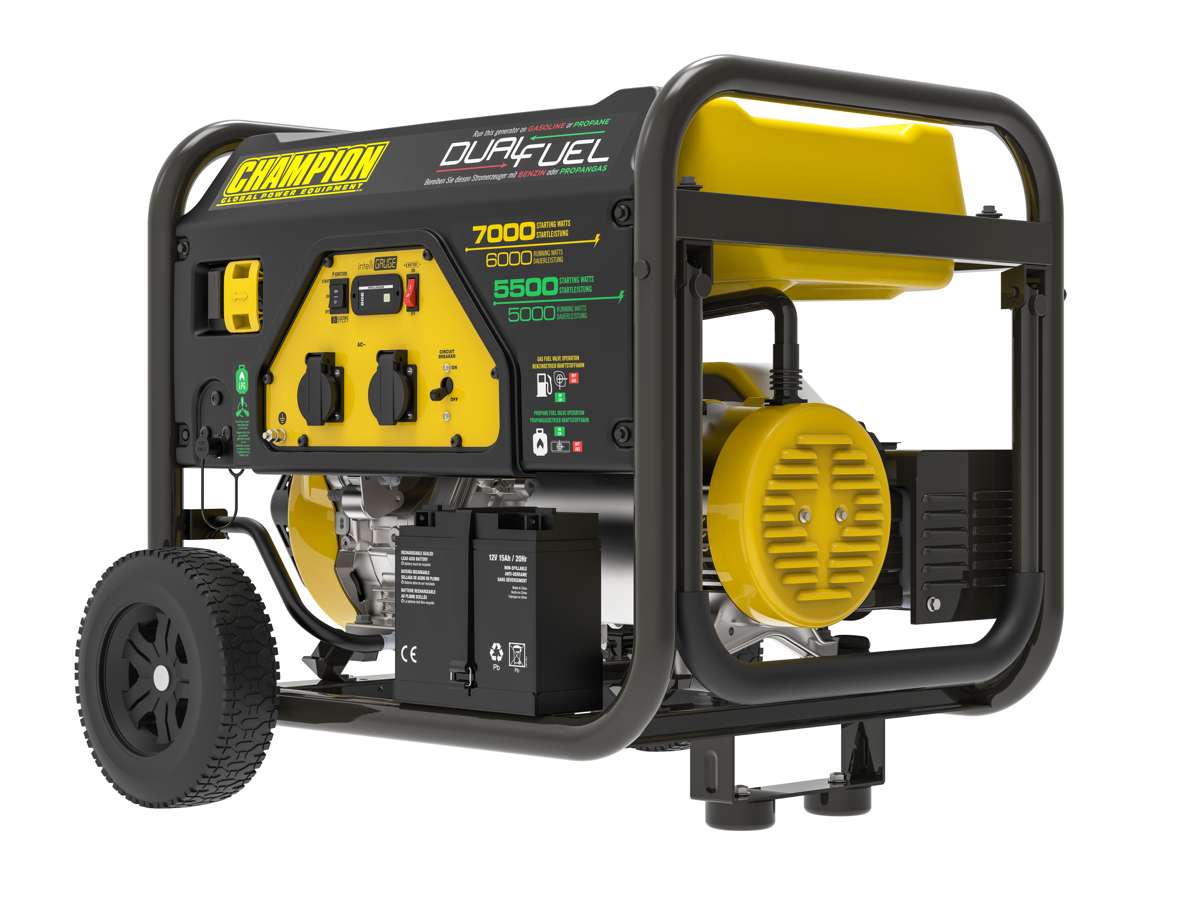
The Champion 3800 is the generator we see recommended most often in off-grid communities, and the specs back up the reputation. It delivers 3,800 starting watts on gasoline (3,420 running) and 3,420 starting watts on propane (3,078 running), with a 224cc Champion engine that owners consistently report lasting thousands of hours with basic maintenance.
Who it’s for: Off-gridders who need a primary backup generator that handles well pumps, refrigerators, and basic lighting circuits without overspending.
Pros:
– Cold Start Technology fires reliably down to -20°F — critical for remote winter locations
– 10.5-hour runtime at 50% load on a full gasoline tank; connects to standard 20 lb propane tanks
– Volt Guard built-in surge protector keeps appliances safe without an external unit
Cons:
– At 119 lbs, it’s not something you’re casually moving around
– No electric start on the base model — pull-start only, which matters in cold weather despite the cold start tech
Westinghouse WGen3600DF Dual Fuel Generator
Off-Grid Insider
Get off-grid guides & gear picks in your inbox — free

Westinghouse’s WGen3600DF punches above its price point. It puts out 3,600 peak watts on gasoline and 3,240 on propane, runs up to 13.5 hours at 25% load on gas, and comes with a transfer-switch-ready outlet — a feature many budget generators skip entirely.
Who it’s for: Budget-conscious off-gridders who want a dependable backup without paying Champion or Honda premiums.
Pros:
– Transfer-switch-ready L5-30R outlet included out of the box
– One of the longest runtimes in its class on a 4-gallon tank
– Plug-and-play propane hookup with a regulator hose included
Cons:
– 212cc engine runs louder than competitors — measured around 72 dB at rated load
– Slightly lower propane output means you’ll feel the wattage drop more with heavy loads
DuroMax XP13000EH Dual Fuel Generator

When your off-grid setup includes a workshop, a large well pump, or central HVAC, you need raw wattage — and the DuroMax XP13000EH delivers it. This beast puts out 13,000 starting watts and 10,500 running watts on gasoline, with a 500cc OHV engine that’s built for sustained heavy loads.
Who it’s for: Full-time off-grid homesteads with high power demands — think multiple circuits, large freezers, power tools, and well pumps running simultaneously.
Pros:
– 10,500 running watts on gasoline handles virtually any residential off-grid load
– Electric start with key ignition plus idle control to save fuel during lighter loads
– Full panel includes 120V and 240V outlets, plus a 50-amp outlet for RV or heavy transfer switch connections
Cons:
– 234 lbs — this is a stationary or trailer-mounted unit, period
– Fuel consumption at full load is significant; budget for higher operating costs
Firman H03652 Dual Fuel Generator

The Firman H03652 hits a sweet spot that most dual fuel generators miss: it’s actually portable. At just over 100 lbs with a compact frame design, this 4,550 peak-watt generator is one of the few in its class you can realistically load into a truck bed solo.
Who it’s for: Off-gridders with multiple sites, seasonal cabins, or anyone who needs to move their generator between locations regularly.
Pros:
– portable at ~104 lbs with a well-designed wheel kit and folding handle
– Recoil and electric start — the battery is included, not an upcharge
– 9-hour runtime at 50% load on gasoline; clean fuel switching between gas and propane
Cons:
– 4,550 peak watts means you’ll need to manage loads carefully with larger appliances
– Noise level around 67 dB is acceptable but not quiet — you’ll hear it from inside the cabin
Pulsar G12KBN Dual Fuel Generator
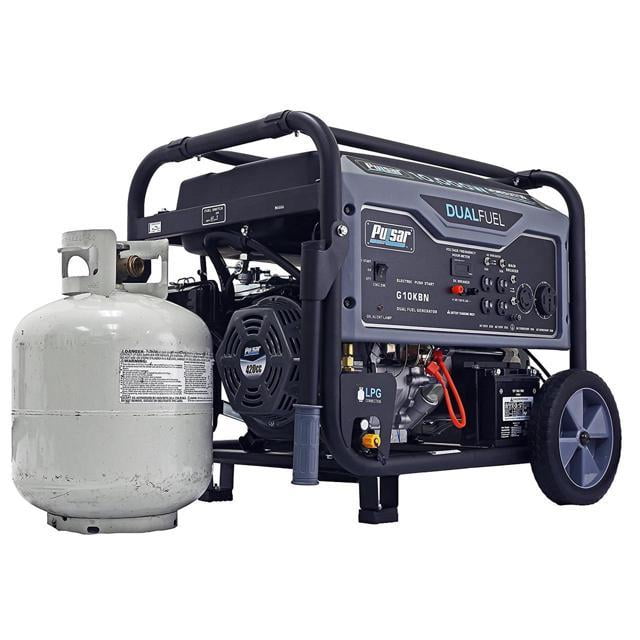
The Pulsar G12KBN is a serious contender for whole-cabin off-grid power at a price point that undercuts the DuroMax by a meaningful margin. It delivers 12,000 peak watts on gasoline and 10,800 on propane, with a switch panel that includes both 120V and 240V circuits.
Who it’s for: Off-grid homesteaders who need high wattage but are watching the budget — especially those running a transfer switch to power an entire panel.
Pros:
– 12,000 starting watts at a price often $200-400 less than comparable DuroMax or Champion units
– 457cc engine with electric start and automatic low-oil shutoff
– 8-gallon fuel tank provides extended runtime between refills
Cons:
– Build quality feedback is more mixed than Champion or DuroMax — some owners report minor fit-and-finish issues
– At 210 lbs, portability is not a consideration
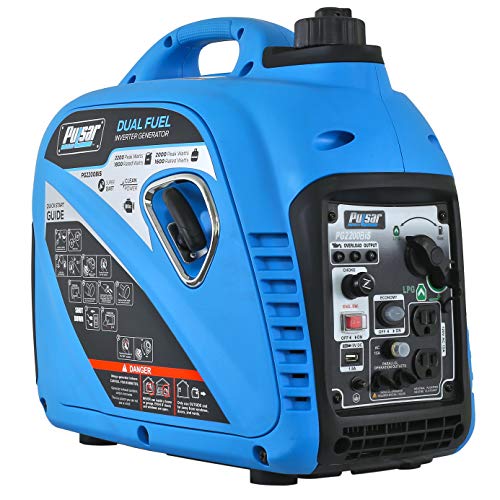
A-iPower SUA4000iD Dual Fuel Inverter Generator
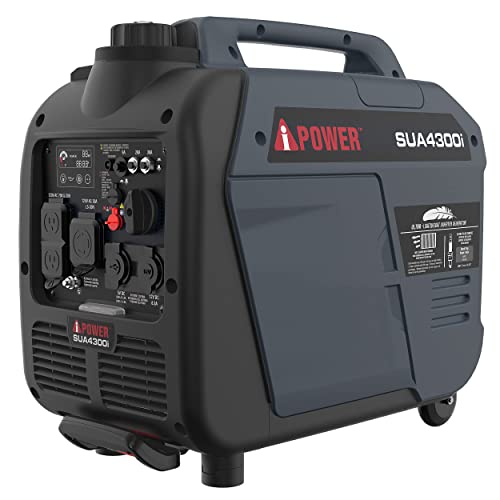
If your off-grid setup includes sensitive electronics — charge controllers, inverter-chargers, communication equipment, or medical devices — you need clean power. The A-iPower SUA4000iD is a dual fuel inverter generator, meaning it produces less than 3% total harmonic distortion. That’s power quality comparable to what comes out of your wall outlet in a grid-tied home.
Who it’s for: Off-gridders with solar/battery hybrid systems who need a backup that won’t fry their charge controllers or inverters.
Pros:
– True inverter technology with <3% THD — safe for all sensitive electronics
– Runs at variable RPM based on load, significantly reducing fuel consumption and noise during lighter use
– Dual fuel with easy selector switch; 4,000 starting watts on gasoline
Cons:
– Running wattage (3,500W gas / 3,150W propane) may not handle large motor loads like well pumps during startup surge
– Inverter generators cost more per watt — you’re paying a premium for clean power
How We Chose
We started with every dual fuel generator between 3,000 and 13,000 watts currently available from major retailers, then filtered for models with at least 200 verified buyer reviews and an average rating above 4.0. From there, we cross-referenced specs against real-world owner reports on Reddit, homesteading forums, and YouTube teardown channels. We weighted heavily for propane performance (since propane storage is the backbone of most off-grid fuel strategies), cold-weather starting reliability, and long-term durability reports from owners past the 500-hour mark. Models with consistent complaints about fuel system failures, voltage regulation issues, or warranty problems were cut regardless of price.
Buying Guide: What Actually Matters in a Dual Fuel Generator for Off-Grid Use
Running Watts vs. Starting Watts
Every generator lists peak (starting) watts prominently because it’s the bigger number. Ignore it for sizing purposes. What matters is running watts — the sustained output your generator maintains under continuous load. Add up the running wattage of everything you need to power simultaneously, then add 20% headroom. For well pumps and refrigerator compressors, check the startup surge rating separately — these can pull 2-3x their running wattage for the first few seconds.
Propane Performance Drop
Every dual fuel generator produces less power on propane than gasoline — typically 10-15% less. This isn’t a defect; it’s physics. Propane has a lower energy density per unit volume. The practical impact: if you’re sizing your generator around propane as your primary fuel (and for off-grid, you probably should be, since propane stores indefinitely while gasoline degrades), size based on the propane running wattage, not the gasoline number.
Fuel Storage and Runtime Math
Gasoline goes stale in 3-6 months even with stabilizer. Propane doesn’t. For off-grid use, this makes propane your strategic fuel — you can store 500 gallons and it’ll be fine in five years. But propane runtime per tank is shorter than gasoline runtime per gallon due to the energy density difference. Map out your daily watt-hour needs, calculate how many hours per day the generator needs to run (especially if it’s charging a battery bank), and figure out your propane consumption rate at 50% load. That number determines how much propane storage you actually need for a given period of grid independence.
Noise Level and Placement
Conventional generators run 65-75 dB at rated load. That’s roughly the volume of a vacuum cleaner to a loud conversation. Inverter generators run 50-62 dB. If your off-grid cabin is compact and the generator sits within 50 feet, every decibel matters — especially at night when you’re charging batteries. Factor in placement: hard surfaces reflect sound, soft ground and vegetation absorb it. A simple three-sided plywood baffle with acoustic foam can drop perceived noise by 5-8 dB without restricting airflow if you design it correctly.
FAQ
What size dual fuel generator do I need for off-grid living?
Most off-grid cabins with a well pump, refrigerator, lighting, and device charging need 3,500-5,000 running watts. If you’re running power tools, HVAC, or multiple large appliances simultaneously, step up to 7,500-10,500 running watts. Always size based on propane running watts, not peak gasoline watts.
Is propane or gasoline better for off-grid generator use?
Propane is generally better for off-grid primary use because it stores indefinitely without degradation, burns cleaner (extending engine life), and is available in bulk delivery to remote properties. Keep gasoline on hand as a backup, but plan your fuel logistics around propane.
How long will a dual fuel generator run on a 20 lb propane tank?
At 50% load, most 3,500-4,000 watt dual fuel generators run 8-12 hours on a standard 20 lb propane tank. Larger generators in the 10,000+ watt class will consume a 20 lb tank in 4-6 hours at 50% load. For extended off-grid use, connect to a 100 lb or 250-gallon bulk tank with the appropriate regulator.
Can I use a dual fuel generator to charge my off-grid battery bank?
Yes, and this is one of the most common off-grid use cases. Run the generator for 2-4 hours to bulk-charge your battery bank through your inverter-charger, then shut it down and run on batteries. If your system includes sensitive charge controllers or lithium BMS units, use an inverter generator (like the A-iPower SUA4000iD) to avoid harmonic distortion damage.
How often should I maintain a dual fuel generator used off-grid?
Change oil every 50-100 hours of operation (check your manual — some engines specify 50 hours for the first change). Clean or replace the air filter every 100-200 hours, more frequently in dusty conditions. Run the carburetor dry if storing on gasoline, or switch to propane before shutdown to clear gasoline from the fuel system. Inspect spark plugs every 200 hours. For off-grid primary backup generators, we recommend a full service at the start and end of each heavy-use season.
Our Verdict
For most off-grid setups, the Champion 3800-Watt Dual Fuel Generator remains our top recommendation. It delivers the right balance of reliable wattage, proven cold-weather starting, and long-term durability at a price that doesn’t sting. If you need significantly more power for a full homestead, step up to the DuroMax XP13000EH. And if clean power for sensitive electronics is non-negotiable, the A-iPower SUA4000iD is worth the inverter premium. Whatever you choose, size for propane output, not gasoline — your future self hauling fuel to a remote property will thank you.