
5 Best Satellite Messengers 2026
When you’re miles from the nearest cell tower — or there simply isn’t one — a dead phone isn’t an inconvenience, it’s a genuine safety risk. Off-grid properties, remote homesteads, and backcountry travel all share the same problem: reliable communication requires hardware that doesn’t depend on terrestrial infrastructure. We spent weeks digging through satellite messenger specs, Iridium and Globalstar network coverage data, subscription plan fine print, and thousands of verified buyer reports to find the devices actually worth your money.
The market for satellite communicators has exploded in the last few years, but most “best of” lists barely scratch the surface. We’re cutting through the noise to tell you which devices deliver reliable emergency communication off-grid property owners and travelers actually need — and which ones will leave you frustrated when it matters most.
Our Top Picks at a Glance
| Category | Pick | Why |
|---|---|---|
| Best Overall | Garmin inReach Mini 2 | Tiny, proven Iridium network, full two-way messaging and SOS |
| Best Budget | ZOLEO Satellite Communicator | Lowest subscription costs, dead-simple interface |
| Best for Navigation | Garmin GPSMAP 67i | Full topo GPS + inReach messaging in one unit |
| Best Satellite Phone | Iridium 9575 Extreme | True voice calls anywhere on Earth |
| Best for Families | Garmin inReach Messenger | Affordable device, preset messages, location sharing |
| Best Compact | ACR Bivy Stick | Lightweight two-way with Iridium network |
| Best Budget Tracker | SPOT Gen5 | One-way SOS and tracking at the lowest price |
Our Picks
Garmin inReach Mini 2
Off-Grid Insider
Get off-grid guides & gear picks in your inbox — free

The inReach Mini 2 is the device we recommend to most people living or working off-grid. It runs on the Iridium satellite network — the only constellation offering true pole-to-pole coverage — and packs two-way texting, SOS with 24/7 GEOS monitoring, weather forecasts, and GPS tracking into a unit that weighs 3.5 ounces.
Who it’s for: Anyone who needs a reliable, pocketable garmin inreach off-grid communicator — homesteaders, backcountry hunters, overlanders, and remote property owners.
Pros:
– Iridium network means global coverage with no dead zones, even in deep valleys and high latitudes
– Interactive SOS connects to GEOS International Emergency Response Coordination Center with two-way chat during rescues
– Up to 14 days of battery life in default 10-minute tracking mode; rechargeable via USB-C
Cons:
– Requires a Garmin satellite subscription (plans start around $14.95/month with an annual commitment; $11.95 Freedom plan with no contract but higher per-message fees)
– Small screen makes composing custom messages tedious — most users pair it with the Garmin Messenger app on their phone
ZOLEO Satellite Communicator
ZOLEO hit the market as a direct competitor to Garmin’s inReach line and has carved out a strong niche thanks to its lower subscription costs and seamless app integration. It uses the Iridium network for satellite messages but intelligently routes through cellular or Wi-Fi when available, saving you money on your plan.
Who it’s for: Budget-conscious off-gridders who want two-way messaging and SOS without Garmin’s subscription pricing.
Pros:
– Subscription plans start at $6/month (basic) with check-in and SOS included — the cheapest Iridium-backed plan we’ve found
– Smart routing automatically sends messages via cellular or Wi-Fi when in range, reducing satellite message costs
– SOS button triggers a GEOS-monitored emergency response with two-way communication
Cons:
– No built-in GPS navigation or maps — it’s a communicator only, not a nav device
– Slightly larger and heavier (150g) than the inReach Mini 2, though still very pocketable
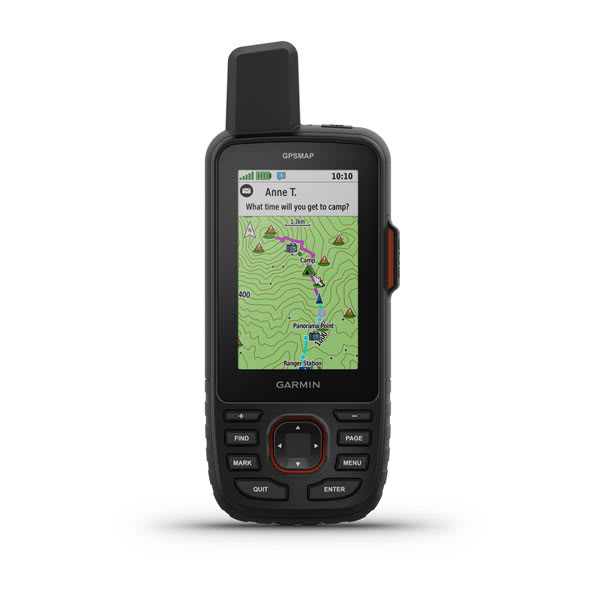
Garmin GPSMAP 67i

If you want a full-featured handheld GPS and a satellite messenger in one device, the GPSMAP 67i is the best option available. It combines Garmin’s multi-band GNSS navigation with full inReach satellite communication — two-way messaging, SOS, weather, and tracking — on a large sunlight-readable display.
Who it’s for: Off-grid explorers, hunters, and property owners who need topographic navigation and satellite communication in a single rugged device.
Pros:
– Multi-band GPS with preloaded TopoActive maps delivers accuracy to roughly 2 meters — far superior to phone-based GPS
– Full inReach functionality including two-way messaging, interactive SOS, and weather forecasts
– Battery life rated at up to 180 hours in expedition mode; powered by internal rechargeable lithium-ion with AA battery backup
Cons:
– Premium price point (typically $500–$600) plus the same Garmin satellite subscription as other inReach devices
– At 8.2 ounces, it’s more than double the weight of the Mini 2 — overkill if you don’t need onboard navigation
Iridium 9575 Extreme Satellite Phone

Sometimes text messages aren’t enough. For coordinating supply deliveries, calling emergency services directly, or staying in voice contact with family, a satellite phone off-grid living setup remains the gold standard. The Iridium 9575 Extreme is the most widely used sat phone on the market, trusted by aid workers, military personnel, and remote homesteaders worldwide.
Who it’s for: Off-grid homesteaders, remote workers, and anyone who needs actual voice calls — not just text — from locations with zero cellular coverage.
Pros:
– True voice calls to any phone number on Earth via the Iridium constellation — no dead zones
– Built-in GPS and programmable SOS button with emergency call capability
– MIL-STD-810G rated for dust, shock, and water ingress (IP65); operates from -20°C to +55°C
Cons:
– Expensive: the handset runs $1,000–$1,300 and airtime plans start around $50–$75/month for minimal minutes
– Requires a clear view of the sky — calls can drop under heavy tree canopy or indoors without an external antenna
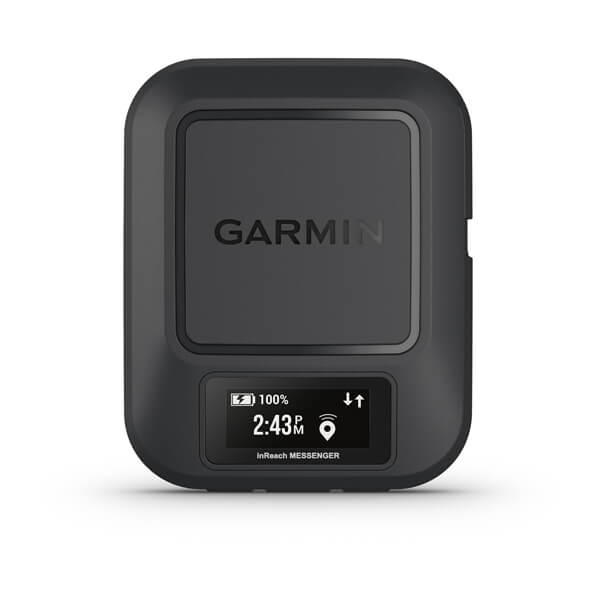
Garmin inReach Messenger
Garmin’s most affordable inReach device strips out the GPS navigation screen and focuses purely on communication. It’s designed to pair with your smartphone via Bluetooth, using the Garmin Messenger app for composing and reading messages while the device itself handles the satellite uplink.
Who it’s for: Families and homesteaders who want the reliability of garmin inreach off-grid communication at a lower device cost — and don’t need onboard maps.
Pros:
– Lowest-cost Garmin inReach device (typically $200–$250), making the Iridium network more accessible
– Excellent battery life — up to 28 days in low-power mode with 4-hour tracking intervals
– Location sharing via MapShare lets family members track your position on a web page in real time
Cons:
– Minimal on-device interface; you’ll almost always need your phone paired via Bluetooth for anything beyond preset messages
– Same Garmin subscription costs as the Mini 2 and GPSMAP 67i — the savings are on the hardware, not the plan
ACR Bivy Stick
ACR is a legacy name in emergency beacons, and the Bivy Stick is their entry into two-way satellite messaging. It runs on the Iridium network, supports two-way texting and SOS, and pairs with a polished smartphone app. At 3.5 ounces, it matches the inReach Mini 2’s portability.
Who it’s for: Users who want an alternative to Garmin’s ecosystem with competitive subscription pricing and a clean app experience.
Pros:
– Iridium network with global coverage and two-way interactive SOS monitored by GEOS
– Subscription plans are competitively priced with check-in, tracking, and messaging tiers
– Compact and lightweight (100g), clips easily to a pack or belt
Cons:
– Smaller user community than Garmin means fewer online resources and community troubleshooting
– No onboard display — entirely dependent on the smartphone app for message composition and reading
SPOT Gen5 Satellite GPS Messenger
The SPOT Gen5 is the budget entry point for satellite-based emergency communication off-grid property owners should consider if they primarily need SOS capability and location tracking without two-way messaging.
Who it’s for: Off-gridders on a tight budget who want an SOS lifeline and basic tracking — and can live without two-way texting.
Pros:
– Lowest upfront cost (~$150) and basic plans start around $12/month — the cheapest way to get satellite SOS
– One-touch SOS button sends your GPS coordinates to GEOS emergency response
– Runs on 4 AAA lithium batteries with tracking life up to several days depending on interval settings
Cons:
– One-way messaging only — you can send preset messages and SOS, but you cannot receive replies on the device
– Uses the Globalstar network, which has known coverage gaps at extreme latitudes and in certain Southern Hemisphere regions
How We Chose
We evaluated every satellite communicator currently available against four criteria: network reliability (Iridium vs. Globalstar vs. newer LEO constellations), real-world message delivery success rates reported by verified buyers, total cost of ownership over 12 and 24 months (device + subscription), and ruggedization specs. We cross-referenced manufacturer claims against FCC filings, user reports from overlanding and homesteading forums, and published SAR (search and rescue) incident data where satellite messengers were used. We gave significant weight to Iridium-network devices because the 66-satellite constellation provides global coverage — Globalstar’s coverage, while improving, still has documented gaps that matter if your property or travel route falls in one.
Buying Guide: What to Look For
Network Coverage
This is the single most important factor. The Iridium network covers 100% of the Earth’s surface, including oceans and poles. Globalstar covers roughly 80% and has documented weak spots in parts of Africa, Southeast Asia, and the Southern Hemisphere. If your off-grid property is in North America, both networks work. If you travel internationally or are at high latitudes, Iridium is the only safe bet.
Total Cost of Ownership
Don’t just look at device price — the subscription is where these companies make their money. A $150 SPOT Gen5 with a $12/month basic plan costs $438 over two years. A $300 inReach Mini 2 with a $14.95/month annual plan costs $659 over two years. A ZOLEO at $200 with a $6/month basic plan costs $344 — the cheapest Iridium option. A satellite phone is the most expensive at $1,200+ for the handset plus $600–$900/year in airtime. Run the math for your actual usage before buying.
Two-Way vs. One-Way Messaging
One-way devices (SPOT Gen5) let you send SOS and preset messages but cannot receive replies. This means during an emergency, you can’t communicate with rescuers about your situation, injuries, or changing conditions. Two-way devices (all Garmin inReach models, ZOLEO, ACR Bivy Stick) allow interactive conversations — including with SAR teams during an active rescue. For most off-grid applications, two-way messaging is worth the extra cost.
Durability and Battery
Off-grid gear gets dropped, rained on, and forgotten in a truck bed. Look for IPX7 water resistance at minimum (submersible to 1 meter for 30 minutes). Battery life varies dramatically by tracking interval — a device rated for “14 days” at 10-minute tracking may last only 3 days at 2-minute intervals. If you’re on a remote property and can recharge from solar, battery life matters less. If you’re on multi-day trips, it’s critical. Devices using disposable batteries (SPOT Gen5) are easier to keep charged without infrastructure but more expensive per hour of use.
FAQ
What is the best satellite messenger for off-grid living?
The Garmin inReach Mini 2 is the best overall satellite messenger for off-grid living. It offers two-way messaging, interactive SOS, GPS tracking, and weather forecasts on the Iridium network with true global coverage. If budget is the priority, the ZOLEO Satellite Communicator offers similar core features at a lower total cost of ownership.
Do I need a satellite phone or a satellite messenger for my off-grid property?
Most off-grid property owners are better served by a satellite messenger. A satellite phone off-grid living setup makes sense if you need regular voice calls — for coordinating deliveries, running a remote business, or staying in daily voice contact with family. If your primary needs are emergency SOS, check-in messages, and occasional texts, a messenger like the inReach Mini 2 or ZOLEO costs a fraction of what a sat phone costs and weighs far less.
How much does a satellite messenger subscription cost per month?
Monthly costs range from $6/month (ZOLEO basic plan) to $65/month (Garmin Expedition plan with unlimited messaging). Most off-grid users land in the $15–$25/month range, which covers SOS, tracking, and a reasonable number of text messages. Satellite phone airtime is significantly more expensive, typically $50–$150/month depending on minutes. Some services allow seasonal suspension if you only need coverage part of the year.
Can I text from a satellite messenger without cell service?
Yes — that’s the entire point. Two-way satellite messengers like the Garmin inReach Mini 2, ZOLEO, and ACR Bivy Stick send and receive text messages via satellite constellations orbiting Earth, with no cell towers required. Messages typically take 30 seconds to a few minutes to send depending on satellite positioning and your view of the sky. You can text any phone number or email address, not just other satellite device users.
What is the cheapest way to get emergency SOS capability off-grid?
The SPOT Gen5 at roughly $150 with a $12/month basic plan is the cheapest way to get satellite SOS. However, it only supports one-way communication — you can trigger an SOS but cannot exchange messages with rescuers. For two-way SOS at the lowest price, the ZOLEO at around $200 with a $6/month plan is the best value. Either option provides genuine peace of mind for emergency communication off-grid property situations where cellular coverage simply doesn’t exist.
Our Verdict
The Garmin inReach Mini 2 is our top recommendation for off-grid communication. It hits the best balance of size, reliability, features, and network coverage — the Iridium backbone means it works everywhere, period. If you’re watching your budget, the ZOLEO Satellite Communicator delivers the lowest total cost of ownership on the Iridium network and is the smarter pick for fixed-property use where you’re mostly sending check-ins rather than navigating. Whatever you choose, don’t go without one — when you’re 50 miles from the nearest cell tower, a working satellite link isn’t a luxury, it’s infrastructure.