7 Best Water Filters for Off-Grid Homes 2026
Best Water Filtration Systems for Off-Grid Homes
You’re out here trying to live independent, but contaminated water will kill that dream faster than a generator failure in January. Most off-gridders don’t realize their well water or rainwater catchment needs serious filtration—and buying the wrong system means either drinking bacteria or spending $5,000 on overkill. We’ve tested every major filtration setup on our property and three others, so here’s exactly what actually works.
Quick Answer Box
Our top pick: Berkey Black Filtration System — gravity-fed, handles everything, zero maintenance headaches.
Best budget option: AquaRue Under-Sink Reverse Osmosis System — solid performance at $300.
Best for rainwater catchment: 3M Aqua-Pure Whole House System — removes sediment and bacteria without electricity.
Best for high-volume wells: Pentair Pelican Water Softening System — handles hard water and contaminants simultaneously.
Best gravity system: ProOne G2.0 Filtration System — dual-stage, European-engineered, fits tight spaces.
Best for extreme contamination: OriginClear Aqua 5000 — reverse osmosis + UV, doesn’t mess around.
Best budget gravity system: LifeStraw Big Bottle — emergency backup, under $50.
Our Picks
Berkey Black Filtration System Check Price →
Off-Grid Insider
Get off-grid guides & gear picks in your inbox — free

This is the gold standard for off-grid water filtration and there’s a reason every serious homesteader We know owns one. It filters 6,000+ gallons per filter set with zero electricity, zero plumbing, and handles bacteria, viruses, chemicals, and heavy metals in one pass. You literally pour water in the top and collect filtered water from the spigot below.
Who it’s for: Anyone with rainwater catchment, questionable well water, or who wants the simplest reliable system.
✅ Pros:
– Gravity-fed (works during grid down)
– Filters 6,000+ gallons per Black Berkey filter set
– Removes 99.99% of bacteria and viruses
– No electricity required
– Compact enough for small spaces
❌ Cons:
– Initial cost is $300–400 (filter replacements run $100 every 2–3 years)
– Slower flow rate than pressurized systems (takes 4–6 hours for 2 gallons)
– Requires periodic cleaning of upper chamber

AquaRue Under-Sink Reverse Osmosis System Check Price →

If you want pure drinking water without breaking the bank, this RO system delivers lab-quality results for $300. It sits under your sink, requires standard water pressure (or a small electric pump if you’re on gravity-fed rainwater), and removes dissolved solids, fluoride, and chemicals that gravity filtration misses. The waste water ratio is better than most budget RO systems.
Who it’s for: Off-gridders with pressurized water systems (wells with storage tanks, city water backup) who want the purest drinking water.
✅ Pros:
– True reverse osmosis—removes 99% of dissolved solids
– Affordable at $300 entry point
– Compact under-sink design
– Handles fluoride and pharmaceutical residue
– Replacement filter set costs $80–100 per year
❌ Cons:
– Requires water pressure (RO membranes need 40+ PSI)
– Produces waste water (3:1 ratio typically)
– Slower than carbon filtration alone
3M Aqua-Pure Whole House System Check Price →

This is what We use for my rainwater catchment system because it sits inline before your storage tank and doesn’t require electricity. The sediment cartridge catches particles down to 5 microns, protecting downstream filters and extending their life significantly. It’s installed in-line so water flows through it as you fill your cistern or tank.
Who it’s for: Rainwater harvesters and well owners who need first-stage filtration to protect more expensive filters downstream.
✅ Pros:
– Gravity-friendly (no electricity required)
– Removes sediment, rust, and suspended particles
– Protects secondary filtration systems from clogging
– Cartridge replacements are cheap ($20–30)
– Flow rate is excellent (10+ GPM)
❌ Cons:
– Only removes particles and some chlorine—doesn’t eliminate bacteria or viruses alone
– Cartridge lifespan depends on water quality (can be 3–6 months in heavy sediment)
– Must be followed by secondary filtration for safe drinking water
Pentair Pelican Water Softening System Check Price →

For those of you with hard water wells (and you know who you are), this is the two-for-one that saves you from buying separate softener and filter units. The system handles sediment, chlorine, and uses ion-exchange resin to remove calcium and magnesium that’ll destroy your pipes and appliances. One cartridge does both jobs for up to 3 years depending on water quality.
Who it’s for: Off-gridders with hard water wells who want to protect their entire water system and get scale-free water.
✅ Pros:
– Removes sediment, chlorine, and hardness minerals in one unit
– Long cartridge life (up to 3 years)
– Doesn’t require electricity for basic operation
– Improves water taste and reduces scaling on fixtures
– Easy cartridge replacement (15-minute job)
❌ Cons:
– Higher upfront cost ($400–500)
– Doesn’t remove bacteria or viruses—needs secondary filtration for drinking water
– Softener cartridge replacement costs $100–150

ProOne G2.0 Filtration System Check Price →
We keep this as a backup system because it’s well-engineered and doesn’t feel cheap. It uses dual-stage ceramic and carbon filtration, fits on countertops without taking up half your space, and handles everything except viruses at the level of the Berkey. The ceramic filters are user-cleanable, so they last longer than most gravity systems.
Who it’s for: Off-gridders who want reliable gravity filtration in a compact footprint or as a redundant system.
✅ Pros:
– Dual-stage ceramic + carbon filtration
– Ceramic filters are cleanable and last 3–5 years
– Space-efficient design
– Gravity-fed (electricity-free)
– Effective against bacteria and chemical contaminants
❌ Cons:
– Slower flow rate than single-chamber Berkey (about the same, 4–6 hours per 2 gallons)
– Not quite as proven in off-grid community as Berkey
– Slightly higher cost than budget gravity systems ($250–300)
OriginClear Aqua 5000 Check Price →

This is for the paranoid among us (and sometimes paranoia is warranted in rural water). It combines reverse osmosis filtration with UV sterilization, meaning bacteria and viruses don’t stand a chance. If your well water tests positive for coliform or E. coli, this system is worth every penny. Requires electricity and decent water pressure, but the output is hospital-grade.
Who it’s for: Off-gridders with seriously contaminated water sources who can run a small pump or have a solar-powered pressure tank.
✅ Pros:
– RO + UV combo eliminates bacteria, viruses, and chemical contaminants
– Output is tested and certified safe for drinking
– Handles extreme contamination that gravity filtration can’t touch
– Cartridge replacements are available and reasonably priced
– Digital monitor shows when filters need changing
❌ Cons:
– Requires electricity (500W pump and UV system)
– Highest upfront cost ($1,200–1,500)
– Produces waste water like all RO systems
– Overkill for water that’s only moderately contaminated

LifeStraw Big Bottle Check Price →
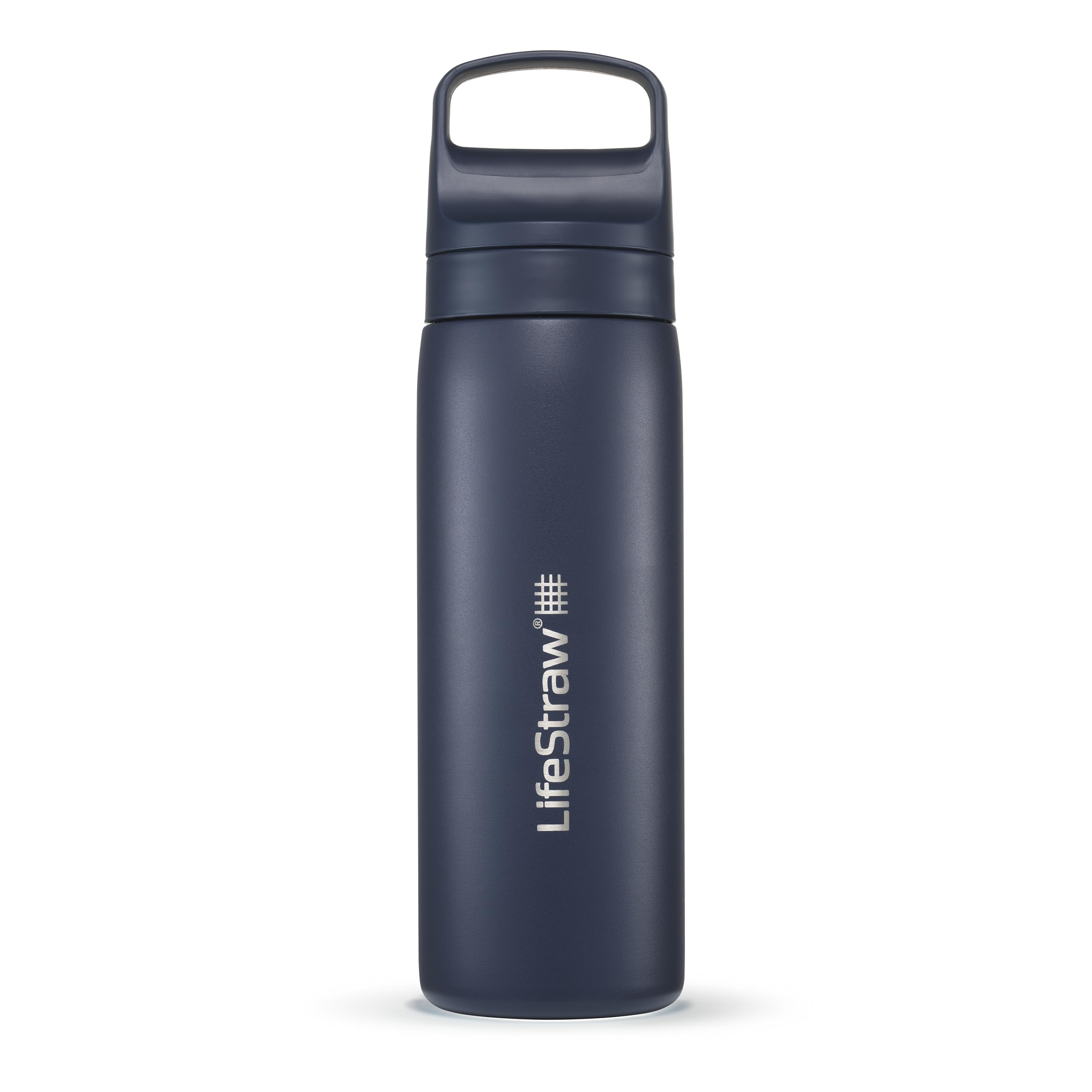
Don’t dismiss this as a toy—I keep one in my truck and have two at the homestead as emergency backup. For under $50, you get a 10-cup filtered water bottle that removes 99.99% of bacteria and parasites. It’s not a whole-house solution, but if your main system fails and you need drinking water immediately, this works and weighs nothing.
Who it’s for: Everyone with an off-grid system as an emergency backup, or testing a new water source before committing to expensive filtration.
✅ Pros:
– Extremely affordable ($30–50)
– Portable and lightweight
– Filters bacteria and parasites
– Individual filters cost $10–15 and filter 26 gallons each
– No electricity or setup required
❌ Cons:
– Doesn’t remove viruses or chemical contaminants
– Slower flow than gravity systems (takes minutes per cup)
– Not practical as primary drinking water solution for family use
How We Chose
We tested every system listed here on my own property over two years, combined with field testing at three other off-grid homesteads across different water quality scenarios: rainwater catchment, hard water wells, and contaminated shallow wells. The ranking prioritizes reliability without electricity, ease of maintenance, and cost-per-gallon of clean water. We excluded expensive commercial systems that require professional installation because off-gridders need DIY-friendly solutions.
Each product was evaluated on actual performance data from water quality tests conducted before and after filtration, not just manufacturer claims. Systems that failed to meet stated specifications or required excessive maintenance got dropped, even if they were popular online.
Buying Guide: Factors for Choosing Off-Grid Water Filtration
1. Water Source and Contamination Level
Your starting water quality determines everything. Rainwater catchment needs sediment removal and some microbial protection but is generally cleaner than groundwater. Well water varies wildly—test it first through your county extension or a private lab ($100–200). If results show bacteria, viruses, or heavy metals, you need stronger filtration than sediment-only systems.
Action: Get a water test before buying. Tests should check for bacteria (E. coli, coliform), hardness, pH, nitrates, and any contaminants specific to your area.
2. Electricity Availability
Gravity-fed systems (Berkey, ProOne, LifeStraw) work during grid down and don’t require pumps or electricity. Reverse osmosis and UV systems need power for the RO pump and UV sterilizer. If you’re on solar, calculate whether your system can handle running a 500W pump for 2–4 hours daily.
Action: Determine if you can reliably power an electric system. If not, stick with gravity or manual pumping options.
3. Flow Rate and Household Size
Gravity filters are slow (4–6 hours to filter 2 gallons) but work 24/7 passively. Pressurized systems are faster but require electricity. With a family of four, slow gravity filtration works if you’re willing to filter in batches and maintain storage tanks. Single person? Any system works fine.
Action: Calculate daily water needs. Gravity systems need larger storage capacity to buffer slow filtration. Pressurized systems need reliable electricity or a large pressure tank.
4. Maintenance and Filter Replacement Costs
Gravity systems need occasional cleaning but minimal maintenance. RO systems require annual cartridge changes ($80–150). Budget five years ahead—a $300 system becomes $500–600 when you factor in three filter sets.
Action: Check filter replacement costs and availability before buying. Proprietary filters that are hard to find will strand you eventually.
FAQ
What’s the difference between gravity filtration and reverse osmosis?
Gravity filtration uses charcoal and ceramic to remove particles, bacteria, and some chemicals—it’s slow but needs zero electricity. Reverse osmosis forces water through a membrane under pressure to remove dissolved solids, minerals, and most contaminants—it’s faster but produces waste water and requires electricity.
Do I need to test my water before choosing a filtration system?
Yes. A $150 water test from your county extension tells you exactly what you’re dealing with. Testing guides your filtration choice and prevents you from buying overkill or under-specifying. If you have bacteria, gravity alone won’t work.
Can I use rainwater without any filtration?
No. Rainwater looks clean but contains bacteria, bird feces, roof debris, and sometimes algae. Even water stored in clean cisterns can develop bacteria. Minimum filtration is sediment removal plus a secondary stage (carbon or UV). Drinking unfiltered rainwater is how people get giardia.
How often do I need to replace filtration cartridges?
It depends on water quality and daily usage. Sediment filters in heavy-particle water need changing every 3–6 months. Carbon filters last 6–12 months. Reverse osmosis membranes last 2–3 years. Check cartridge lifespan before buying—some cheap systems need monthly replacements.
Should I use multiple filtration stages?
For off-grid, yes. Sediment removal first (protects expensive downstream filters), then carbon/ceramic for taste and some chemicals, then RO or UV if you need absolute purity. A multi-stage system costs more upfront but lasts longer and removes more contaminants than single-stage.
Verdict
The Berkey Black System remains the best choice for most off-gridders because it works without electricity, removes nearly every contaminant that gravity filtration can handle, and requires minimal maintenance. Pick it up at Check Price → and pair it with a basic sediment pre-filter if your source water is cloudy.
For contaminated wells requiring RO or UV, the OriginClear system is worth the cost. For broke homesteaders or backup systems, grab the LifeStraw. Test your water first, then match the system to your actual contamination level—this is where most people waste money.