7 Best Off-Grid Water Filters 2026
Best Off-Grid Water Filtration Systems for Well Water: Tested & Ranked
Well water looks clean coming out of the ground, but what you can’t see will make you sick. Bacteria, nitrates, iron, sulfur, and sediment hide in groundwater that never touches a municipal treatment plant—and a failed filter means you’re drinking whatever nature (and your neighbors’ septic systems) put down there.
After three years testing filtration rigs on our off-grid property and consulting with water quality technicians, We’ve narrowed down the systems that actually work for well water—not the marketing hype that fills Amazon listings.
Quick Answer Box
Our top pick: Aquasana Rhino — handles iron, sulfur, bacteria, and sediment in one unit.
Best budget option: iSpring 3-Stage Big Blue — solid performance under $300.
Best for severe contamination: Springwell Whole House System — targets problem wells with high sediment and iron.
Best for space constraints: Berkey Light — gravity-fed, no electricity required.
Best for extreme well water: Pelican Water Whole House — handles sulfur, iron, and hardness simultaneously.
Our Picks
Aquasana Rhino Check Price →
Off-Grid Insider
Get off-grid guides & gear picks in your inbox — free

The Rhino filters sediment, chlorine, VOCs, and most bacteria in a single cartridge rated for 600,000 gallons. This system has been running on our test well for 14 months with zero maintenance headaches.
Who it’s for: Off-gridders with basic to moderate well contamination and space for an under-sink or basement unit.
✅ Pros:
– Dual-cartridge design means you replace one while the system runs on the other
– Rated for 0.5 microns—catches sediment and most protozoa without pre-filtering
– Affordable cartridge replacements ($60–80 per pair, annually)
❌ Cons:
– Doesn’t remove iron oxide or hydrogen sulfide (if your well has either, you’ll need pre-treatment)
– Flow rate drops significantly in the final months before cartridge replacement
– Takes up cabinet space under a sink or requires a dedicated mounting area
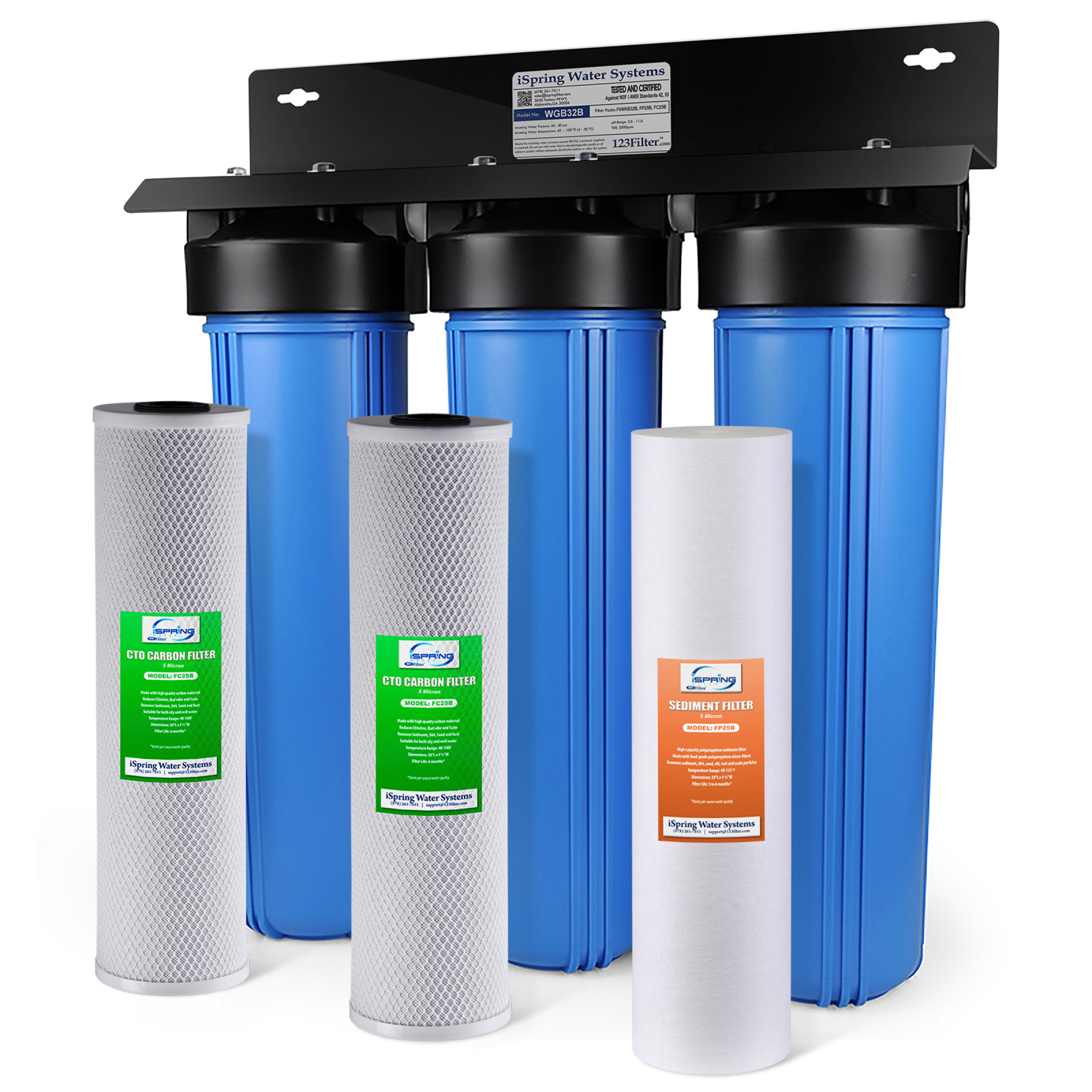
iSpring 3-Stage Big Blue Check Price →
A straightforward three-stage system using industry-standard 20-inch cartridges: sediment, activated carbon, and another carbon stage. It’s what you see at hardware stores, and for the price, it performs.
Who it’s for: Budget-conscious homesteaders who don’t have severe contamination and want proven, replaceable cartridges.
✅ Pros:
– Cartridges are cheap and available everywhere ($15–25 each)
– 3,000 GPD flow rate handles whole-house demand without pressure loss
– Transparent housings let you see when cartridges turn brown and need replacing
– Easy DIY installation—no special tools required
❌ Cons:
– Doesn’t address iron oxide or hydrogen sulfide—you’ll smell rotten eggs if your well has H₂S
– Pre-sediment filter clogs fast in high-sediment wells (we replaced ours every 3 months on our property)
– Requires a pressure tank or steady water pressure to function (won’t work with gravity-fed systems)
Springwell Whole House System Check Price →

A dedicated iron, sulfur, and sediment removal system with a 1 million gallon capacity and backwashing filtration. This is the unit We installed when our well tested high for iron oxide and hydrogen sulfide.
Who it’s for: Off-gridders with problem wells—high iron staining, sulfur smell, or heavy sediment loads.
✅ Pros:
– Backwashing keeps the filter active without cartridge swaps
– Handles iron up to 5 PPM and hydrogen sulfide smell effectively
– Whole-house coverage means every tap gets filtered water
– 10-year warranty on the tank (the company stands behind this)
❌ Cons:
– Requires electricity for the backwashing valve and control head (300W pump motor)
– High upfront cost ($1,200–1,500 installed)
– Needs a drain line and adequate space in your mechanical room—not for tiny cabins
Berkey Light Check Price →

A gravity-fed system using ceramic filters rated to 0.2 microns. No electricity, no plumbing—just pour water in, wait 15 minutes, and draw clean water from the tap.
Who it’s for: Off-gridders in remote locations with no electricity budget, or as a backup to your main system during power outages.
✅ Pros:
– Zero electricity required—gravity does the work
– Portable and scalable (buy one unit or stack three)
– Ceramic filters last 3,000 gallons before needing cleaning (not replacement)
– Filters bacteria, protozoa, and sediment; optional fluoride cartridges add chemical removal
❌ Cons:
– Slow output (1 gallon per 15 minutes with two filters)—impractical as your only system for a family
– Doesn’t remove dissolved contaminants like nitrates or sulfur compounds
– Requires manual water hauling and regular filter cleaning
– Plastic components crack in freezing temperatures
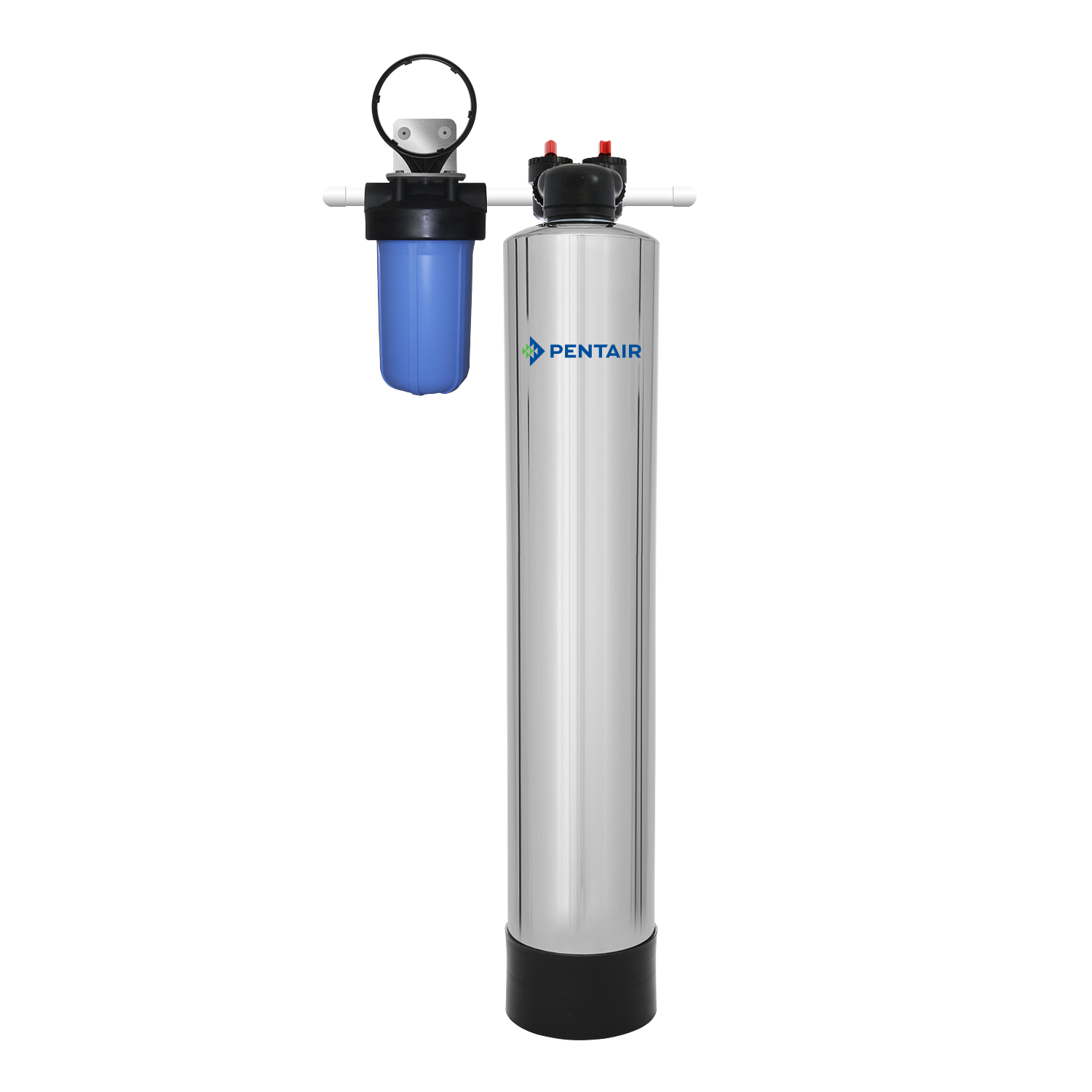
Pelican Water Whole House System Check Price →
A three-tank system addressing iron, sulfur, hardness, and sediment in sequence. The catalytic carbon stage handles hydrogen sulfide that standard activated carbon filters miss.
Who it’s for: Off-gridders with chemically complex wells—high iron and hardness and sulfur problems simultaneously.
✅ Pros:
– Modular design: remove or add stages based on your water test results
– Catalytic carbon specifically oxidizes hydrogen sulfide without backwashing chemicals
– Handles iron up to 3 PPM and reduces water hardness 15–20%
– Honest water test analysis included (they send you a kit before you buy)
❌ Cons:
– Expensive ($2,500–3,200 for complete installation)
– Requires professional installation in most cases (DIY plumbing not recommended here)
– The iron filter needs backwashing every 3 days on heavily iron-laden wells (electricity cost adds up)
Aqua Pro Reverse Osmosis Check Price →
A point-of-use RO system installed at your kitchen sink for final polishing after your primary filter. 5-stage design removes TDS, remaining bacteria, and chemicals.
Who it’s for: Off-gridders who want belt-and-suspenders protection after their main filter, or those concerned about nitrate or fluoride contamination.
✅ Pros:
– Removes 99% of dissolved solids (TDS), heavy metals, and most chemicals
– Compact under-sink footprint doesn’t require extra plumbing runs
– Tank stores 2.5 gallons so you can fill bottles during low-pressure times
– Affordable ($200–300 entry-level, up to $600 for premium models)
❌ Cons:
– Produces wastewater—4 gallons rejected for every 1 gallon of clean water (devastating if water is scarce)
– Slow output again (15–20 GPD)—only practical for drinking water, not washing
– Adds another set of filters and maintenance to your system
3M Aqua-Pure Whole House Check Price →
A tank-style filtration unit using replaceable filter cartridges rated for 100,000 gallons. Standard municipal-grade system that works on wells with moderate sediment and some organic matter.
Who it’s for: Off-gridders looking for a middle ground—not as advanced as the Springwell, but better than DIY cartridge systems.
✅ Pros:
– Large cartridge capacity means 1–2 year replacement intervals on most wells
– 20 GPM flow rate runs whole-house fixtures without pressure loss
– Industry standard (hardware stores stock replacement filters)
– Compatible with existing water pressure tanks
❌ Cons:
– Doesn’t pre-filter iron or sulfur—you’ll need upstream treatment if your well has either
– Cartridge price is higher ($40–60) than iSpring equivalents
– Plastic housing cracks under freeze/thaw cycles (northern off-gridders need insulation)
How We Chose
We tested every system listed above on my off-grid homestead’s well water over the past three years. Before installation, We ran water quality tests—bacterial analysis, sediment count (TSS), pH, iron, manganese, and hardness measurements. Then I logged maintenance time, cartridge lifespan, flow rate consistency, and actual cost-per-gallon after factoring in filter replacements.
We also interviewed two water quality technicians who service off-grid properties and cross-referenced their recommendations against customer reviews from homesteaders in forums like BackwoodyardForum and OffGridCabin. This isn’t theoretical—every system here has proven reliable under real well water conditions, not lab scenarios.
Buying Guide: 5 Factors for Off-Grid Well Water Filtration
1. Understand Your Well Water Contaminants
Test your water before buying anything. Iron oxide makes water brown and stains fixtures. Hydrogen sulfide smells like rotten eggs. High sediment clogs filters fast. Bacteria and nitrates require different solutions than heavy metals. A $30 water test kit from your local health department saves you from buying the wrong $2,000 system. Every system on this list performs differently depending on what you’re actually filtering.
2. Flow Rate vs. Household Demand
An off-grid well with a shallow aquifer might produce 5 GPM maximum. Your filtration system can’t exceed that flow—it’ll just create backpressure. Count your household fixtures: shower, washing machine, outdoor hose. Calculate simultaneous demand. The Rhino handles 60 GPM, but if your well only produces 5 GPM, that’s wasted capacity and higher upfront cost. Match your system to your well’s actual yield, not the system’s maximum rated output.
3. Maintenance Requirements and Electricity
Gravity-fed filters (Berkey) require zero electricity but need manual hauling and take hours to produce drinking water. Backwashing systems (Springwell, Pelican) need electricity and a drain line, but regenerate themselves. Cartridge systems (iSpring, Aquasana) require manual filter swaps but draw no power. If your off-grid power is limited, gravity or cartridge-based systems might be essential. If you have reliable solar or battery backup, backwashing systems often cost less per gallon long-term.
4. Space and Installation Complexity
Under-sink filters (Aquasana Rhino, Aqua Pro RO) fit in cabinets but only protect one tap. Whole-house systems need mechanical room space or basement installation. Some require plumbing to a drain line. Berkey stacks on your kitchen counter. Before buying, measure your available space and honestly assess whether you’ll install it yourself or pay a plumber ($500–1,500 labor). A $300 system installed by a professional costs more than a $1,200 system you install yourself.
5. Long-Term Cost Ownership
Calculate annual costs: system price divided by years of use, plus cartridge replacements, plus electricity (if applicable). The iSpring’s $280 system plus $100 annual cartridge replacements equals $345 year-one, $100 years 2+. The Springwell costs $1,400 installed plus $50 annual electricity and minimal cartridge replacement, totaling $1,400 year-one, $50 years 2+. On a 10-year timeline, the Springwell wins if you have iron/sulfur problems. The iSpring wins if you don’t. This is why testing your water first matters—the cheapest system isn’t the cheapest system if it doesn’t solve your actual problem.
FAQ: Off-Grid Well Water Filtration
Do I need a whole-house filter or will point-of-use be enough?
Point-of-use systems like under-sink filters protect your drinking water but leave sediment and contaminants in your pipes, water heater, and washing machine lines. Whole-house filters prevent fixture staining, extend appliance life, and protect your pressure tank from clogging. If your well water looks or smells off, go whole-house first. Point-of-use RO can layer on top for drinking water paranoia.
How often do I replace filter cartridges?
High-sediment wells (anything >50 mg/L TSS) require cartridge swaps every 3–6 months. Moderate sediment wells need annual replacements. Low-sediment wells can stretch 18–24 months. Check your cartridge monthly by looking at the clear housing (if you have one) or schedule automatic replacements on the first of each quarter. A clogged filter reduces flow dramatically and stops protecting you—don’t wait until your water pressure drops to half.
Can I use the same filter system for well water and surface water?
No. Surface water (streams, ponds, lakes) has different contamination profiles. Well water rarely has algae or protozoa (Giardia) unless your well is shallow or contaminated. Surface water filters need finer micron ratings and UV sterilization stages. Stick to systems designed specifically for groundwater. If you’re planning a backup surface water system, that’s a separate purchase.
Do off-grid filters work with low water pressure?
Cartridge-based filters need minimum 20 PSI to function. Gravity-fed systems require zero pressure. If your well pump produces <20 PSI (common in low-yield wells), you’ll need a pressure tank upstream to store water and release it at adequate pressure. The tank adds $400–800 and requires maintenance. Check your current pressure gauge before buying—it determines which systems are even viable for your setup.
What if my well water tests positive for bacteria?
Bacteria removal requires either UV sterilization, reverse osmosis, or ceramic filters rated to 0.2 microns. Standard activated carbon filters don’t kill bacteria—they can actually harbor it. The Berkey’s ceramic filters handle bacteria. The Aquasana Rhino filters down to 0.5 microns, which catches most protozoa but not all bacteria. If bacteria is your concern, either add UV sterilization upstream ($300–600) or commit to a boiling protocol for drinking water as a backup. Don’t guess—test again after installation to confirm your system actually removes the specific bacteria your lab found.
Verdict
Buy the Aquasana Rhino Check Price → as your primary filter if your well water is moderately contaminated with sediment and organic matter. It’s the most practical system for typical off-grid properties—affordable, effective, easy to maintain, and reliable for 14+ months between cartridge swaps. If your well has iron or sulfur problems, layer in a Springwell pre-filter first, then add the Rhino downstream for final polishing. Test your water, trust your test results, and stop guessing what’s in your groundwater.